
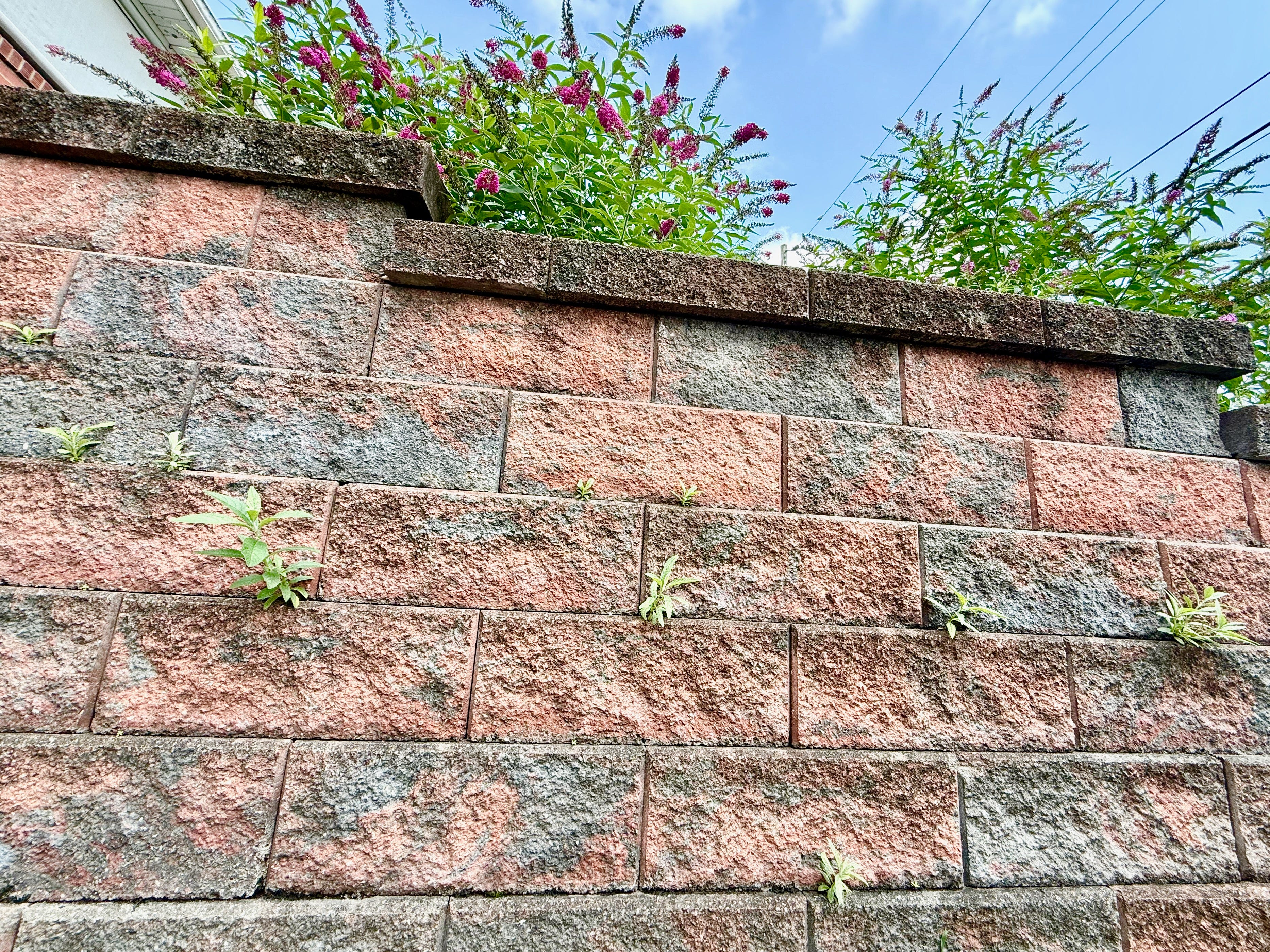
We find ourselves playing host to a nursery of butterfly bush seedlings this summer, volunteers from two plants which were themselves volunteers in a different section our yard a couple years ago. We moved the parent bushes to the steep hillside from our yard to the driveway, hopeful that they would withstand erosion, deer, and full sun.
They have loved their new home, growing this year into a messy burst of color that brings an endless variety of butterflies, bees, and other pollinators to our yard. We’re delighted by how they’ve transformed from gangly babies in an overcrowded bed into lush bushes that vibrantly welcome us home.
And the seedling nursery? It’s the retaining wall just below the bushes that separates our yard from our driveway. Mountain living means creative construction, so our garage sits at basement level with our ranch house is raised above it. The retaining wall stones, manufactured with texture and installed to create a gentle slope backward from the ground, are apparently perfect nursery beds for butterfly bush seedlings.
Guided by gravity, sheltered in the damp, dusty cracks of the wall, these sprouts are proof that the goldfinches haven’t managed to pick up every seed for their hungry brood. Against the odds, some survived, germinated, and are growing remarkably fast for how little soil holds them.
The dilemma weighs on my heart. The pain of how best to care for these little survivors is real. Left on the wall, they will inevitably run out of space to sink roots, setting them up for a slow demise. But removing them and putting them in soil is likely to damage their still fragile roots and cause transplant shock.
Both options feel risky, potentially cruel. I don’t want to make a misstep.
A part of me chides my emotional side for its sentimentality. Nature knows that not every seed will see its full lifecycle. Some become food for goldfinches. Others sprout and die off quickly, becoming food for earthworms. Nothing is wasted, even though not everything blossoms.
I sense the time has come to decide. The recent cool, wet weather that has nurtured the seedlings will be giving way to more sun and heat. The tiny sprouts have become full-fledged plants, with larger roots. Soon, the leaves will demand too much from the home in which the plants find themselves. They cannot remain here indefinitely.
My sensitive, sentimental side—which I love—took me to the garden center to buy a bag of soil. Later today, when the sun has moved behind the mountain and the plants are resting in the shade. I’ll mist the wall. I’ll put the fine, rich potting medium into recycled planters. I’ll gently speak to the seedlings, telling them why I’m moving them and asking their pardon for taking them out of what seems to be a lovely place to grow. I’ll invite them to settle their roots into new, temporary pots.
I’ll fuss over them for the next few days, few weeks, encouraging them for however long it takes until they have taken root once more. I will say goodbye to the ones who don’t make it through this process.
My heart will feel better, knowing that I have done something, however small or random (at least from the perspective of my more conventional suburban neighbors, with their chemically soaked lawns and aggressively manicured flower beds).
Eventually, I hope to replant some of these volunteer seedlings closer to our house—and farther away from the driveway. I know their seeds need more space to spread freely, onto better soil than the cracks in our retaining wall. Their ancestors are strong, resilient. I hope these seedlings will prove to have that same mettle.
Time, tending, and a little bit of luck will tell if the risk was worthwhile. The next chapter of their story is still to be written.
Thanks for reading Singularly Sensitive®! This post is public so feel free to share it.
This article is written and edited 100% by me, without the use of AI. I’ve disabled Substack’s AI detection on this post, because the environmental impact of needless, speculative use of AI is far too great. Plus, consider the vocabulary and em-dashes I use throughout my writing, and it’s not hard to imagine the false positives I’d get! Stay human, part of nature, and keep AI an option, not a default on Substack and across the web.
Comments
Nothing yet. Say the first thing.
Sign in to join the conversation.