
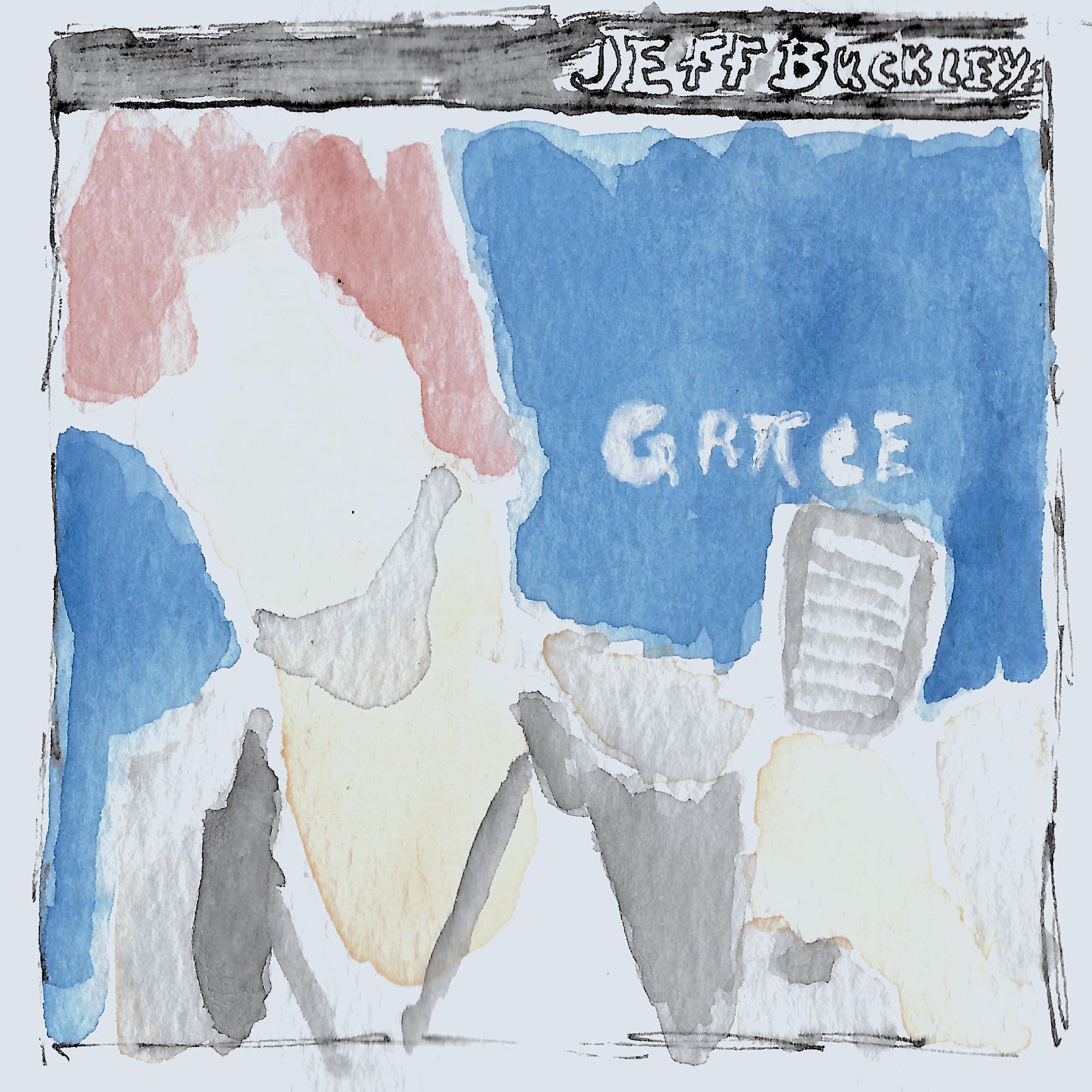
“Lover, You Should’ve Come Over” was my best friend’s girlfriend’s AIM away message when I was a teenager. They were a volatile couple, always making up and breaking up. I was the shoulder she would cry on when that happened. I think I was the one that put her onto Jeff Buckley in the first place, too.
I told myself I didn’t want to be with her as such, but like so many young men, I was confused about how to communicate my sensitivity. I wanted girl friends and girlfriends in equal measure, because I felt uncomfortable with the machismo of young men my age, how we were forced into rigid identity categories. Chatting with girls on the internet flattened many of the signals that I otherwise would have had to steel myself against when I was speaking with them in person.
I had always imagined this was a problem Jeff never had. He was simply, impossibly himself. He was so beautiful too—his face was cherubic and beatific on the album cover, larger-than-life, his voice emanating from the speakers was the clarion call of the angels. Someone doing their own thing surely had to be on another level.
Look no further than his obsession with qawwali. For all the Christian imagery (he’s got “Hallelujah” on there, after all), I think this is a Sufi record above all else, spinning endlessly into the heavens. You hear snatches of it at the beginning, in the string parts of “Last Goodbye”. Most rock ballad strings just reinforce chord roots and simple diatonic lines, and sometimes they double the melody too; but here, the line is more independent, with scalar motion and ornament that evokes a Hindustani violin, closer to a morning raga than to standard Western counter‑melody.
Through-and-through, it is an exhalation, an exuberant exalting of music and love and sorrow and all of the human condition wrapped up in less than an hour. It is no coincidence for me that Jeff considered Nusrat Fateh Ali Khan his Elvis, performing one of his songs at Sin-é in phonetic Urdu, leaning into the operatic leaps while the audience laughed, either out of seeing the refracted joy in the performer or the discomfort of not understanding if this was a bit. Of course it was earnest; why wouldn’t it be? You can hear the melodies of the qawwalis he had on repeat when coming up with his vocal parts. To my teenage ears, he was the prophet, calling the audience to prayer. For a generation of indie kids, his melodies became a backdoor into qawwali the same way The Weeknd would introduce Ethiopian melodies and melisma to the pop charts a generation later. He was a one-man boy choir, turning downtown guitar music into something choral and devotional.
Equally important, I think, is the specter of his father hanging over the creation of the record. The last song on the album is equal parts kaddish and transfiguration. It’s the ultimate ending to such a strong musical statement: Jeff doing his big-bodied cathartic singing over top an Eastern-tinged modal figure about an imagined vision of his father, a friend, a brother; and in that very moment a temporary shapeshifting into him, soon to transform into him forever within the annals of pop culture.
Another thing worth noting: when the Beatles collapsed all of musical reality to a point with “Tomorrow Never Knows”, seeding a thousand 90s trip-hop artists with their blend of sitar-tanpura and looped drums, Jeff was caught in the shockwave. His version of that inheritance was smaller and stranger, filtered through his father’s shadow and Van Morrison’s folk-jazz mysticism. It lands somewhere between rock song and sacramental rite: not exactly pop, not world music, not quite rock, but a form other artists could keep borrowing from for subsequent generations.
But there’s an anxiety to influence as well; that was probably the thing I understood the most, even at that early age: when one is overcome by big feelings, we gesture at other things to attempt to capture them, to pin them down, to prevent them from spilling out. We borrow another language—sometimes a symbol, sometimes literally a language—and share it with others to feel less alone. But just when you think another person understands, a barrier shoots up. The away message leaves you with fingers on keyboard, trying to figure out if the silence means mystery, rejection, or they’ll be back after dinner.
Verdict: Keep
Which “Hallelujah”—Jeff/Leonard/Rufus?
No posts
Comments
Nothing yet. Say the first thing.
Sign in to join the conversation.