
I’ve been teaching courses on Buddhist history for several years now. I’ve had a diversity of students in my classes, including Buddhist monks and nuns and priests. Some of my students have been practicing Buddhism there whole lives, some have started more recently, and some don’t practice it at all. Some of my Buddhist students are Black, some are white converts, and some are heritage students.
The diverse makeup of students in my classes means that we always have fascinating conversations, and that our curiosities take us in new directions. The unexpected learnings are some of my favorite things about teaching.
One thing I can expect consistently, though, is that my students’ self-awareness and ethical commitments drives a conversation around authentic practice. Who is authentically Buddhist? How do we embrace the practices without appropriating them? And what do we do with the whiteness of American Buddhism?
These are constant questions in my classes, though this semester, the issues seemed more thorny than others. From the first day of class, I could tell that students were struggling with these questions at a more existential level, and I knew that I needed to address it with urgency and sensitivity.
That’s when I decided to phone a friend. The first person I though of was my friend Liz Bucar, a scholar of religion at Northeastern University. I’ve known her for several years now and have loved her writing on religion and culture. I loved her last book on religious appropriation, and I had read early drafts of her book on the wellness industry. Liz joined my class and helped us think through some of our challenges on these topics. Her insights helped provide guardrails that we’ve been returning to all semester.
I have directly benefited from Liz’s coaching and her wisdom, which is why I’m excited that her new book, Beyond Wellness, comes out today. It’s smart and engaging and so relevant to how religion and spirituality operate in our everyday lives. I highly recommend buying a copy, which you can do so here or here, or honestly, wherever books are sold.
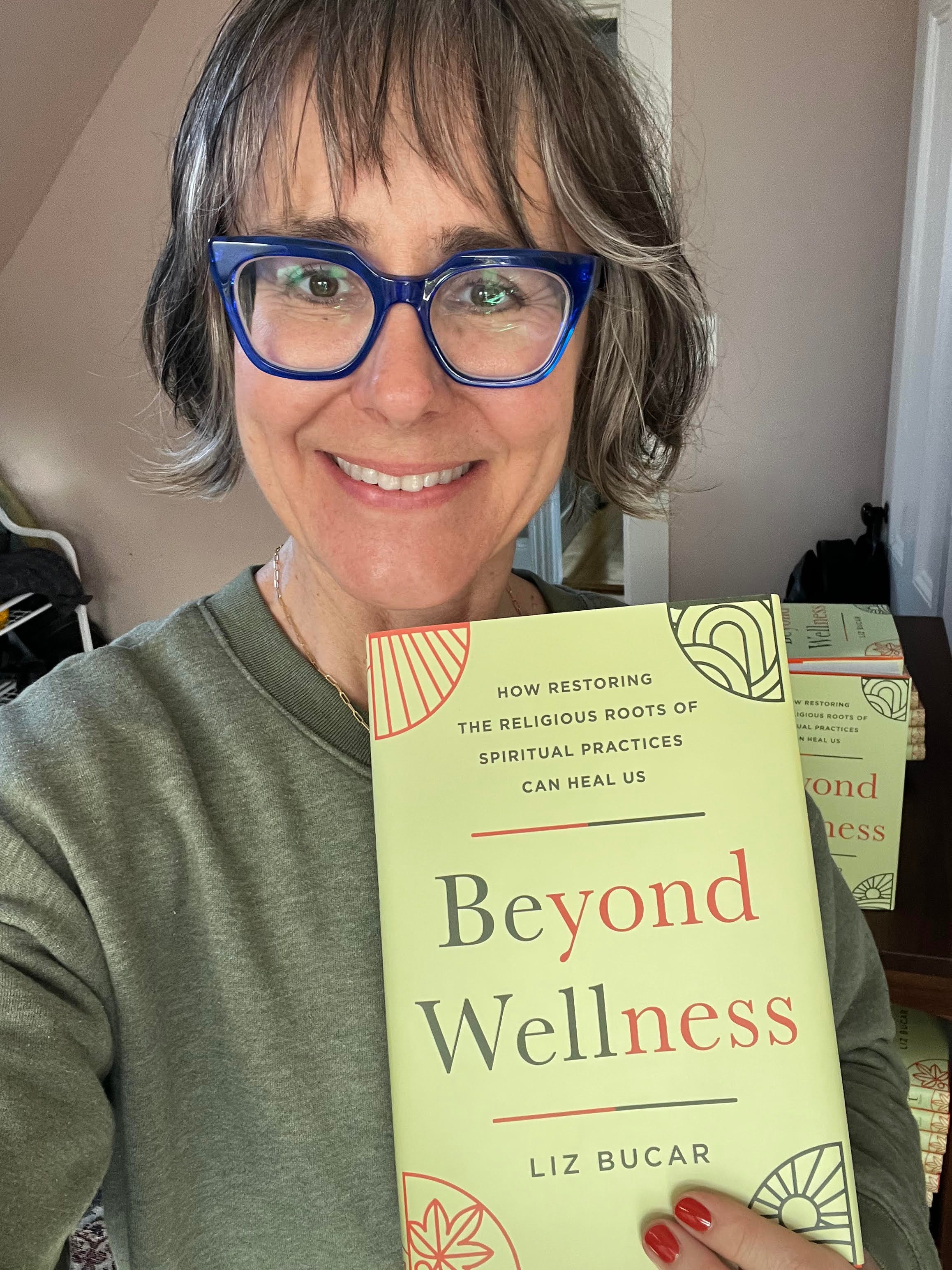
I asked Liz to share a bit more about her new book, and she agreed to do a brief interview with me. Read below to learn more about her big ideas and why they matter. And before you go, please make sure to click on this link and buy her book!
Q: Your last book was about religious appropriation. This one is about the wellness industry. How would you describe the connection between the two?
Something that tends to happen with me is that by the time I finish one book, I’ve already started thinking about the next one. My last book had a chapter on yoga, on the ways the yoga industry, particularly in the US, is implicated in structural injustice, how it encourages things like spiritual bypassing and political quietism. But I ended that chapter feeling like I hadn’t given people anywhere to go. People find yoga genuinely useful. I didn’t want to just leave them with a critique.
So this book is sort of the next step: where do we go from there? It’s really about how we engage with religious diversity, with the religion of other people, with religion in general, especially if we ourselves aren’t religious. And wellness becomes the case study for that, because so much of what we’re consuming in the wellness space right now is a watered-down version of religious practices, things being marketed as “spiritual, not religious,” with the original context and community scrubbed away to make them more universally appealing.
But I also wanted to offer something more constructive. If the last book was trying to help people see that their yoga practice wasn’t as unpolitical or unproblematic as they thought, this book is more like, okay, so you like yoga. What could that practice actually be doing for you? Could you think about embodied movement not just as a way to transform your body or calm your nervous system, but as part of a bigger project of figuring out what a full human life looks like?
Q: You openly criticize the wellness industry, but you also participate in it. How do you reconcile those two positions? Do you ever find yourself feeling pushed and pulled about what’s appropriate and what’s not?
Yes, constantly. I am regularly confused and uncomfortable about this, and honestly, I think that’s a productive space to be in, especially for someone who is a professional ethicist.
I do practice a lot of what I write about in this book. And for research, I engaged with even the practices I didn’t have a personal relationship with (like sound baths and psychedelics), particularly in more explicitly religious containers.
Here’s how I think about it: a lot of us have figured out that the wellness industry didn’t quite deliver on what it promised, and that there are a lot of grifters in that space. But the desire for wellness, that’s real. I just think the bar has been set too low. I’m more interested in what I call real well-being: something beyond BMI, beyond longevity, beyond optimization in a performance sense. Something that asks what it actually means to have a full human life, and orients our wellness practices toward that.
Q: Your book reads like an exploration, and also like a service. It feels like you care about your reader and want to help protect them from getting hurt. Does my perception reflect your intention?
Yes, I think that’s right. The book is very much a personal exploration. I treat my writing a bit like my teaching, where I show you my missteps and my own journey, not because my journey is the right journey, but as an invitation to go on your own.
But I think I’m also writing a little bit as a parent. Like, look, I figured some of this stuff out the hard way, and I want to share it with you because maybe you didn’t know.
And I’ve been thinking a lot about the question of consent. These practices are powerful and can genuinely transform your life, but sometimes in ways you’re not expecting. And I want readers to know what they’re getting themselves into.
The book does not offer a checklist. It’s not one-size-fits-all. But I think the more people understand why they’re drawn to a practice, the better that practice can actually work for them. I want more from these practices, not less, and I think the way to do that is to put more context and content put back in. I want them to be more ethical, more meaning-making, and I want them to actually work better for us.
And I feel some urgency to that right now. There’s so much chaos and fear—politically, environmentally, technologically—and religions have been great conversation partners for humans trying to figure out how to move forward, even if you’re not religious yourself. That’s another thing I’m trying to offer: that there’s still a reason to engage with religion, even if you don’t identify as religious.
Q: What was the hardest part of writing this book? What has been the most rewarding aspect?
This is my fifth book, but my first trade book, and the hardest part was getting the tone right. It’s genuinely uncomfortable for academics, or at least for me, to write in a more constructive mode. I’m pretty good at pulling things apart. Building something up, offering a positive and future-directed vision? That’s harder.
And I was also working a lot of this out in real time, in my own relationship to religion. I’m not quite the bystander I’ve been for most of my academic career, and figuring out what I actually think, and then writing from that place, was its own challenge.
As for the most rewarding part: What I keep hearing from early readers is that I’m putting into words something people had felt but hadn’t quite been able to articulate. And that feels like public scholarship at its best. Taking all this history and these frameworks and concepts we’ve spent decades learning and teaching, and actually making them useful for people in their real, everyday lives. That’s been really rewarding.
Thanks for reading my interview with Liz. Before you go, make sure to buy her book, Beyond Wellness: How Restoring the Religious Roots of Spiritual Practices Can Heal Us.
No posts
Comments
Nothing yet. Say the first thing.
Sign in to join the conversation.