
👋 Hej,
This edition is a bit different.
I am sharing it with a guest — and not just any guest. I am co-writing this one with Colette Molteni, author of Empathy Elevated (The newsletter for people who are too smart to ignore the human side of work). If you work in tech, data, product, or any field where hard skills dominate and human dynamics get underestimated, Colette’s work is for you.
We started talking about sprints — the kind used in agile teams, but also the kind you run quietly on your own to get things done. And we kept arriving at the same uncomfortable observation:
Sprints are one of the most powerful tools for individual focus. And one of the most misunderstood tools at the team level.
So we decided to split it down the middle. I take the brain architecture angle — what sprints actually do neurologically when you are working alone. Colette takes the team layer — where sprints get hijacked, fragmented, and quietly turned into something nobody agreed to.
Two lenses. One honest picture. Let me start with my humble point of view 👇
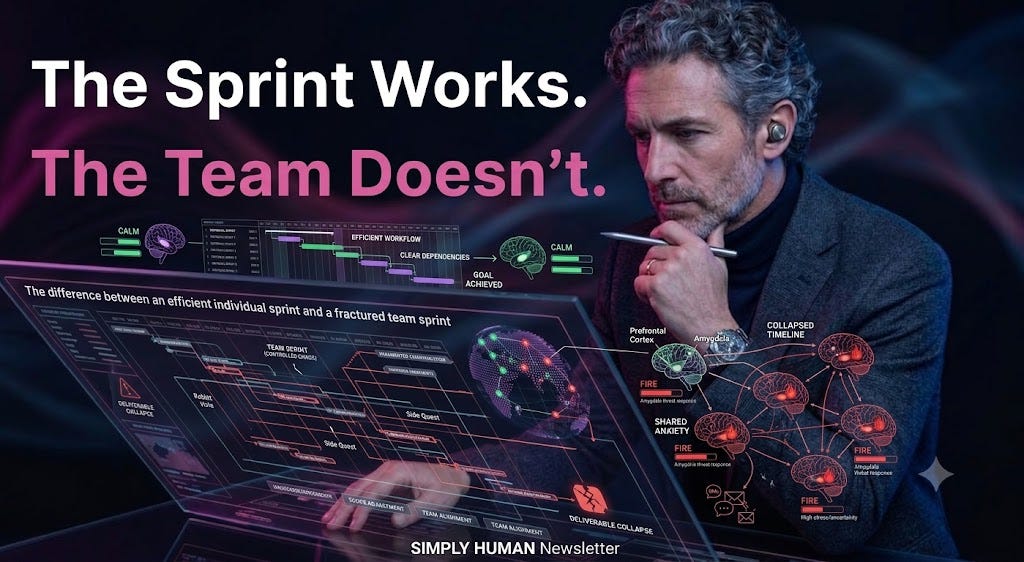
I want to start with your brain. Not metaphorically. Literally.
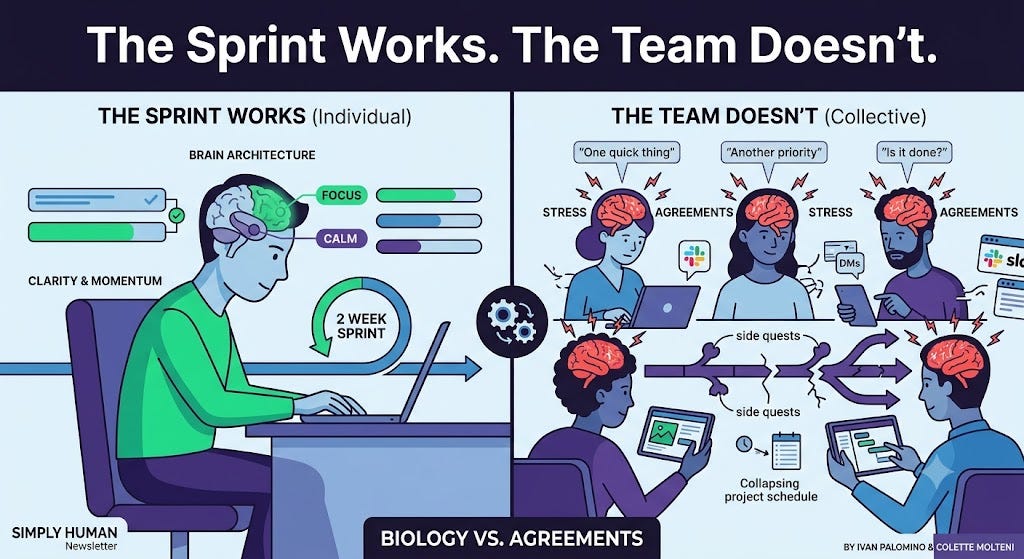
When you run a sprint as an individual — a focused 2-week period with a single clear outcome — something specific happens neurologically. The prefrontal cortex, which handles planning and decision-making, stops competing with the amygdala, which handles threat and uncertainty. You gave it a container. A clear end. A defined scope. And the brain exhales.
This is not productivity theory. This is threat-response biology. The amygdala quiets when it can predict the near future. Short sprints do exactly that. They shrink the horizon to something the brain can actually hold — which is why agency goes up, chronic stress goes down, and you start finishing things you previously couldn’t.
I wrote about this in a recent Simply Human edition. The insight that changed how I run my own work wasn’t a system or a tool. It was understanding that my brain was not built for five-year visions — it was built for short, meaningful loops with visible progress.
Small. Iterative. Focused. Repeat.
For an individual, sprints feel like oxygen. You know the scope. You own the decisions. You feel the momentum. The dopamine from completing a sprint cycle is real — and it compounds. Each finished loop builds the neurological case for starting the next one.
Here’s the uncomfortable part. That same mechanism, the one that makes sprints so effective for individuals, is also the reason they become so fragile the moment you add other people.
The brain’s threat-response doesn’t disappear inside a team. It just multiplies.
Every person in the sprint brings their own uncertainty tolerance, their own definition of “done,” their own unspoken priorities. The prefrontal cortex of one person is not in sync with the prefrontal cortex of another. And when ambiguity enters — a reopened decision, a misaligned expectation, a stakeholder who didn’t get the memo — the amygdalae of the whole group start firing.
And sprints, which were designed to create focus, quietly become containers for controlled chaos.
This is not a process failure. It is not a discipline failure.
It is what happens when you apply an individual brain architecture solution to a collective human system — without adapting for what changes at the team layer.
That is exactly what Colette Molteni from Empathy Elevated unpacks next.
Ivan is right about the biology argument. But I would pivot here to the team layer, where our nervous system often must coexist in the same room with others.
Sprints in a team setting do not just need our minds to hold steady; they also need the agreements to hold.
I’ve worked on dozens of agile projects to know that sprints start with an agreed-upon scope. I have sat in the room where the higher-ups are smiling, and those of us looking ahead to the sprint are knocking our heads in agreement that the plan will stick.
By mid-sprint, someone often reopens a decision everyone thought was closed. It often slips in during minute 14 of the daily standup, with “one quick thing.”
I remember, a few years ago, during the summer, our daily standups when the scope and timeline were clear. Then, in week 2, 3 days in, a sales stakeholder dropped one of those “one quick thing” asks. It was not quick. It reopened a decision like a wound. It was brought up for clarification, but really, it was a departure. By day 5 of the second week, we were all working on something committed to by Monday, and saddled with weekend work to make the deadline.
The cost is that most will re-litigate it internally, even if they don’t say it. The container of the sprint can quietly crack, without anyone noticing the break.
On the Kanban board, the team is working towards one sprint goal. In practice, when the Analyst is running a side quest and the PM is eagerly trying to make several deadlines before the weekly update on Fridays, the team project can fragment.
No one immediately flags it. It is a deviation from the plan, but it doesn’t feel like one. But the result is that the stated scope and the sprint’s scope actually diverge. By the time it surfaces, the timeline has collapsed.
Why does this happen? The same conscientious people who make sprints succeed and keep the nervous systems of those around them in check are the ones who often absorb the side work. The quick asks turn into a half-day of diversion down a rabbit hole.
Saying “no” or “that’s out of scope” feels rude, rigid, or even uncollaborative. So scope creep gets in through the door, labeled as being a “good teammate.” The team optimizes for relational comfort over the integrity of the sprint. Both matter, but only one is being protected. Empathy is getting weaponized against the sprint.
The practical move is to document decisions with a timestamp, not just discuss them. Reopening a decision requires naming what is changing, not just the free-flowing thought.
Parallel tracks get surfaced in standups, not hidden in a DM on Slack.
This is fine, as sprints by their very nature are about incremental iteration and continuous improvement. But the tracks must be surfaced, open, and not a diversion from the core path.
The team agrees in advance that protecting the sprint is the empathic move.
Individual sprints, not in an official agile sense, can calm the amygdala because the horizon is clear. Team sprints can only calm the collective amygdala when the agreements are equally clear.
You can lead the effort, but it is collaborative. Biology gives you the way, and team hygiene gives you the how.
Without the second layer, the sprint becomes a container for shared anxiety, not shared focus.
Same shape. Very different contents.
Here is what Colette and I kept coming back to in our conversation:
The sprint is not broken. The assumptions around it are.
Most teams adopt sprints as a productivity format. A way to go faster. A structure to impose on chaos. But as Colette describes — and as the neuroscience confirms — sprints only work when two things are true simultaneously: the individual brain has clarity, and the collective agreements hold.
Remove either one, and the container doesn’t just stop working. It actively generates the anxiety it was meant to reduce.
So before your next sprint — individual or team — ask two questions:
For yourself: Does my brain actually have a clear horizon, or am I running a sprint inside a fog of competing priorities? If the answer is the latter, the sprint is decorative. Shrink the scope until the amygdala genuinely relaxes.
For your team: What decisions are we treating as closed — and have we actually said that out loud? Unspoken agreements are not agreements. They are future conflicts with a delayed fuse.
The biology is on your side. The team hygiene is a choice.
Both are available to you. Most people only use one.
Subscribe to Colette’s newsletter Empathy Elevated — human skills for high-intellect professionals navigating work in the age of AI.
Our commitment is to help grow human-centric workplaces — and human-centric ways of working. This is what the Simply Human Tribe is about.
Thanks for reading the Simply Human Newsletter! Subscribe for free, like or share with others to support our work.
Stay Human, Made with 💚 by Ivan Palomino
Both angles combined This week, before any sprint or focused work block: write the outcome, then share it with one person on your team. See if they describe it back to you the same way. The gap between your version and theirs is exactly where sprints go to die.
No posts
Comments
Nothing yet. Say the first thing.
Sign in to join the conversation.