
👋 Hej,
A few weeks ago, I got early access to something that stopped me mid-scroll.
A dataset of 5 million employee voices, across 1,500 companies, in 59 countries. Six years of trends.
Not exit interviews. Not annual engagement surveys filled out under fluorescent lighting with one eye on the door. Real, ongoing employee voice data: the kind that captures what people are actually feeling, months before they act on it.
And here is the headline finding, the one that made me sit back in my chair:
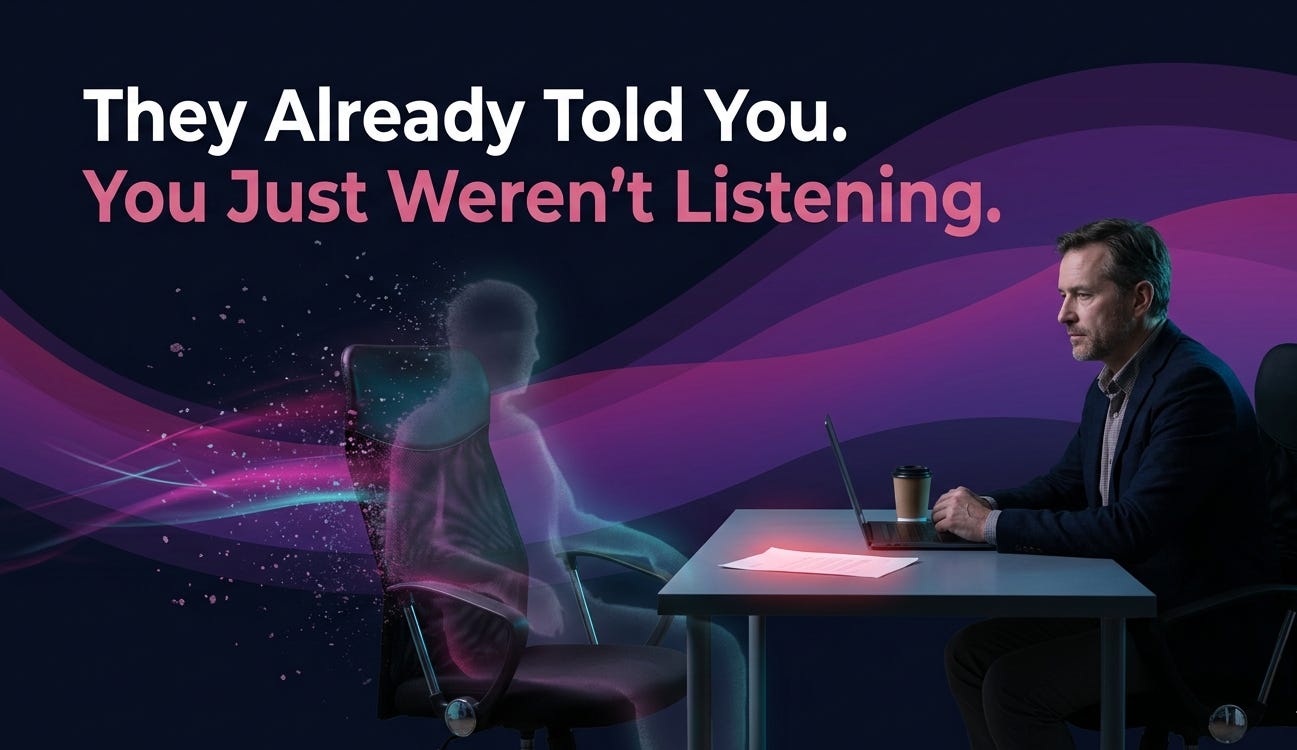
Quiet quitting doesn’t start with a resignation letter. It starts about six months earlier with signals most HR dashboards aren’t built to see.
Here’s the sad truth about how most organisations try to understand attrition.
They wait until someone resigns. Then they schedule a polite 30-minute conversation, often with the very HR function the departing employee has no incentive to be honest with. They ask “what could we have done better?” to someone who has already mentally left, has nothing to gain from candour, and everything to lose from burning a bridge on the way out.
The result? Vague, diplomatic, deeply unhelpful data.
An exit interview tells you what killed the relationship. It does not tell you when the relationship started dying.
By the time someone hands in their notice, the real damage happened months ago — in a hundred small, everyday moments that nobody was measuring.
Here is what that shift sounds like in practice. These are composite examples, the kind of phrasing that shows up again and again in sentiment data, long before anyone updates their LinkedIn:
“I used to say ‘we’re working on this.’ Now I just say ‘it’s on my plate.’”
“Nothing dramatic happened. I just stopped raising my hand in meetings.”
“I’m not angry. I’m just... not curious anymore.”
“I still do good work. I just stopped caring whether anyone notices.”
“My manager asked how I was doing. I said ‘fine.’ We both knew it wasn’t true. Neither of us said anything else.”
When people start disengaging, they don’t announce it. The brain doesn’t work that way. Disengagement isn’t a decision — it’s a slow withdrawal of psychological investment, the same mechanism that protects us from sinking more emotional energy into something that no longer feels safe or rewarding.
What changes first isn’t effort. It’s language.
The way people talk about their work, in surveys, in one-on-ones, in casual comments, shifts in subtle, measurable ways long before performance visibly drops. People stop using “we.” They stop referencing the future. They start describing their role in terms of tasks rather than purpose.
And here’s the part that should make every HR leader sit up: none of the early signals are about money.
Compensation is almost always the stated reason in an exit interview, because it’s the safest, most face-saving answer to give on the way out. But it is rarely the real reason, and it is almost never the first reason.
The real signals are quieter. They live in how people experience fairness, growth, and whether they feel seen by the people they report to. And they show up consistently, across industries and countries, long before anyone starts updating their LinkedIn.
Here is where most culture conversations go wrong: they jump straight to perks, surveys, or sweeping “culture transformation” initiatives that take 18 months and a consulting budget to roll out.
But if the signals appear six months early, the response doesn’t need to be a transformation. It needs to be earlier and smaller.
A few principles that the data — and the neuroscience — both point to:
Measure the leading indicators, not just the trailing ones. Engagement scores and exit interviews are rearview mirrors. The organisations that retain top talent are tracking sentiment shifts in real time, the same way a good doctor tracks early symptoms rather than waiting for a diagnosis.
Train managers to notice language, not just output. A high performer who suddenly starts saying “my role” instead of “our mission” is telling you something — long before their numbers slip. Most managers are never taught to hear this.
Make fairness visible, not just real. People don’t just need to be treated fairly. They need to see that they are — in how decisions are explained, how recognition is distributed, and how growth opportunities are communicated. Invisible fairness doesn’t protect engagement. Perceived fairness does.
Close the loop, visibly. One of the fastest ways to deepen disengagement is to ask people how they feel and then change nothing. If you collect signals and don’t act — or at least explain why — you teach people that speaking up doesn’t matter. That lesson, once learned, is very hard to unlearn.
None of this requires a massive budget. It requires looking earlier, and looking at the right things.
This is exactly what I’ll be unpacking live, with the team behind this dataset, in a session I’m hosting on June 25.
The Culture Signal: What 5 Million Employees Say Before They Quit
We’ll open the database live: real benchmarks, real patterns, your industry pulled up on screen if you want it. The 3 hidden factors that predict attrition 6 months out. What the top 10% of companies do differently. And three concrete actions you can bring back to your leadership team that same week.
This is limited to 15 senior leaders (for ex. CHROs, VPs of People, Heads of Employee Experience).
If you can’t make it live, register anyway — the full recording goes out within 2 hours.
Think of one person on your team whose language has quietly changed in the last few months — less “we,” more “it,” less future, more task. Have a real conversation with them this week. Not a check-in. A conversation. You might be six months early. That’s exactly the point.
Our commitment is to help grow human-centric workplaces. This is what the Simply Human Tribe is about.
Thanks for reading the Simply Human Newsletter! Subscribe for free, like or share with others to support our work.
Stay Human, Made with 💚 by Ivan Palomino
No posts
Comments
Nothing yet. Say the first thing.
Sign in to join the conversation.