
The Economist has sounded alarm on Russian strikes against Ukraine’s infrastructure in the wake of the latter’s undeclared war on the Wildberries chain. They report that Ukraine’s economy is facing unprecedented damage as consequence of the unceasing and systematically debilitating Russian campaign:
Presumably so as not to choke out the last vestige of hope for pro-Ukrainians, the article first runs down the laundry list of deep-strikes Ukraine has successfully conducted against Russia, and the economic consequences that have resulted. But then the authors admit that Russia has responded, and Ukraine is much more vulnerable in this mutual scorched-earth blow-for-blow:
But the choking now runs both ways, and Ukraine is more vulnerable. Odesa’s ports, the country’s economic lifeline, were the first to feel the pressure. Threatened at the war’s start, the deep-sea ports reopened first with a Turkish-brokered grain deal, and then with a protected corridor for Ukraine in 2023. Russia kept targeting port infrastructure, but shippers tolerated the risk, moving 210m tonnes over the following three years. The calculus changed in mid-July when Russia began hunting the ships themselves. On July 19th cruise missiles hit and sank a Turkish-owned cargo ship as it left Chornomorsk, one of three big ports in the region. Ten people were killed. Since then every vessel entering or leaving Odesa has been targeted. A few ships still dare make the run, but the ports are commercially dead.
The timing could hardly be worse, with 50m tonnes of harvest still to move. The alternatives are not attractive. “One ship of 100,000 tonnes is equivalent to 5,000 trucks, 5,000 drivers, and 5,000 border procedures,” says Dmytro Barinov, president of the Ukrport association. The situation is worse than it was in 2022, he says, when ports on the Danube offset some of the losses. Now the river’s low water level and Russian attacks make that route harder to use.
Interestingly, the Economist authors go on to debunk Ukraine’s “over-exaggerated” claims of the economic damage inflicted on Russia in Ukraine’s own attacks, claiming the real damage is 1/10th that claimed by Ukraine:
Both sides inflate statistics. Ukraine’s general staff says it has caused $13.5bn-worth of losses to Russia’s refining industry since August 2025. Sergei Vakulenko of the Carnegie Endowment, a think-tank, reckons the real, immediate losses to business is perhaps one-tenth of that, and that it has barely touched state income. “The strikes hurt, but not where or on the timescale Ukraine claims,” he says.
The Economist predicts things will only get worse if Russia persists with this new campaign, as Ukraine’s winter crop sowing season may entirely be cancelled, summarizing the back-and-forth with clear imagery:
“It’s as if we played open football with the Brazilians,” rues one former senior official. “We scored three and are celebrating, but they scored 13.”
The piece ends with a warning that continued Russian strikes could cause a mass exodus out of Kiev, admitting that the overriding plan now is simple survival until next spring—which does not sound very promising or comforting:
“A colleague was telling me how they had a big meeting yesterday called Autumn Actions, about future plans,” he says. “Today it already has a new name: Survive Till April.”
But the most important aspect the piece intentionally conceals is that the war has completely turned against Ukraine. What the Economist and other Western publications have slyly been doing is framing the latest crisis as revolving around Ukraine’s depletion of Patriot missiles, with the natural solution offered being further Western involvement and investment in order to restock these highly coveted interceptors; it’s a kind of deliberately false dialectic.
CNN laments a Ukrainian Patriot launcher sitting abandoned somewhere in a field because it has no missiles to fire—video below:

Christiane Amanpour@amanpour
In Ukraine, @npwcnn sees a rare sight firsthand: a Patriot missile launcher, sitting empty and unused, as they plead for more interceptor missiles. It’s the only way Kyiv can take down Russian ballistic missiles, but this launcher hasn’t been used in 10 weeks, its engineer says.
5:30 PM · Aug 17, 2026 · 60.6K Views
16 Replies · 172 Reposts · 501 Likes
This is intentional misdirection to conceal the fact that Ukraine is coming undone in virtually every quantifiable way. By creating a false dilemma, and then a manufactured solution for it, they can reframe Ukraine’s disastrous situation as being based on one small correctable issue. And the solution for that issue happens to be something which cunningly seeks to tie depleted Western countries into the conflict further, particularly at a time when interest and political support is drastically waning.
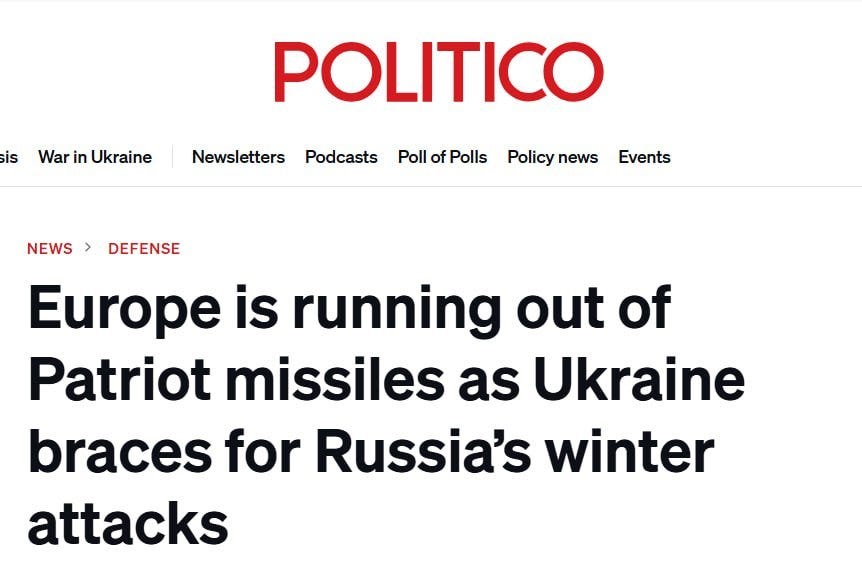
This entirely papers over the stark reality: that Ukraine is bleeding out in every measurable metric, and no one catchall solution exists. The Patriot scam is crafty misdirection meant to perpetuate the narrative that Ukraine is still winning or “turning the tide”, and that Russia is just on the brink of losing, so long as Ukraine is able to be resupplied with more missiles. Nothing could be further from the truth—even when Ukraine had plenty of Patriots, they did little in stopping Russian ballistic attacks, and there yet remains zero proof of a single Iskander actually having been intercepted by these systems.
On the other hand, a German publication along with Euromaidan Press has revealed that Russia shoots down virtually every single Ukrainian Flamingo missile:
Russia has been shooting down most of Ukraine’s best long-range cruise missiles as fast as Ukraine can launch them. Just one or two of the $500,000 Fire Point FP-5 Flamingo missiles have hit their targets in recent weeks.
That means Russian air defenses are working for now. Whether they’ll continue to work is the critical question for Ukrainian strike planners.
Interestingly, they credit the high success rate to Russia’s A-50U AWACs planes, which now regularly patrol the Flamingo routes and can spot them from long range, then delegate fire solutions to appropriate ground units.
Granted, on August 15th Ukraine was able to score a hit on an important Roscosmos enterprise in Samara, Russia, allegedly with two such Flamingo missiles which somehow managed to bypass defenses. It is the Russian Soyuz plant where the rockets which bring Russia’s Starlink-analogue “Rassvet” satellites into space are manufactured.
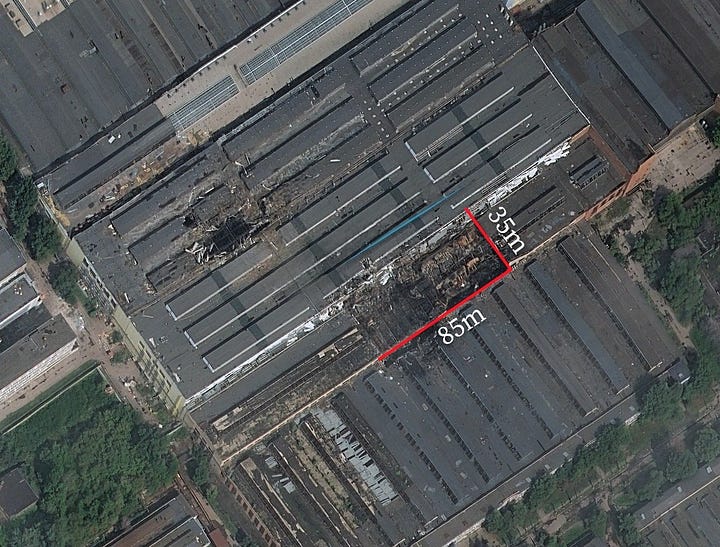
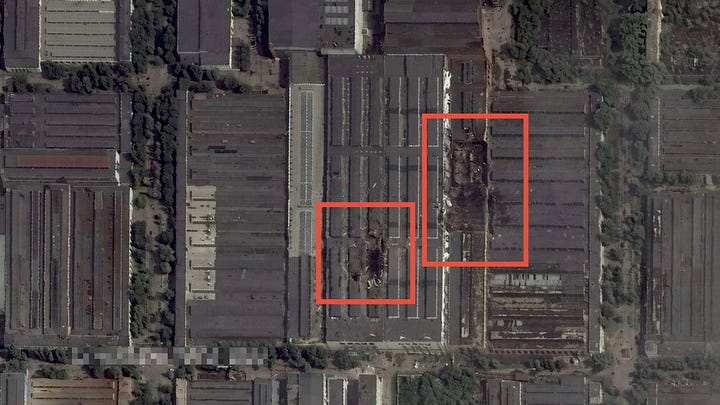
The enemy is publishing satellite images showing the aftermath of a strike by two FP-5 "Flamingo" missiles on one of the workshops of the Rocket Space Corporation "Progress" in Samara on August 15th.
You can estimate the size of one of the craters.
As a reminder, the Rocket Space Corporation "Progress" is a leading Russian rocket and space enterprise that manufactures "Soyuz" carrier rockets, including those used to launch "Bureau-1440" satellite internet devices into orbit, which are currently causing great concern for Ukraine.
Therefore, it is likely that the enemy will continue to target this enterprise in an attempt to prevent Russia from developing an analogue to the American Starlink system, and also to significantly undermine the entire space industry. Protecting such a unique asset should be a top priority.
But the complex is massive, and the damage is unlikely to have much effect:
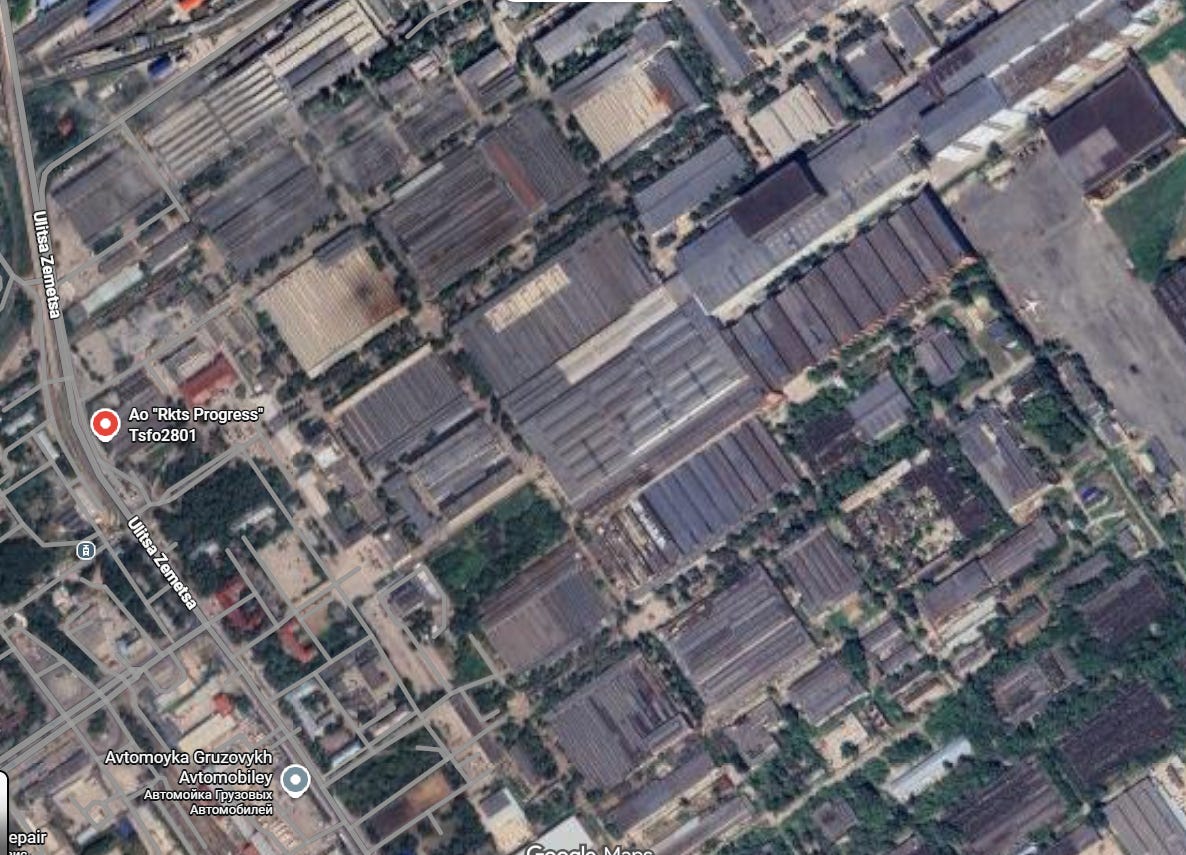
These huge industrial spaces have ceilings which are lined with massive metal gantries and other various types of structures. Such attacks usually just blow a hole in the roof, and as can be seen in one of the pictures above where the gantry grid is visible, do not even penetrate past that down to the workshop floor.
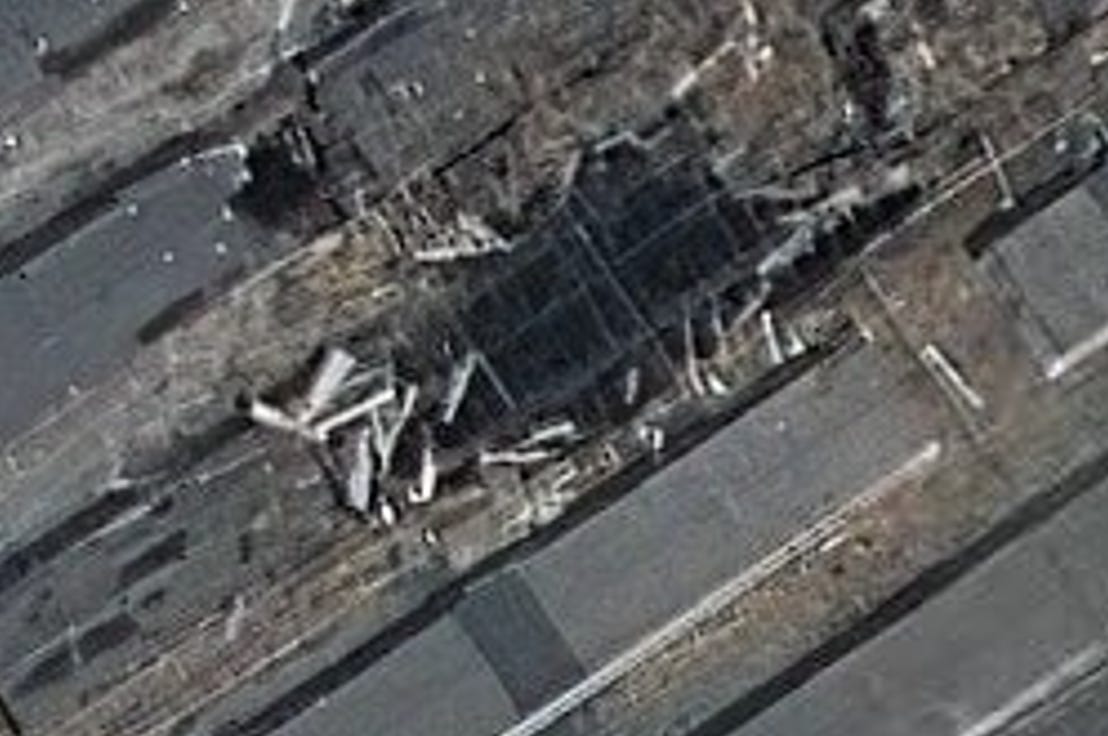
The slow speed of the missiles does not give them enough kinetic force to do so—only things like Russia’s hypersonic Iskanders coming down vertically can truly blow through such industrial workshops to the ground floor and beyond.
Meanwhile, Ukraine’s frontline situation continues to decline. A prominent channel run by a Ukrainian air assault brigade officer recently shared the following “realist” perspective:

In more troubling news, star ex-Defense Minister Fedorov who Zelensky unpopularly removed in last month’s shake-up has now decided to play hardball, amidst today’s proposal submitted by Zelensky to the Verkhovna Rada for the appointment of Major General Yevhen Khmara to the position of Minister of Defense. Fedorov has released a video calling for Ukrainian elections, essentially a threatening ‘broadside’ against, and a challenge to, Zelensky’s rule:
“Democracy cannot be held hostage by Russia.”
It’s clear that forces are gathering against Zelensky. With no more patsies like Yermak left to throw under the bus, this culminating winter could see the arrival of a political breaking point for the embattled and increasingly isolated and unpopular Ukrainian leader.
For those interested, Ukrainian outlet Strana has published a very thorough and interesting breakdown of the political scheming involved in Fedorov’s latest move, and what it could mean for Ukraine’s political future:
“The coordinated statements from former Defense Minister Fedorov and his support group, regarding a crisis in state governance and the need to hold elections before the end of the war, appear to be a carefully planned tactic ahead of the vote on Khmara’s nomination as Minister of Defense. This effectively rejects the demands of the “cardboard Maidan” movement to reinstate Fedorov.
The maximum goal is to sow doubt among members of parliament (especially among the “servants of the people”): “Is it necessary to vote for Khmara and go against Fedorov, if elections and a change of power are imminent?” Alternatively, it may be to persuade Khmara himself to withdraw from the position.The minimum goal is to, even if there are enough votes for Khmara, give new meaning to the “cardboard Maidan” actions, which will now be held not to bring back Fedorov, but to hold elections.
In Ukraine, during a war, only presidential elections can theoretically be held. Parliamentary elections are prohibited by the Constitution, which cannot be amended during a state of emergency. Presidential elections are also prohibited, but not by the Constitution, but by two laws (the Electoral Code and the law on martial law), which can be amended by a majority vote in the Verkhovna Rada.
In other words, Fedorov and his support group (which is largely composed of grant-funded organizations, previously close to the US Democratic Party, and now supported by Europe – those whom their detractors call “Sorosites”) want to implement a scheme in which elections are held in the country during the war, and their representative (Fedorov) becomes president, thereby allowing them to quickly reshape both the parliamentary majority and the entire power structure.
The tools to force Zelenskyy to do this include protests, criminal cases from the NABU and SAP against his inner circle, and pressure from Europe.
Zelensky is being forced to relinquish power - he is being offered to announce elections, lose them (which is indicated by all the polls), and leave office. It is quite possible that this will be followed by criminal prosecution. And certainly, it will lead to the downfall of his entire economic and political group (”Family”). This is clearly not the future that Zelensky envisions for himself. Therefore, he will likely try to resist. For example, he may order the SBU to strike against the NABU/SAP and their support group (such a scenario is being discussed even within the grant-funded circles).
Another question is whether Europe will exert pressure, and how much. This is a key point, because Zelensky can withstand protests, and even the next criminal cases against Yermak and his associates, but if the Europeans (who are currently financing Ukraine) put pressure directly, it will be much harder to resist. Last year, during the attempt by the Presidential Administration to bring the NABU and SAP under its control, such pressure was exerted. But it was not as strong regarding Fedorov’s resignation. And it is not yet known whether Europe will insist on elections.
Thirdly, polls show that Fedorov is far from the only candidate with a chance of winning. Zaluzhny has a higher approval rating than him, and Budanov is only slightly lower. Are both of them willing to silently watch as Fedorov is brought to power? Or will they fully engage in the struggle, fiercely opposing the former minister? All of this could add elements of radical unpredictability to the process of “restoring democratic processes.”
Fourthly, the topic of “Ukraine needs elections” will begin to gain traction within the country, which could sharply intensify public discussion about Zelensky’s “illegitimacy.” Incidentally, this is what has been constantly stated in Russia, demanding that elections for the President of Ukraine be held in order to have a “legitimate head of state” with whom negotiations can be conducted. And if elections are held during the war, then, formally, the Kremlin’s demand will be fulfilled. Of course, Fedorov is unlikely to soften the negotiating position compared to Zelensky. More likely the opposite – his support group often issues calls for a tightening of mobilization, a reduction in the conscription age, an intensification of the fight against “evaders” and the “fifth column,” etc. However, any of the other “viable” candidates could cautiously (not personally, but their support group) begin to promote the idea that “Zelensky was an obstacle to achieving peace, because Putin didn’t want to talk to him about anything. If I become president, I will be able to negotiate normal terms for ending the war.” And it is not excluded that such a position could prove more popular than various variations of “fighting to the bitter end.”
What can we say? Get the popcorn ready.
Your support is invaluable. If you enjoyed the read, I would greatly appreciate if you subscribed to a monthly/yearly pledge to support my work, so that I may continue providing you with detailed, incisive reports like this one.
Alternatively, you can tip here: buymeacoffee.com/Simplicius
No posts
Comments
Nothing yet. Say the first thing.
Sign in to join the conversation.