
Allen Ginsberg at 100, Queen Elizabeth Hall, London, July 12th, 2026
By Simon Warner
A CELEBRATION of Allen Ginsberg in London town at one of the great city venues? It’s hard not to think of that earlier occasion at the Albert Hall when a British social revolution was kickstarted by the leading Beat poet, his illustrious foot soldiers and a sell-out crowd.
The International Poetry Incarnation, a title now disputed but one that still sticks, was a great moment in the joining of the Anglo-American counterculture. On Sunday, in a space, named not for a Victorian consort but a late monarch, became home for the evening to a memorial, a centenary commemoration of Ginsberg’s rich life and voluminous works. The audience was solid if slimmer in number, less feverish but loyal still to this late literary visionary.
If we think of the Ginsberg history in long blocks of time, the poet was not yet 40 when. he led the bill at the Albert Hall, but he has now been dead for. nearly three decades, the hundredth anniversary of his birth was recorded last month and ‘Howl’, his signature artistic statement, is 70 years old as a published work later this year. In short, there are various Zen diagrams overlapping and interjecting.
Different versions of this live birthday party have been planned by the poet’s estate, including events in New York City, San Francisco and Milan with this capital occasion an important element in the transatlantic odyssey. Here, a three-hour programme was fronted by magnificent Ginsberg ally, the English-born though long Americanised singer/guitarist Steven Taylor, who enjoyed a 20 year association as musical accompanist to the writer. He last appeared on this stage as a Fug in 2011’s Meltdown Festival.
The show, rounding off a steamingly hot day by the river, was devised by Peter Hale and Jesse Goodman and bid to cover Ginsberg’s achievements in multiple ways: through talk briefly, by short films occasionally, by verse sometimes, but primarily through a remarkable blend of words and music, a trans-genre prism casting shards of illuminating light on the poet’s canon.
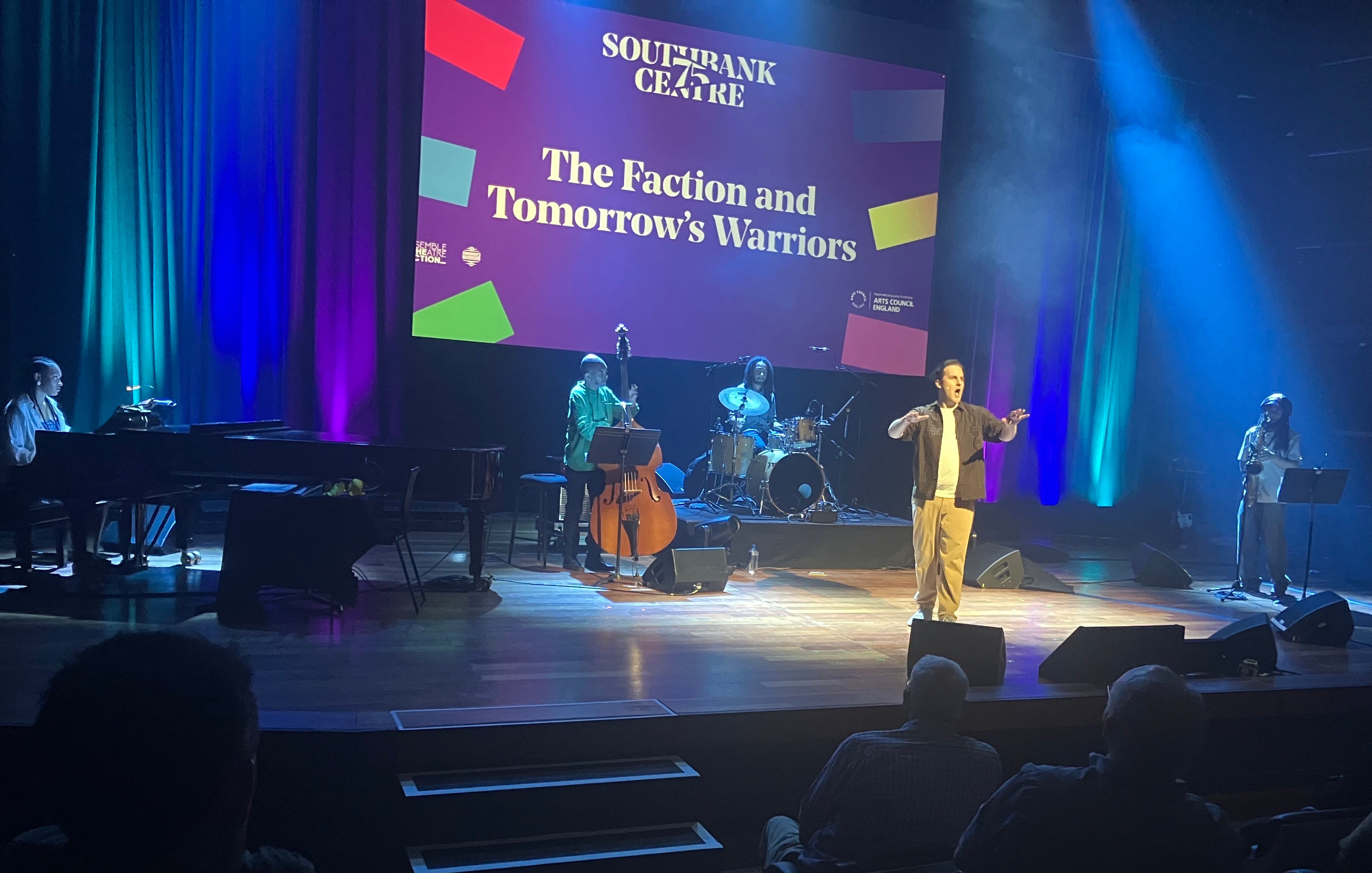
Pictured above: Marl Leipacher leads an outstanding jazz rendition of ‘Howl’
The opening segments could hardly have been more dissimilar. MC Taylor played Ginsberg’s ‘A Western Ballad’, his very first song from 1948, as solo voice supported by the poet’s own harmonium, the holy sound box a stunning surviving piece in the reliquary. It was quiet, it was gentle, it was charming. Then the room exploded with a tour de force of sustained spoken word.
A group combining performance troupe the Faction and jazz hitters Tomorrow’s Warriors delivered a stunning rendition of the massive first section of ‘Howl’. Bassist Gary Crosby led a finely-honed trio providing the springboard for a stunning lead reading by Mark Leipacher, spitting, spouting, shaping, every gripping line of the vast piece without a hint of a prompt. Bebop kabbalah: simply epic.
After that extended entrée, the treats came thick and fast, as the Raincoats’ Gina Birch turned up the overdrive to 10 on guitar and, with Karina Townsend on a quirky array of found instruments, delivered grunge-adjacent versions of the anti-capitalist satire ‘Put Down Your Cigarette Rag’ and the enduringly unnerving memory of Ginsberg’s own New York street mugging.
After that came famed producer and Killing Joke ace Youth, joined by Mo’Wax mainstay James Lavelle, on a gruff, grainy take on ‘Slow Horse’, a slice of mekanika leavened by the female sprechgesang of Alex Perry. To follow, the twinkling Scanner soundtrack to ‘Elegy for Neal Cassady’, minimal electronica feeding a mind-twisting video work by Antonio Pagano. Strange, hypnotic, but too long, I felt.
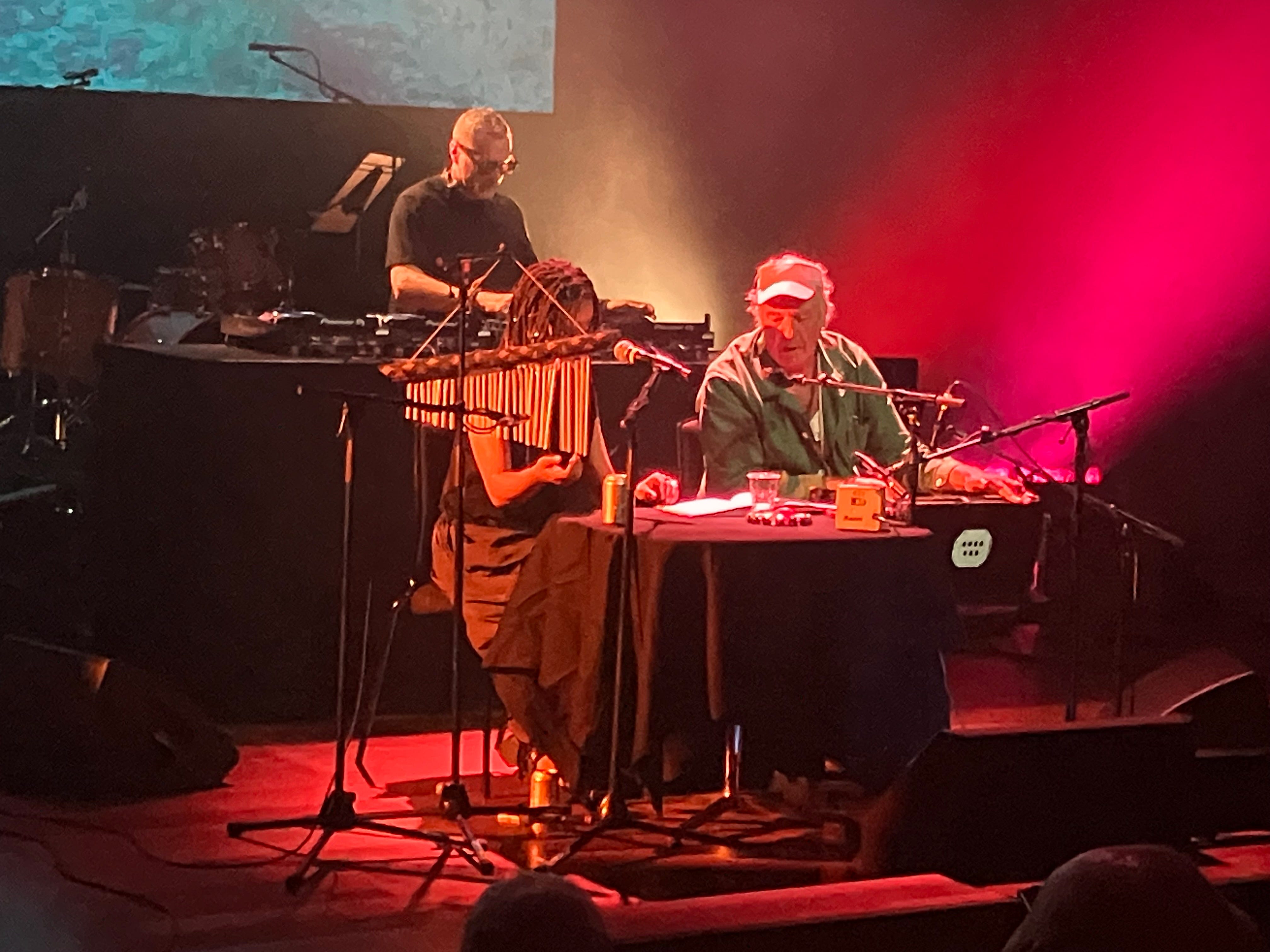
Pictured above: Youth (right), James Lavelle (behind) and Alex Perry on ‘Slow Horse’
Thurston Moore lifted the poetry baton, solidly declaiming ‘Magic Psalm’ to a piano etude by Philip Glass, played with determined control by Mary Dullea, an instrumental work which owed more to a nineteenth century German chamber tradition than Sonic Youth’s committed modernism. In short, a further surprise.
Yet the sequence in the set that raised more than a little laughter was a surrealistic rap from US playwright Mark Stewart – who referred to Ginsberg as ‘a Fidel Castro among poets’ – and then disabused us of the thought that his contribution had anything to do with the poet!
Instead, backed by piano and congas, Stew related an anecdote about a forthcoming movie that would feature a figure called Friendsberg and make connections with Amiri Baraka and Jean-Paul Sartre to mention but a few. Fake or not, fun ramble or genuine film preview, that was a definite hoot.
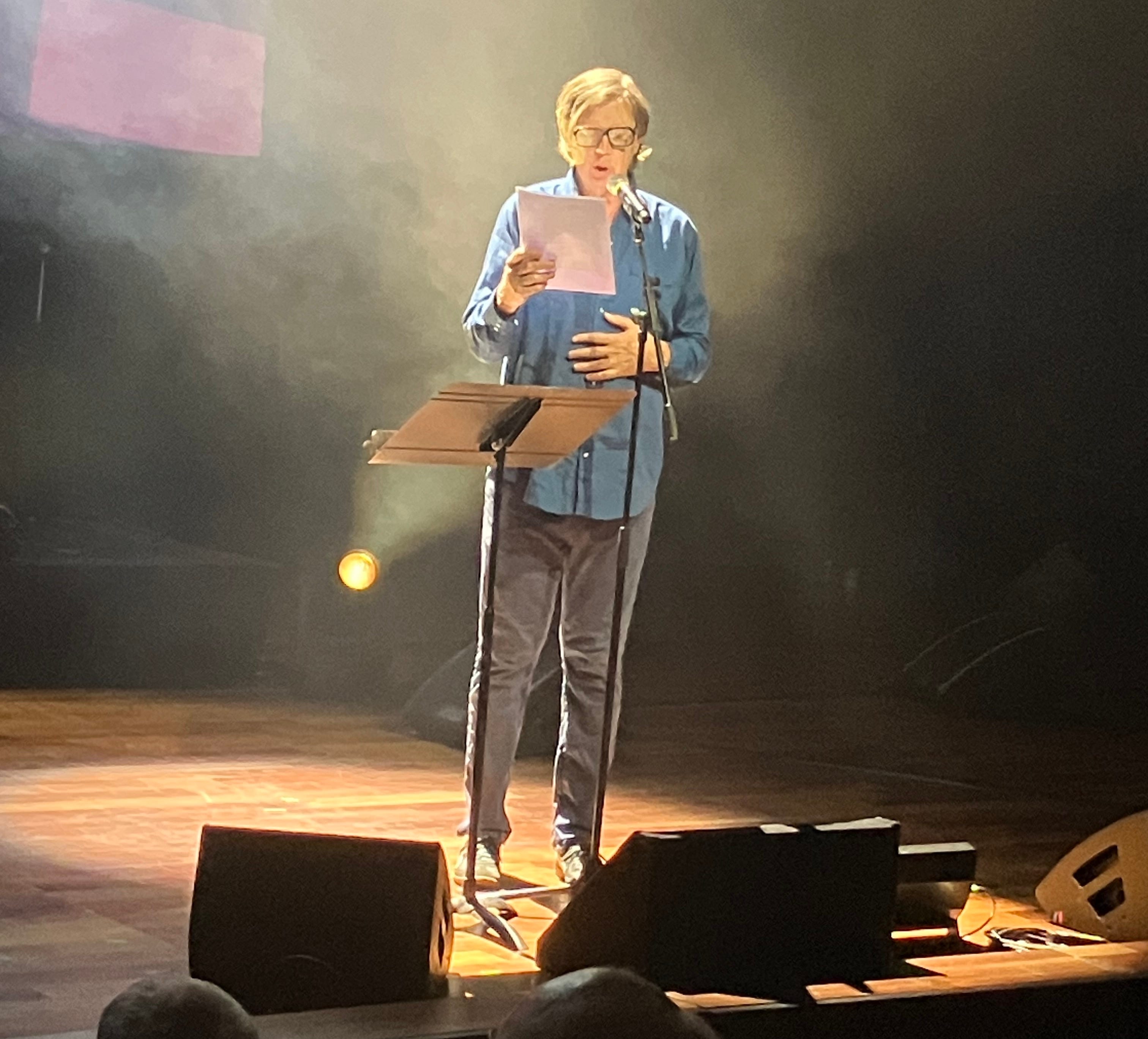
Pictured above: Thurston Moore reads Ginsberg
Eclectic always and electric at times, dynamic and dialectical, the show, attended by British Beat stalwarts including Barry Miles and Oliver Harris, ended in touching fashion with William Blake very much at the heart of the moving finale.
Steven Taylor brought the whole cast back on stage as he sang ‘Nurse’s Song’ alone before the ensemble and crowd were roused to join in on the repeated motif, ‘And all the hills echoèd’. In that ancient rustic unison, the ghost of Ginsberg haunted the Southbank’s balmy night.
No posts
Comments
Nothing yet. Say the first thing.
Sign in to join the conversation.