
Amidst the Monets and Van Goghs a small painting hung on a side wall that stopped me in my tracks. A tear welled up in my eyes, and I stood transfixed taking in every detail, filled with a wash of emotion. I stood rooted in the spot, overwhelmed by discovering one of my favourite paintings just causally hanging there.
I had spent an entire day wandering the Metropolitan Museum of Art in New York, an overwhelming experience for someone aesthetically geared like me, and exhausted, I was starting to leave when I realised that I had somehow managed to miss the painting galleries on the second floor. I had missed an entire floor of paintings! I couldn't leave without seeing them. So, despite my complaining feet and stomach, after hours of walking endless galleries, I wearily wandered up the steps. I was so glad I did.
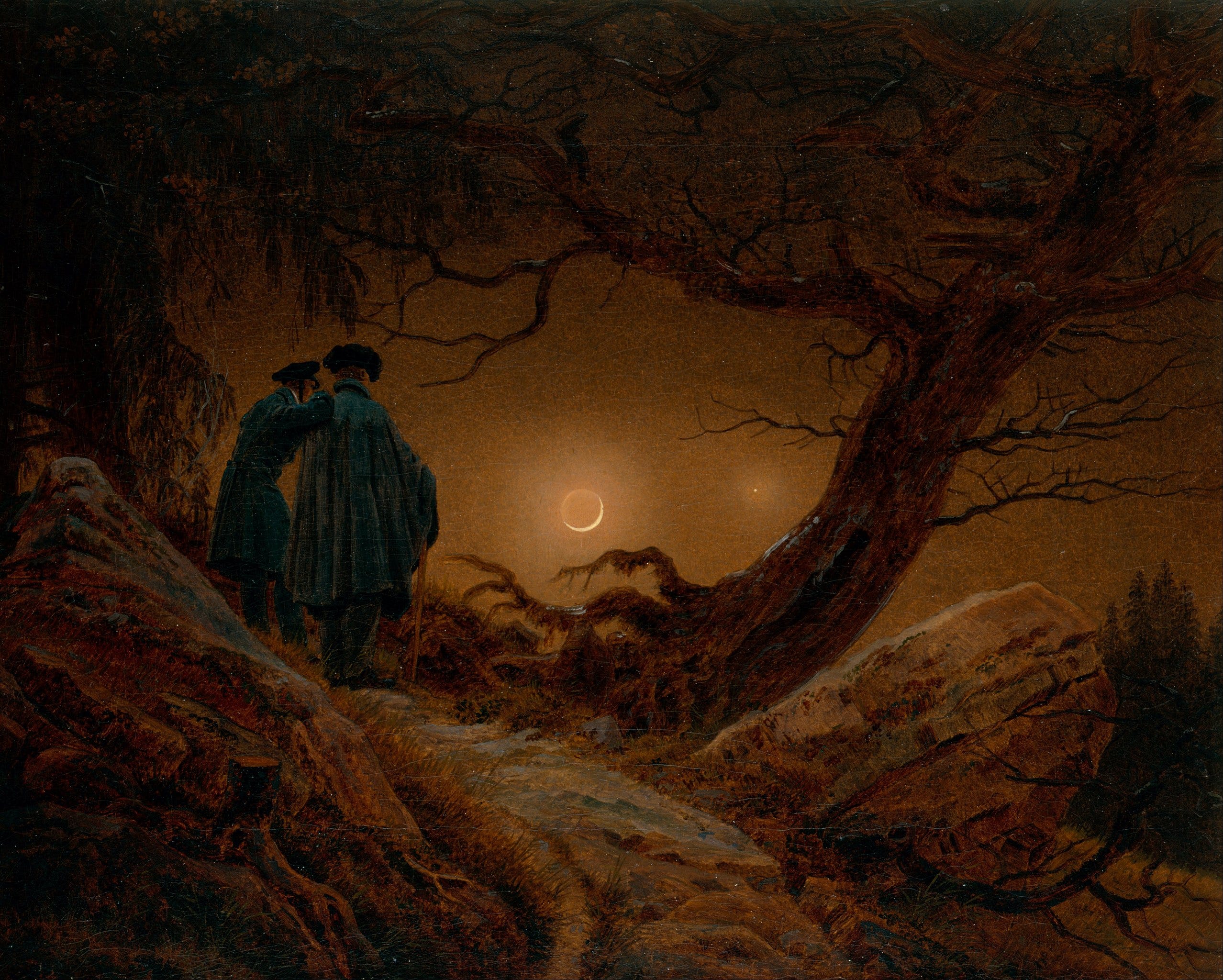
Caspar David Friedrich painted three versions of 'Two Men Contemplating the Moon'. The third and final version hanging in the Met was painted somewhere between 1825 and 1830. He has become the poster boy of German Romanticism, a movement that still holds much cultural sway today. Internal contemplation, deep, complex emotional journeys, and a sense of transcendence and sublime are defining features of the movement. All are in view in his paintings. Living downstream of this movement has had a big impact on our value of the individuals’ emotional experience that defines culture today. As much as I am aware of some of the negative impacts this has had on us, I cannot help but be absorbed and transfixed by the paintings of this movement. I guess I have been culturally wired to. But this painting, in particular, speaks to things that I hold so dear. Friendship, beauty and faith. That’s why I love it so much that stumbling across it brought so much emotion out of me.
Friedrich had an early life filled with grief. While still young he lost his mother, two sisters and watched his brother fall through fragile ice to his death. Such loss couldn't but help to leave a mark on the rest of his life. There is a deep sadness that threatens to overwhelm you in his paintings. You can understand where it comes from. His adult life was marked by bouts of depression. In his paintings figures are usually small, dwarfed by vast moody landscapes. He very much retreated into himself in later life and was known as a recluse, living a life of isolation. His experiences flow through his brush. The clear sadness and loneliness of his paintings always speaks to me in my own experiences of these things. He finds solace not in people, but in nature, something I do frequently myself. Maybe it's the sense of perspective you get in appreciating nature, you and your problems feel a little bit smaller. Maybe its the soft fascination of swaying branches or gently drifting clouds that is soothing and distracting. In his paintings the world around represents the person within. Complex, melancholy, beautiful.
But this painting feels different. The sadness is there, but the figure is not alone. Two men walking together at night contemplate the moon. The casual fellowship clear as one leans on the other's shoulder. A beautiful moment of fellowship caught by the artists hand. (It is thought that the painting is of Friedrich and his friend August Heinrich).
In a particularly low point in my life, just as I was starting to figure out what it looks like to truly share with others and be vulnerable, I would have a regular dinner with a friend. After, we would sit in the car as I shared what was going on my my heart and mind. As he (very patiently) listed to a lot of angst we sat, facing out. Looking out of the windscreen into the night. I can't remember if the moon was ever visible, but this image makes me think so much of those times. It reminds me of precious memories of a dear patient friend. One I am so thankful for. Because of that, it reminds me more broadly of the real joy and beauty of friendship. It's one we can so often take for granted. Something we feel the absence of when we long for it. What a beautiful thing friendship is!
Sadness may be something that naturally isolates, but there is nothing like a friend coming to join you in that sadness. It's not a path we have to walk alone. Before Job's friends open their mouths and put their feet right in them, they sit in the dust with Job, joining him in his grief. Not saying a word. Just sitting together in the discomfort. I feel like the two men in the painting are similarly just standing there in silent contemplation of the beauty before them.
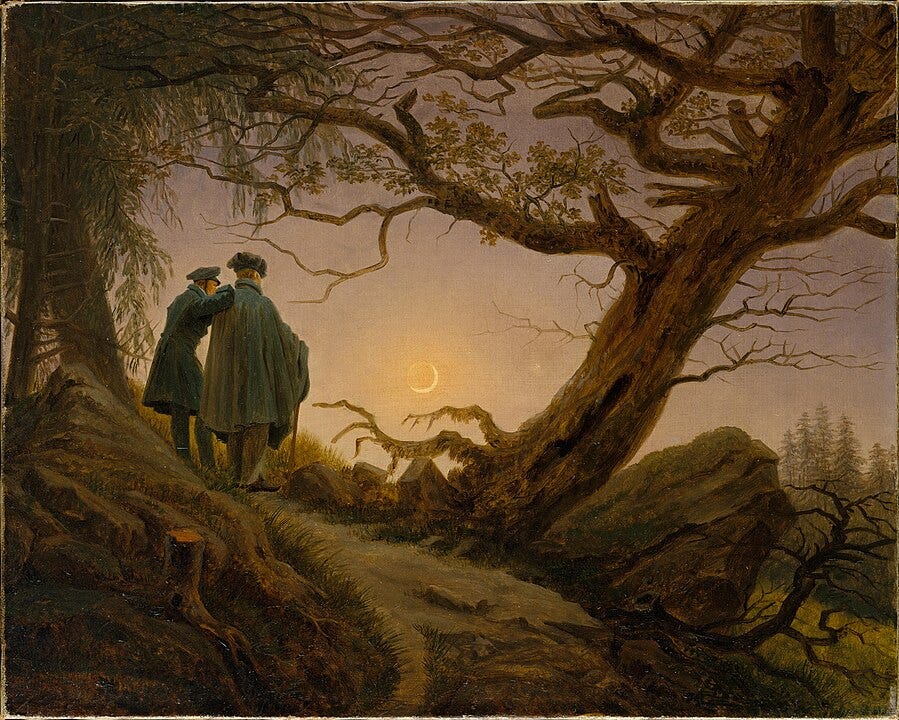
Friedrich's paintings are infused with a kind of magical beauty. The world is somehow enchanted. While he never really painted magical creatures in his work, you'd be forgiven for thinking that there was some fairy or dragon hiding around the corner. And that is part of the point, the gothic mystery of German Romanticism the world is somehow infused with emotions and the spiritual, you don't need the more obvious fantastical elements, the beauty of nature was enough.
I used to long to get lost into fantastical worlds, wander into Narnia or Middle Earth. But as I got older I realised, when you stop and look at it, the world is magically beautiful enough. As I write this I'm looking out onto bare branches adorned with raindrops and blossoms in the pink-hued evening light. Beauty is all around us. Beauty is good for us. There have been numerous studies into how time out in nature is good for our well-being. Spending time contemplating the beauty of the world God has made refreshes our tired minds, and improves our mood.
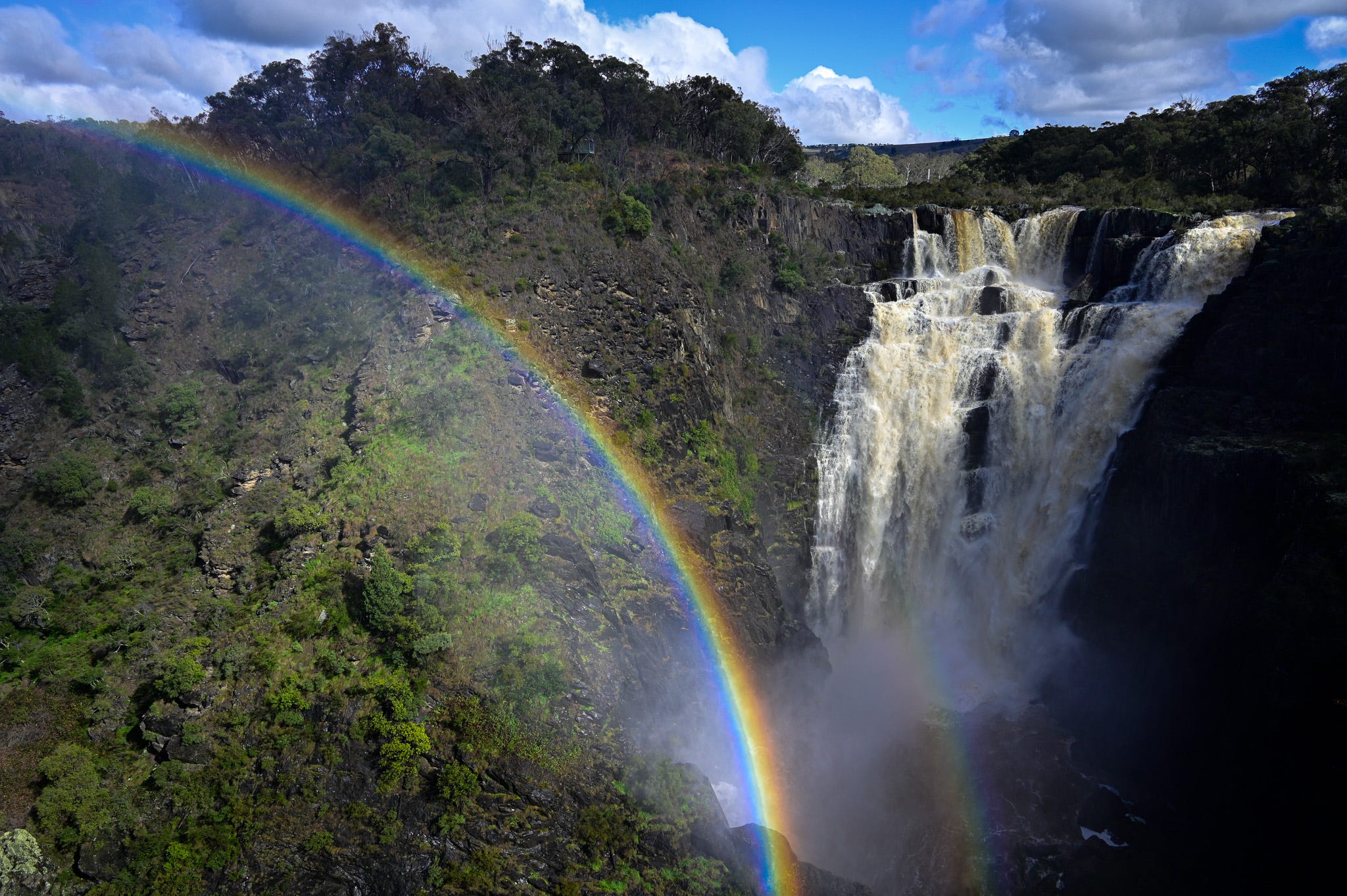
On a drive back from Armidale, on a whim I stopped off at a waterfall along the way home, and was blown away by it. Recent rains had swollen the river, and the waterfall was a roar of foam and mist, which drifted up in the morning sun, casting rainbows. I was utterly overwhelmed by it. Lost for words I stood contemplating the beauty before me. In my own mind, I grew small as the vast beauty before me overwhelmed me. I was like the small figures in Friedrich's paintings, lost in the beauty of the world. The transcendent beauty points to something greater. Points to the one who made it.
In the paintings of the Romantics the world is infused with the sublime, an almost pantheistic sense that God is in each twisted branch or jutting rock. The romantics, in particular, regarded the moon as an object of 'pious contemplation'1 the supernatural is immanent. Near to them. Sometimes, protestants can react so strongly to the wrong in this idea that we forget that the beauty of nature is something that declares God's glory. That it is a good thing that points to our good God. It is not God itself, but it points us to him.
Psalm 19 begins with these effervescent verses:
The heavens declare the glory of God;
the skies proclaim the work of his hands.
Day after day they pour forth speech;
night after night they reveal knowledge.
They have no speech, they use no words;
no sound is heard from them.
Yet their voice goes out into all the earth,
their words to the ends of the world.
Psalm 19: 1-4
This is the joy I find in creation that points me to God. Not that I find him in the beauty of creation, or the paintings of the romantics, but his created world cries out praises of his glorious nature.
I think our iconoclasm, our right concern for false idols can make us dismiss beauty as something superfluous or even dangerous. We can dismiss art as unnecessary. But by that same logic we would have to dismiss the beauty of all the creation God has made. Christopher Watkin writes beautifully on this, that creation is an act of divine superabundance. It is not necessary by definition- God did not need to create it. And he did not need to create such sublime beauty that it brings me to tears.
"...God has not created a world with just enough sustenance, variety, and abundance for survival, but God created a superabundant world fit to foster the flourishing of his creatures.
He has not limited supply to the level of demand. Why have one or even one thousand species when you can have an estimated 8.7 million? Why just eat to survive and have sex to procreate when you can experience great enjoyment at the same time? Why create a monochrome world if you can make a human eye that can distinguish between 7 and 10 million colours? And stars: don't even go there! Astronomers estimate there are around 300 billion stars in our Milky Way galaxy alone, and perhaps 2 trillion (2 million million) galaxies. Now I ask you: What's the point of that? What a waste? What a delight!"2
This is the God we put our faith in. The one who delights in what he has created, and made us to delight in it too.
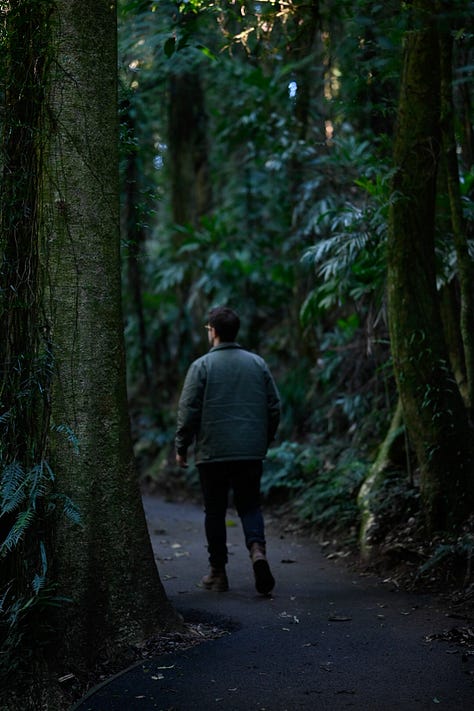
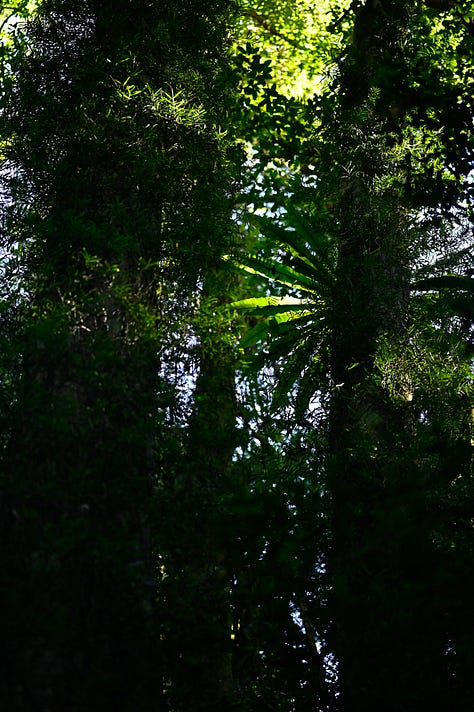

God has given us a sublime creation to enjoy and appreciate. He has given us people to appreciate it with. And all these good gifts that point us back to him. That is the final thing I love about this painting: how it speaks to all these things and how they are better together. Appreciating the beauty of God's creation with a friend is a beautiful thing. In that moment, you are delighting in three beautiful things simultaneously- the friend, creation, and God. I recently went on a walk in the Dorrigo Rainforest with a friend. The walk was longer than we were expecting. We were tired by the end, but it was a joy to delight in each other’s company and mutual awe at the world God has made.
What a gift we have been given. What a waste when we never take a moment to look up, appreciate beautiful things, and thank our God for them all. That is why this painting stops me in my tracks, and brings me to tears.
Praise God for beautiful things.
Thanks for reading Simon’s Substack! This post is public so feel free to share it.
Christopher Watkin, Biblical Critical Theory, p71
No posts
Comments
Nothing yet. Say the first thing.
Sign in to join the conversation.