
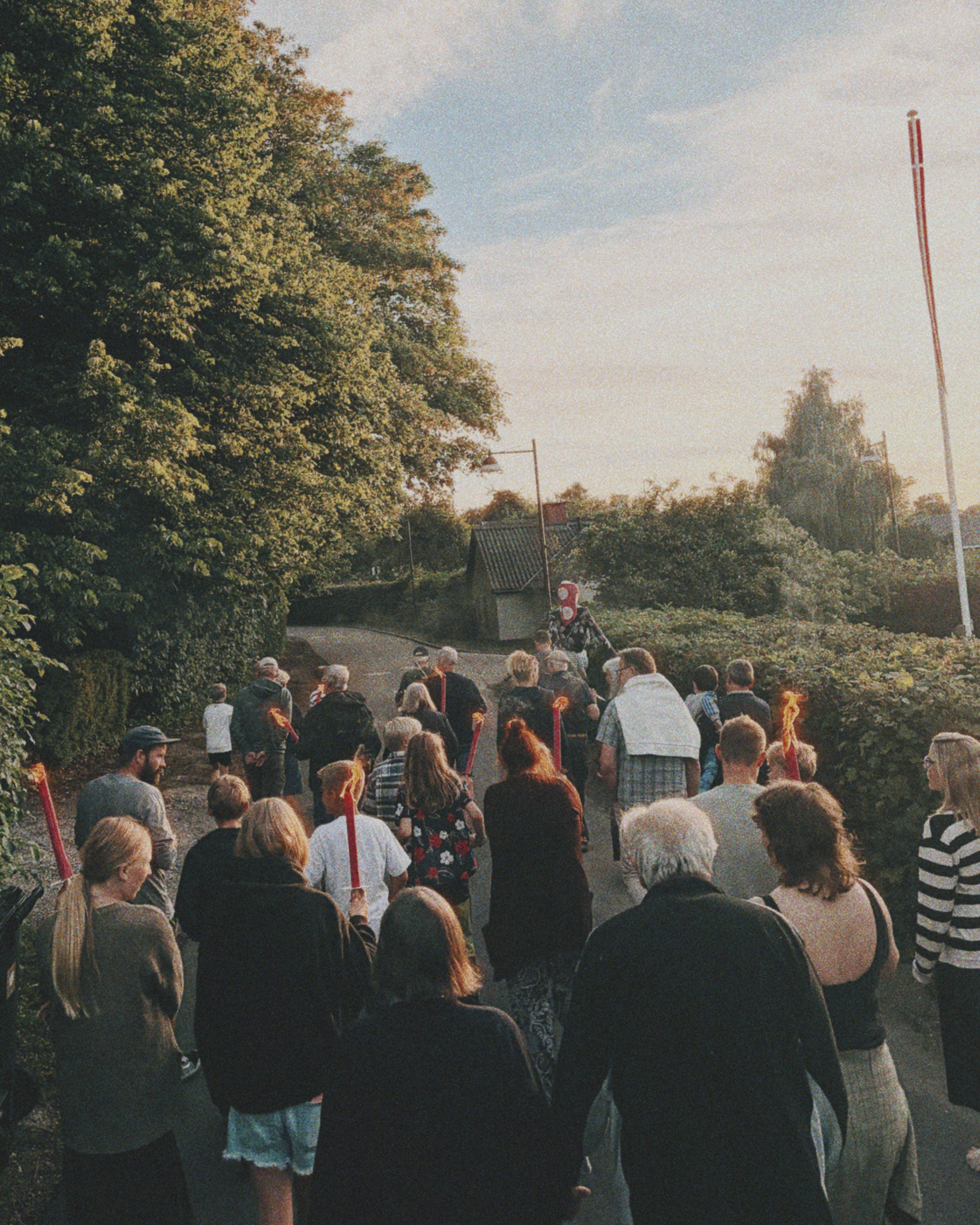
This week we celebrated St. Hans — midsummer here in Denmark. In the afternoon we gathered with friends, everyone bringing something to the table, and we ate and played games and let the evening run long. Then, late, when the children were already tired, we stepped outside — and most of the village was there. Not a handful of neighbours. Most of the families on our streets, more than I would have guessed.
We met at one end of the village and walked through it together. Some up front played music. Someone carried the witch up to be burned. People held torches, and the light was that soft northern blue — a few small clouds high up, not a single car moving. For ten minutes we just walked. Then we stood around the large fire, so warm that everyone kept a ten meters distance, and sang, someone gave a short speech, and people talked and held each other in the half-light. Nobody was performing. Nobody had been recruited. It was simply: this is us, this is the place we live in together — and for one evening it did not matter who among us agreed with whom.
A nurse, giving the evening’s short speech, said something I have been thinking about this morning: you can’t feel the fire through a screen.
I have been thinking about it all morning — less as a clever line than as a description of something I could feel that night. It put me beside people I had not chosen, in a place we share whether or not we agree, around a fire none of us would have lit alone. That is what a living middle feels like: a story larger than my family and smaller than the nation, holding us for one evening without anyone needing to be persuaded to belong. And standing inside it, you feel by contrast how much of ordinary life no longer holds you that way at all.
Something has gone missing from the middle of our lives. You can feel it in the way a neighborhood meeting empties out before the agenda is half done. In the way a community garden committee dissolves after a single season. In the silence where a shared story used to be — a story that told people who they were together: in this place, doing this thing, holding something none of them could hold alone.
Picture an hourglass. At the top, a handful of imperial narratives — growth, progress, efficiency, competition — colonised the world alongside actual empires and now function as invisible infrastructure. They no longer feel like stories. They feel like physics. The logic of endless expansion and market optimization shapes policy, education, urban planning, even the rhythms of how we raise children — so deeply embedded that questioning it feels less like dissent and more like madness. [1]
At the bottom, the narrative of the self — hyper-individuated, algorithmically reinforced, increasingly produced for us by platforms that treat identity as a market segment. Social media turned “who am I?” from a philosophical question into a content strategy. We perform ourselves in public, curate our pain, and package our growth into carousel posts. The self has become both product and consumer of its own story. [2]
And in the middle — the place where communities, congregations, movements, and civic cultures once generated organising narratives — a thinning. A disappearance. The meso-level stories that said “we are the people who gather at this river,” or “we are the ones who build this way,” or simply “we belong to each other in this struggle” — those stories have been hollowed out. Not destroyed. Hollowed. The shell remains, but the living tissue inside has dried up.
And the hollowing is uneven. In the older village the monthly dinner still happens; the committee still meets — practices laid down decades ago by people who learned to belong when leaving was not an option, still running on their own momentum. What has broken is the replacement rate. The conditions that once produced new meso-narratives — proximity you did not choose, repetition you could not skip, the friction of staying — have migrated into digital spaces where they evaporate on contact. So the middle looks intact wherever it is coasting on what was built before, and empty exactly where you would expect new growth: among the young, in new neighborhoods, anywhere the work of belonging has been made frictionless. The tide is going out, and the places that still feel full are standing on higher ground.
This is the narrative hourglass. And it might be the sharpest way to understand the crisis of meaning that philosopher John Vervaeke has spent years mapping. Vervaeke’s “ecology of practices” — his term for the interconnected web of rituals, relationships, and reflective habits that once sustained shared relevance — has collapsed at precisely this meso-level. [3] What remains is either too abstract to feel (the imperial top) or too personal to share (the individuated bottom). The middle, where meaning was made together, stands empty.
Seen this way, the politics snap into focus. Identity politics and the resurgence of nationalism are both attempts to refill the meso-level. They sense the hunger. They feel the void where community narrative used to live. But they reach backward into old containers rather than growing new ones — offering top-down blueprints for belonging rather than bottom-up, living, place-based story systems.
Identity politics fills the belonging void by organising around shared wounds rather than shared projects. It answers “who are we?” with a category rather than a story — a necessary response to real exclusion, but one whose narrative grammar tends toward protection and boundary-making rather than generative co-creation. [4] Nationalism fills the void by resurrecting the nation-state as the “natural” unit of belonging. “Take back control” may be the purest meso-narrative slogan of the decade. But it is a defensive meso-narrative — one that protects the old story rather than composting it into something new.
Both are reaching for the middle. Both prove the point: people are starving for organising narratives that are bigger than the self but smaller than “humanity” or “the market.” The demand is enormous. The supply is broken.
But surely the middle did not disappear. It migrated. Open any phone and the meso-level looks like it is thriving — thousands of communities, each one gathered around a shared interest or a shared identity. The gardening forum, the founder Slack, the subreddit for people who grew up in the same kind of town. If a meso-narrative is a story that binds a group larger than the self and smaller than humanity, the feed looks like a meso-narrative machine running at full speed.
The resemblance thins when you look at how these communities form. We choose them, and we choose them around what we already like or already are. The old physical meso-level did its sorting differently. It gave you the people who happened to be there: the neighbour you would never have picked, the committee member whose politics make you wince. And because leaving was hard, because you still had to share the same street and the same water, you had to do the slow work of staying — learning to negotiate, to repair, to tolerate the people you could not simply remove from the group. The economist Albert Hirschman called this the choice between exit and voice. [7] When the cost of leaving drops to a single tap, voice goes quiet, because nobody difficult ever has to be woven into the story. The frictionlessness that makes a digital community so easy to join is the same quality that keeps it from ever setting, like water held just above freezing.
Which raises a harder question. A group sorted by identity, entered by choice, abandoned at no cost — is that the middle of the hourglass at all? It may be the bottom of it, the individuated self, simply multiplied. A room where each of us performs a curated identity at all the others, and we mistake the echo for belonging. If that is true, the digital middle does not refill the hourglass. It empties it faster, by handing us just enough of the sensation of community that we stop going looking for the kind that asks something of us. The fire on the screen is still only light — you cannot warm your hands at it.
There are exceptions, and they are the most interesting part of the picture. Some corners of the internet do grow real meso-narratives: the mutual-aid group rooted in one neighbourhood, the online organising that spills out into a march, the guild whose members genuinely depend on one another. What sets these apart has little to do with the screen. It comes down to a single question — are people bound to others they did not choose, doing something together that costs them something? The digital middle keeps sliding back toward the bottom because it is built from affinity and opinion, and meso-narratives have never grown from either. They grow from something older, and more demanding.
If the middle cannot be rebuilt through ideology, nostalgia, or a frictionless feed, where does it come from? The evidence points in a direction that is both ancient and surprisingly practical.
First: shared practice, not shared opinion. Communities that do things together — steward water, grow food, build shelter — generate stories as a byproduct. The narrative is not imposed from above. It emerges from the drainage channel dug by hand, the training completed side by side, the flood footage reviewed together over tea. Practice produces plot.
Second: human-scale containers. Robin Dunbar’s research on cognitive limits suggests that meaningful social relationships max out around 150 individuals — the threshold at which people can still see themselves in a shared story. [5] Beyond that number, connections thin, accountability fades, and the group narrative becomes abstract. Meso-narratives need intimacy to survive. They need faces, not demographics.
Third: temporal depth. A meso-narrative without roots in the past and tendrils into the future is just a slogan. Indigenous knowledge systems sustain this through seven-generation thinking — the practice of making decisions with both ancestors and descendants in mind. Modern communities have largely lost this capacity, because the attention economy compresses everything to the present tense. The hourglass has no memory.
Fourth: translation infrastructure. The meso-level does not only need stories — it needs ways for stories to travel between communities without being flattened into universal narratives or captured by platforms. Something like a mycelial layer — a network where local stories can cross-pollinate without merging, where a water stewardship narrative in Uganda can resonate with a food sovereignty story in Denmark without either losing its texture. [6] Not a grand narrative. A commons of meso-narratives.
The authoritarians already understand this. They are rebuilding the meso-level with blood-and-soil stories, with “real people” rhetoric, with the emotional architecture of belonging hijacked for exclusion. They are filling the hourglass from the wrong well.
The question, then, is whether there is a generative alternative — meso-narratives rooted but not walled, that offer belonging without requiring an enemy. Stories grown from practice, held in human-scale containers, stretched across time, and connected through infrastructure that serves the commons rather than the algorithm.
The hourglass does not need a new top. It does not need a new bottom. It needs its middle back.
And the work is the part we flinch from. There is a line that has been making the rounds — everyone wants a village, but no one wants to be a villager — and it lands because it is exactly right. We want the fire without the year of small, unrewarded commitments that produces the people who can light it: the committee nobody volunteers to run, the turn nobody wants to take, the neighbour it would be easier to mute than to sit beside.
Sit beside them anyway, and you are handed something no screen can counterfeit. I stood in it last night — not the bonfire itself; a screen can show you a better one than memory will. What it cannot hand you is the rest: the neighbours you did not choose, the slow walk at a shared pace, the heat that pushed the whole circle back a step, the quiet smiles and laughing talks, the sense that for one evening this place and these people were a single story you were inside of rather than watching. That is the middle, full again. You cannot feel the fire through a screen, and you cannot feel the belonging through one either. The work is making sure there are still fires worth gathering around — and the people who have practised, all year long, the unglamorous craft of staying.
[1] Vervaeke, J. (2019). Awakening from the Meaning Crisis. Lecture series, University of Toronto. Link
[2] Storr, W. (2019). The Science of Storytelling. William Collins. Link
[3] Vervaeke Foundation. Ecology of Practices. Link
[4] Heyes, C. (2020). “Identity Politics.” Stanford Encyclopedia of Philosophy. Link
[5] Dunbar, R. (2010). How Many Friends Does One Person Need? Dunbar’s Number and Other Evolutionary Quirks. Faber & Faber. See also: Dunbar, R. (1992). “Neocortex size as a constraint on group size in primates.” Journal of Human Evolution, 22(6), 469–493. Link
[6] Institute for Social Capital. “Shared Narratives.” Link
[7] Hirschman, A. O. (1970). Exit, Voice, and Loyalty: Responses to Decline in Firms, Organizations, and States. Harvard University Press. Link
Comments
Nothing yet. Say the first thing.
Sign in to join the conversation.