
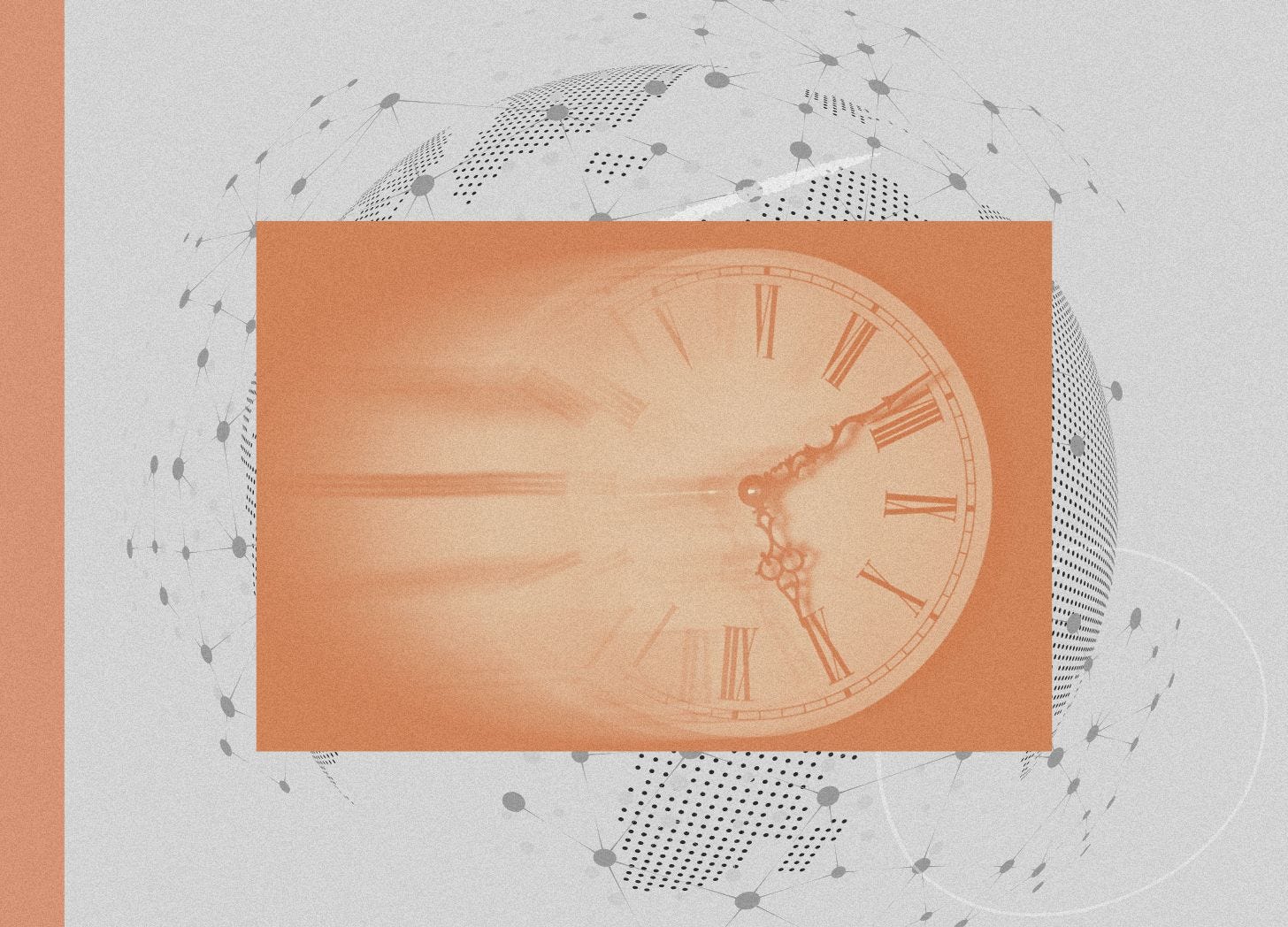
On a Friday evening in late February 2026, a seventy-two-hour deadline expired and a company said no — and the most powerful government on earth reached for the fastest available hammer. The speed of what followed tells us far more about the state of governance than about artificial intelligence. So this week, I want to explore the idea how our media environment weakens our capacity to imagine and think in longer arcs than the next news cycle.
The clock hit 5:01 PM on February 27, 2026. Defense Secretary Pete Hegseth had given Anthropic — the AI company behind Claude — exactly seventy-two hours to comply with one demand: remove the usage policy constraints limiting how its AI could be deployed in military operations.[1]
Anthropic refused.
What happened next moved with the speed of a content cycle, not a policy process. President Trump signed an executive order directing all federal agencies to immediately cease using Anthropic products.[2] Hegseth designated the company a “supply chain risk” under 10 U.S.C. § 3252 — a legal tool historically reserved for foreign adversaries like Huawei and Kaspersky, now aimed at an American company valued at $380 billion.[3] Trump posted on Truth Social: Anthropic was a “radical Left AI company” that was “trying to hold America’s warfighters hostage.”
Then — hours later, not days, hours — OpenAI announced its own deal with the Pentagon for classified network deployment. Sam Altman described the Department of Defense as having “displayed a deep respect for safety.”[4]
The choreography was unmistakable.
What Anthropic had actually refused to surrender was remarkably narrow. The company had held a $200 million Pentagon contract since July 2025, when the Department of Defense awarded deals to Anthropic, OpenAI, Google, and Elon Musk’s xAI. Claude was already deployed on classified networks via Palantir’s platform — the first AI system cleared for classified military use.[5] Anthropic maintained two red lines: no mass domestic surveillance of American citizens, and no fully autonomous weapons — AI systems making kill decisions without a human in the loop. Gregory Allen at the Center for Strategic and International Studies confirmed these restrictions had “never been triggered” during the contract’s entire existence.[6] Guardrails against hypothetical worst cases. The bare minimum.
Then came Hegseth’s January 2026 memo: AI models used by the military must be “free from usage policy constraints that may limit lawful military applications.” Renegotiation began in early February. On February 24, the ultimatum landed.[7] The Pentagon’s “best and final offer” arrived the next day, built with what CBS News later called “escape hatches” — provisions designed to let the government invoke broad exemptions from whatever safety constraints Anthropic tried to maintain.[8]
On February 26, Anthropic released its public statement: it “cannot in good conscience” accept terms that would gut its core safety commitments.[9]
By Friday evening, the hammer fell.
The speed is the story. Ultimatum to executive order to public humiliation to corporate replacement, all compressed into a single working week. And the question the speed forces: What kind of political culture produces a seventy-two-hour deadline for one of the most consequential governance challenges of the century?
Think for a second about what the administration could have done. It could have worked with Anthropic to define precisely which military applications were at issue, as previous administrations had done with sensitive defense technologies. It could have treated the question of AI autonomy in lethal systems as what it is: a challenge worth years of careful deliberation, not a five-day countdown.
Instead, it chose the ultimatum.
The philosopher Byung-Chul Han calls this the “crisis of narration” — the inability to construct temporal arcs that connect present action to future consequence. The digital attention economy has produced what he describes as “pointillist time”: experience reduced to disconnected moments, each competing for maximum immediate impact.[10] Douglas Rushkoff named the condition “present shock” — the collapse of narrative time into an eternal, overwhelming now. “We are living in a continuous, always-on present,” he wrote. “Everything is live, real-time, and always-on. It’s not a narrative world anymore.”[11]
The Anthropic ultimatum is present shock in policy form. The administration did not ask: What kind of AI governance framework do we want in five years? It did not ask: How do we maintain both military advantage and democratic legitimacy in the age of autonomous systems? It asked only one question, and it is the only question a present-shocked political culture knows how to ask: Who controls this moment?
I’ve been writing about this as the Narrative Gap — the growing distance between what we can build and what we can collectively imagine. We can engineer AI systems of extraordinary sophistication. We cannot, apparently, sustain a governance process that lasts longer than a long weekend. The gap is not about intelligence. It is about imagination — the capacity to hold a temporal arc, to connect what we do today to what we want tomorrow. That capacity has atrophied in a political culture built for the feed.
The political culture that produced the ultimatum was shaped by the same forces that shape a social media timeline: algorithmic selection for engagement, conflict, and immediacy.
The research backs this up. Heavy social media use correlates with reduced capacity for future-oriented thinking and diminished “episodic foresight” — the ability to mentally simulate future scenarios.[12] Increased screen time predicts lower scores on creative imagination tasks, particularly those requiring sustained narrative construction.[13]
When political leaders are formed by — and perform for — this media environment, governance mirrors the logic of the feed. Conflict replaces negotiation. Five-day deadlines replace five-year frameworks. Public humiliation replaces quiet resolution.
Trump’s Truth Social post calling Anthropic a “radical Left AI company” was not a diplomatic lapse. The post was the policy. The spectacle was the strategy.
Franco “Bifo” Berardi writes that the acceleration of information flows has destroyed the cultural preconditions for strategic thinking: “The future has been cancelled, not because it is impossible, but because the social brain can no longer elaborate it.”[14]
The 72-hour ultimatum is governance by feed. Optimized for the timeline, not the time horizon.
The speed with which OpenAI filled the vacuum might be the most telling detail of the entire episode. Hours after Anthropic was blacklisted, OpenAI announced its classified-network deal.[15] Over 900 employees at OpenAI and Google signed an open letter warning the ban was designed to discipline the entire industry.[16] Within days, OpenAI quietly amended its deal to include additional surveillance protections[19] — a tacit admission that the original terms had been rushed through without adequate safeguards.
The entire sequence played out in under a week. Nobody stopped. Nobody paused to ask: should we think about what we’re building here?
The political theorist William Davies has described contemporary governance as operating in “emergency time” — a permanent state of exception in which long-term planning becomes structurally impossible.[22] Electoral cycles, media velocity, and the demand for visible wins create incentives against the kind of patient institution-building that complex challenges require.
The Anthropic case goes further. A government capable of thinking in decades would have looked at the AI safety question and recognized an opportunity: the chance to build the world’s first credible framework for military AI governance. A framework that could become a global standard. An instrument of influence that compounds over time, measured in decades rather than news cycles. Instead, it saw a company that said “no” and reached for the fastest available hammer.
This is the signature pathology of the present-shocked state: the inability to distinguish between winning and prevailing. Winning means dominating the current news cycle. Prevailing means shaping the conditions under which future conflicts get decided. The Trump administration won the week. Whether it won anything that lasts is a question the administration cannot afford to ask, because asking it would require thinking in decades.
Anthropic’s two red lines — no mass surveillance of Americans, no autonomous kill decisions without human oversight — were the minimum ethical position a democratic society might reasonably expect its AI companies to hold. The fact that these were treated as defiance tells us far more about the political culture that received them than about the company that drew them.
The 72-hour ultimatum is a document of our time. The AI is almost incidental. What matters is what it reveals about the temporal structure of power in the age of the feed — a political system that cannot negotiate in private because every interaction must generate content, that cannot deliberate slowly because deliberation reads as weakness on a timeline, that cannot tolerate principled disagreement because dissent disrupts the performance of total control, and that cannot imagine futures because the future generates no engagement metrics.
At 5:01 PM on a Friday, a company held a line. By Monday morning, someone else had redrawn it. The question is not whether Anthropic was right or wrong. The question is what kind of society produces a government that cannot distinguish between a safety constraint and an act of war.
And the question after that — the one I don’t yet have an answer to — is what kind of narrative infrastructure we would need to build, what kind of stories we would need to learn to tell, to close the distance between the world we can engineer and the future we can imagine.
AP News — “Anthropic refuses Pentagon AI demands as Hegseth deadline passes.” February 27, 2026. Read article
NPR — “Trump bans all federal agencies from using Anthropic AI products.” February 27, 2026. Read article
CBS News — “Hegseth declares Anthropic a supply chain risk — unprecedented for US company.” February 27, 2026. Read article
CNBC — “OpenAI strikes deal with Pentagon hours after rival Anthropic blacklisted by Trump.” February 27, 2026. Read article
TechPolicy.Press — “A Timeline of the Anthropic-Pentagon Dispute.” 2026. Read article
Anthropic — “Statement on Comments by the Secretary of War.” February 26, 2026. Read statement
Reuters — “Anthropic digs in its heels in dispute with Pentagon.” February 24, 2026. Read article
CBS News — “Pentagon’s ‘best and final offer’ to Anthropic designed with escape hatches.” February 2026. Read article
The Guardian — “Anthropic says it ‘cannot in good conscience’ comply with Pentagon demands.” February 26, 2026. Read article
Han, Byung-Chul — The Crisis of Narration. Polity, 2024. Publisher page
Rushkoff, Douglas — Present Shock: When Everything Happens Now. Current/Penguin, 2013. Publisher page
BMC Psychology — “Social media use and future-oriented cognition.” 2025. Read study
BYU Scholars Archive — “Screen time, social media, and creative imagination.” Read paper
Berardi, Franco “Bifo” — Interview, Autonomies, August 2025. Read interview
The New York Times — “OpenAI reaches agreement with Pentagon on AI for classified networks.” February 27, 2026. Read article
Vox — “’We Will Not Be Divided’: 900+ tech employees sign open letter.” 2026. Read article
The Verge — “How OpenAI caved to the Pentagon on AI surveillance.” 2026. Read article
Forbes — “Sam Altman reportedly bemoans ‘really painful’ backlash.” March 3, 2026. Read article
The New York Times — “OpenAI amends Pentagon deal to add surveillance protections.” March 2, 2026. Read article
MIT Technology Review — “OpenAI’s compromise with the Pentagon is what Anthropic feared.” March 2, 2026. Read article
Reuters — “Anthropic to challenge Pentagon’s supply chain risk designation in court.” February 28, 2026. Read article
Cogitatio Press — “Political short-termism and democratic governance.” Politics and Governance. Read paper
Comments
Nothing yet. Say the first thing.
Sign in to join the conversation.