
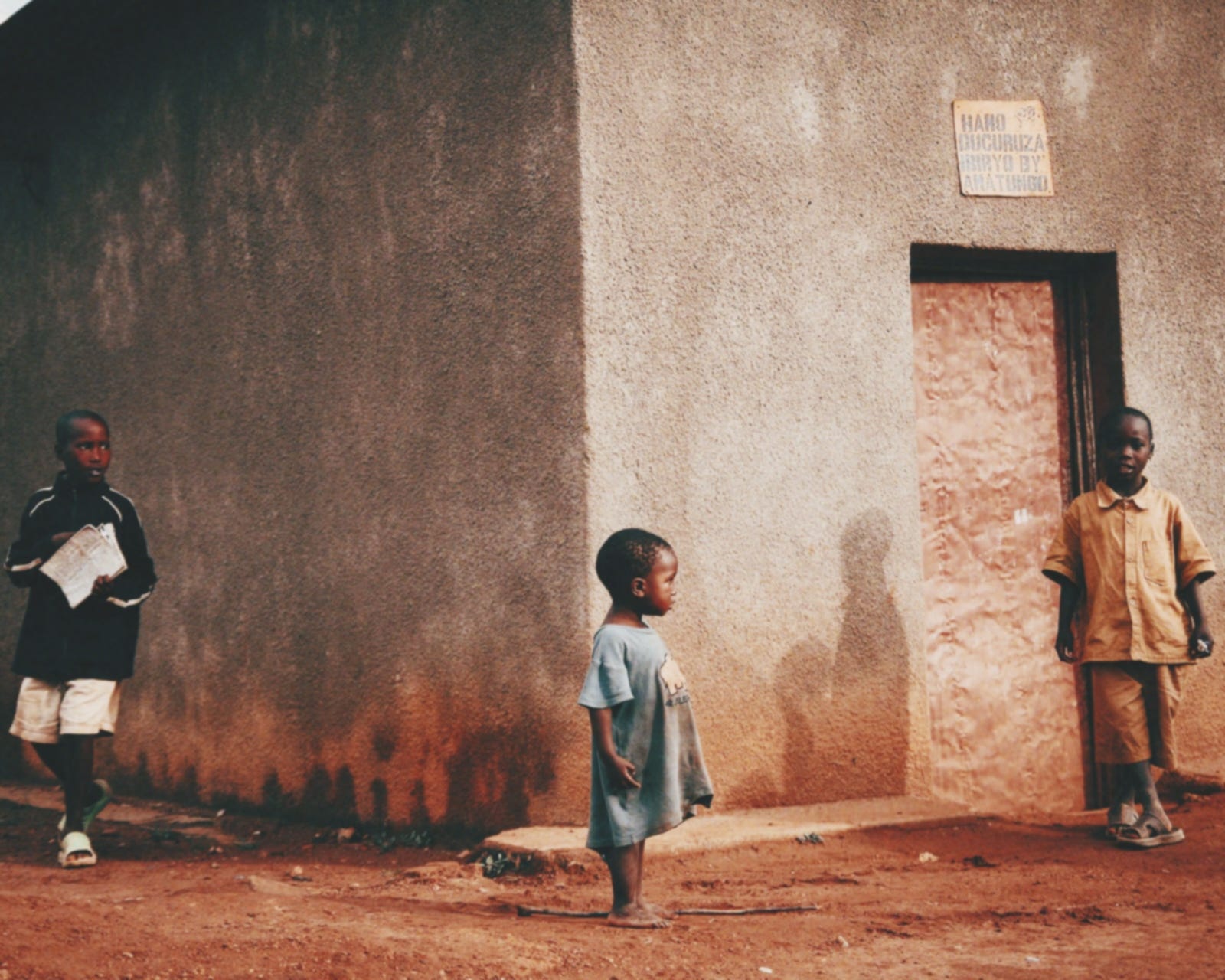
Years after the genocide, I was in Rwanda. The country was rebuilding itself under a single phrase: We are all Rwandan. And on the surface, it was working. I watched two guys — one Hutu, one Tutsi — party together all night. Dancing, drinking, laughing as if nothing separated them.
But later, in private, one of them quietly pointed out that they wouldn’t sleep under the other’s roof. They didn’t say it in public. It was a small itch. A subtle confession of something the national narrative had moved past but their bodies had not.
I think about those two friends whenever someone tells me that the question of who tells a story doesn’t matter — that what matters is the story itself. Roland Barthes argued something like that in 1967: the author should “die” so the reader can be born, so meaning can be liberated from biography. [1] It was a powerful idea. But Barthes assumed someone had crafted the text. His provocation was about how we read, not about whether anyone had written.
What we face now is different. Large language models produce text that was never authored in any meaningful sense. No person behind it. No stable position. No conviction held when challenged. No consequence suffered when it turns out to be wrong.
And I find myself caught between two feelings that don’t resolve. Because I use these tools. Daily. I build with them. My writing is assisted by one right now. And at the same time, something in me keeps returning to that Rwandan night — to the gap between the public story and what was actually true. The narrative said reconciliation. The body said not yet. Who was right? Both. Neither. It depended on who you asked and when.
That’s the kind of truth that stories are supposed to hold. The ambiguous kind. The kind that has a person standing inside it, uncomfortable, unable to give you a clean answer.
Authorship requires a place to stand.
When a person writes, they write from somewhere — from experience, conviction, a particular angle of vision. You may disagree with their position. You may think it’s wrong, limited, dangerous. But it is a position. It can be engaged, argued with, tested against reality.
An LLM has no position. It has a statistical distribution. Ask it to argue for something and it will. Ask it to argue the opposite and it will do that too — with equal fluency, equal confidence, equal emptiness.
I recorded one of my many voicenotes about this last year, walking through Copenhagen: “the “I” in an LLM’s sentence is empty. It can simulate responsibility but it cannot bear it. It loses nothing when it contradicts itself. It “apologises” with no inner cost and no actual repair to do.”
But here’s where it gets complicated. Because I also recorded a voicenote about what AI does well — and I meant it. I said the transition we’re seeing is like the shift from horses to cars, from painting to photography. Every time, there was this feeling: now we lose it, now things get too fast. And every time, something new opened up. AI strips away friction. It amplifies voices that were previously silent. For communities I work with — young people in Kampala, in Nairobi, in Freetown — that amplification is not theoretical. It’s the difference between being heard and being invisible.
So I hold both. AI has no position, no conviction, no stable self. And it gives tools to people who’ve never had them. I don’t know how to resolve that. I’m not sure it should be resolved. But it’s worth exploring as it might lead to a better understanding of how we could use AI without losing authorship.
For most of human history, making stories carried risk. The oral storyteller stood before the community — present, identifiable, confrontable. In print, a publisher’s name on the spine meant money, reputation, legal exposure. [2] Even social media maintained a thread of traceability.
Each medium preserved a core principle: someone had something to lose.
I know what that feels like from documentary work. People often ask how I can photograph the things I photograph. The honest answer is: the camera protects me. I focus on the frame, the light, the composition, and that gives me distance. The feelings come back in the evening.
But not always. In Enbu, Kenya, I photographed a boy named Dennis — physical and mental disabilities, locked every day in a goat stable by parents who had no choice. They had to work. The other kids would throw things at him. He sat in dust and dirt, living his days in that space. And I was behind the camera and crying at the same time. Not because anyone was cruel. Because the situation was inhumane and nobody intended it.
That moment taught me something about authorship that I couldn’t have learned from theory. To make a story about Dennis is to be changed by Dennis. To carry something afterward that you didn’t carry before. It’s not comfortable. It’s not clean. But it’s the thing that separates a story told by a person from a story generated by a system.
AI-generated content severs this completely. The system bears no professional consequences for errors. No legal liability. No reputational cost. No relationships strained by the impact of what it wrote. The output has real consequences. The producer has none.
And the scale is already staggering. A romance author recently revealed she had published 200 AI-generated novels in a single year under a pseudonym. [3] In academia, researchers embed AI-generated text in papers — what The Scholarly Kitchen calls “a contemporary form of ghost authorship.” [4] The U.S. Copyright Office has ruled that works solely generated by AI lack copyright protection — because they lack human authorship. [5] The accountability chain — what a recent Springer paper calls authorship “distributed across programmers, datasets, algorithms, and readers” with no single point of responsibility [7] — has no structural way to close.
Writing has always been an act of compression. We take the roaring flood of human experience and we press it into sentences.
Good storytelling makes the compression invisible. It makes the map feel like the territory. You read it and you feel the ambiguity, the layers, the texture of what the words are pointing at.
But most storytelling doesn’t do that. Most storytelling is linear, simplified, binary. And that is exactly what AI is trained on — billions of texts, the vast majority already reductionist. When AI predicts the next word, it gravitates toward the statistical average: bullet points, neat categories, clean narratives, tidy resolutions. Not because AI is incapable of nuance, but because the average of human writing is mediocre.
I recently watched a video of the Artemis II flight path and noticed something: from Earth’s perspective, the Moon appears to pull the spacecraft in and sling it back. From the Moon’s perspective, the trajectory barely shifts. Everything depends on where you’re standing. I use this to think about compression. From the inside, creative work feels like expansion — new ideas flooding in, connections forming. But from the perspective of the ten million bits we process every second, it’s hardcore compression. Only fifty bits reach conscious awareness. The immensity gets crushed into something language can carry.
When a human author compresses, they make choices — what to keep, what to cut, what matters enough to survive the reduction. That’s taste. That’s the author’s hand on the material. AI does a version of compression too, but it compresses without choosing. It gravitates toward the average, not toward the specific. It destroys texture instead of preserving it. The map replaces the territory. And because the volume is so vast — AI-generated content now flooding “almost every part of the internet” [8] — the territory itself starts to disappear. Fluent text with nobody on the other side.
Regulation matters — the EU AI Act, watermarking, the AI Accountability Act’s transparency requirements. [6][9] But regulation addresses symptoms. The root is cultural: the quiet assumption that stories are products rather than relationships. That content is a commodity. That the connection between a narrative and a responsible human being is optional.
I came back from Sierra Leone last year and wrote down a thought during a walk: “what’s left after AI is narrative, taste, and trust. Narrative because story shapes how things feel, not just what they do. Taste because AI can produce anything but chooses nothing — taste is conviction, values, the willingness to say this matters and that doesn’t. And trust because in a world where everything can be faked, the relationship between maker and audience becomes the last real currency.”
And something is happening to readers, too. In a world of authorless text, the reader’s labour shifts from interpretation to verification. Not “what does this mean?” but “is this real?” Not “who is speaking?” but “is anyone speaking?” The birth of the reader that Barthes celebrated depended on texts that had been crafted — even if the author’s intentions were bracketed. When the text was generated by a system that had no intentions to bracket, the reader faces a different kind of emptiness. [7]
I should be honest about where I land — which is not on firm ground. It’s this question:
Could the same technology that dissolves authorship also be used to strengthen it?
The market’s current answer is defensive — “Human Authored” badges, [10] bookstores refusing AI covers, companies hiring storytellers instead of content generators. [11] Those are real signals. But they draw a line between human and machine and say stay on your side. The more interesting possibility lives on the line itself.
Think about what AI actually does well. Not the writing — the writing is the statistical average. But the infrastructure. The pattern recognition. The capacity to take a person’s fragmented thoughts — voicenotes recorded on morning walks, half-finished ideas in notebooks, reading highlights scattered across months — and help that person see what they’re actually thinking. That’s not the dissolution of authorship. That’s the amplification of it.
I’ve been building something like this for myself — a curated knowledge system rooted in my readings, my notes, my conversations, my lived experience. AI doesn’t author within it. It helps me find the threads between things I already know, lived, explored but haven’t connected yet. The unique perspective stays mine. The friction of making it visible gets reduced. The taste — the decisions about what matters — remains human.
Now scale that thought to the communities I’ve worked with. In Kampala, young people who’ve never been able to document the oral histories of their neighbourhoods. In Kono, Sierra Leone, a young woman named Christiana whose hands shook the first time she touched a computer — who told her father she had access to learn, and he said wow, my daughter finally has access, even though she didn’t continue formal education. What these people lacked was never authorship. It was infrastructure. When Christiana types her own name on a screen, she is authoring. She has position, consequence, stake. AI didn’t give her a story. It gave her a way to tell hers.
The danger is real: that these tools will mostly be used to flood the world with authorless text produced by no one for no one, optimised for engagement and stripped of accountability. [8] The responsibility vacuum is expanding.
But the possibility is also real: that AI becomes the thing that lowers the barrier to authorship rather than replacing it. That the technology designed to produce stories without authors could, if we choose differently, produce more authors for stories that were never told. And pretending this possibility doesn’t exist — pretending the only story here is loss — would itself be a failure of authorship. A refusal to hold the full picture. The comfortable position.
This is not guaranteed. The market incentives all point the other direction — toward more content, less accountability, cheaper production, rented cognition. Making AI serve authorship rather than replace it requires deliberate choices: about ownership, about commons, about who controls the infrastructure and for whom.
A world that produces more stories than ever and stands behind none of them has a responsibility problem. But the answer to that problem is not fewer stories. It’s more authors. More people with something at stake, something to lose, something that changes when the work meets the world.
I don’t have a clean ending. I have a direction I’m leaning toward and a doubt I haven’t resolved. The tools that dissolve authorship and the tools that could democratise it are, for now, the same tools. What we do with that will depend on what we value more: efficiency or accountability. Scale or stake.
[1] Roland Barthes, “The Death of the Author” (1967). https://writing.upenn.edu/~taransky/Barthes.pdf
[2] Elizabeth L. Eisenstein, The Printing Press as an Agent of Change (Cambridge University Press, 1979). https://www.cambridge.org/core/books/printing-press-as-an-agent-of-change/7DC19878AB937940DE13075FE839BDBA
[3] Alexandra Alter, “A.I. Is Writing Fiction. Publishers Are Unprepared,” The New York Times, March 19, 2026. https://www.nytimes.com/2026/03/19/books/ai-fiction-shy-girl.html
[4] “The Ghost in the Machine: Why Generative AI is a Crisis of Authorship, Not Just a Tool,” The Scholarly Kitchen, January 2026. https://scholarlykitchen.sspnet.org/2026/01/22/guest-post-the-ghost-in-the-machine-why-generative-ai-is-a-crisis-of-authorship-not-just-a-tool/
[5] U.S. Copyright Office, “Who Owns the Copyright to AI-Generated Works?” https://copyrightalliance.org/faqs/artificial-intelligence-copyright-ownership/
[6] AI Accountability Act, H.R.1694, 119th Congress (2025). https://www.congress.gov/bill/119th-congress/house-bill/1694
[7] “From Barthes to algorithms: reimagining authorship and reader agency in the AI era,” AI and Ethics, Springer, 2026. https://link.springer.com/article/10.1007/s43681-026-01108-0
[8] Katelyn Chedraoui, “AI Slop Is Destroying the Internet. These Are the People Fighting to Save It,” CNET, February 22, 2026. https://www.cnet.com/tech/services-and-software/features/ai-slop-is-destroying-the-internet-these-are-the-people-fighting-to-save-it/
[9] Bernard Marr, “8 AI Ethics Trends That Will Redefine Trust And Accountability In 2026,” Forbes, October 2025. https://www.forbes.com/sites/bernardmarr/2025/10/24/8-ai-ethics-trends-that-will-redefine-trust-and-accountability-in-2026/
[10] Authors Guild, “Human Authored” Certification Program. https://authorsguild.org/human-authored/
[11] Alison Coleman, “Why Human Storytelling Still Wins In An AI World,” Forbes, February 2026. https://www.forbes.com/sites/alisoncoleman/2026/02/26/why-human-storytelling-still-wins-in-an-ai-world-and-how-to-harness-it/
Comments
Nothing yet. Say the first thing.
Sign in to join the conversation.