
Thanks for reading Anti-Capitalist Musings. It is a small operation, and I hope it offers something worth your time. There will be no premium subscriber content here: everything published will remain free to read. If you value these pieces and want to support the writing, buying me a coffee helps fund media subscriptions and the books that keep the analysis grounded. Every contribution, however modest, is genuinely appreciated.
Richard Dawkins recently amplified Brendan O’Neill’s claim that Jason Arday was “both built up and destroyed by the ruthless machinery of DEI”. Carl Benjamin has called Arday “100% a woke project”. Gad Saad has turned him into evidence against what he calls the “DIE cult”. Within days of Arday’s death, the argument had moved well beyond questions about plagiarism, his appointment at Cambridge or disputed parts of his biography. Arday was being asked to settle the argument about diversity itself.

Richard Dawkins@RichardDawkins
I am bewildered, and not very impressed, by the visceral, naked, irrational hatred spat out by some defenders of Jason Arday. If a Cambridge professor is accused of being an unqualified charlatan, the accusation might be racially motivated. On the other hand it might not,
10:07 AM · Aug 19, 2026 · 1.18M Views
1.17K Replies · 5.77K Reposts · 41.9K Likes

Carl Benjamin 🏴@Sargon_of_Akkad
Aaron's mistake here is forgetting that woke is still very much alive, and that the merits of a case are completely irrelevant when a woke martyr is being canonised. Arday was 100% a woke project: his selection, person, cause, and death were all because of woke.

Novara Media @novaramedia
'Professionally I erred, but ethically I really screwed up.' Novara Media co-founder Aaron Bastani has apologised for comments he made on X about professor Jason Arday.
12:00 PM · Aug 19, 2026 · 48K Views
55 Replies · 130 Reposts · 2.16K Likes

Gad Saad@GadSaad
It is astounding. Imagine having a guy who was an utter academic fraud (including orgiastic plagiarism) and a narcissistic liar of the highest order (who made up countless stories about his life's story) being elevated to the status of a martyr because he was black. This is

Committee for Academic Freedom @ComAcFreedom
STATEMENT: The Committee for Academic Freedom (CAF) was troubled to see academics smeared from the stage at last night’s vigil for Jason Arday in Trafalgar Square. As reported by several national media outlets, Diane Abbott MP claimed that “other professors” had waged a
4:50 PM · Aug 18, 2026 · 274K Views
434 Replies · 2.71K Reposts · 15.1K Likes
Reading Great and Unfortunate Things in the middle of this produces a peculiar effect. It is impossible to encounter its extraordinary claims with the innocence the publisher presumably anticipated, but the memoir is more interesting than either the inspirational story once told about Arday or the anti-DEI morality tale now replacing it. Arday’s own book repeatedly undermines the idea that he created himself through determination alone. Other people make almost every important advance possible. Institutions sometimes obstruct him and sometimes open doors. His mother adapts the world around him. Friends teach him how to study. Mentors give him opportunities. Universities provide support. Yet by the time Cambridge enters the story, this complicated process has been compressed into something much easier to market: the impossible boy who became a Cambridge professor.
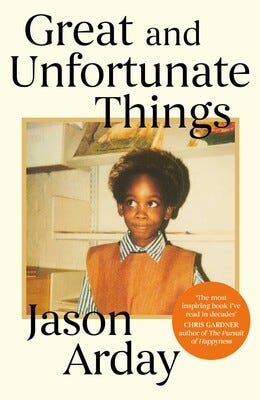
The book opens with that appointment. Arday has returned to the council house in Clapham where he grew up after two days of interviews when Cambridge telephones to offer him the Professorship in the Sociology of Education. Giff, his mother, sees his expression and asks whether he has got the job. “No, Giff,” he tells her. “We did. We did it.” It is an important correction to the story the book is about to tell. Arday may be the person receiving the chair, but he immediately distributes the achievement backwards through his life.
Giff deserves much of the credit. Doctors tell her that there is “no one in there”, that Jason will never speak, read or live independently. She refuses to let a diagnosis become a forecast. “These experts don’t have a crystal ball,” she decides. When Jason cannot understand an instruction to bite an apple, she draws pictures, demonstrates the action, reduces it to stages and repeats the exercise for months. Eventually he does it. Long before Arday encounters the academic language of disability, Giff has grasped something close to its social model: failure may tell you as much about the environment and the method as it does about the person struggling within them.
The same pattern continues through school and further education. Arday learns through snooker, football, sewing, music and television when formal education often cannot reach him. Debs helps him with phonics. Sandro finds a route into further education when Connexions has almost nothing to suggest. Other students later share notes and explain how academic writing works. At eighteen, according to the memoir, Giff tells a careers adviser that Jason still cannot read or write and had not begun speaking until nearly twelve. Cofnas has pointed to Arday obtaining GCSEs before eighteen as evidence against the late-literacy story, but the memoir says that a support assistant acted as a scribe during the exams and that his papers were mostly empty because he did not know the material. That does not prove every part of Arday’s account, but it does make the simple GCSE argument much less decisive than it first appears.
At St Mary’s he says he arrived only a little more than a year after learning to read and write, unable to keep up with lecture notes and unable initially to construct a university essay without considerable help. The achievement is striking, but so is the amount of social infrastructure holding it up. The public myth concentrated on Arday’s will. The book itself describes something closer to collective production. Somebody repeatedly gives him the time, knowledge, accommodation or confidence he needs for the next stage.
By 2021 Arday had become Professor of Sociology of Education at Glasgow. Cambridge did not manufacture an academic career out of nothing. He already had a doctorate, publications, university appointments and a professorship. What Cambridge could do was attach a different order of prestige to what already existed. When his appointment was announced in February 2023, his scholarship and biography were fused together. He was not simply a newly appointed professor but the youngest Black professor in Cambridge’s history, a man who had supposedly been non-speaking until eleven and unable to read or write until eighteen. Cambridge’s own publicity described him as an exceptional scholar whose work would contribute to addressing racial and socio-economic under-representation.
The university therefore did more than appoint him. It gave institutional authority to the story attached to him. Cambridge did not invent Arday’s childhood claims, but its name changed how they were received. A remarkable assertion repeated by an individual is one thing. The same assertion appearing in BBC profiles and then in the official publicity of the University of Cambridge begins to look like settled biography. The reasonable assumption is that somebody, somewhere, has checked.
The BBC had been helping that process along since 2020. Steven Edginton has turned its repeated appearances with Arday into a claim about a six-year “propaganda campaign”, which is much too grand. Arday was an academic working on racism and inequality and there was nothing improper about interviewing him. The problem is more ordinary. His biography became familiar programme material. Claims travelled from interview to interview, publication to publication and institution to institution. Repetition began doing the work of corroboration. Cambridge then placed perhaps the most powerful educational brand in Britain behind the whole package.

Andrew Neil@afneil
Very damaging. But a telling example of the groupthink mindset that has steadily come to dominate the BBC, not just news (tho prevalent there) but drama, documentaries, religion, comedy etc. It’s become pretty much a one-party state when it comes to liberal-left

Steven Edginton @StevenEdginton
I consumed (nearly) all of the BBC’s coverage of Jason Arday, dating back six years. What I found was extraordinary: years of uncritical interviews, repeated nonsense claims, and, once Arday was caught out, a broadcaster that chose to ignore the story, then double down on its
6:52 AM · Aug 20, 2026 · 65.2K Views
50 Replies · 213 Reposts · 1.61K Likes
This mattered because of what Cambridge still represents. Oxford and Cambridge have become much more ethnically diverse, but social class continues to shape access. Oxford’s latest figures show that roughly a third of UK students admitted in 2025 came from independent schools, while only 6.6 per cent had been eligible for free school meals. The privately educated remain dramatically over-represented. Arday arrived at Cambridge carrying almost none of the familiar markers of that world: Black, autistic, raised in a council house, with an unconventional educational history and a claim to have learned to read extraordinarily late.
That made him symbolically valuable. Elite institutions have always been capable of incorporating exceptional outsiders, and the outsider can help legitimate the institution that incorporates him. One man crossing an enormous social distance can be presented as evidence that the distance no longer matters. The concentration of money, tutoring, better-funded schools, confidence, contacts and cultural familiarity becomes easier to ignore once the university can point to somebody who arrived without them. Arday’s appointment could therefore be evidence that Cambridge had changed even while the structures surrounding Cambridge remained far less transformed.
None of this proves that he was appointed because he was Black or because of a diversity policy. That is precisely where O’Neill and Cofnas move too quickly. Cambridge’s public enthusiasm for what Arday represented does not establish what happened inside the appointments committee. Rosalind Arden writing in Quillete has made the more interesting attempt to test the academic case, comparing Arday with recent professors appointed in related fields and arguing that his publication, grant and book record looked unusually thin for the rank. Her comparison needs more information before it can carry the conclusion she places on it, but it leaves Cambridge with a fair question. When its pro-vice-chancellor called Arday an “exceptional scholar”, what exactly was exceptional about the scholarship?
Perhaps there is a convincing answer. Appointments are not made by counting publications on a spreadsheet, and academic merit has never been a single measurable quantity. Fields differ, departments have particular needs, interviews matter and a candidate may offer intellectual qualities that raw publication totals miss. The independent inquiry should tell us far more. What Cambridge cannot do is rely on the symbolism of the appointment to answer a question about its academic basis.
Questions about Arday’s published work were already reaching Cambridge within months of the appointment. In May 2023, Dave Harris contacted him about similarities between one of his papers and earlier research. Martyn Hammersley subsequently raised concerns with senior figures at Cambridge. Cambridge did not simply ignore them: Hilary Cremin met Arday and the faculty’s director of research, and the paper was temporarily removed for revision. Yet the faculty continued to express full support, while Cambridge’s integrity office took the position that because the research had been produced before Arday arrived, formal investigation properly belonged elsewhere.
There is an obvious difficulty with that response. The pre-Cambridge scholarship was relevant when the university decided that Arday merited a Cambridge chair. Once questions were raised about the integrity of that scholarship, its age suddenly made it somebody else’s responsibility. The problem is less a dramatic cover-up than a system in which responsibility became fragmented. Journals looked at particular papers. Previous universities were responsible for work conducted under their names. Cambridge dealt with the person it had appointed. Nobody appears to have taken responsibility for asking whether the whole record still justified the confidence that Cambridge had publicly placed in it.
By 2025 Times Higher Education had investigated allegations concerning Arday’s thesis and publications, but its article did not appear after lawyers acting for Arday intervened. Cofnas came later. That chronology matters because the academic-integrity questions did not originate with his politics, even though his intervention transformed their meaning. He published evidence that deserves to be examined rather than dismissed because of who found it. Where unattributed copying occurred, it is unattributed copying.
Cofnas then asks the evidence to do far more than that. Weak or disputed scholarship becomes proof that Arday was a DEI appointment. Qualitative research without statistics is dismissed as hardly scholarship at all. Cambridge’s desire to improve representation becomes the explanation for the appointment. By the end, plagiarism has been made to prove something about racial differences, Black academics and the corruption of universities. The investigation turns into an ideology.

Nathan Cofnas@nathancofnas
DEI Fraud and Cover-Up: ncofnas.com/p/dei-fraud-an… It’s an open secret at Cambridge University, but everyone is afraid to speak out. Newspapers backed away after getting hit with legal threats. Here, I tell the true story of Jason Arday—DEI superstar and the youngest black
ncofnas.com
DEI Fraud and Cover-Up at Cambridge

12:21 PM · Jul 21, 2026 · 1.06M Views
839 Replies · 1.02K Reposts · 5.85K Likes
The attempt to make Cofnas the pure meritocratic opposite of Arday has also started to fray. Academics at Ghent had raised their own questions about the process by which Cofnas obtained a postdoctoral position there, arguing that his expertise did not obviously match several areas central to the post. That does not make Cofnas a fraud and should not be used as revenge for his scrutiny of Arday. It makes a simpler point. If Arday’s appointment can be examined against the requirements of his job, Cofnas’s can too. Standards become meaningful only when they are applied to people we agree with as well as people we dislike.

Benjamin Ryan@benryanwriter
Ghent University, where Nathan Cofnas, who broke the story about Nathan Arday's alleged plagiarism and fabulism last month and who believes that race is associated with IQ, is a post-doctoral researcher, announces it has "decided to take appropriate action within its powers and

1:25 AM · Aug 20, 2026 · 22.9K Views
40 Replies · 16 Reposts · 81 Likes
J.K. Rowling, unexpectedly, expressed the useful principle in a few words: more than one thing can be true. Cofnas can hold racial views that deserve criticism while producing evidence about Arday that requires an answer. Arday can have experienced racism while also being responsible for deficiencies in his scholarship. Cambridge can sincerely want to broaden access while having questions to answer about one appointment. The BBC can have interviewed Arday for perfectly defensible reasons while treating parts of his biography too credulously. There is no reason to buy an entire political worldview as the price of accepting one fact.
The memoir becomes most revealing when Arday’s own faith in relentless effort begins to fail him. His story of running thirty marathons in thirty-five days captures the ethic perfectly. On day twenty-one, he says, he suffered a seizure, discovered he had a hairline fracture in his fibula and ignored medical advice to stop. There is contemporaneous evidence that the fundraising challenge existed, although individual details remain open to scrutiny. What matters within the memoir is why he tells it. Pain is something to pass through. Stopping means giving up. Rocky becomes a philosophy.
Years later that same philosophy acquires another meaning. During the pandemic Arday describes autistic burnout so severe that he struggles to speak, hides behind a switched-off camera during university meetings and conceals his condition from colleagues and family. He recognises that he has spent “decades pushing myself and refusing to give in” while rarely allowing himself to rest or acknowledge distress. The quality celebrated throughout the inspirational story is also presented as something capable of doing enormous damage.
Nothing in those pages allows us to explain his death. Arday died on 14 August, nine days after resigning from Cambridge. Police said the death was unexpected but was not being treated as suspicious. His family has spoken about the effect of the recent allegations and abuse, but the circumstances should not be forced into another morality tale before the proper processes have concluded.
That restraint has been conspicuously absent in some of the commentary. Benjamin has declared even Arday’s death a product of “woke”. Saad has assigned responsibility to Arday and the progressive academics who supposedly enabled him. Andy Ngo has folded his death into a sneering post about disappointing memoir sales. On the other side, there is a risk that unresolved questions about Arday’s conduct are flattened into a story in which scrutiny itself becomes racist persecution. Both moves repeat the same mistake. One complicated human being becomes useful only once he can be turned into a symbol.
Great and Unfortunate Things makes that transformation harder to accept because Arday keeps returning to the people who made his life possible. The book thanks Giff, Debs, Sandro, friends, teachers, colleagues and those who accommodated his disabilities. Even the memoir itself was collaborative: he thanks a fact-checker and describes spending hundreds of hours working with another writer to turn his academic voice into a personal one. The solitary hero at the centre of the publicity was always surrounded by other people.
Near the beginning of the book, Arday says that Cambridge was merely the “cherry”. For Giff, it was never the cake. “The cake was all in the moments that came before.” The line now reads almost as a warning against what happened next. Cambridge became the thing that made the rest of the story legible to the world. The BBC repeated it. Publishers sold it. Liberal institutions could point to it as evidence that barriers were falling. Arday himself clearly participated in the making of that public identity.
His critics are now performing the same operation. The remarkable childhood becomes fabrication. The academic rise becomes DEI. Cambridge becomes proof of collapsing standards. The whole complicated life is reorganised around a different destination.
Who created Jason Arday is therefore the wrong question if it demands one culprit. Arday helped create the public version of himself, but institutions gave that version authority and extracted value from it. Cambridge in particular has to explain what it believed it was appointing, why it considered him exceptional and why early questions about the scholarship underlying that judgement were allowed to remain fragmented between other institutions and journals.
The liberal success story and the anti-DEI morality tale appear to be enemies. They depend on the same thing: Jason Arday must become evidence. His own memoir, for all its unanswered questions, keeps telling us that a life is messier than that.
RIP Jason Arday.
Thanks for reading Anti-Capitalist Musings. It is a small operation, and I hope it offers something worth your time. There will be no premium subscriber content here: everything published will remain free to read. If you value these pieces and want to support the writing, buying me a coffee helps fund media subscriptions and the books that keep the analysis grounded. Every contribution, however modest, is genuinely appreciated.
Comments
Nothing yet. Say the first thing.
Sign in to join the conversation.