
Welcome! I’m Simon Owens and this is my media industry newsletter. If you’ve received it, then you either subscribed or someone forwarded it to you.
If you fit into the latter camp and want to subscribe, then you can click on this handy little button:
Let’s jump into it…
Puck’s Julia Alexander gave a theory as to why YouTube signed a deal with Peacock that would make the latter company’s content available to YouTube Premium subscribers:
The short answer is that YouTube wants to be taken seriously as a premier destination for blue chip advertisers. As recently as 2017, an investigation into ads running next to extremist and disturbing content on the platform sparked the so-called “adpocalypse”—a boycott that resulted in hundreds of advertisers fleeing. Amid a looming A.I. content deluge, nobody at the company wants to return to those dark ages …
Indeed, YouTube’s near future will be defined, in part, by how effectively it manages the exponential increase in A.I. slop and spam. (Already, seemingly every other ad on YouTube appears to have been created entirely with A.I.) Fortifying the platform with premium content, as well as incentivizing its top creators to produce longer-form videos via algorithmic changes, is one way to counter a tidal wave of horny fruit soap operas.
I actually don’t really agree with this take. YouTube has done a tremendous job over the last year or so of changing the narrative so it’s now thought of as a TV-forward platform that’s beating out every other entertainment company for TV watch time. Brands have caught on to this narrative, and recent data shows that advertisers are moving YouTube from their “digital” budgets into their TV budgets, which tend to be much larger.
I think the real opportunity here is for YouTube to grow its Premium subscription base. Before, it had to rely entirely on simply annoying users into Premium subscriptions by inundating them with ads. Now it’ll have a real library of must-watch programming, including live sports. That improves the YouTube Premium value proposition considerably.
While we don’t know the terms of the deal, my guess is that YouTube will share revenue with Peacock only when its subscribers actually watch Peacock content, which means there’s a tremendous opportunity to first capture subscribers with the allure of NFL games and then push those subscribers into YouTube’s much wider ecosystem which, lo and behold, includes a lot of NFL-adjacent videos and podcasts. It might even help YouTube bring in older demographics who don’t typically seek out YouTuber content.
With any luck, a year from now you’ll no longer have to explain to your Boomer parents who MrBeast or iShowSpeed are.
(BTW, I used a gift link so you can access that Puck article for free.)
Founder Pat Walls discussed how he automated his process so that the site now operates as a sort of flywheel.
From the WSJ:
Forty-one percent of long-form posts and 30% of all comments posted publicly on LinkedIn from April to June were entirely AI-generated, according to an analysis of nearly 57,000 items from AI detection startup Pangram Labs.
Another AI-detection startup, Originality.ai, examined 5,000 public LinkedIn posts in July for signs they used AI more than a “moderate” amount. It concluded that 81% likely met that threshold. Just under half of 5,500 public Reddit posts examined from July fell into the same category.
Of all the social platforms, LinkedIn is inundated with the highest volume of AI slop. I can’t tell you how many times I’ve encountered it in my comments section and then clicked over to the user’s profile to see they’re commenting on multiple posts a minute with similar drivel. And the thing is, it’s LinkedIn’s own fault, since the platform itself constantly prompted users with the option to write something with AI. It basically trained its own users that slop was not only acceptable, but wanted.
(I used a gift link so you can access that article for free.)
This is a reminder that I’m extremely active in my Substack chat, which anyone can access. Not only am I curating media industry news there, but I’m also very responsive to user comments. Come chat with me and other media operators!
The WSJ published a great profile of Whitney Frick, the editor who’s shepherded a number of female-authored memoirs onto bestseller lists. “Frick gravitates toward books about people ‘who thought their life was going to follow a certain script, and then something shifts and the script changes.’” [WSJ] (I used a gift link so you can access that article for free.)
When Ellen Hyslop and her co-founders launched The Gist in 2017, none of them had worked in media or the sports industry. They were young professionals in financial services who had grown frustrated with a sports media ecosystem that largely catered to men while overlooking millions of potential female fans. What began as a side project built during evenings and Sundays has since grown into a sports media brand with more than 1 million newsletter subscribers, hundreds of thousands of social followers, a podcast, paid community, proprietary games, and partnerships with major advertisers.
In a recent interview, Hyslop explained how scrappy marketing helped attract The Gist’s first subscribers, why social media became an important source of revenue, and how the company is expanding into a paid community and launching its own games.
Check out the interview on YouTube.
If you want to listen to an audio version, subscribe to the Business of Content wherever you get your podcasts: [Apple] [Spotify]
Here’s what I have on deck for paid subscribers:
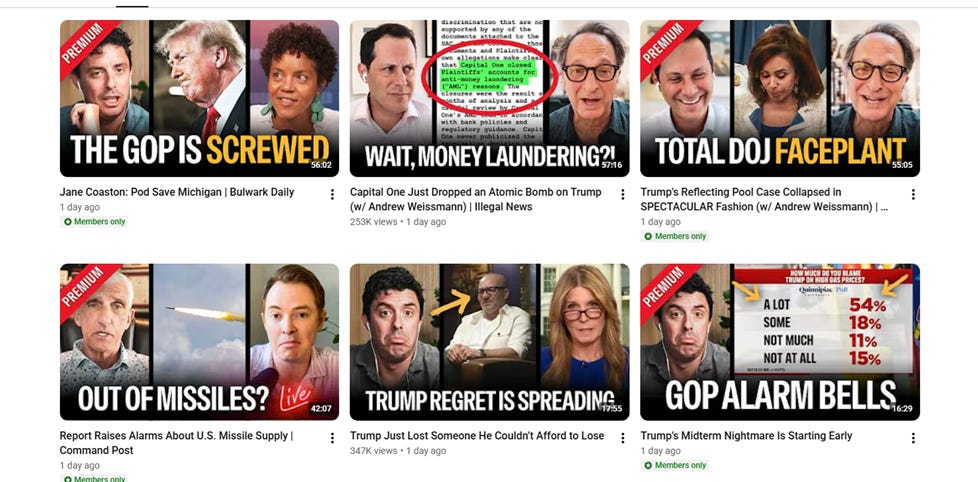
The Bulwark converted its YouTube success into paid subscribers
When you accidentally become an influencer
Fox zigged on its streaming strategy when all its competitors zagged
Let’s jump into it…
Comments
Nothing yet. Say the first thing.
Sign in to join the conversation.