
A few years ago I decided to publish my 2020 serial No Adults Allowed as a paperback and ebook. As with all my major projects, I’d written it in Scrivener.
While I love Scrivener as a writing tool, it doesn’t really work for me as a design tool. Exporting a pretty book is harder than it should be! I turned to Reedsy Studio, and had a good time using it to produce the paperback. Quick and easy, free to use, with decent end results.
Fast forward to 2026 and I’m again looking at book production, this time for Tales from the Triverse. As such, I’m evaluating a bunch of tools and services. Coincidentally, Reedsy also got in touch to ask if I wanted to check out the premium features of the paid version.1 So here we are.
Pricing
A lot of Reedsy Studio is free to use. I produced the No Adults Allowed paperback without needing to subscribe to anything.
Here’s what you need to know about cost:
Everything: £124.99 per year
Craft pack only: £4.99 per month
unlimited history
advanced stats
custom goals
daily check-ins
dark mode
Outline pack only: £7.99 per month
unlimited boards
unlimited notes with attributes
pinned notes
list view
dark mode
First thing to say is that the pricing of Reedsy Studio has always confused me. The vast majority of the features are provided for free (hence me being able to produce the No Adults Allowed paperback and ebook for free), with the premium subscriptions offering what strikes me as a somewhat arbitrary selection of features.
Some of these features are niche and quirky, such a ‘custom goals’ and ‘daily check-ins’. Paying for the privilege of some extra pressure and annoying reminders? Then there are other features which seem quite essential: unlimited history, list view, dark mode. I mean, having to pay for dark mode? That’s a bizarre thing to paygate.
It’s an odd assortment, ranging from superfluous (daily check-ins) to very powerful (unlimited boards). The value of each feature is unclear and will vary from writer to writer. Scrivener users will want the unlimited boards and notes, though Reedsy Studio is unlikely to pull a Scrivener user away from their beloved software. Custom goals and check-ins might be useful productivity and motivation assists, but can be easily replicated using a notebook and any word processor with a word count.
Bear in mind that Reedsy Studio is a subscription service. That’s £124.99 per year, every year. If you just go for the craft pack, at £4.99 per month you’re talking £60 per year. Assuming that you’re planning on writing for more than one year of your life, this is going to add up over time. I’ve been writing professionally and semi-professionally for about a decade, which means I’d have spent £1,249 on Reedsy Studio if I ‘d been using it throughout.
Compare that to Scrivener, which is a one-time £55 purchase. I think I had to pay to upgrade a few years back, which was about £24. In terms of lifetime costs, those are pretty low.
Which brings me to my next point.
Reedsy Studio is cloud-based and works entirely in a browser window. This comes with all the usual pros and cons: you can login to your account from any browser anywhere with an internet connection and continue writing. But if you don’t have an internet connection, or if Reedsy Studio is having server issues, you won’t be able to access your projects at all.
We’re all used to the vagaries of cloud software in 2026, so you’ll know whether you’re up for it or not. I use Google Docs quite happily for general writing (anything which isn’t my fiction). I use Substack to publish this newsletter, which is entirely cloud-based.
I have no inherent problem with cloud tech, is what I’m saying. But I do pause when I’m talking about critical infrastructure, and for an author your choice of word processor is precisely that.
If I lost internet for some reason, even if I was just travelling on a train with terrible wifi (which in the UK means being on any train), I could keep writing in Scrivener without any issues. If the developers Literature & Latte disappeared tomorrow, I could continue using the software that I have installed on my computers. All of my projects are stored locally (and backed up to the cloud), and could be recovered even if Scrivener itself stopped working.2
If Reedsy disappears, or decides to ‘sunset’ Studio, that would be a big problem. All my Reedsy Studio projects are within my Reedsy Studio account, and this feels like an unacceptable point of weakness. The risk is too high.
This would matter less if I could export my projects in a useful manner, but the export options only include the primary manuscript. All of the accompanying notes are trapped inside Reedsy Studio, as far as I could tell, and would need to be manually copied and pasted to extract them.
As I mentioned at the top, I used Reedsy Studio back in 2021 to create the paperback of No Adults Allowed. It’s such a fast and easy-to-use tool that it made perfect sense for that. Crucially, my master project file remained with Scrivener on my local machine. Reedsy Studio was a design assist and it wouldn’t have been catastrophic if something bad had happened to the designed version.
I’m possibly getting ahead of myself here. Reedsy Studio’s premium features didn’t thrill me, but the core offering is pretty good. So:
At its core, Reedsy Studio is a simple word processor that is designed primarily to make it easy to export projects to ebook and print interior formats. In a couple of clicks you can export and have a PDF or epub file ready to distribute or plug into a print-on-demand service.
This is what I used for No Adults Allowed. I’d originally written the story in Scrivener, but needed a way to turn it into an ebook and paperback. Step 1 was to transfer it into Reedsy’s editor:
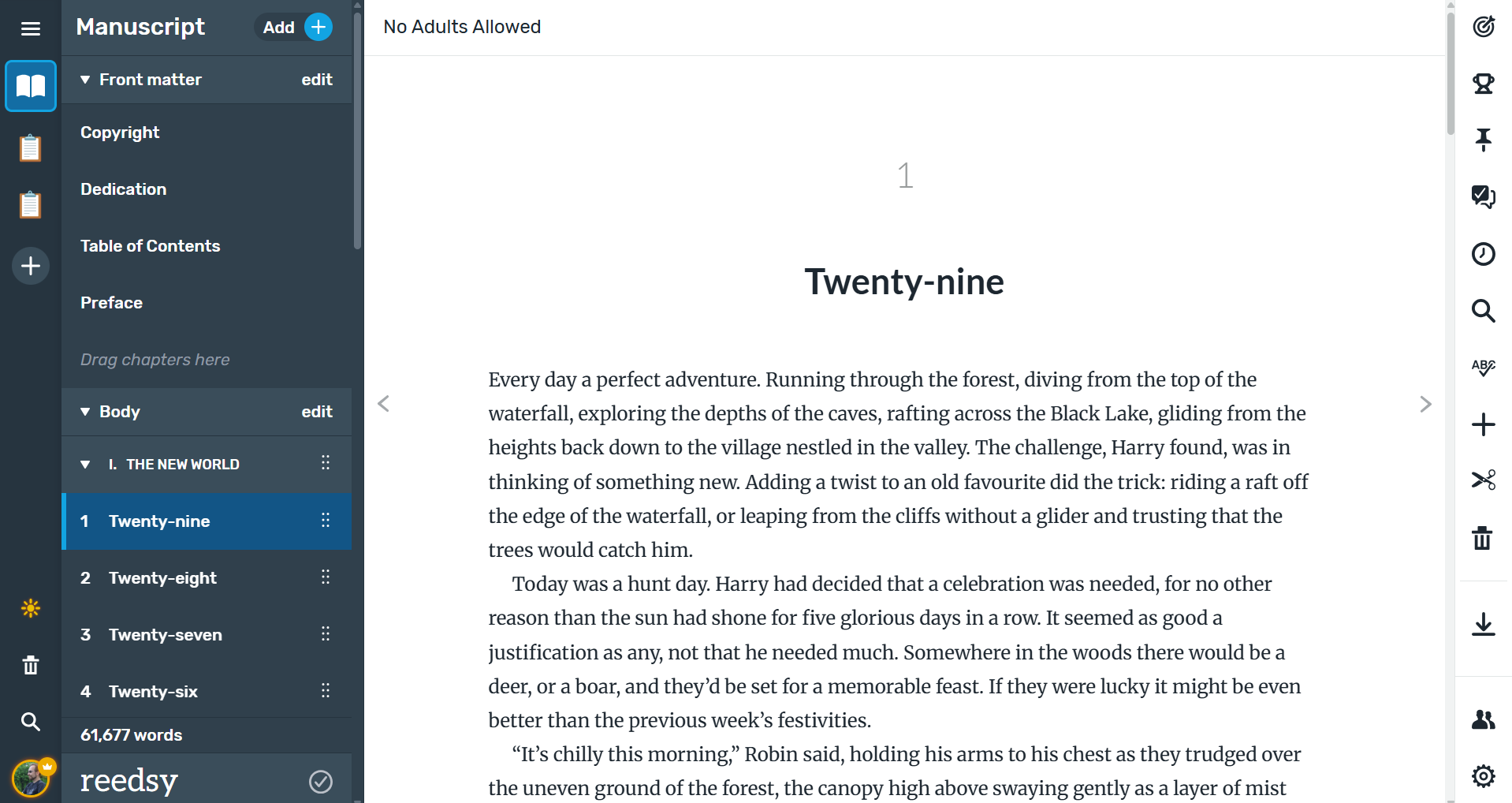
This was a relatively simple copy-and-paste job. Reedsy makes it easy to split chapters and insert scene breaks, and the chapter listing on the left of the screen feels close enough to Scrivener’s binder to avoid confusion.3
Exporting is extremely simple and finds a sweet spot in terms of producing a professional output without needing you to be an expert.
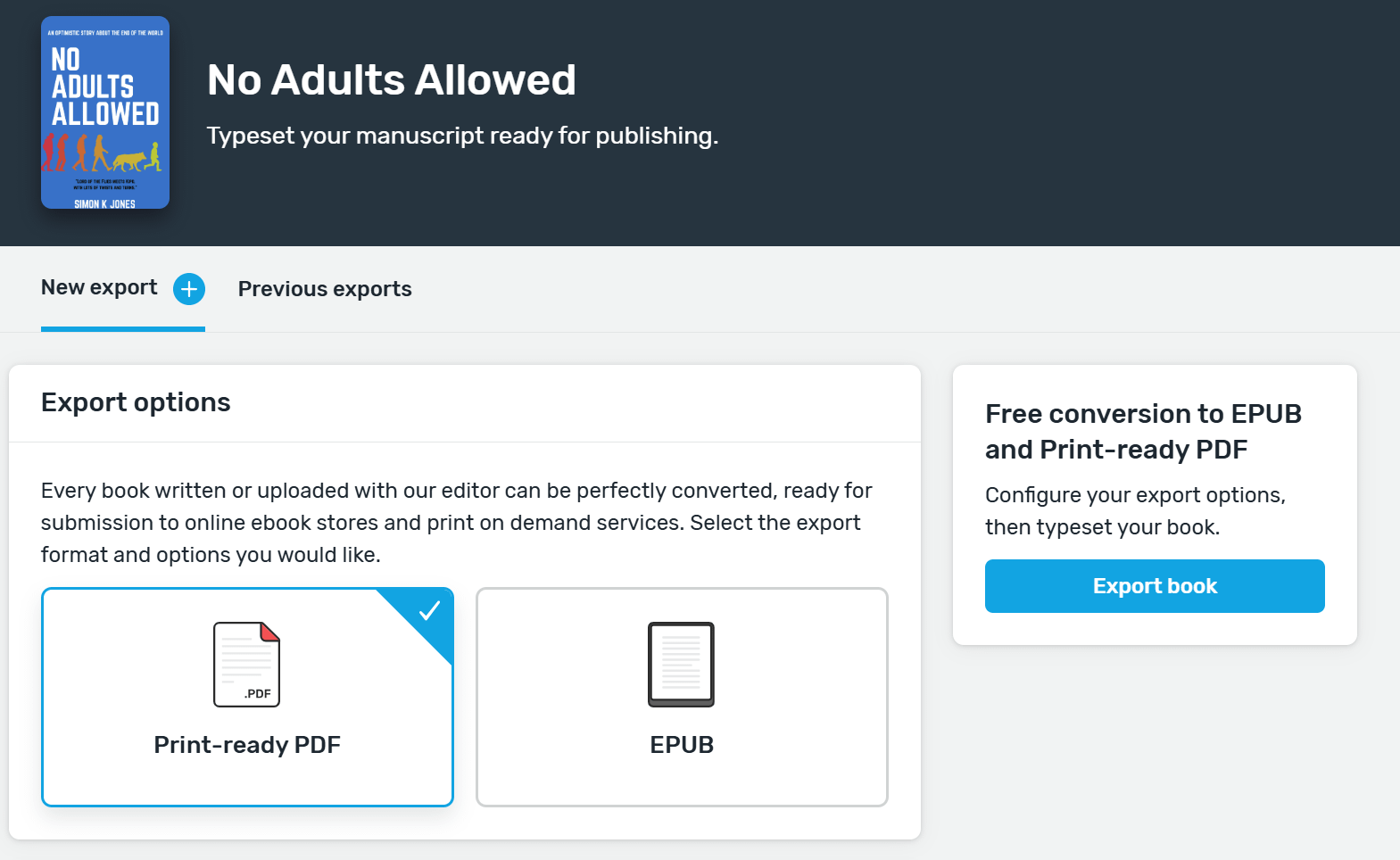
You get some formatting choices but it’s basic in the extreme:
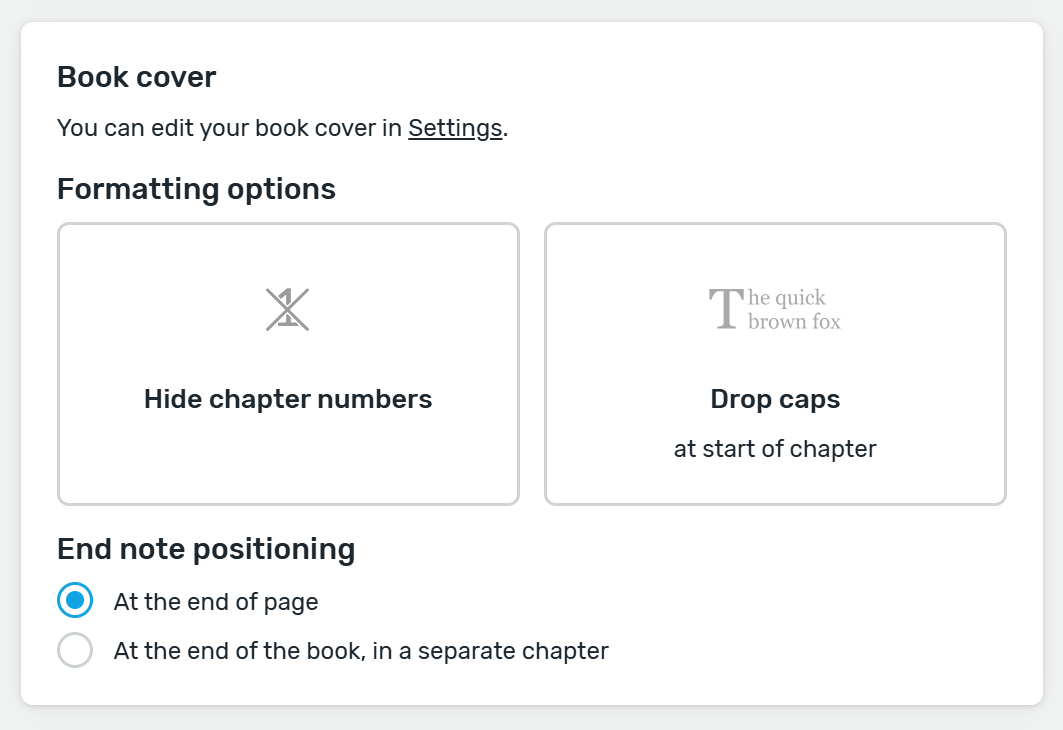
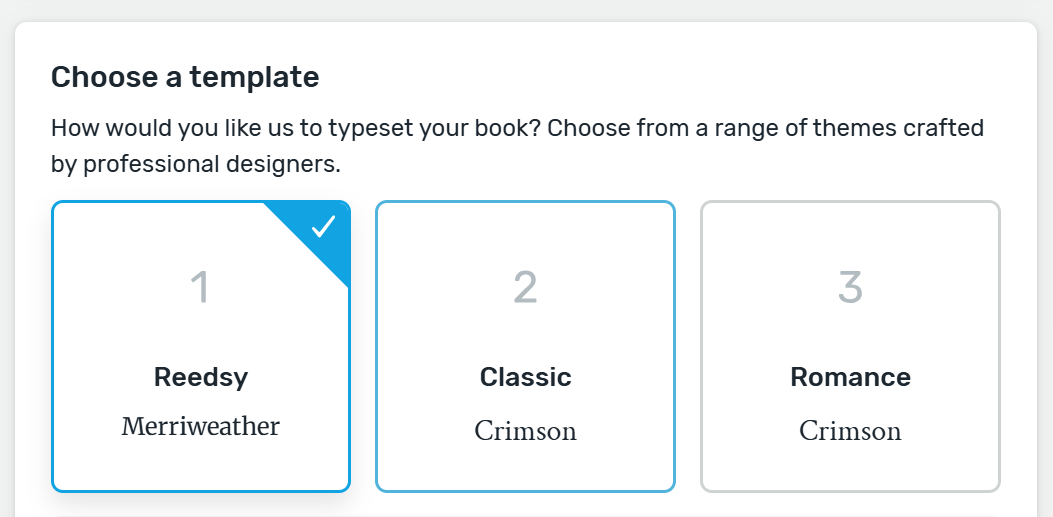
Those three templates are all you get and you can’t customise them beyond the presets. That said, the presets are good and produce high quality results. Crucially, the output looks like a book. I was very happy with the print version of No Adults Allowed.
There’s no pretending that you’re the designer, though. Reedsy Studio is designed to be fast, simple and easy, and it succeeds in that aim. If you want to learn typesetting and interior layout, you’re going to need to look elsewhere.
That was my use case for Reedsy Studio: port over my book, export it to publishable formats. Job done! But there’s a whole bunch of extra functionality for anyone who wants to dive a little deeper.
The other key element of Reedsy Studio is the ability to add additional ‘boards’. These sit separately from your manuscript and are where you can store research, character notes, plot outlines, world building and so on. Similar to additional folders in Scrivener.
While you can create blank boards and use them however you want, Reedsy Studio’s big draw is the sheer number of pre-built templates. They go extremely deep:
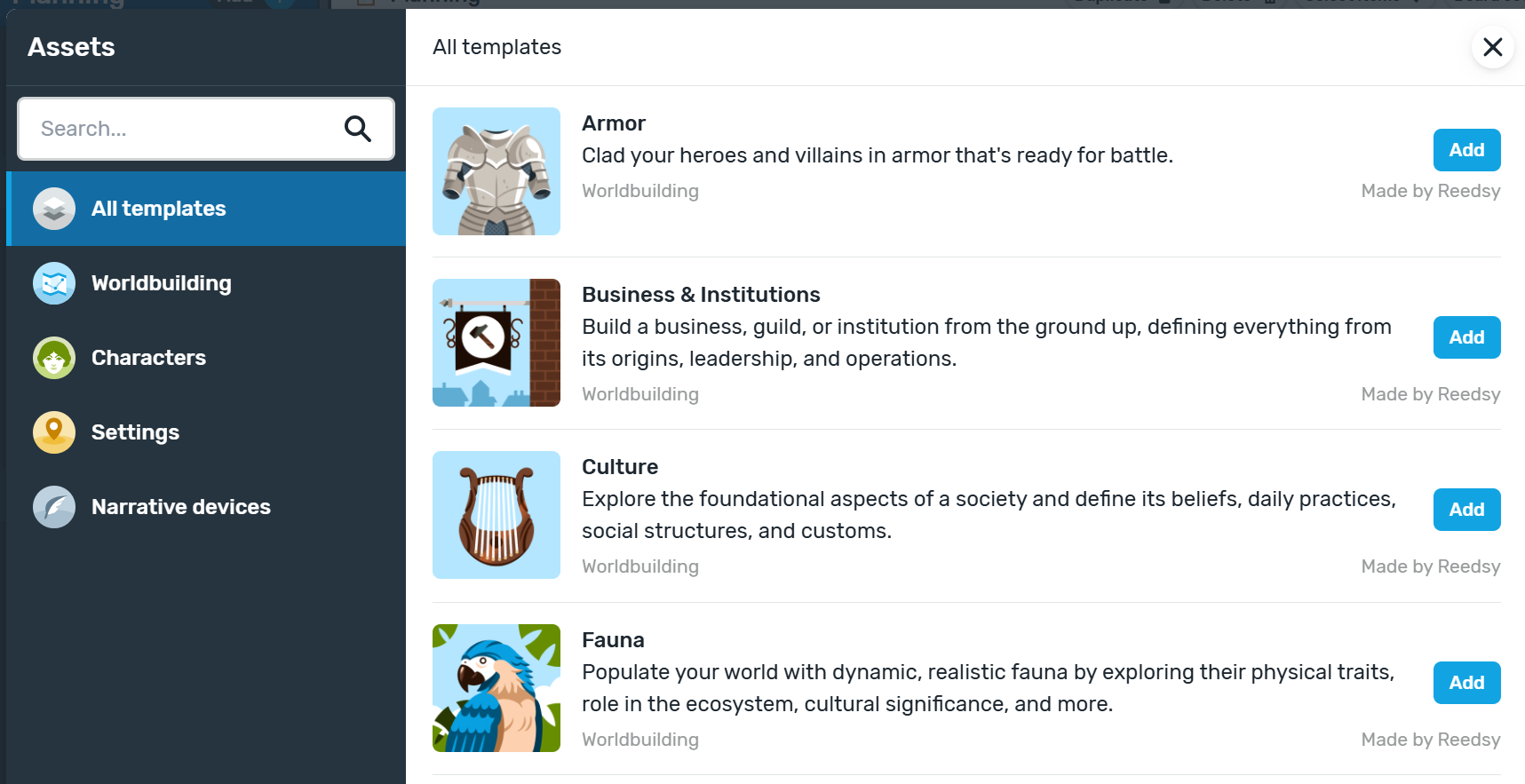
Yes, that’s an entire template for ‘Armour’4.
If I add that template to my board, I get a pre-built form of sorts with lots of prompts:
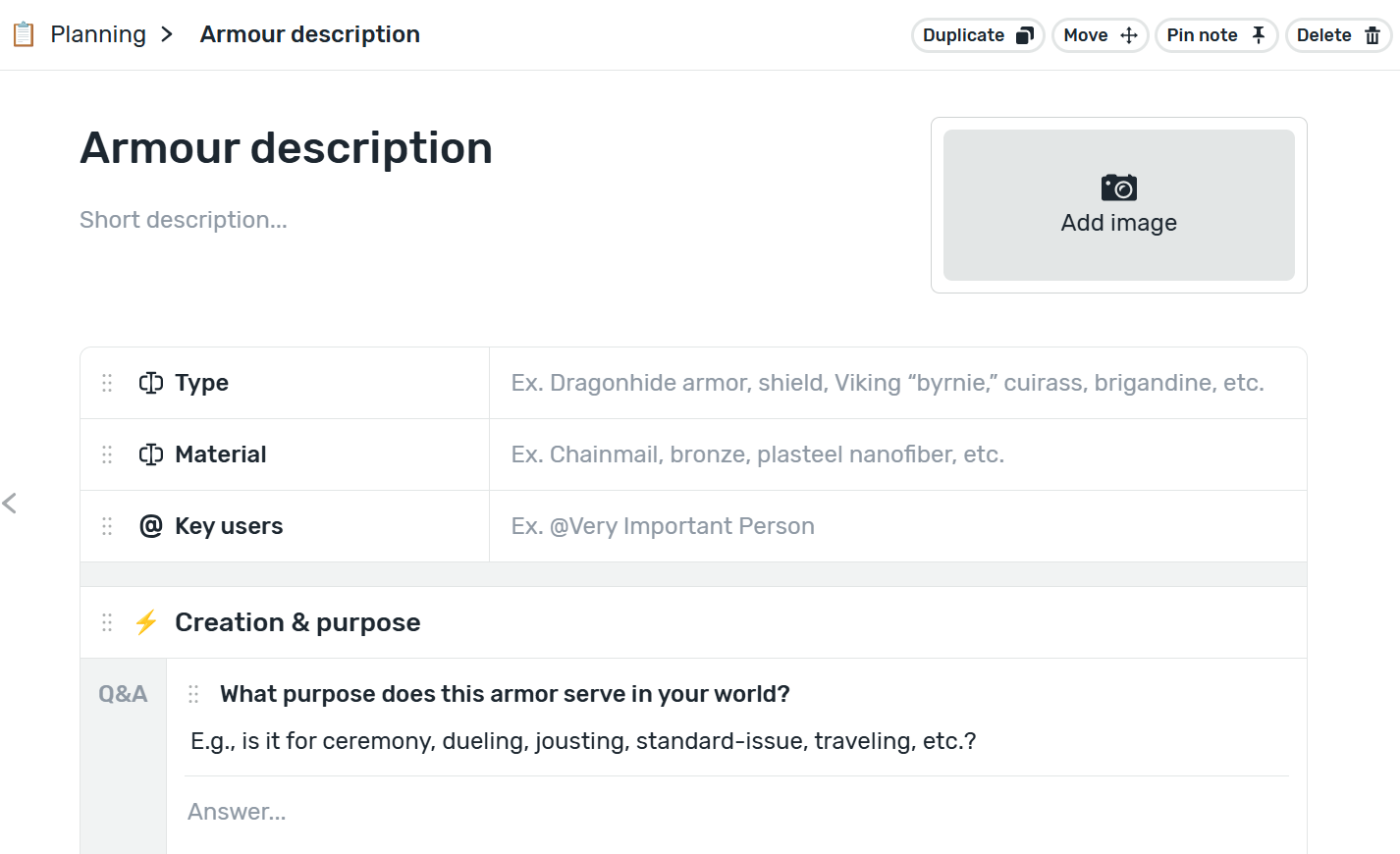
It keeps going:
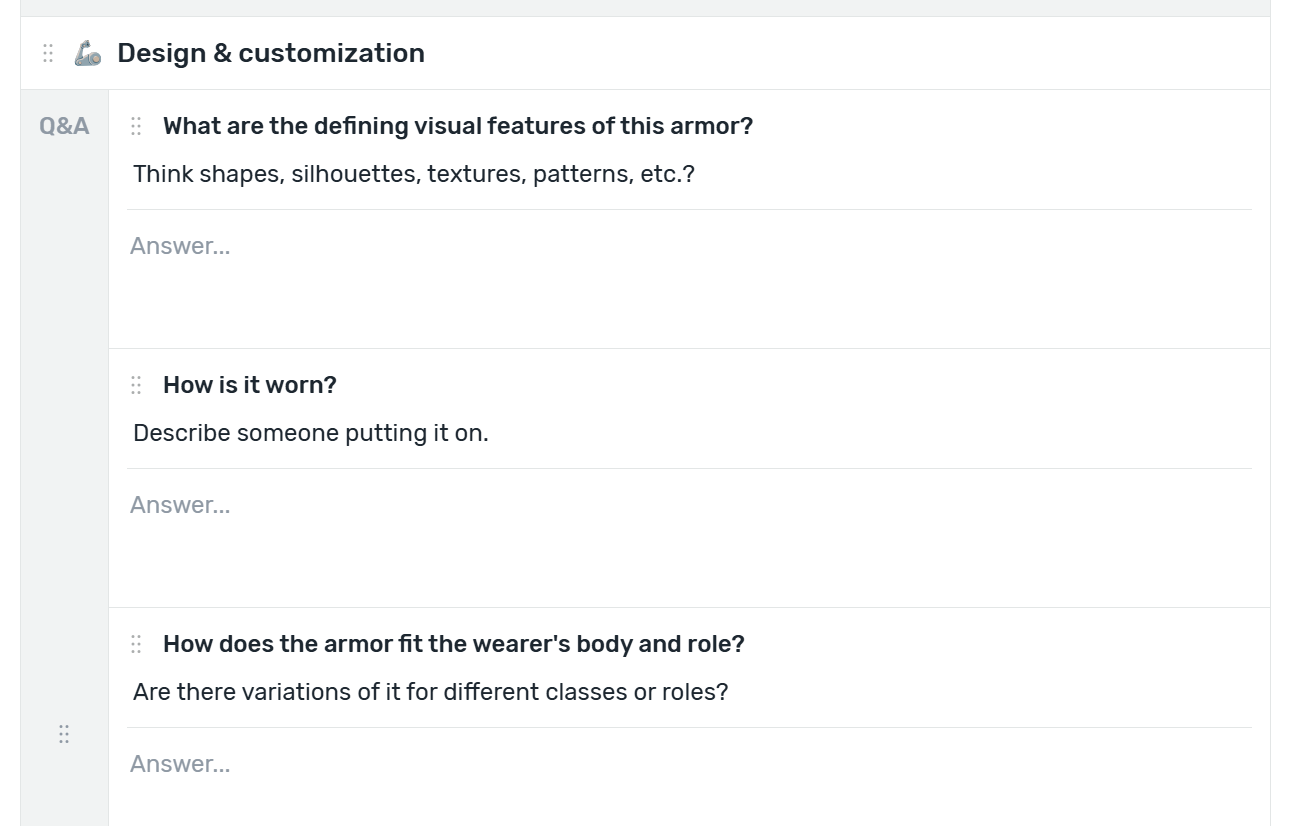
And going:
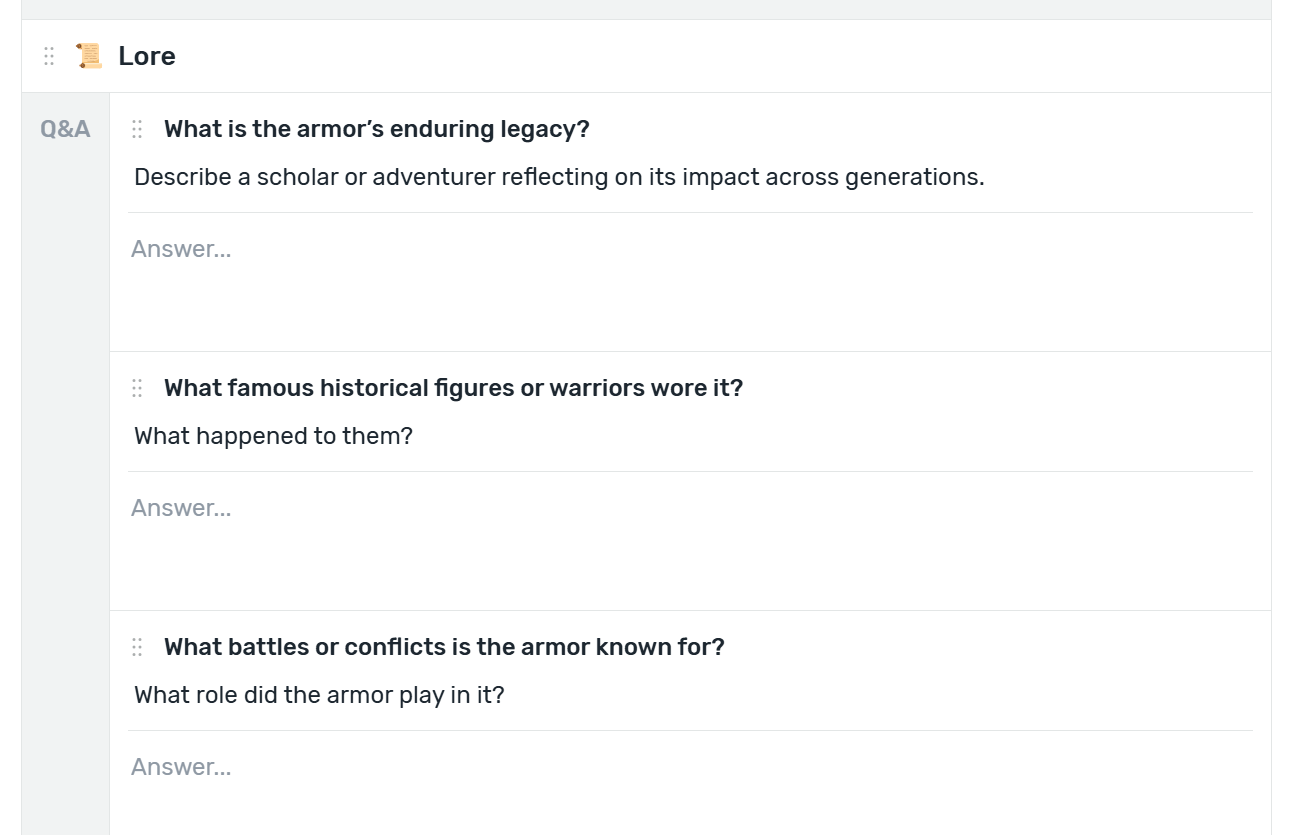
You get the idea.
There are templates like this for everything, from items to characters to places to plot structure. What you think of that will depend entirely on your preferred way of working. It’s the sort of thing I’d have loved in my teens and possibly early-20s, when I was more interested in MAXIMUM LORE, and spent more time planning and world building than writing the actual story. There is a slight risk of such a templated approach pushing writers all down the same narrow tunnel.
Even if you’re well into lore details, I do question the design of some of these templates. The level of detail is extreme: the food template has forty questions/prompts. Sure, it’s up to the writer how much detail they add and nobody is going to be marking your homework, but I can’t help but worry that all this scaffolding is a way of avoiding writing the manuscript itself.
If you’re on the paid plan there are nifty features like switching between grid and list views, and specific notes can be pinned for easy reference while writing. I’ve used similar features in Scrivener many times, so can absolutely see the value here.
The deal-breaker here for me is that, as mentioned earlier, there doesn’t seem to be a way to export boards. Any effort you put into filling out these world building templates is going to be locked inside your Reedsy Studio account. That would actively discourage me from engaging with any of these extra features in the first place.
In specific scenarios, Reedsy Studio provides a useful featureset. When I wanted to quickly spin up the print and ebook versions of No Adults Allowed, Reedsy Studio was an incredibly easy and surprisingly effective solution.
If you’re not already invested in other writing software, Reedsy’s editor is very easy to use and delivers a pleasant writing experience. Features such as goals, challenges and the template boards may be of interest depending on your writing style. I do question the overall value of the subscription fees, compared to more powerful pay-once alternatives such as Scrivener.
There is an entire other side to Reedsy, which is its marketplace. This is where you can go to find editors, cover designers and other professionals to hire. Don’t expect anything to be cheap here, but I have heard of people being pleased with their overall experience.
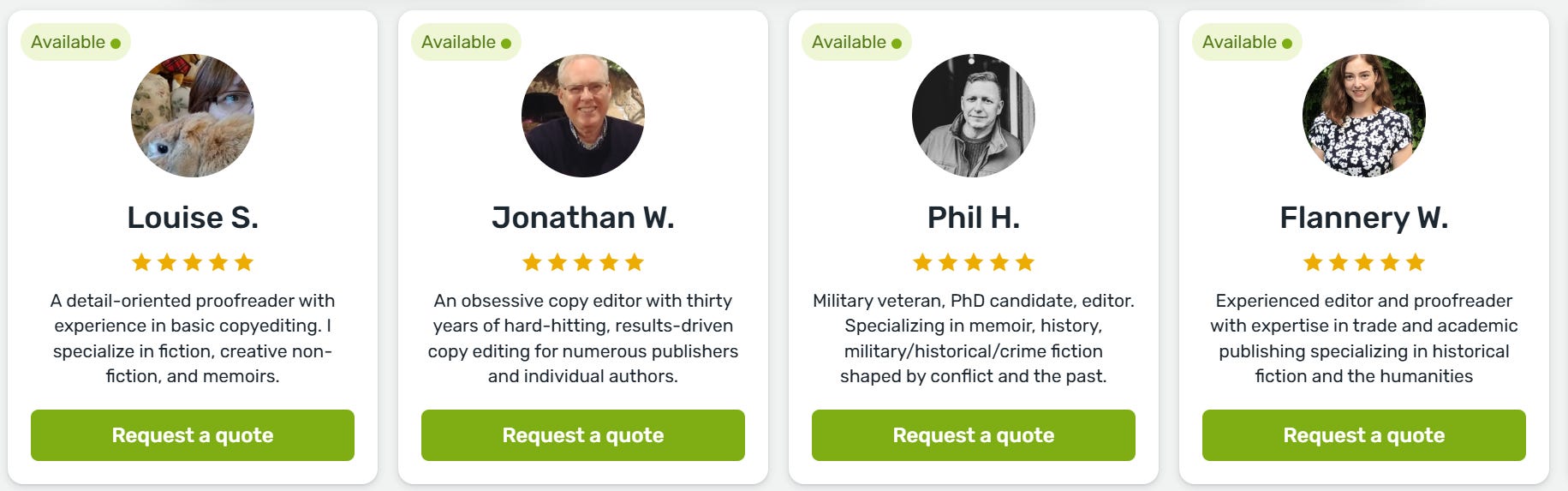
Ultimately, I do wonder whether Reedsy Studio exists solely as a marketing magnet to bring writers into the wider Reedsy ecosystem. This would explain the somewhat lacklustre and confusing paid features of the editor: what they really want is for you to engage with the entire Reedsy offering.
I’m not implying there is anything nefarious going on with that strategy: it’s just something to bear in mind. It can absolutely work out, clearly, if you’ve got the money:
That said, it does seem that their process for accepting freelancers into the system is somewhat opaque:
Lloyd is an interesting example of someone who had a great experience using Reedsy’s marketplace system, but would now go about it a different way:
Lloyd’s point is fascinating, in that it speaks to a shift in how writers can now network and find other professionals with whom to collaborate. Rather than go through a formal marketplace and pay the associated fees, Lloyd could simply…ask around.
That’s been my experience as well. I’m currently gearing up for the launch of my next big fiction serial, The Mechanical Crown, and I’m working with a couple of amazing illustrators. Before Substack I would likely have investigated Reedsy’s marketplace and spent ages trawling through Google searches and online portfolios. Instead, I already had some people in mind, and also put out a call on Substack Notes. It’s good, old-fashioned networking and recommendations in action, without the corporate intermediary.
To bring it back to the focus of this article: Reedsy Studio provides a bunch of fast and easy features, especially it’s free version. I’m unconvinced by the paid offerings, but how much value you see in those features will depend on your writing preferences.
If you do fancy signing up to Reedsy, doing so via this link helps this newsletter out.5
I hope that was useful! I haven’t done such detailed reviews of specific software/services previously, but was prompted to do so by an increasing number of these things popping up in my inbox. I’ll be looking at more writer tools in the coming weeks, including a brand new product that’s currently in beta but has me quietly excited.
On the side, away from Write More, I also have a little newsletter for writing about movies, books, games that I’ve enjoyed. Latest being a look at the beautiful game Gris. It’s worth looking at the post for the screenshots if nothing else:
Over the weekend I enjoyed reading this:
It’s another good example from Mike of AI (and some AI users) rather missing the point when it comes to being creative.
Also, this article absolutely hits the nail on the head:
Max’s piece is a far more succinct and coherent examination of the issues I was poking at late last year here:
Elsewhere, I quietly slipped this one out onto the Write More front page:
I finished serialising Tales from the Triverse in January and somehow here we are in July. Where has half the year gone? Sure I’ve put out a couple of short stories in that time, but still. Ridiculous.
Anyway — I’ve been busy, preparing the next big project. The Mechanical Crown kicks off 7 August and I can’t wait to introduce you to Tranton, Tarn and Kirya. I’m calling this the Reforged edition, so even if you’ve encountered the story elsewhere in the past you’re going to get something fresh. :)
Thanks, as ever.
Apparently this is a thing that starts happening when you tip over a certain number of subscribers. Which is cool, but also raises a bunch of ethical conundrums, like: how can I accurately assess something if I haven’t paid for it with my own money? I’m still figuring some of that out.
This would be a massive pain in the arse, but it’s not impossible.
This method has an obvious drawback: with Scrivener remaining the master project file, any changes I made had to be mirrored across the Reedsy and Scrivener versions. Not difficult, but enough of a pain to be annoying. This is more to do with my workflow than a criticism of either system, though — if I had fully committed to Reedsy’s editor, I wouldn’t have needed the duplication.
Aluminum. Aluminium. Etc.
I’m deeply suspicious of the corrosive influence of affiliate links, which is what that is. I think the review here speaks for itself, and can’t really imagine many people signing up for a paid Reedsy Studio plan off the back of it, but still: the question remains that if I gave something a really positive review and was using an affiliate link, how on earth would you be able to trust the review? I guess we’ll have to figure that one out if it ever comes up.
Comments
Nothing yet. Say the first thing.
Sign in to join the conversation.