
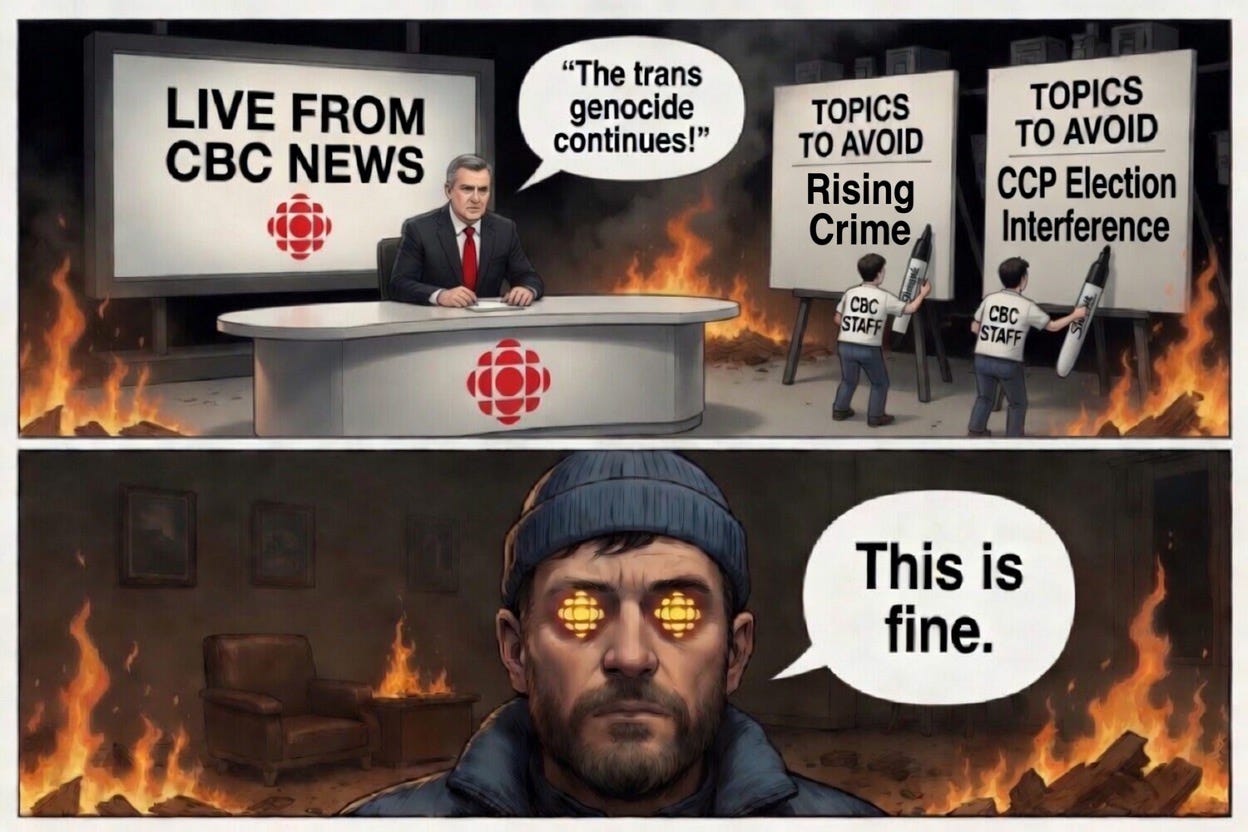
There has always been a lot of debate in Canadian politics about the role played by the CBC.
For as far back as I can remember, there have been campaigns about “Saving the CBC,”— hysterics about “dangerous funding cuts” to the heroic public broadcaster.
As a youth, I remember thinking that this must have been one particular debate, a snapshot in our history where there was a struggle for the CBC, but as I reflect, this campaign never ended. As a 42-year-old man, I realize that this is a perpetual campaign.
“Save the CBC” is a drone note in our history. It’s a campaign that has never ceased, triggered by both Liberal and Conservative funding cuts throughout history. Dissent against the CBC, and their response to dissent: “We need more money,” isn’t new to Canadian politics.
What has changed, however, is technology and the power it gives the media to influence human cognition.
Technology has amplified the media’s ability to influence what we consume and what we don’t. In turn, this manages how we perceive reality and the choices we make based on that perception. In other words, technology has created centralized access to human cognition.
This is why the CBC’s bias has never been more of a threat to Canadians. In the past, their grip on public consciousness was limited to what technology availed them to.
This is why it’s important to remove the debate about the CBC from the trenches of political rhetoric and take a close, empirical look at how this institution manages the Canadian experience of reality.
Let’s explore the practical impact of CBC on Canadian cognition.
An April 21 piece by Stephen Nagy for the Macdonald-Laurier Institute entitled: Information warfare and editorial bias in Canada’s Indo-Pacific news coverage makes a strong, empirical case for the high-stakes game being played with Canadian minds by our media:
“a troubling dissonance plagues Canada’s public discourse, driven by a national media apparatus that frequently substitutes ideological framing for objective geopolitical analysis.”
To navigate the sea of narratives competing for not just their attention but their perception, Canadians need reliable information sources.
We are living through an information war. Canadians entering the battlefield with a source like CBC as a weapon reads like someone bringing a rainbow pride dildo to a knife fight. It’s not only inadequate, but weirdly biased, and comically useless.
Nagy brings up a prescient layer when it comes to cognitive threats:
“A recent CBC News segment characterizing Japan’s defence spending boost as “militarization” perfectly encapsulates this phenomenon. It reveals not only a profound misunderstanding of allied security postures but also exposes deep-seated institutional biases that leave Canada vulnerable to foreign interference and cognitive warfare.”
It’s important, then, to point out both tactical threats at play:
CBC is itself a form of cognitive warfare, given that it uses an endless stream of progressive narrative reframing to condition the perception of millions of Canadians.
As Nagy points out, the conditioning that CBC exerts on Canadians leaves them more vulnerable to cognitive weaponry being deployed by other bad actors, both foreign and domestic.
In the case of our military spending compared to Japan’s, Nagy makes a relatively empirical case:
“The hypocrisy is laid bare by per capita metrics. The average Canadian pays roughly C$977 per year for defence, compared to approximately C$608 for a Japanese citizen. This means that Canada’s per capita defence burden is already about 60 per cent higher than Japan’s, even as Western media such as CBC labels Japan’s build-up “militarization.”
This is a strange position to take, given that it flies directly in the face of the facts. Why praise Carney’s military spending but shame Japan’s?
The answer to this comes down to a feedback loop many Canadians are now familiar with: the use of government institutions and state media as an endless cycle of self-referential, absolute authority.
The obvious danger here is that the people of Canada should be able to rely on the media to hold the state accountable. The centralization of power that occurs with any government, especially since it is supposed to represent the power of the people, needs to be constantly held in check.
In fact, this tension is built directly into our parliamentary system, in which the opposition party exists to hold the current government to account. This is the reason “shadow ministers” exist in Canadian politics.
Power needs to be kept in check.
A state-funded media apparatus that routinely relies on government sources poses a significant threat, especially when the government frequently utilizes these entities to promote its policies.
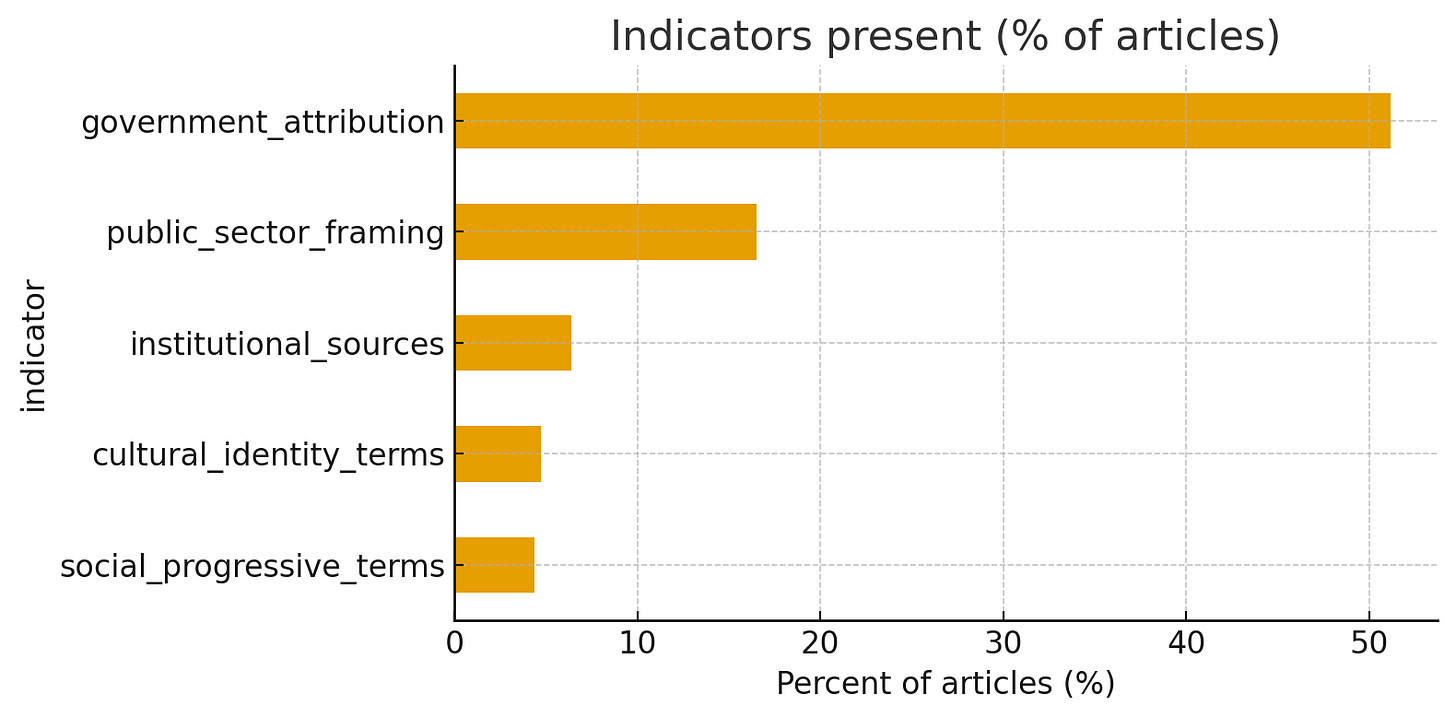
As pointed out in David Clinton’s The Audit, in a piece called There’s No Bias at CBC News, You Say? Well, OK…, an examination of nearly 300 CBC stories randomly selected from the CBC’s Top Stories RSS feed in the first half of 2025 reveals that:
“around 62 percent of domestic political stories published by the nation’s public broadcaster either quote government (federal or provincial) sources as the primary voice, or are framed around government announcements, reports, funding promises, or inquiries.”
Human cognition is extremely malleable when it comes to narrative repetition. When we are shown one particular narrative (or metanarrative) over and over again, it saturates our cognitive system and begins to influence our perception.
For the millions of Canadians who rely on the CBC, their own ability to hold the government to account is being degraded by this kind of propaganda.
In fact, presenting the state as an unquestionable authority thousands of times a year can have one of two effects in a politically divided nation like Canada.
Progressive-leaning citizens blindly trust institutions they should be scrutinizing.
Right-leaning Canadians who distrust the CBC tend to blindly distrust those institutions without their own empirical deliberations.
The role of journalists is not to intentionally foment distrust in our institutions, because this is a form of national demoralization that severely retards the Canadian national will. However, blind trust in these institutions creates unchecked power, which also degrades our national will.
Maintaining the creative tension that comes from always scrutinizing government institutions based on the fruits of their labour is how the media is meant to serve the people. This creative tension is what informs our alleged democratic will.
The feedback loop between state-funded media and other state-funded entities, such as the Canadian Anti-Hate Network, is now wildly out of control. The CBC’s recent collaboration with this organization, using a false narrative about the rise of “white nationalist extremism” in Canada as a pretext for policy change, is an excellent example.
READ:
CBC has become a source of policy creation as well as an authority on how correct a government policy is.
Because CBC is defending one particular progressive metanarrative, the opposite can also be true when it comes to state policy. When a government policy (often a conservative one) challenges that progressive metanarrative, the state is suddenly open for criticism.
This brings up Dave Snow’s research, in which he uses a particularly poignant example of editorial bias by coalating his CBC data around coverage of a specific event: Saskatchewan’s parental consent policy for children’s gender pronoun changes in schools.At the time, the Premier of Saskatchewan, Scott Moe, passed a bill ensuring that schools had to obtain consent from parents to socially transition children to a new gender identity. Given that in other nations within the commonwealth, such as the United Kingdom, social transition on children has recently been labelled as having “severe psychosocial effects”, the position of the parents demanding this law was backed by good research.
While progressive teachers scream about ‘saving trans kids from bigoted parents,’ the data pouring out of other nations has exposed that social transition not only severely alters a child’s development, but drastically increases the likelihood that the child will end up on the path of medical transition: making them medically and pharmaceutically dependent for life.
Put on top of this the social stakes for a child (especially girls) when they decide to socially detransition, and go against the cool new trans fad all their friends are into, and it’s plain to see that this is a big decision that needs parental awareness and input.
Needless to say: this was an issue that Canadians desperately needed accurate coverage for. It’s an issue that is defining our nation. And yet the results of Snow’s research revealed a dangerous refusal to serve the people of Canada:
“During this period, the CBC published 38 news stories in which Saskatchewan’s policy featured prominently.”
“Across 38 articles, the CBC quoted more than five times as many critics of Saskatchewan’s policy as supporters (81 critics, 15 supporters, and five neutral).”
Here, the state-media feedback loop is laid bare, especially when we consider that the Federal Liberal government’s position on transitioning minors is, by comparison to the rest of the world, radically far left. As Snow’s research reveals, the CBC’s focus in this instance was to attack the provincial authorities and to defend the Liberal party’s ideological agenda at the federal level. When it comes to nation-defining issues like this one, the CBC’s message is always the same: The State is right, and those questioning it are dangerous.
From an even simpler lens, the Saskatchewan story reveals what should have been a simple democratic process. Moe was responding to overwhelming support from parents who wanted this law in place. He was merely working for his constituents in a relatively straightforward way.

Scott Moe@PremierScottMoe
A new poll from Angus Reid Institute shows strong support in SK and across Canada for Parental Inclusion and Consent in education with 86% in SK supporting some level of notification for parents when children want to change their gender identity in school. Just 10% agree with

2:30 PM · Aug 28, 2023 · 571K Views
790 Replies · 932 Reposts · 4.64K Likes
Thanks for reading Subversive Clarity! This post is public so feel free to share it.
It’s time we stopped pretending the CBC’s bias is simply a matter of political argumentation. In this age of influence, with smartphones offering news on demand, and a drastic increase in the amount of content we consume, the narratives and metanarratives Canadians consume dictate perception, thinking and behaviour. We are far more maleable than we like to admit.
Understanding fifth-generation warfare in Canada matters because it helps us frame what the CBC is really doing. They are denying Canadians free thought.
Not only do Canadians who rely on the CBC end up being conditioned to think inside of a box built exclusively by the Liberal Party of Canada, but conservative voices end up having to struggle within the chosen issues and selective framing that the progressive media ecosystem in Canada insists on maintaining.
We can dissent, but there’s a caveat. Decades of dissent have been pigeon-holed into CBC’s carefully crafted narratives, leaving less room for genuine debate on the issues Canadians need to focus on protecting, defending, and growing our nation.
David Clinton’s piece in The Audit points this out expertly:
Now here’s a partial list of significant stories from the target time frame (the first half of 2025) that weren’t meaningfully represented in my sample of CBC’s Top Stories:
Housing affordability crisis barely appears (one of the top voter concerns in actual 2025 polls).
Immigration levels and labour-market impact.
Crime-rate increases or policing controversies (unless tied to Indigenous or racialized victims).
Private-sector investment success stories.
Any sustained positive coverage of the oil/gas sector (even when prices are high).
Critical examination of public-sector growth or pension liabilities.
Chinese interference or CCP influence in Canada (despite ongoing inquiries in real life).
The rest of the known galaxy (besides Gaza and the U.S.)
This brings us back to the tactical layers at play: CBC is itself a cognitive warfare operation, given that it uses narratives to condition the perception of millions of Canadians. However, as Nagy points out, the conditioning that CBC exerts on Canadians also leaves them more vulnerable to cognitive weaponry being deployed by other bad actors, both foreign and domestic.
Case in point: the CBC’s failure to cover CCP interference in our elections makes us more susceptible to CCP influence operations.
The cognitive bandwidth of any nation’s people is limited. The real estate of our nation’s Overton Window is precious and should serve our nation’s interests, not a singular ideological metanarrative.
The warfare lens matters because the most meaningful struggle in modern warfare is not deploying the best cognitive weapons, i.e., singular narratives that act like tactical weapons.
The most meaningful struggle in a world mired by fifth-generation warfare is the struggle to shape the cognitive battlespace itself and this is tragically what the people of Canada have been paying the CBC to do.
No posts
Comments
Nothing yet. Say the first thing.
Sign in to join the conversation.