
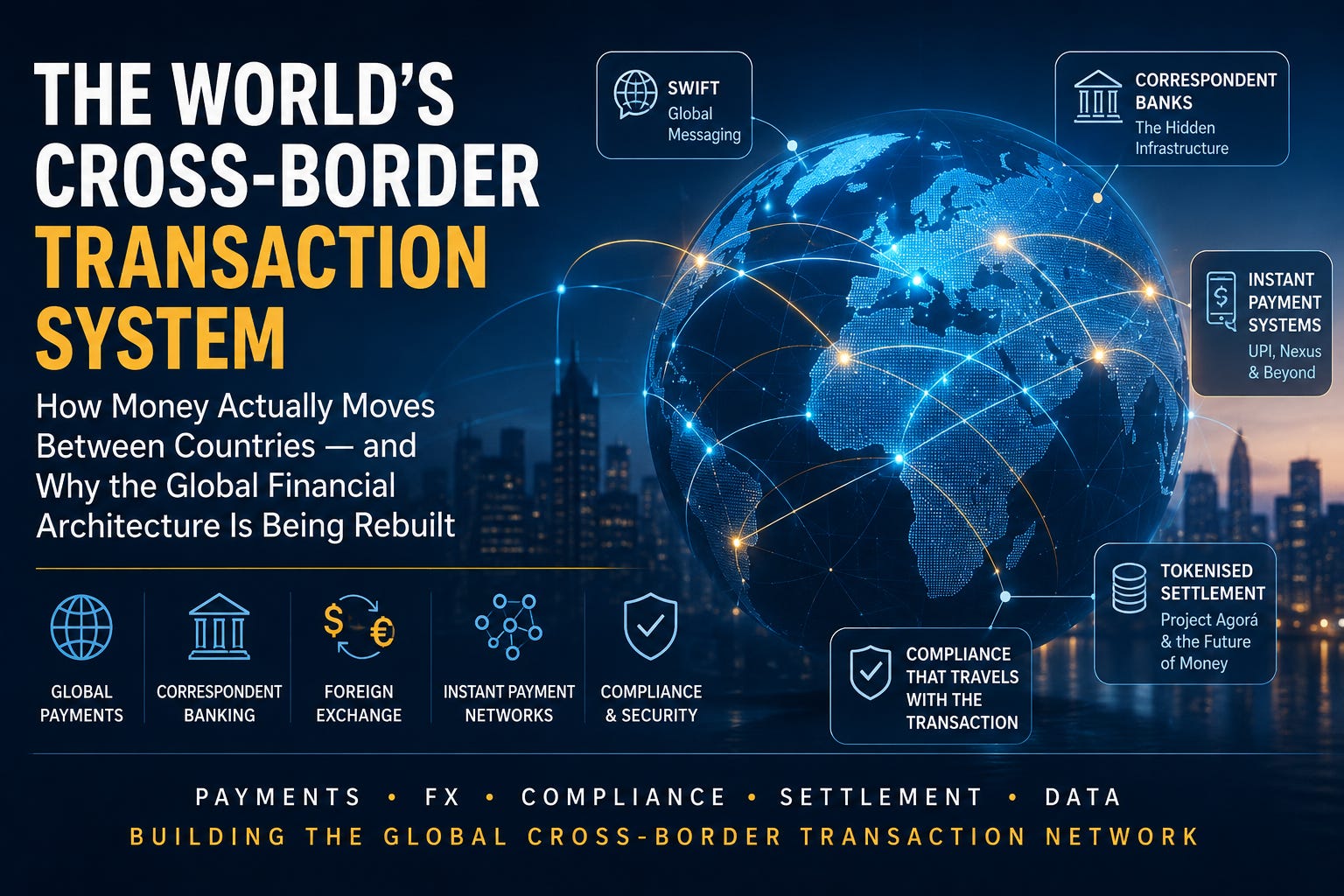
A company in India buys machinery from Germany. A UAE holding company receives dividends from Africa. An Indian investor acquires shares in a foreign subsidiary. A freelancer in Singapore receives payment from a US customer.
From the customer’s perspective, each transaction may look simple: instruct the bank, convert the currency and send the money.
Behind that instruction, however, sits one of the most complex infrastructures in global finance.
There is no single “world payment system.”
Instead, global cross-border transactions operate through an interconnected architecture of commercial banks, correspondent banks, central banks, foreign-exchange markets, payment networks, messaging standards, clearing systems, settlement systems and regulatory frameworks.
And in 2026, that architecture is undergoing one of its biggest transformations in decades.
When people hear “international bank transfer,” they normally think of SWIFT.
SWIFT is extremely important, but its principal role is financial messaging.
Think of SWIFT as the secure language and communication network through which financial institutions tell one another:
“Transfer this amount, in this currency, from this customer, through these institutions, to this beneficiary.”
The actual financial value is generally transferred through accounts maintained between banks, domestic or international settlement systems, and central-bank money.
This distinction is fundamental.
Indian Importer
↓
Indian Bank
↓
SWIFT / ISO 20022 payment instruction
↓
Correspondent Bank
↓
Foreign Correspondent / Clearing System
↓
Supplier’s Bank
↓
Foreign Supplier
If the originating bank does not maintain the required account or liquidity in the destination currency, one or more intermediary banks may enter the chain.
Every additional intermediary can introduce:
time + cost + FX spread + compliance checks + reconciliation + operational risk.
That is precisely why cross-border payments remain much more complicated than domestic instant payments.
A useful way to understand the global system is to divide every international transaction into seven layers.
Transaction layer — What is happening economically? Import, export, dividend, loan, investment, royalty, service fee, securities purchase or another transaction.
Regulatory layer — Is the payment legally permitted under foreign-exchange, capital-control, sanctions, tax and other applicable regulations?
Messaging layer — How do financial institutions exchange structured payment instructions? SWIFT and increasingly ISO 20022 sit here.
FX and liquidity layer — Who converts INR into USD, USD into EUR, AED into INR or another currency, and where does the necessary liquidity sit?
Correspondent banking layer — Which banks maintain accounts with one another so value can move across jurisdictions?
Clearing and settlement layer — Where does the payment finally become an irrevocable transfer of value?
Compliance and reporting layer — AML, KYC, sanctions screening, source of funds, purpose codes, tax documentation and regulatory reporting determine whether the transaction can actually pass through the system.
This explains why an international transfer may be technically possible but still fail from a regulatory perspective.
Payment capability and regulatory permissibility are two different questions.
Suppose Bank A in India needs to send USD 1 million to Bank B in another country.
Bank A may not directly participate in the relevant US dollar settlement infrastructure.
Instead, it may maintain a USD account with a large international bank.
That account is traditionally described through Nostro and Vostro relationships.
For Bank A:
“Our money with you” = Nostro account.
For the correspondent bank:
“Your money with us” = Vostro account.
The payment can therefore travel through a chain of banking relationships until the beneficiary institution receives value.
This architecture has connected the world for decades, but it creates structural friction.
The Financial Stability Board identifies the principal problems affecting cross-border payments as high costs, low speed, limited access and insufficient transparency. Despite substantial international policy work, its 2025 assessment concluded that improvements had still not translated into satisfactory benefits for end users globally.
That is the central challenge the next generation of financial infrastructure is attempting to solve.
India provides an excellent example.
A domestic UPI transaction can move between two accounts almost instantly.
Many countries now operate similarly sophisticated fast-payment infrastructure.
But imagine connecting:
UPI in India + PayNow in Singapore + FAST in Singapore + PromptPay in Thailand + other national systems worldwide.
The challenge is no longer merely transferring electronic information.
Different countries operate different:
currencies,
banking rules,
AML regimes,
payment infrastructures,
settlement hours,
data-protection rules,
sanctions frameworks,
foreign-exchange regulations,
transaction limits,
identification systems.
Cross-border payment infrastructure must therefore achieve not merely technical interoperability, but also regulatory interoperability.
That is substantially harder.
One of the most important changes has already happened.
On 22 November 2025, the coexistence period between legacy MT messaging and ISO 20022 for SWIFT cross-border payments and reporting ended.
SWIFT now describes ISO 20022 as the global standard for cross-border payments.
Why does this matter?
Older payment messages often carried relatively limited or inconsistently formatted information.
ISO 20022 allows far richer structured data.
Instead of a payment instruction effectively saying:
“Send $100,000 to Company XYZ.”
the financial infrastructure can carry structured information about the payer, beneficiary, intermediary institutions, addresses, references, remittance purpose and other payment details.
Better structured data can improve:
straight-through processing, sanctions screening, AML monitoring, reconciliation, fraud detection, invoice matching and regulatory reporting.
The future global transaction infrastructure is therefore not simply about moving money faster.
It is about moving money and structured data together.
The next logical step is to connect domestic fast-payment systems internationally.
This is where Project Nexus becomes important.
The BIS developed Nexus as a framework through which domestic instant-payment systems can connect through a common architecture instead of every country building separate bilateral connections.
According to the BIS, more than 70 countries now have domestic instant-payment capabilities, and interconnected systems could potentially allow many cross-border retail payments to reach recipients within around 60 seconds.
India is directly involved.
In 2025, the central banks of India, Indonesia, Malaysia, the Philippines, Singapore and Thailand incorporated Nexus Global Payments to move the initiative toward live implementation.
The RBI had earlier joined the initiative to connect India’s UPI ecosystem with fast-payment systems in participating countries.
This represents a fundamentally different model.
Country A
→ Bank
→ Correspondent Bank
→ Correspondent Bank
→ Bank
→ Country B
Country A Fast Payment System
↔ Interoperability Layer ↔
Country B Fast Payment System
That could materially change global retail remittances.
Sending ₹25,000 to a family member overseas is different from settling a $200 million acquisition.
Global finance also requires a wholesale infrastructure for:
international trade,
institutional investments,
securities transactions,
treasury movements,
intercompany funding,
syndicated loans,
mergers and acquisitions,
foreign-exchange settlement.
This is where another technological transformation is emerging.
One of the most significant experiments in the global monetary system is Project Agorá, led by the Bank for International Settlements with public- and private-sector participants.
The concept is striking.
Instead of sending payment instructions through multiple sequential banking systems, commercial bank deposits and central-bank reserves can potentially be represented on a shared programmable infrastructure.
Project Agorá demonstrated a prototype combining tokenised commercial bank deposits with tokenised central-bank reserves, enabling multi-currency atomic settlement.
Atomic settlement essentially means that the different legs of a transaction can be completed together — or not completed at all.
This can reduce settlement risk.
The project moved even further in 2026.
In July 2026, Project Agorá conducted controlled real-value testing involving 28 financial institutions and central banks across Asia, Europe and North America. Transactions across multiple currencies totalled approximately CHF 800,000 across 17 scenarios.
This does not mean tokenised cross-border banking has replaced conventional banking.
It means something much more important:
the financial system is testing whether the traditional correspondent-banking chain can eventually be compressed into shared, programmable settlement infrastructure.
Consider an international acquisition.
Today:
Buyer sends money
→ compliance checked
→ intermediary banks process payment
→ seller receives funds
→ shares are separately transferred
→ parties reconcile records.
A programmable infrastructure could theoretically connect conditions.
For example:
Release payment only when the securities transfer condition is satisfied.
Or:
Release trade finance when shipment documentation meets predefined conditions.
Or:
Execute FX conversion and settlement simultaneously.
This is where tokenisation becomes much more interesting than the speculative use of blockchain commonly associated with crypto-assets.
The institutional objective is not simply “put money on blockchain.”
The objective is:
compress transaction, compliance, settlement and reconciliation into a common programmable financial architecture.
Another experiment has involved multi-central-bank digital currencies.
Project mBridge explored a common distributed-ledger platform through which participating central and commercial banks could conduct cross-border payments and FX transactions using CBDCs.
It reached minimum viable product stage in 2024 before the BIS handed the project to its participating partners.
The wider lesson remains important.
Three competing — and potentially complementary — models are emerging:
Model 1 — Improve correspondent banking
SWIFT + ISO 20022 + better APIs + longer operating hours + improved compliance.
Model 2 — Interconnect domestic instant-payment systems
UPI + Nexus-style interoperability + regional fast-payment networks.
Model 3 — Create shared tokenised settlement infrastructure
Tokenised deposits + central-bank reserves + wholesale CBDCs + programmable settlement.
The future global system may ultimately incorporate elements of all three.
A common misconception is that faster payments will reduce compliance requirements.
The opposite is more likely.
When transactions become instantaneous, banks have less time to identify suspicious transactions.
Therefore the future architecture requires increasingly sophisticated:
real-time sanctions screening, AML analytics, digital identity, Legal Entity Identifiers, transaction-purpose identification, beneficial ownership information and automated regulatory reporting.
The BIS’s 2026 work on cross-border payment infrastructure emphasises ISO 20022 harmonisation, APIs, interoperability and expanded operating hours as important foundations for improving the system.
The transaction of the future therefore may be processed in milliseconds technologically — while simultaneously being subjected to multiple automated legal and compliance checks.
India enters this transition from an unusually strong position.
UPI has already demonstrated the scalability of instant retail payments.
NPCI data shows UPI processed more than 23.2 billion transactions during May 2026 alone, with transaction value approaching ₹29.9 trillion.
India is also participating in Nexus and has already established cross-border fast-payment connectivity in selected corridors.
The opportunity is bigger than allowing travellers to scan UPI QR codes overseas.
The strategic opportunity is for India to become part of the underlying infrastructure through which:
payments + trade + foreign exchange + digital identity + compliance + settlement
interact globally.
For Indian businesses, banks, fintech companies and cross-border advisers, this could be transformational.
Today’s international transaction may involve:
Customer
↓
Commercial Bank
↓
SWIFT Message
↓
Correspondent Bank
↓
FX Conversion
↓
Foreign Correspondent
↓
Foreign Bank
↓
Beneficiary
↓
Manual Reconciliation
The future architecture could move toward:
Digital Identity
↓
Transaction Instruction
↓
Automated Regulatory Validation
↓
Real-Time FX
↓
Tokenised / Instant Settlement
↓
Automatic Compliance Reporting
↓
Beneficiary
Potentially within seconds.
This distinction matters enormously.
Money is only one component of a cross-border transaction.
Consider an Indian company investing in a UAE subsidiary.
The transaction contains:
**corporate approval
valuation
foreign-exchange permission
banking documentation
payment
ownership creation
regulatory reporting
tax consequences
ongoing compliance.**
Traditional financial systems handle many of these processes separately.
The next generation of infrastructure will increasingly connect them.
Imagine a system where the transaction itself carries:
identity + beneficial owner + transaction purpose + legal classification + invoice or contract reference + tax information + regulatory permission + payment + settlement record.
That is the real opportunity.
The global financial architecture is moving from transferring money toward transferring verified financial transactions.
For cross-border businesses, the most important development may therefore not be whether SWIFT disappears, whether CBDCs dominate, or whether blockchain wins.
The real transformation is convergence.
Banking, foreign exchange, tax, regulatory compliance, corporate ownership, payment infrastructure and data architecture are moving closer together.
A cross-border adviser of the future cannot analyse a transaction only from the tax perspective.
Nor only FEMA.
Nor only banking.
Nor only company law.
A transaction increasingly needs to be considered as one integrated flow:
Transaction Structure
→ Regulatory Permission
→ Tax Treatment
→ Banking Route
→ Payment Infrastructure
→ Documentation
→ Reporting
→ Repatriation
That is the direction in which global cross-border advisory itself must evolve.
For decades, international finance was built around a simple principle:
banks communicate with banks and reconcile later.
The emerging architecture is moving toward a different principle:
systems communicate directly, compliance travels with the transaction, and value settles almost simultaneously.
SWIFT and correspondent banking will remain enormously important.
But around them, a new ecosystem is developing:
ISO 20022.
Instant-payment interoperability.
Nexus.
Tokenised deposits.
Tokenised central-bank reserves.
CBDCs.
APIs.
Digital identity.
Programmable compliance.
24×7 settlement.
We may therefore be entering the transition from the world’s cross-border banking network to something much larger:
And the institutions that understand the difference early — banks, corporations, fintechs and advisers — will be better positioned for the next generation of international commerce.
This article is intended for educational and strategic discussion purposes. Cross-border transactions remain subject to jurisdiction-specific foreign-exchange, banking, taxation, sanctions, corporate and regulatory requirements. Professional advice should be obtained before implementing any transaction structure.
No posts
Comments
Nothing yet. Say the first thing.
Sign in to join the conversation.