
Finally a moment to update Substack. I am running my Writing Fantasy course right now, and what with an event-filled October, haven’t had a chance to post. While I must sit on my full publishing news until next year, at least I got to reveal the title of my 2027 novel! It has been my most popular social post ever - now 10k views and counting! I am thrilled to see everyone’s enthusiasm and excitement this far out from publication. These next two books are my best yet, and I can’t wait for them to be in the world - in heads other than mine.
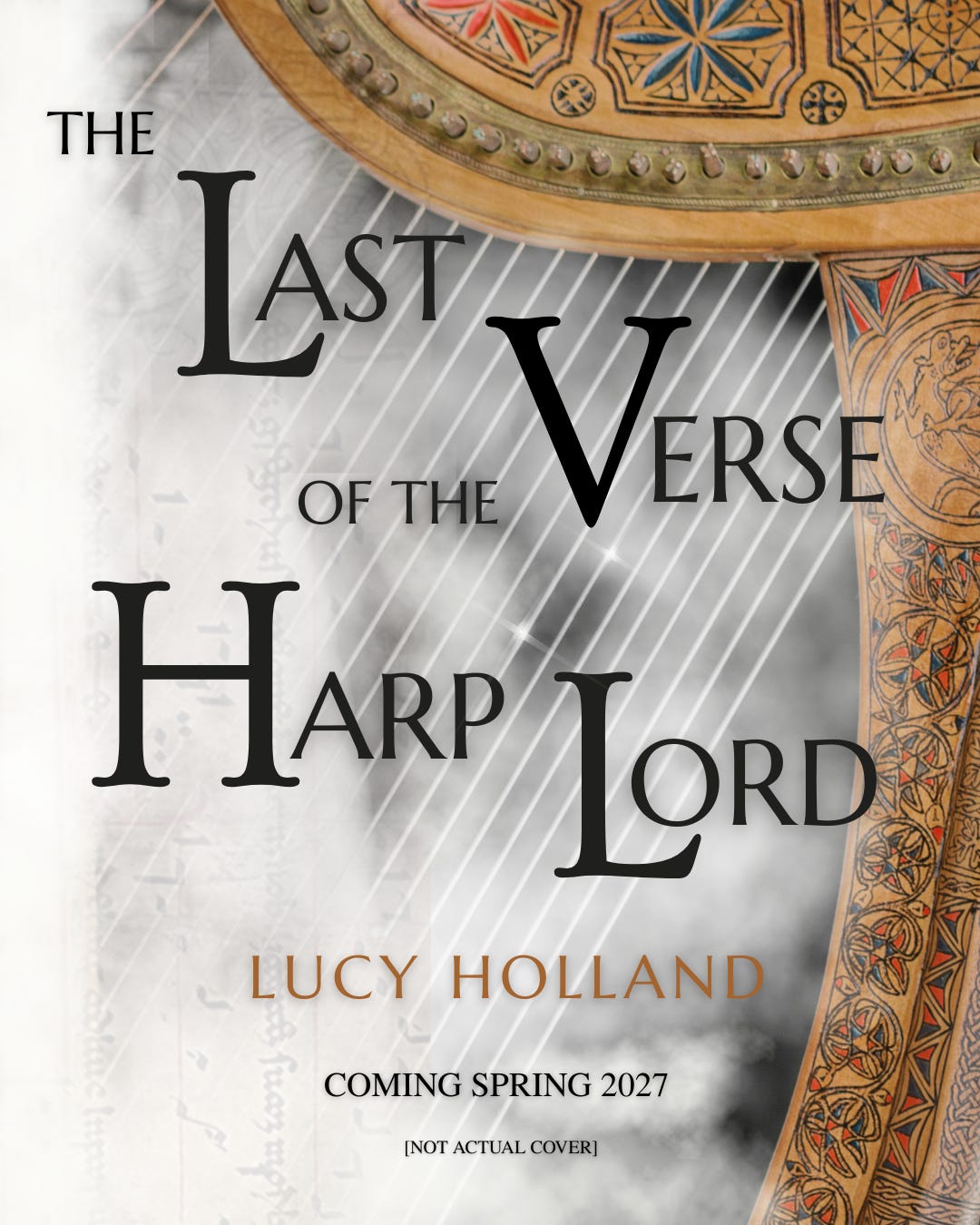
Poetry, pining, grief and glory. A love that survives after death. Inspired by Britain’s earliest literature, history and myth, THE LAST VERSE OF THE HARP LORD is the story of legendary bard, Aneirin.
In pursuit of poetic fame, he must survive the rigorous training of the bardic school, bloody battlefields where warriors win death or glory, and the machinations of powers both mortal and immortal. Ultimately he must decide what price he is willing to pay to break the curse that binds the man he loves.
You can find a few more plot teasers in the post below:
What's next?
·
July 3, 2025
‘But most of all, I will sing of battle. Men with red in their hair like the blood of my kin spilt upon the high hills. I will sing of lands soaked in strife.’ I swallowed hard. ‘I will go with them into the abyss, and I will bring out their bodies, make verses of them.’ I thought of Dwywei. ‘I will sing,’ I whispered, ‘of a mother’s wail, which the glo…
In the run-up to title reveal, I shared two epigraphs I have chosen for the book. (I am a big fan of epigraphs and get very excited when I stumble across one or more quotes that resonate with my themes). The first - these haunting lines by Welsh poet, R.S. Thomas:
Text within this block will maintain its original spacing when published
King, beggar and fool, I have been all by turns,Text within this block will maintain its original spacing when published
Knowing the body’s sweetness, the mind’s treason;Text within this block will maintain its original spacing when published
Taliesin still, I show you a new world, risen,Text within this block will maintain its original spacing when published
Stubborn with beauty, out of the heart’s need.
I discovered R.S. Thomas through Alan Garner, who also used his poetry as an epigraph – in The Owl Service. It sent me on a quest to seek out more of his haunting lines, and these are from his poem “Taliesin 1952”. If you’re familiar with Welsh history, literature and myth, you’ll recognise some of the powerful images Thomas invokes: Myrddin after the battle of Arfderydd; prince Owain Glyn Dŵr; the exiled 18th century poet, Goronwy Owen.
What most strikes me about the figure of Taliesin is how multitudinous he is. If there was an individual, he is lost to the mythic. Taliesin became a persona, a cloak to be donned for the declaiming of verse. A name that bestowed poetic authority. He is everyone and he is no one. He is the creative spirit given form.
I wanted to explore the burden, the curse, of wearing so many faces that you forget if you ever had your own. The power that comes with an ability to be - in Thomas’ words - all men known to history. Who or what dwells alone behind those layers of self? What would it take to catch hold of that person? What cost would you pay for loving them?
This post is public so feel free to share it.
My second epigraph is from Rosemary Sutcliff’s The Shining Company:
Every harper plays upon his hearers as he does upon the strings of his harp. It is so that the music comes, between the harp and the hearts of men.
This novel - inspired by events related in Aneirin’s epic, Y Gododdin - was always going to be mandatory reading for the bard book since the Gododdin is one of my key texts too. But Sutcliff showed me how to weave the language of the Britons into my prose. She conjures simply and deeply. She manages to capture the essence of that lost medieval world, bright with blood and song, dark with the violence of men, who give women sons, take them away and give them back again as bodies broken in senseless battle.
Yet amidst this darkness is comradeship. Love, loyalty, soaring verses that capture the exquisite agony of living. It’s an astonishing book that I feel ought to be more widely read and appreciated. Few other authors – although Mary Renault displays equal genius – are able to evoke the spirit of an age so effectively.
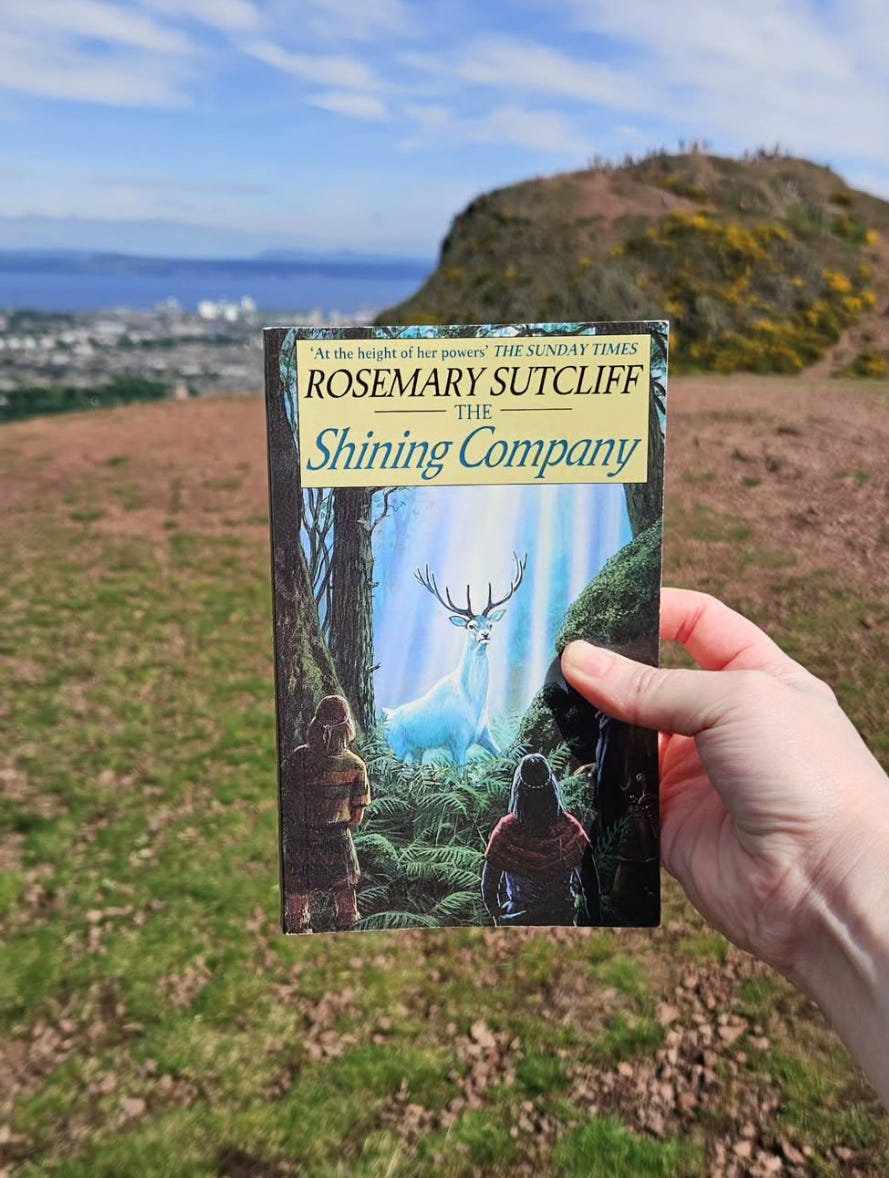
I took this photo last year atop Arthur’s Seat. It was from Dyn Eidyn (Edinburgh) that the three hundred chieftains and their shieldbearers went forth to die at Catraeth, far from home. In Sutcliff’s words:
“Two and two they rode, a shining company, and the sun and rain clashing together as they came. And for that one moment, the thought came to me – an odd unchancey thought to be pushed away hurriedly – that it is not good for mortal men to wear that particular bloom of light.”
I can’t wait until 2026 when we start the publicity campaign officially and I can share all the news with you. Rest assured, however, that the books are coming to both the UK and the US. We’ve yet to start the process of selling translation rights. However, it’s my dream to have the book translated into Cymraeg because more than anything this story was born from my love of Welsh literature and myth. And of course the beautiful language used by y Cynfeirdd - the early poets - that remains with us today.
[The harp on the graphic was made by Ériú Harps in Ireland and I really hope to own one even half as beautiful one day]
No posts
Comments
Nothing yet. Say the first thing.
Sign in to join the conversation.