
This post comes to you a week later than expected. This is mostly because I was in the final push to get the full draft of a book done (it’s done!) but also because I kept getting distracted by cat videos on YouTube. Happy New(ish) Year.
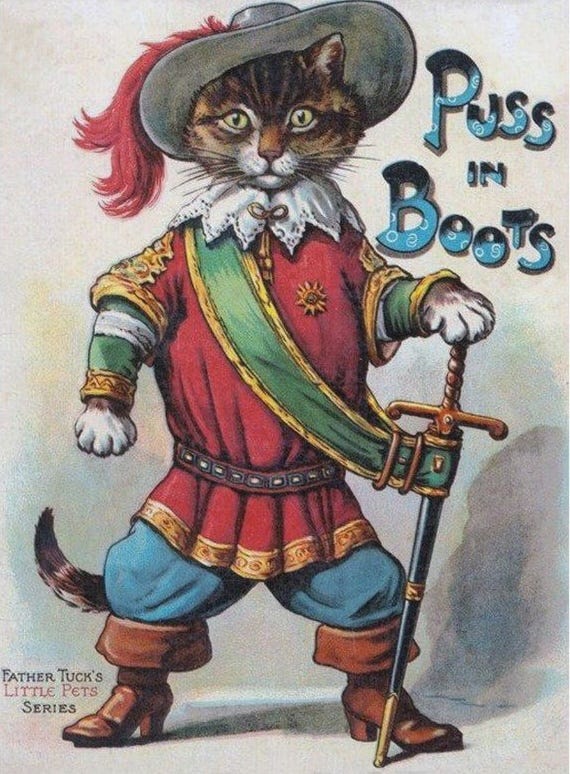
While I am not, by any stretch of the imagination, a dog person, it’s no secret that I’m a fan of cats. One of the many fascinating things about cats is how polarising they are. As the anthrozoologist Sarah Brown observes in The Cat: A Natural and Cultural History, people don’t tend to be indifferent towards cats. They either love them or vehemently dislike them. In essence, if dogs are ‘man’s best friend’, cats are probably our best frenemy.
As Tiffani Howell, a psychologist specialising in human-animal relationships, notes of the plight of people who live in dog-loving countries, ‘While it’s not unusual to hear people talk openly about hating cats, it’s less socially acceptable to express a dislike of dogs’. Conversely, it’s perfectly appropriate to write ‘must love dogs’ on your online dating profile, but ‘must love cats’ is clearly code for ‘raging psycho’. After all, to love cats is to place oneself in the company of crazy old ladies and supervillains.
Interestingly, Europeans’ love-hate relationship with cats seems to have very old roots. According to the historian David Engels’ Classical Cats: The Rise and Fall of the Sacred Cat, felines were worshipped in ancient Egypt, Greece and Rome due to their associations, respectively, with the goddesses Isis, Artemis and Diana. However, attitudes turned in the Middle Ages. It wasn’t just witches who were hunted; cats were massacred too.1
Cross-culturally, we see evidence of similarly ambivalent attitudes, Japan being a case in point. As Zack Davisson outlines, while there is considerable evidence of Japan’s love of cats, Hello Kitty and maneki neko (lucky cats) being prime examples, the country’s folklore is nevertheless full of stories of monstrous and mischievous supernatural cats. These include the bakeneko—magical cats who can take human form, sometimes by consuming their owners2—and the corpse-stealing kasha, along with numerous other creatures and legends.

The anthropologist Ellen Hertz suggests that cats’ uncontrollability lies at the heart of both their veneration and loathing. While dogs can be readily trained, you can’t really get a cat to do anything it doesn’t want to. This is precisely why we know so much less about cats than we do about dogs—felines are notoriously difficult to conduct experiments with.
According to an article in Science, in the first study comparing how well cats and dogs understood people pointing towards hidden food, cats performed just as well as dogs—when, that is, they could be arsed participating. Unfortunately, various cats ‘dropped out’ (to use the language of the experimenters) of the study, by either ignoring the researchers or wandering off. Subsequent studies point to similar problems. For example, Hertz reports that in a 2020 study on whether verbal cues affect cat behaviour, 21 of the 68 potential cat subjects simply refused to cooperate and only seven completed all four stages of the experiment.
Of course, it’s precisely the independent-mindedness of felines that is part of the attraction they hold for cat lovers. As the writer and cat lover Mark Twain3 once said, ‘Of all God’s creatures, there is only one that cannot be made slave of the leash. That one is the cat’. However, this independence means that cat owners can never be sure that they’ve claimed their feline’s affections.
For example, in an article about neighbourhood conflicts over pet cats in London, the journalist Sirin Kale reports on a couple who were waging a legal battle to prevent a neighbour from stealing their Maine coon, Ozzy. They accused the neighbour of repeatedly attempting to ‘seduce’ their cat by feeding him. Although who is seducing whom is often a little unclear in these situations, given that the neighbour had replaced Ozzy’s cat collar with one containing her own phone number and the words ‘My home’, the accusation does seem justified.
Still, the neighbour’s defence was telling. ‘He is very loved and well cared for and he is very attached to his territory, and to me’, she wrote. ‘Surely leaving him where he is determined to be and where you can be reassured he is settled and happy and healthy is the best thing for everyone involved, both feline and human’. ‘He is not your cat and we are not just giving him over to you!’ the irate owners responded. Whatever you might say about dogs, it’s difficult to imagine anyone challenging a dog-napping charge on the basis that the dog had ‘chosen’ them.4
As the anthropologists Jessica Lynch and Christopher Kelty observe, ‘Humans (as cat owners will attest) do not control cats, and cats are not domesticated in the sense of being dependent on or under the control of humans or directed to specific tasks’. Indeed, they argue that the domestication of cats has been partial at best. Unlike dogs, cats are able to move back and forth between feral and tame states, suggesting that they’ve resisted full domestication of their genetic traits and biology.
Although there is archaeological evidence that cats have willingly interacted with humans for at least 10,000 years, cats were domesticated around 4,000 years ago—much later than dogs. Indeed, Felis catus, the contemporary house cat, remains very biologically close to wildcats.5 Domestication syndrome—the term for morphological and behavioural changes resulting from artificial selection—is far less pronounced in cats than dogs. The prevailing view is that this is because we didn’t actually domesticate cats; instead, they voluntarily came to us once we settled down in villages, because villages meant food stores and food stores meant rodents.6
In fact, some scholars have argued that the adaptations made by domesticated cats seem to be those that maximise our domestication. According to Hertz, a widely held view is that cats possess ‘baby releaser’ traits characterised by a round face, big cheeks, large, forward-facing eyes and a small nose that enhance human attention and focus—nicely illustrated by Puss in Boots in the Shrek films. Still, Lynch and Kelty argue that while cats seem to be ‘preadapted for extreme cuteness’ in human eyes, these traits predate human evolution and are more about maximising hunting effectiveness.
In contrast, the cat’s meow does seem to have evolved primarily as a means of communicating with humans. All cat owners are familiar with the insistent cry their pet makes when they want something (food, attention, to be let into a room or, conversely, outside of it five seconds later). Indeed, as I noted in my last post, the cat’s meow is explicitly likened to a baby’s cry in Korea. Notably, cats rarely meow to each other in the wild. Cats, in a very real sense, have thus cultivated us to meet their needs. In this respect, they differ radically from dogs.
Although dogs are more popular globally than cats as pets, Ellen Hertz observes that cat videos are far more popular than dog videos. Indeed, they are amongst the world’s most viewed materials—Hertz cites figures suggesting that cat videos constitute around 15% of all internet traffic, indicating that they’re even more popular than porn. Her tongue-in-cheek name for this phenomenon is ‘cat-based Mass Enjoyment through Online Witnessing’, or ‘cat-based MEOW’ for short.
The prevailing view is that the popularity of cat videos can be explained by the aforementioned cuteness of felines to human eyes. In this view, to quote Hertz, ‘It would seem that cat-based MEOW boils down to human hardwiring gone astray’. But she suggests that our fascination resides in the unique kinetic and aesthetic qualities of cats, something evident in the different genres of cat videos, like dancing cats, surprised cats,7 cats pushing things off surfaces and stalker cats.
Indeed, what is striking is how different cat influencers like Maru—‘the most famous cat on the internet’—are to dog influencers like JiffPom and Doug the Pug. Before his recent death, Maru’s videos frequently focused on his extraordinary ‘meltability’. JiffPom’s and Doug the Pug’s videos, on the other hand, mostly feature them dressed in human clothing and engaging in human activities.
In the end, I suspect that this tells us something significant about our relationship with cats and dogs. If dogs are prized for the ways they are like us, cats are adored (and reviled in equal measure) for the ways they are different. Mark Twain says it best. ‘If man could be crossed with the cat, it would improve man, but it would deteriorate the cat’.
Although probably not en masse. To quote Spencer McDaniel’s Tales of Times Forgotten blog, ‘a handful of artistic representations are not in any sense evidence of a widespread pogrom against cats’.
This legend may have some basis in reality. Anecdotal accounts suggest that hungry cats will start taking bites out of their deceased owners sooner than dogs will. First responders indicate that dogs typically wait until after the body has started to decompose, but ‘cats will start chewing on the body as soon as it starts to cool’. This is typically taken as evidence that dogs are more loyal than cats, but it probably also indicates that cats are smarter.
At one time, Twain owned 19 cats. He apparently loved cats so much that when he went away on holidays, he used to rent them for the summer.
Intrigued by the case, I managed to track down the outcome. One £20,000 court battle later,* the owners won the case, with the neighbour promising not to feed Ozzy, remove his collar, or allow him into her flat, except to ‘carry him through and put him out back’ in the event that he was meowing out the front.
*I suspect this case proves that people might be crazy, but cat people are C.R.A.Z.Y.
And retains its impressive hunting instincts, which is why domestic cats are such successful predators. As footage compiled for the BBC programme The Secret Life of the Cat shows, house cats—at least, those allowed outdoors—retain many of the patterns of their ancestors: they police their territory, often covering considerable ground to do so; they hunt and bring home prey; and enter territorial disputes with other cats—the researchers found that these are typically resolved by ‘time-sharing’ arrangements, whereby one cat makes itself scarce when the other is on the prowl.
In Classical Cats, Engels argues that cats have played a largely unsung role in our age-old battle against rodents. He writes, ‘In silent, in secret, and often at night, the ancient battle between the cat and the rodent, mankind’s greatest natural enemy, has continued through the ages’. Still, as Hertz observes, the ‘unsung’ aspect of this role is probably at least partially explained by the fact that ‘the only clear purpose they serve—catching mice—appears to stem not from a desire or need to be useful but from a kind of hobby, a pastime or passion from which they draw sadistic pleasure.’
If you don’t find the ‘Surprised kitty’ video adorable, you’re dead inside—79 million views can’t be wrong.
Comments
Nothing yet. Say the first thing.
Sign in to join the conversation.