
I recently saw an article titled ‘Jon Snow: A Last Big Story review—the finest swan song you could hope for’. Excited, I was nevertheless a little surprised that this was the first I was hearing about it, as this is the sort of news that tends to break the internet. ‘Finally, the King of the North will get a proper ending’, I thought. However, a quick perusal of the article clarified why I hadn’t heard about the show before—it’s actually a documentary about the British investigative journalist Jon Snow, who was recently diagnosed with Alzheimer’s.
In 2014, much to the delight of the press, the journalist met the actor, Kit Harington, who played Jon Snow in Game of Thrones. ‘The meeting that has been eagerly anticipated by fans of the news programme and the HBO fantasy series has finally happened’, reported the breathless newspaper coverage. For better or worse,1 this was later elaborated into a full segment on Channel 4.
Complicating matters further for the real Jon, he also shares his name, although not the exact spelling of it, with another illustrious figure, the nineteenth-century physician John Snow. Considered one of the founders of modern epidemiology, Snow is best known for his work in tracing the outbreak of an 1854 cholera epidemic in London to a Broad Street water pump.
I have a particular interest in the topic of sharing one’s name with someone famous. As I have previously discussed and occasionally satirised on this Substack, I too share a name—or, rather, almost share a name2—with a celebrity. My term for this phenomenon is ‘namesis’. While they don’t know you exist, like any proper nemesis, they are the bane of your life, haunting you not just online but every time some wit makes a joke about meeting Veronica Mars, thinking you haven’t heard it hundred times before.3
My misreading of the subject of ‘Jon Snow: The Last Big Story’ got me thinking more about the topic of shared names, which is basically a universal problem. If you look up your name on LinkedIn, the chances are high that you share it with at least ten other people. For example, according to a Forbes article about people on LinkedIn who share names with a celebrity, there’s a Mr Brad Pitt, a Justice Sandra Bullock and a Mr Paul McCartney. And spare a thought for Mr Bill Clinton Gates, who gets it in the neck on two counts. Basically, we’ve all got name doppelgängers. The primary exception is people whose parents have gone out of their way to give them a barmy name—like Jermajesty Jackson, son of Jermaine and nephew of Michael.
However, imagine you are one of the thousands of people who share your name with Michael Jackson himself. The anthropologist Michael Jackson has reflected at length on this experience. A white Kiwi octogenarian, he was never going to be mistaken in person for the King of Pop,4 but when you share a name with someone famous, it inevitably encroaches upon your life. Jackson notes that he has encountered numerous Michael Jacksons in his lifetime, including several whose debts he was, albeit briefly, saddled with. However, no one teased him about his name until the 1970s, when he started becoming the recipient of jokes about not being black and questions about whether he sang and danced.
For my own part, I didn’t have a clue who Kristen Bell was until people started calling me Veronica Mars circa 2005 or so. Likewise, I wasn’t aware of her recent ‘semi-cancellation’5 until someone made a joke to me about it. In essence, whether you’re paying attention or not, events happening in the life of your namesis have ripple effects on your own.
For example, a 2020 Vice article on the ups and downs of sharing a celebrity name discusses the experiences of one Matthew Kelly, who shares his name with the British TV presenter who was arrested in 2003 on kiddie fiddling charges. Kelly notes that if the presenter had been found guilty (TV Kelly was later cleared), he would have had to change his name. Conversely, in a 2017 Vice article on the same topic, Kate Middleton (22, of London) discusses the fact then when her name twin got engaged to Prince William, she suddenly received over 3,000 friend requests on Facebook.6
Middleton notes that the name has mostly worked in her favour, being ‘a great ice-breaker and great for networking in my job.’ Likewise, the publishing industry expert and commentator Jane Friedman has referenced how she has benefited from sharing the name of the former CEO of the publishing giant HarperCollins, who is considerably older.
Clearly, such benefits are sometimes due to an outright case of mistaken identity. For instance, in the aforementioned 2017 Vice article, one Jennifer Lawrence (36, of Massachusetts) talks about an airport official saying ‘I can’t wait to go home and tell my friends I just met Jennifer Lawrence.’ But the thing is that even if he didn’t mistake her for the celebrity, he can still genuinely claim that he has met Jennifer Lawrence. Indeed, the anthropologist Michael Jackson talks of the fact that when his daughter was in high school, she brought some classmates home who wanted to meet him, ‘as if I would afford them some magical connection with the pop star.’
As Jackson reflects, these reactions point to the significance of personal names and the tangible connection they create between otherwise unrelated people. ‘Is this comparable to being a look-alike—to sharing the physical features of another person, a kind of accidental and unrelated twin?’, he asks. Jackson observes that in many societies, sharing a name with someone frequently invites an informal, joking relationship.
I’ve experienced this phenomenon myself. Because my personal website address is www.notkristenbell.com, I occasionally receive messages from other Kirsten Bells who have stumbled across the site while doing a Google search on their name. The other Kirstens always assume an immediate connection based upon the travails of our shared name, as the following selection of messages attests:
‘Hi Kirsten! I have the same namesis. Lol. Just stopping by on my wanderings to see if I even show up in Google results anymore. Lol. Keep up the good fight. I found you on the first page! Lol. Kb.’
I laughed at your website title!… I was getting fitted for ski boots by a young guy. Three girls walked in and heard my name. They smiled and said “like Kristen Bell.” The young guy goes “No, she is too old.” I almost kicked him in the face. I am sure you can relate!’
Still, I sometimes think about the recipient of a third message once received:
‘So I found your website today, and was amazed. My name is Kirsten Bell and I am currently studying anthropology in post secondary!! I don’t know if there is much point to this message beyond pointing out how interesting I found this. ;)’
Did she continue on with anthropology, and does she curse the fact that my online profile outstrips hers? In other words, am I her namesis?
There’s at least one other academic who shares my name: a kinesiologist at the University of Waterloo who works in the area of health, which is my own academic specialisation. As she is considerably younger than me, I’ve had much longer to build an online academic presence. To differentiate herself from other similar academic names, she frequently lists herself on academic papers as Kirsten E. Bell. Although I am also a Kirsten E. Bell, I get to be plain old ‘Kirsten Bell’ in Google Scholar, simply because I got there first.
Reflecting on sharing a name with the better-known writer, the singer Michael Cunningham observes that,
Names are supposed to point cleanly to one person. That’s the theory, anyway. But when your name overlaps with someone famous, especially someone with decades of cultural head start, the neat one-to-one relationship gets fuzzy—mostly in search results and digital spaces.
According to Michael Jackson, the joking relationships common amongst people who share names, along with the avoidance relationships that exist in some societies, highlight the ambiguity of two people sharing the same name. In his words, ‘The common name suggests a common identity, while the manifest differences between the individuals who share the name confounds this assumption.’ In essence, a shared name invites both connection and comparison: how are you like that person and how are you different?
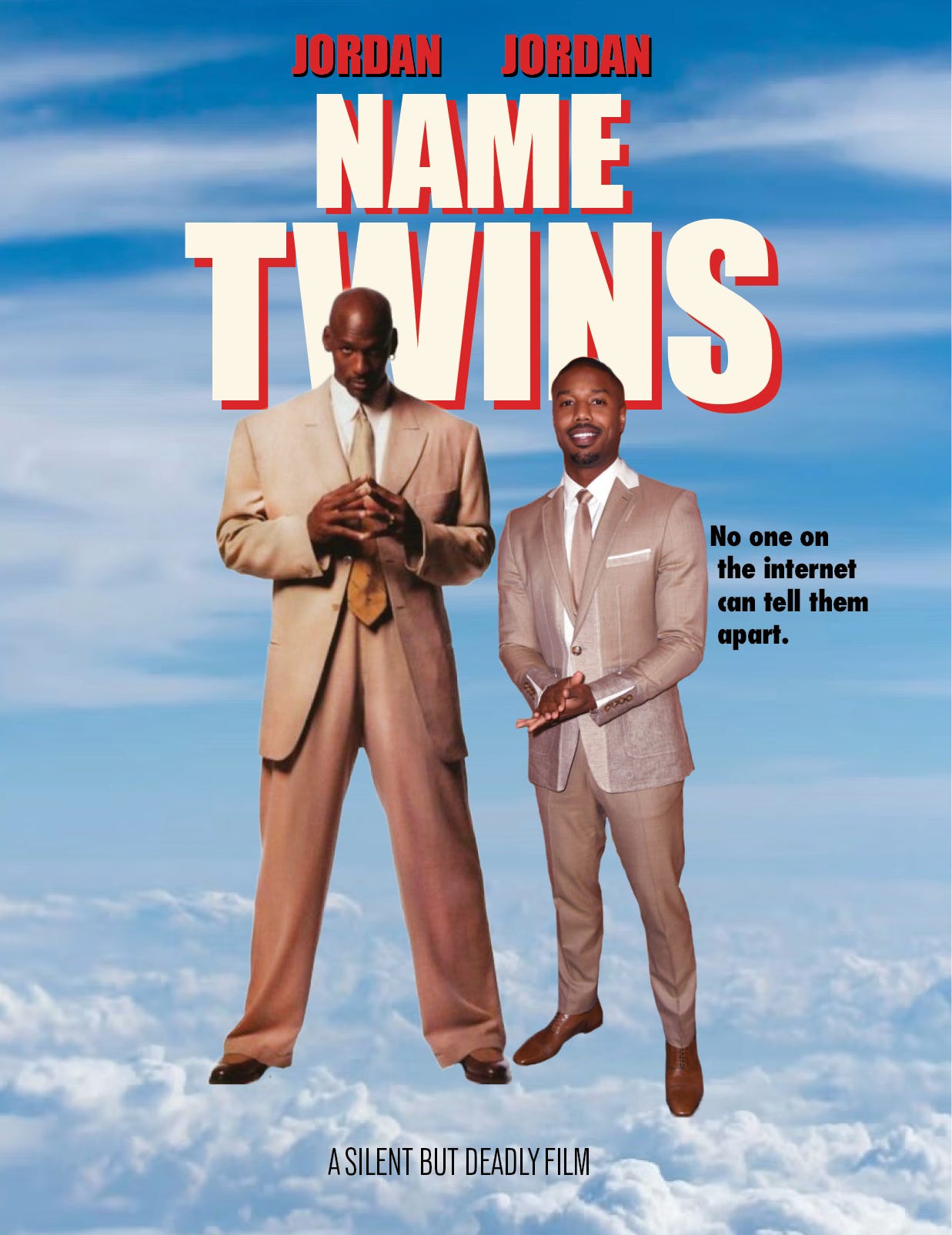
This comes across in the actor Michael B. Jordan’s recent reflections on the impact of sharing his name with arguably the world’s most famous athlete. He talks about the weight of sharing Jordan’s name, which created a ‘healthy chip’ by pushing him to carve out an identity in his own right. Elsewhere, it’s alleged that the actor doesn’t want to meet the athlete ‘unless he can confidently say he has matched—or at least comes close to matching—the legendary status attached to their shared name.’7
Ultimately, nameses point to the profound relationship between names and identity. As Jackson observes, the significance with which we imbue them illustrates the universal human capacity to fuse words with the things they represent. In many respects, this is our greatest superpower. In Jackson’s words, ‘The act of naming… enabl[es] us to create entities out of nothing.’ But when it comes to human names, only so many variations are possible. Inevitably, we will stumble upon someone else with the same name—particularly in the digital era, which has enlarged social networks from our local communities to the world at large.8
Everyone has a namesis—someone whose existence forces you to question what’s so distinctive about you. Still, having recently learned that Kristen Bell hated her given name as a child, and was known universally by Annie9 (her middle name is Anne) until the age of 16, I can’t help but wish she’d stuck with it in her professional life. But then again, it could be worse. I could be named Taylor Swift.
Indisputably worse, I think we can all agree.
The ‘almost’ part is irrelevant to Google,* because it autocorrects my name to Kristen Bell. I believe this is called adding insult to injury.
*And, for the record, Americans.
Although spare a thought for poor Sinead O’Connor (28, of London), who observed in a 2017 Vice article on sharing celebrities’ names that ‘Most people I meet for the first time think they’re the first person to ever tell me that nothing compares to me.’
Likewise, even in dim light on my best day, no one is going to mistake me for the actress. For the record, there’s only one celebrity that I have ever consistently been told I resemble,* and this was only between the ages of 12 and 25: Hayley Mills, the 60s child actress of Pollyanna and Parent Trap fame.
*Well, two, if you count the fact that when doing fieldwork in South Korea in the late 1990s, I was frequently told that I looked like Meg Ryan. As far as I’m concerned, this is definitive proof that the cross-race effect, where people more easily differentiate faces of their own ethnicity than others, is universal.
If making insensitive jokes, especially about one’s husband, is grounds for cancellation, consider this Substack a smoking gun.
Facebook promptly deactivated her account on the premise that she was an impersonator. Rightly or wrongly, I blame my own problems with setting up a Facebook author account on Kristen Bell, because they kept treating it as fake.
Although the recipient of the 2026 Academy Award for Best Actor has got to be close by now. At this point you’ve got to pity anyone else named Michael Jordan.
This creates some unexpected name convergences. For instance, as well as being an old English surname, ‘Ham’ is a common Korean family name. Fun fact: when I worked at Macquarie University, my colleagues initially assumed that my husband was Korean because his last name is Ham and I did my fieldwork in Korea (and many an anthropologist has met their partner in the field).
Following a brief flirtation with ‘Smurfette’.
Comments
Nothing yet. Say the first thing.
Sign in to join the conversation.