
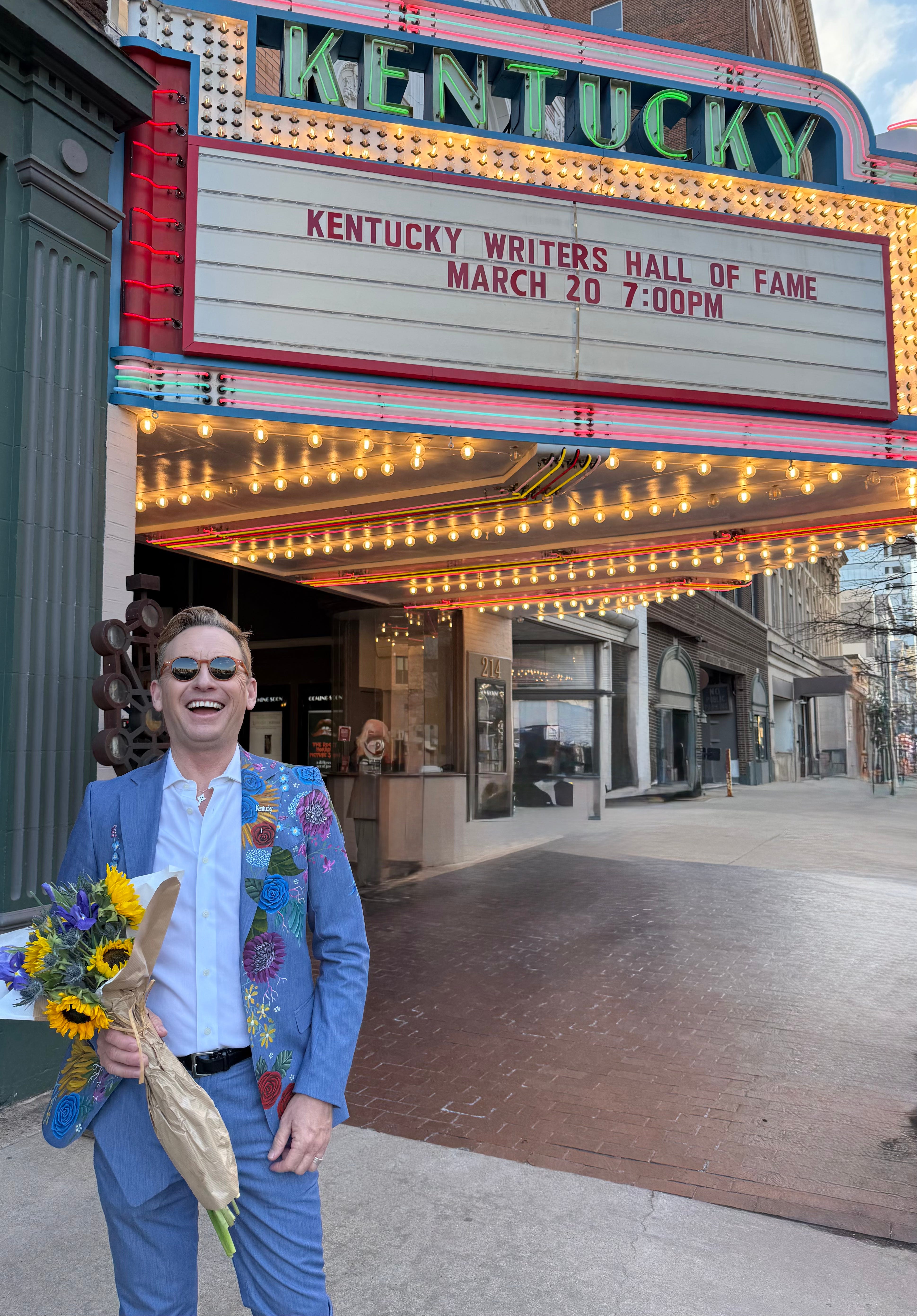
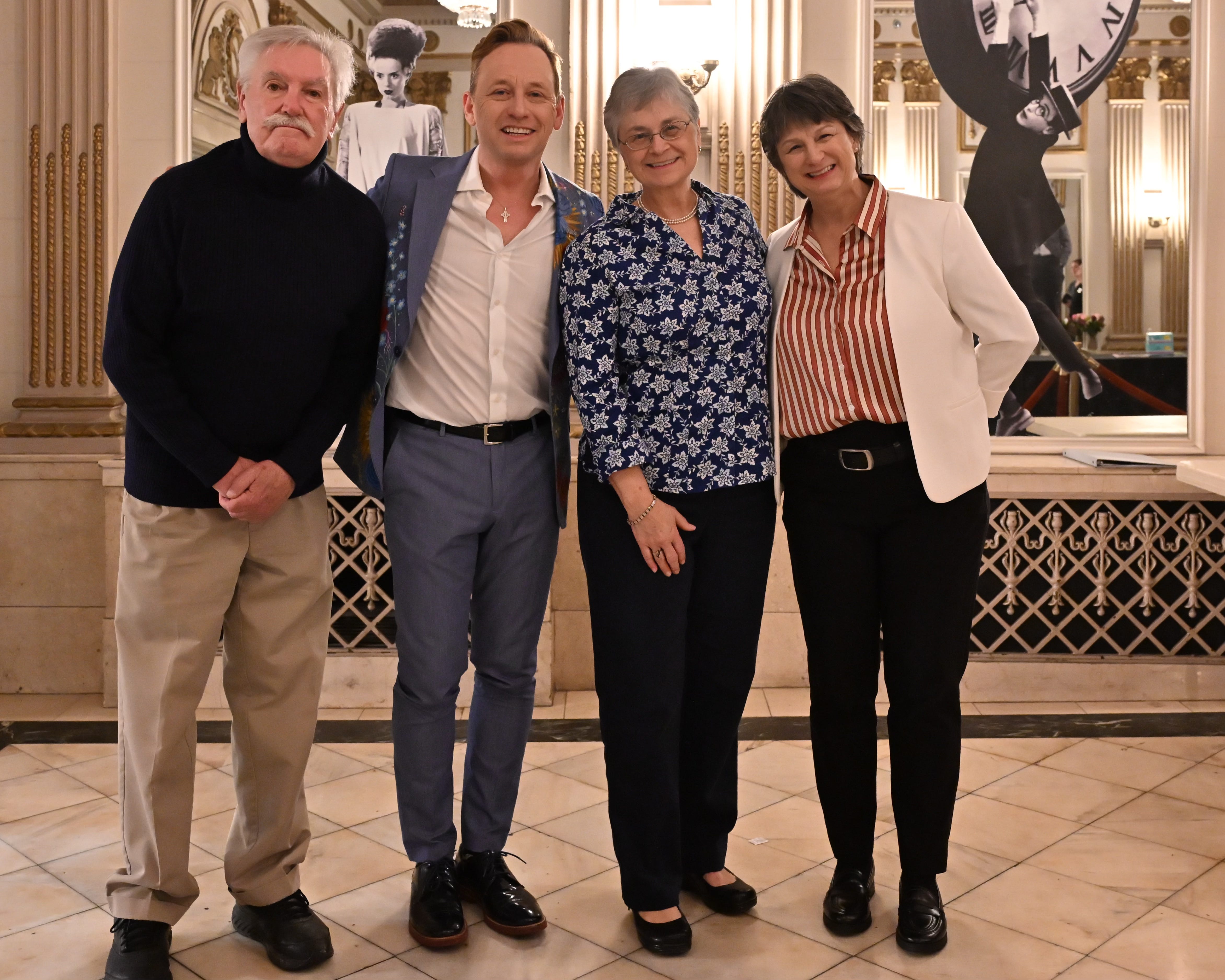
On March 30 I was honored to be inducted into the Kentucky Writers Hall of Fame by Frank X Walker (alongside fellow inductees Debbie Dadey, Marcia Thornton Jones, and Jeff Worley). I’m thankful to the Carnegie Center and the Kentucky Arts Council for this honor. What follows is a condensed version of my speech that I gave upon being inducted, and here I leave out my listing of several people who were integral to my journey as being an artist in the hopes of making it a more concise written piece. I’ve edited the speech down to share with you here at the request of many who were present that night.
In 6th grade my teacher was named Uldean Black and she chose me to write the class play that year. She saw me as a writer. In 7th grade my English teacher read my writing and gave me books that opened my world. Her name is Sandra Stidham. When I was 25 and trying to figure out what to do with the novel I had just finished the writer Lee Smith, my literary mother, took me under her wing and guided me to the Appalachian Writers Workshop at the Hindman Settlement School, where I found a core community that has continued to carry me through my highs and lows. There I also found Mike Mullins, the director at Hindman, who stepped in as a surrogate parent when I needed him the most, and who helped to pave the way for me in the Kentucky literary world. I also found George Ella Lyon, who took me seriously and gave me my first blurb and was kind to me, always. Later, George Ella and I and several other writers worked together in the fight against mountaintop removal. One of the things I’m most proud of is that we fought back. In that fight, Wendell Berry became another mentor for me, and like a good father figure he gently corrected me when I was wrong and told me when I had done right. I found people who were tender, kind, honest and loving.
The older I get, and the longer I am a writer, the more I understand that, as the Beatles have taught us, “all you need is love”. And I’ve found so much love and acceptance in Lexington since I moved here eight years ago. Among writers, and the LGBT community, and in the Episcopal church, which has welcomed me as I am. A few months ago, I and other writers were asked to contribute lines to the new sculpture downtown to capture our feelings about Lexington. My poem goes like this:
A little fire
when others left us
out in the cold.
Our city of refuge.
This city has been that for me as a gay person, as an Appalachian refugee, and as a person of faith.
Before that, the community of my childhood lifted me up as an artist. I’ll only mention the ones closest to me tonight, but there were others. My Aunt Sis bought me my first guitar and said, “Here, now, go be the next Eddie Rabbit.” She bought me my first typewriter and said, “Take this now, and write the next Peyton Place.” She took me to see films that I was too young to see, but that became foundational for me as an artist: Tender Mercies, The Exorcist, Terms of Endearment, Coal Miner’s Daughter. My cousin, Eleshia, let me roll down the windows and hang my body out the window while she played music as loud as it would go and drove fast on the winding country roads.
I was so lucky to have parents who didn’t dismiss my dream of being a writer. Instead, they scraped and saved to buy me the World Book Encyclopedia. My mother took me to the library, and we all know libraries are the epitome of equity and civilization. My father did not scoff when I declared at the age of twelve that I wanted to be a writer. They were my first models in social justice. I often saw them quietly helping others, not asking for recognition. My mother worked in the lunchroom at our elementary school and later I would be told by grown classmates that she often bought them clothes and slipped them money for food. My father spent his free time helping people in the community who needed him. My parents worked all the time because they had been raised in deep poverty and they wanted to make sure that I would not have to experience that.
And they stood by me, even when I was causing big trouble because I could not bear to silently witness injustice. As a senior in high school I was the editor of the paper and I excoriated a group for their blatant classism in a long, controversial editorial that ended up with me being physically attacked by a teacher. This was my first lesson in the power of the written word and its ability to change things. “If you’re making people mad, then you must be doing something right,” my aunt told me.
I grew up across from the foot of a ridge where pine trees and tulip poplars gathered around a creek lined with mossy rocks. There was a steep hill perfect for sledding. In the pastures my childhood best friend Donna and I often laid among the swaying grass to watch the clouds and have existential conversations at the ages of nine or ten.
This was a wild place.
Then one day, bulldozers converged and for the next couple of years this precious place became an open wound. As the grandson of a coal miner in a family that had risen out of poverty due to the mines, for the first time I had a deep understanding of paradox and complexity. But most of all I saw the injustice at hand in the way our commons—air, land, water—were polluted. That strip mine set up a little fire in me that never has gone out and writing has been my greatest outlet for naming injustice and fighting back.
Now, I believe, we are up against the worst injustices of my lifetime. Fascism is moving across the world like a gathering storm, and its eye is posed over the United States. One of the reasons this has happened is because there is less empathy in our country than there used to be. There is less empathy partly because fewer people read. Cruelty is celebrated and laughed about. Arrogance is rewarded instead of ostracized. Art is negated, and tenderness certainly is. We are living under a regime that never speaks of love and does not truck in beauty. I believe art, and especially literature, can fight fascism, and cruelty, and hard-heartedness. I know that it can change people’s minds and hearts because it has changed my own. When I read The Color Purple in the ninth grade, my heart and mind were cracked open. Other books have been life-changing for me, too:
Fair and Tender Ladies by Lee Smith
Gilead by Marilynne Robinson
Beloved by Toni Morrison
The Dollmaker by Harriette Arnow
A Prayer for Owen Meany by John Irving
Jonah’s Gourd Vine by Zora Neale Hurston
Jude the Obscure by Thomas Hardy
My Antonia by Willa Cather
Jayber Crow by Wendell Berry
The Last Report on the Miracles at Little No Horse by Louise Erdrich
There are others. And there are also films, paintings, plays, songs. So many songs. I believe that art can change the world. I believe that art makes us more empathetic. That’s why we all must fight for it. Some of us by continuing to create it. But all of us in refusing to allow it to be negated by legislators or the larger culture, whether it be the art contained in banned books or the art of drag.
We are living in a time when people are being put on lists because of how they identify, a time when poets and nurses are being murdered in the streets for protesting. We must stand up for them by making art and by speaking up, no matter the cost. But most of all by holding onto love and empathy. Some of my favorite lines I’ve written are in a poem called “A River” (full poem here and below) and I want to aim for the close by reading them to anyone who has felt negated or belittled or targeted in this era of new cruelty. The lines go:
You know yourself,
so only be yourself
and do not fret, for if more
could be like you, they might
be free themselves.
As a writer, I want to create more empathy, to conjure hope, to put more tenderness and love into the world even while naming its evils and uglinesses, and to always fight back, to name evil and speak out against atrocity. Sometimes love requires that. I speak out because I love my country. I speak out because I love my state. I write because I want to change the world, even if it’s the heart of only one reader. And I believe that if we do all of these things with love as the propellent, our fight is just.
-end-
The title of this essay is a referene to a favorite song by Mary Chapin Carpenter:
Mentioned:
Comments
Nothing yet. Say the first thing.
Sign in to join the conversation.