

There is a constant truth of creative life that we do not talk about enough.
When your creativity becomes your job, it becomes accountable.
Accountable to briefs.
To clients, stakeholders and, internal teams.
To timelines and tradeoffs.
That accountability is not wrong. It is the work. But it changes where meaning can live if you are not careful.
I have always been a tinkerer. If I am not making something, experimenting, or pulling at an idea, I feel it immediately. That instinct existed long before it became professional. What I have noticed, though, is how easily that instinct gets fully absorbed and solely dominated by client work for many creatives.
Client work can feel like the most legitimate place to put your creative energy. It is visible. It is rewarded. It comes with feedback and affirmation. Oh, there’s a great deal of money at stake.
So it slowly becomes the place where creatives look for everything.
It’s true - creatives do well with boundaries. But if they are not the ones ever to create the boundary, motivations are blurred.
When that happens, creativity narrows. Every idea has to survive a room. A review. Every risk has to be defensible. Every instinct sound. And while great practice, can be daunting for the creative instinct that demands freedom.
Even still, top performers perform. Younger talent can still grow and thrive. The danger is not that the work suffers. The danger is that the creative does. They tend to lose a part of themselves. The thing that drove them to the place they are now. The thing that makes them who they are.
Creativity does not switch modes cleanly between professional and personal. It is a single muscle. And like any muscle, it reflects how it is used.
Client work exercises important parts of it: collaboration, clarity, discipline, restraint. But it rarely exercises raw expression. Curiosity without justification. Play without outcome.
When those parts are left unused, they can weaken.
That is when creatives start to feel flat, cautious, or overly dependent on approval. Not because they lost talent, but because they stopped practicing a full range of expression.
The spark that fuels meaningful creative work does not originate inside constraints alone.
It comes from music made without an audience.
From writing that no one is waiting to read.
From building or learning something purely because it pulls at you.
These practices reconnect creatives to their true creative selves. The part that makes without asking if it is useful. The part that follows instinct instead of instruction.
That energy does not stay outside the work. It feeds it.
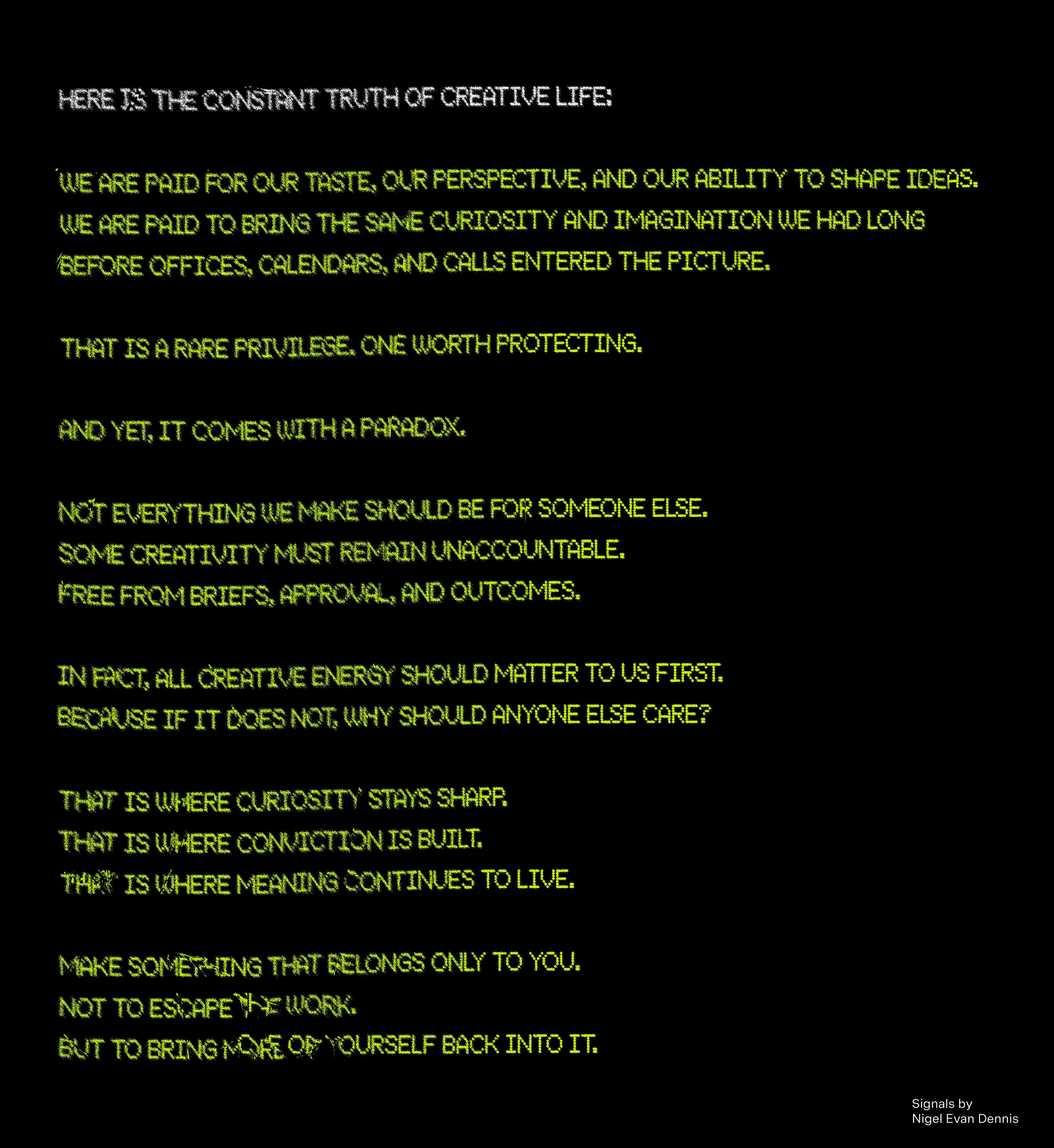
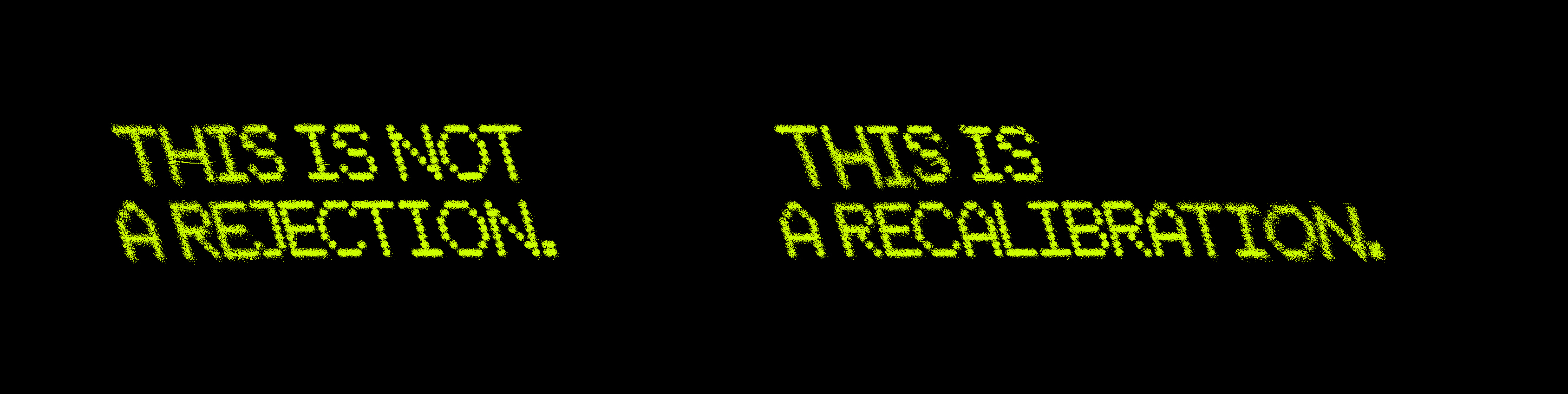
This is not a rejection of client work. It is a correction.
When creatives maintain expression outside of work, they show up differently inside it. More confident. More resilient. More willing to lead with a point of view.
Not because they are trying to extract purpose from the job, but because they are not asking it to be everything.
When they lose expression outside of work, atrophy sets in. And turns to apathy - everywhere.
Do your best to make sure this doesn’t happen.
Protect that space. Schedule it if you have to. Treat it as seriously as you treat your job.
Because creativity does not thrive on output alone. It thrives on practice.
And the work is always better when it is fed by something real.

Now, you may read this and think ‘actually, I’m ok with the balance I’ve struck’ and you are fulfilled with your current situation. And that’s ok too. But tend to that creative muscle and keep an eye on it.
If you feel any inkling in reading this that you need to make a change, please do and reach out in the comments if you’d like to talk directly about ideas for ‘how’.
No posts
Comments
Nothing yet. Say the first thing.
Sign in to join the conversation.