
Let’s dive right in.
Ever wondered why your boomer parents clutch their government bonds while you're HODLing crypto? Or why your Gen X uncle won't stop talking about his S&P 500 index fund? Well, you're in the right place.
I personally think of this meme as the most elegant meme of this year - the Barbell Strategy across generations. It's not just a funny image; it's a window into how different generations perceive and process risk.
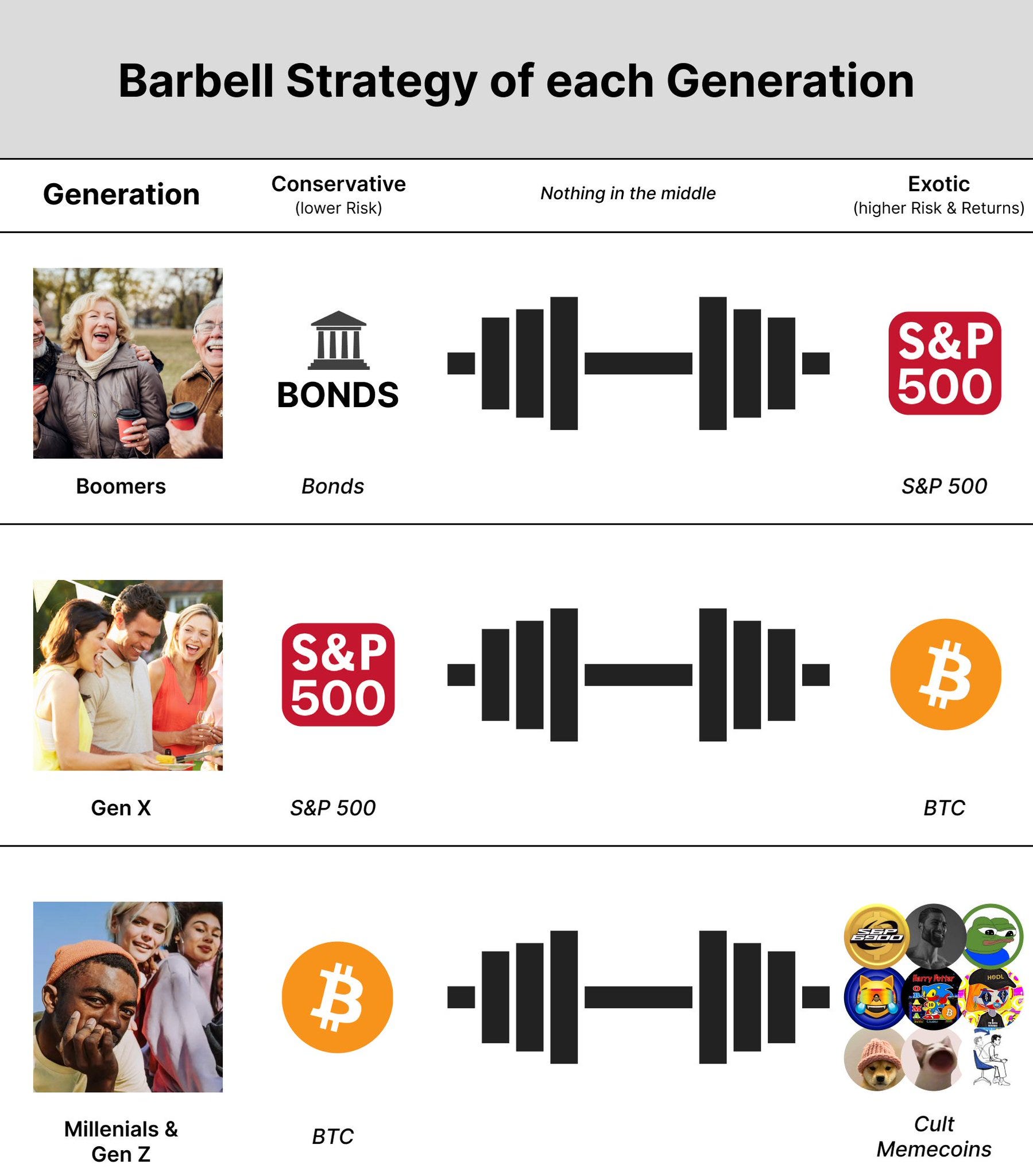
Each generation has redefined what they consider "safe":
Boomers: Government bonds are the bedrock of safety (after all, they lived through the golden age of American hegemony)
Gen X: The S&P 500 is their "risk-free" rate (having witnessed the longest bull market in history)
Millennials/Gen Z: Bitcoin serves as their stability benchmark (growing up through financial crises and monetary experiments)
This shift in baseline risk perception tells us something profound: what one generation considers "extreme volatility," another views as business as usual. It's like how your grandparents think texting while walking is dangerous, while you can practically write a novel on your phone during your morning commute.
The "moonshot" investments are equally telling:
Boomers: Stock picking feels adventurous
Gen X: BTC seems adventurous but I think it is the correct progression
Millennials/Gen Z: Attention economy is where the rewards lie. You make yourself up the ladder taking these risks.
This progression reveals an increasing comfort with digital abstraction and higher volatility tolerance. But it also reveals a small unconscious rebellion towards the traditional order (and the financial systems).
This generational barbell strategy signals a fundamental shift in:
Trust in traditional institutions
Time horizons for investment decisions
What constitutes "real" value in a digital age
The beauty of this simple meme is that it captures a complex transformation in risk perception that no amount of sophisticated financial modeling could better express. While we'll be diving much deeper into system analysis in future posts, this theme of perceived systemic risk will be a recurring motif. These "signals" of collective perception, simple as they may appear, often tell us more about the underlying system than any technical indicator.
Remember: Today's "crazy speculation" might be tomorrow's "conservative allocation." Just don't tell that to your boomer parents while they're checking their bond portfolio.
Imagine the financial world as a city: Wall Street's grand boulevards represent traditional banking, while the Tech and DeFi are the rapidly developing districts where streets are still being paved. This Substack is your guide through both the established neighborhoods and the experimental quarters of this value metropolis.
Think of me as your urban explorer - someone who knows both the city's historic architecture and its emerging frontiers. Together, we'll map the changing landscape of how value moves, stores, and transforms in our modern financial ecosystem.
We'll investigate fundamental patterns that shape this city:
Feedback Loops: Like a busy intersection where one traffic jam creates another, until the whole system grinds to a halt - or mysteriously resolves itself.
Equilibrium: Similar to how neighborhoods find their character over time, but can transform dramatically with one new development project.
Bottlenecks: The bridges and tunnels of our financial system - points where everything must pass through, creating both stability and vulnerability.
Scale: How a small food cart can become a citywide chain, and why some ideas work better at certain sizes than others.
System Resilience: The financial equivalent of earthquake-proofing - understanding how systems can bend without breaking. Just as a city is more than its map, these systems are more than their technical descriptions. They're living, breathing organisms shaped by human behavior, technology, and sometimes, sheer chaos.
The Anatomy of Value Systems
What transforms an arbitrary token - whether a piece of paper or a digital coin - into something we call money? We'll dissect how different systems, from the U.S. dollar to Bitcoin, create and maintain their value through complex webs of trust, technology, and human behavior.
Reading the System's Vital Signs
Think of this as financial detective work. Just as a doctor uses multiple indicators - heart rate, blood pressure, temperature - to assess health, we'll explore the key signals that reveal the true state of value systems. From market microstructure to social sentiment, from institutional flows to technological adoption patterns.
The Evolution of Capitalism
How do systems adapt when everyone starts recognizing the same patterns? It's like when everyone discovers a "secret" trading strategy - it stops working. We'll explore how value systems evolve when their patterns become common knowledge, and what this means for the future of capitalism.
We're living through a unique convergence of transformative forces:
Traditional Systems Are Being Stress-Tested
The U.S. dollar system is experiencing its real challenge since Bretton Woods and expecting more abrupt changes
Central bank experiments have moved from theoretical to practical
Global trade routes are being redrawn faster than a GPS recalculating
New Systems Are Emerging
AI isn't just chatbots - it's reshaping how we create and measure value
Crypto isn't just about Bitcoin anymore - it's about reimagining what money can be with new Hierarchies of Money
Digital networks are creating new forms of capital that don't fit traditional models
Think of it like this: We're not just getting software updates anymore; we're witnessing the entire operating system being rewritten. And unlike your phone's OS, you can't just skip this update - it's happening whether you're paying attention or not.
This isn't just about making money (though that's nice too). It's about understanding the new rules of the game as they're being written. Because in times of massive change, the biggest opportunities - and risks - come from seeing the shifts before they become obvious.
The name "Signals and Systems" comes from engineering - where we learn to extract meaningful patterns from complex data. But instead of analyzing electrical circuits, we'll be decoding something far more intriguing: the patterns of value in our financial world.
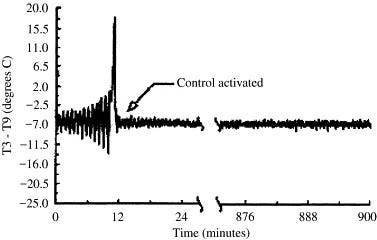
Think of it as pattern recognition for money flows. Just as engineers decode radio waves to extract music, we'll decode market behavior to understand the deeper rhythms of value systems. The key difference? Unlike predictable electrical signals, human behavior and market patterns are delightfully messy and rarely follow the rulebook.
Join me as we decode the signals that shape our financial future.
Comments
Nothing yet. Say the first thing.
Sign in to join the conversation.