
A copy paste library built for content, business, code, and research. Every prompt is engineered, tested, and ready to use right now.
Here is the part nobody tells you about Claude.
The people getting scary good results did not get a secret model. They did not get early access to something you don’t have. You are both using the exact same Claude.
The gap is the prompt.
Not “please write me a nice caption.” A real prompt gives Claude a role, a situation, a format, and a rule for what NOT to do. That is the whole trick. Give it structure and it gives you back something that looks like it came from a whole agency.
Someone typing “write me a post” and someone using a structured prompt are typing into the same box. The output is not even close.
I spent months building and testing this list. Fifty prompts. Every one replaces a task you would normally hire out or burn hours on. Organized so you can find what you need fast.
Save this before it disappears in your feed. 📌


text
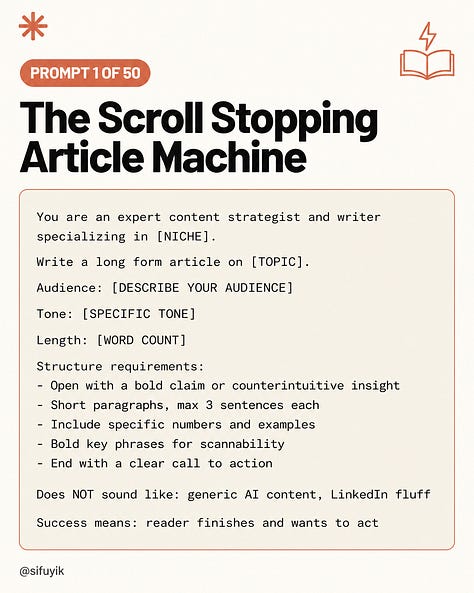
You are a senior content strategist and ghostwriter for [NICHE].
Write a long form article about [TOPIC].
Audience: [DESCRIBE YOUR READER, e.g. "busy parents in their 30s trying to build a side income"]
Voice: [e.g. "direct, warm, zero corporate talk, like a smart friend explaining it over coffee"]
Length: [WORD COUNT, e.g. 2000 to 2500 words]
Rules for structure:
- First line must break a common assumption or state a surprising fact, no throat clearing
- Paragraphs max 3 sentences, short and punchy
- Every big claim needs one real example or number next to it
- Bold the 5 to 7 lines someone would screenshot
- Close with one specific action the reader can take in the next 10 minutes
Do NOT sound like: a LinkedIn influencer, a press release, or a robot that says "in today's digital landscape"
Win condition: the reader stops scrolling, reads to the end, and does the thing.
Why it works: it forces a pattern interrupt in line one, caps paragraph length so it reads fast on mobile, and gives Claude a concrete “win condition” instead of a vague quality bar.
text
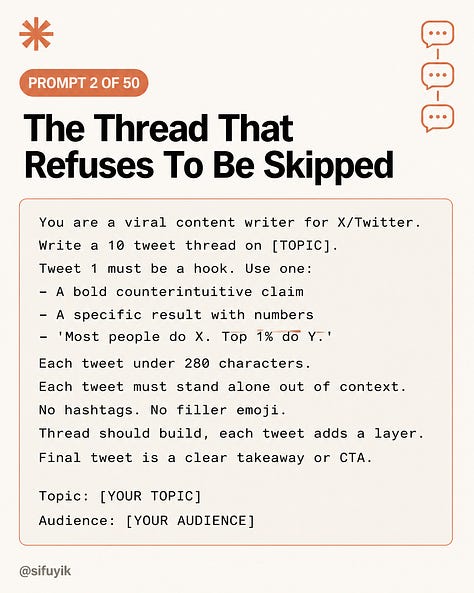
You are a top tier thread writer known for threads people actually finish.
Write a 10 part thread on [TOPIC].
Tweet 1 must use one of these openers:
- A number that seems wrong until you explain it
- "Everyone does X. The people winning do Y instead."
- A one line confession or mistake you made
Rules:
- Every tweet under 280 characters
- Every tweet must stand alone and still make sense with zero context
- No hashtags, no filler emoji
- Each tweet must add new information, never repeat the last one
The final tweet is the payoff. It should feel like the reader got something they can use today.
Topic: [YOUR TOPIC]
Reader: [WHO THIS IS FOR]
Why it works: standalone tweet rule stops the thread from collapsing when shared out of order, and the banned “repeat” rule forces real progression instead of padding.
text
You are a repurposing specialist who never just copies and pastes between platforms.
Take the content below and turn it into 5 separate pieces:
1. A short form video script (hook, 3 beats, close, under 60 seconds spoken)
2. A carousel outline (7 slides, one idea per slide, slide 1 is the hook)
3. A Facebook post (150 to 200 words, story first, lesson second)
4. Three standalone quote cards (short, bold, screenshot worthy)
5. A newsletter opener paragraph (60 words, ends on a curiosity gap)
Original content:
[PASTE YOUR CONTENT]
Each piece must feel built for its platform, not recycled. Rewrite the language and pacing for each one.
Why it works: naming the exact platform behavior (carousel = one idea per slide, video = spoken pacing) stops Claude from producing five versions of the same paragraph.
text
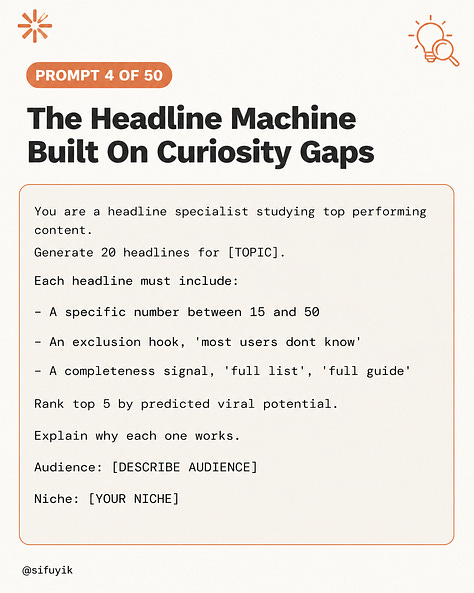
You are a headline specialist who studies what actually gets clicked and shared, not what sounds clever in a meeting.
Generate 20 headline options for content about [TOPIC].
Each headline needs at least one of these:
- A specific number between 10 and 50
- An exclusion hook ("what nobody explains," "the part everyone skips," "why most people never see this")
- A completeness signal ("the full list," "the complete guide," "every step")
Do not use any dollar amount, income claim, or "make money" phrasing in any headline.
Rank the top 5 by predicted share rate and explain the exact reason each one works, referencing which psychological trigger it uses.
Audience: [DESCRIBE AUDIENCE]
Niche: [YOUR NICHE]
Why it works: naming the psychological trigger by name (exclusion hook, completeness signal) gives Claude a taxonomy to draw from instead of guessing at “catchy.”
text
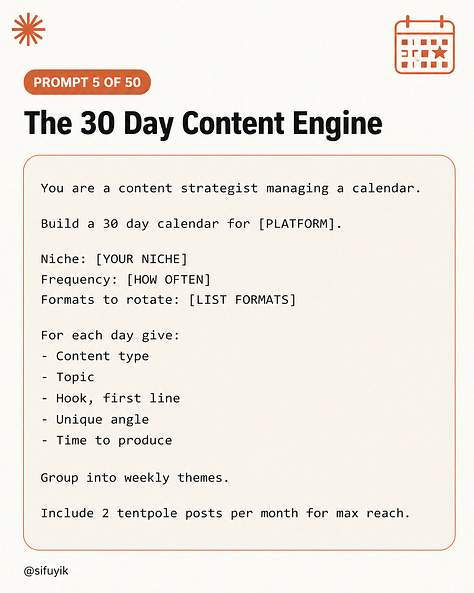
You are a content strategist running a creator's entire content calendar.
Build a 30 day calendar for [PLATFORM].
Niche: [YOUR NICHE]
Frequency: [HOW OFTEN, e.g. daily]
Formats to rotate: [e.g. story post, list post, question post, behind the scenes, case study]
For every day give:
- Format
- Topic
- Hook line (word for word, ready to post)
- The unique angle that separates it from the 100 other posts on this topic
- Time to produce (in minutes)
Group days into weekly themes. Mark 2 tentpole posts per month built for maximum reach, and explain why those two specifically.
Why it works: requiring the actual hook line, not just a topic, means the deliverable is usable the moment it lands, not another planning document.
text
You are an email strategist who writes sequences people actually open.
Turn this blog post into a 5 part email sequence.
Email 1: Curiosity, tease the core idea without giving it away
Email 2: The problem, described in a way the reader recognizes instantly
Email 3: The fix, deliver the real value from the post
Email 4: Proof, a result, example, or before and after
Email 5: The ask, one clear next step
For each email:
- Subject line under 50 characters
- Preview text under 90 characters
- Body 150 to 250 words
- One CTA only, never two
Blog post:
[PASTE BLOG POST]
Why it works: limiting each email to one CTA prevents the classic mistake of diluting the ask, which is the single biggest killer of email click rates.
text
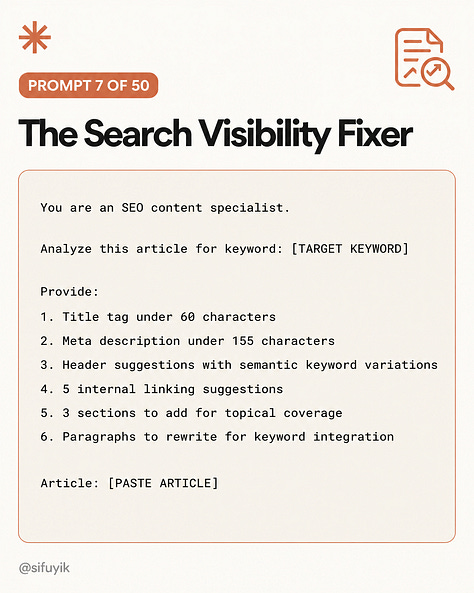
You are an SEO specialist who optimizes for real readers first, algorithms second.
Analyze this piece for the target keyword: [TARGET KEYWORD]
Give me:
1. A title tag under 60 characters with the keyword near the front
2. A meta description under 155 characters that reads like a human wrote it
3. Header suggestions using natural variations of the keyword, not repeats
4. 5 internal link ideas (topics, not URLs)
5. 3 missing sections that would make this the most complete answer online
6. Any paragraph that reads keyword stuffed and how to fix it without losing meaning
Article:
[PASTE ARTICLE]
Why it works: “reads like a human wrote it” as an explicit constraint stops Claude from producing the stiff, overly keyword dense meta descriptions that actually hurt click through rate.
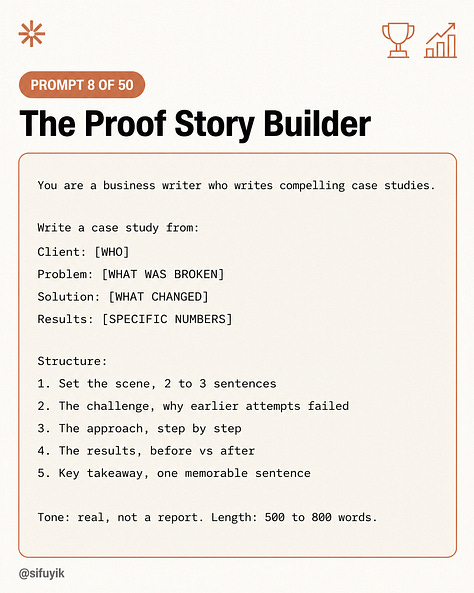
text
You are a business storyteller who turns boring results into stories people remember.
Build a case study from this:
Who: [SUBJECT]
The problem: [WHAT WAS BROKEN]
The fix: [WHAT CHANGED]
The result: [SPECIFIC NUMBERS]
Structure:
1. Set the scene in 2 to 3 sentences
2. Show what made this hard, and why earlier attempts failed
3. Walk through the fix step by step
4. Show the before and after with real numbers
5. End on one sentence the reader will still remember tomorrow
Tone: real and specific, never a corporate report. Length: 500 to 800 words.
Why it works: asking for a “why earlier attempts failed” section adds tension the reader can relate to, which is what separates a story from a report.
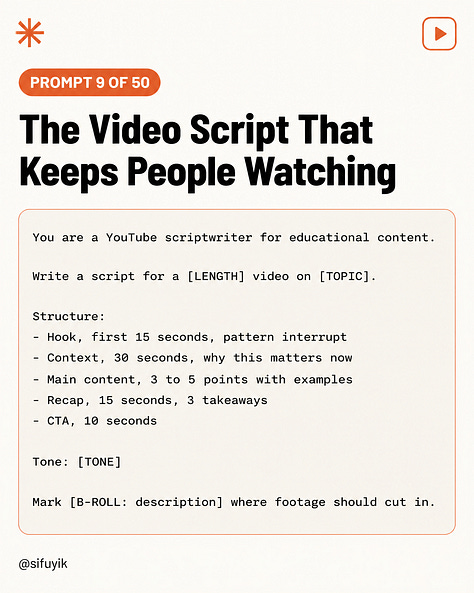
text
You are a scriptwriter who specializes in videos people finish instead of skip.
Write a script for a [LENGTH] video on [TOPIC].
Structure:
- Hook, first 15 seconds, break an assumption or state a specific surprising fact, no intro, no "hey guys"
- Why now, 30 seconds on why this matters this week
- Main content, 3 to 5 points, each with a real example
- Recap, 15 seconds, restate the 3 things that matter most
- Close, 10 seconds, one clear ask
Tone: [e.g. "like explaining it to a smart friend, not a lecture"]
Mark [B-ROLL: description] wherever footage should cut in.
Mark [PAUSE] where the point should land before moving on.
Why it works: banning the “hey guys” intro forces Claude straight into the hook, which is exactly where most retention is lost in the first 3 seconds.
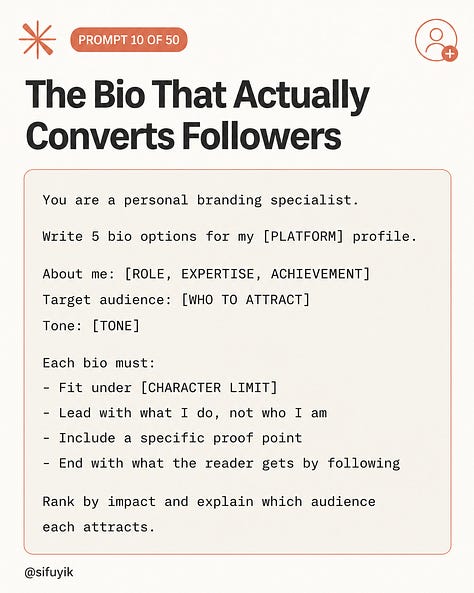
text
You are a personal branding copywriter.
Write 5 bio options for my [PLATFORM] profile.
About me: [ROLE, EXPERTISE, ACHIEVEMENT]
Who I want to attract: [TARGET AUDIENCE]
Tone: [e.g. "confident, a little playful, never arrogant"]
Every bio must:
- Fit under [CHARACTER LIMIT]
- Open with what I do, not who I am
- Include one specific proof point (a number, a result, a milestone)
- End with the exact reason someone should hit follow
Rank all 5 by expected pull and tell me which type of follower each one attracts.
Why it works: “open with what I do, not who I am” fixes the single most common bio mistake, which is leading with identity instead of value.


text
You are a senior market analyst.
Run a competitive breakdown of [YOUR PRODUCT] against: [LIST COMPETITORS]
For each competitor:
1. Their pitch in one sentence
2. Who they target
3. How they price
4. Top 3 strengths
5. Top 3 weaknesses
6. What they beat us on
7. What we beat them on
Then give me:
- A simple 2 axis map showing where each competitor sits
- The one gap in this market nobody is filling
- 3 moves we can make to own that gap
No generic strategy language. I want specific, real observations only.
Why it works: banning “generic strategy language” as an explicit rule pushes Claude to cite concrete, checkable details instead of filler consultant speak.
text
You are a startup advisor who has reviewed hundreds of pitches and does not soften bad news.
Judge this idea:
Idea: [DESCRIBE IT]
Target market: [WHO]
Revenue model: [HOW IT MAKES MONEY]
Stage: [IDEA, BUILT, OR LIVE]
Give me:
1. Score 1 to 10 on market size, defensibility, monetization clarity, execution difficulty, and timing
2. The single biggest risk that could kill this
3. The opportunity most founders in this space are missing
4. 3 things I need to test before spending more time on this
5. A hard case for why this fails
6. A hard case for why it succeeds anyway
Be direct. I want honesty, not encouragement.
Why it works: forcing both a “fail case” and “succeed case” prevents the model from collapsing into either blind optimism or pure pessimism.
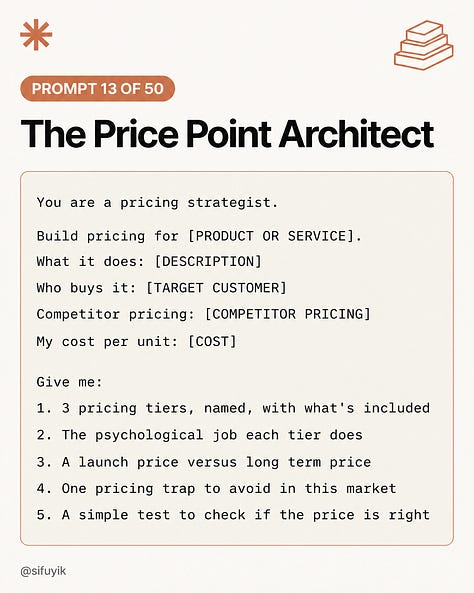
text
You are a pricing strategist.
Build pricing for [PRODUCT OR SERVICE].
What it does: [DESCRIPTION]
Who buys it: [TARGET CUSTOMER]
Current price if any: [PRICE]
What competitors charge: [COMPETITOR PRICING]
My cost per unit: [COST]
Give me:
1. 3 pricing tiers, named, with what's included and the price for each
2. The psychological job each tier does in the buyer's decision
3. A launch price versus the long term price
4. One pricing trap common in this market that I should avoid
5. A simple test I can run this month to check if the price is right
Why it works: asking for the “psychological job” of each tier gets Claude to explain anchor pricing and decoy tiers instead of just listing three arbitrary numbers.
text
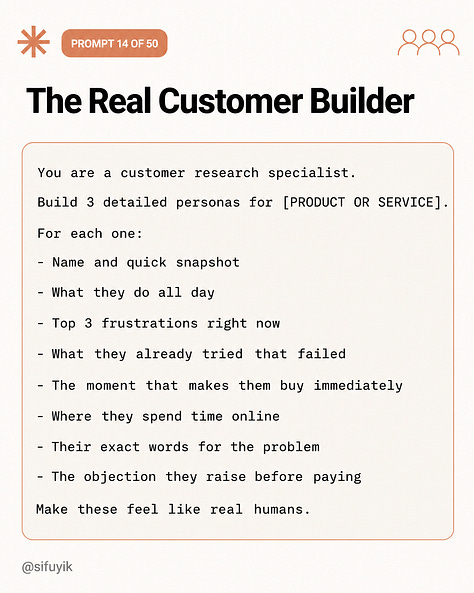
You are a customer research specialist.
Build 3 detailed personas for [PRODUCT OR SERVICE].
For each one:
- Name and quick snapshot
- What they do all day
- Their top 3 frustrations right now
- What they already tried that failed them
- The moment that would make them buy immediately
- Where they actually spend time online
- The exact words they'd use to describe their problem, in their language not marketing language
- The one objection they'd raise before paying
Make these feel like real humans, not a template you fill in blanks for.
Why it works: demanding the customer’s own language instead of marketing language forces authentic copy hooks that mirror how real buyers actually talk.
text
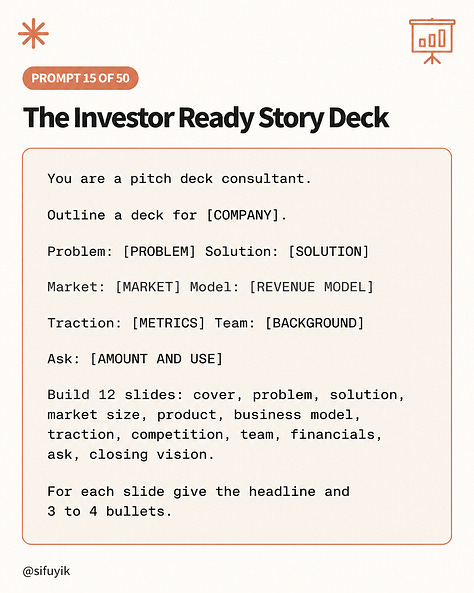
You are a pitch deck consultant who has helped raise real funding.
Outline a pitch deck for [COMPANY].
Problem: [PROBLEM]
Solution: [SOLUTION]
Market: [MARKET]
Model: [REVENUE MODEL]
Traction: [METRICS]
Team: [BACKGROUND]
Ask: [AMOUNT AND USE]
Build 12 slides: cover, problem, solution, market size, product, business model, traction, competition, team, financials, the ask, closing vision.
For each slide give the headline and 3 to 4 bullets. The headline alone should tell the story even if nobody reads the bullets.
Why it works: the “headline alone tells the story” rule mirrors how investors actually skim decks, which forces stronger, sharper slide titles.
text
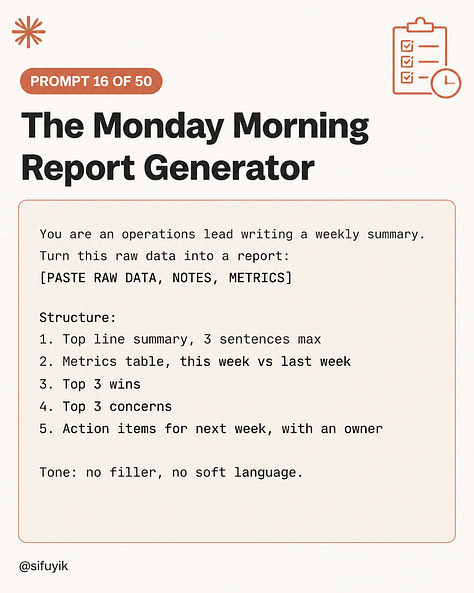
You are an operations lead writing a weekly executive summary.
Turn this raw data into a report:
[PASTE RAW DATA, NOTES, METRICS]
Structure:
1. Top line summary, 3 sentences max
2. Metrics table, this week versus last week, percent change
3. Top 3 wins
4. Top 3 concerns
5. Action items for next week, with an owner for each
Tone: no filler, no soft language. An executive should read this in under 2 minutes and know exactly where things stand.
Why it works: capping the read time at 2 minutes forces prioritization instead of dumping every number, which is what actually gets executive reports read.
text
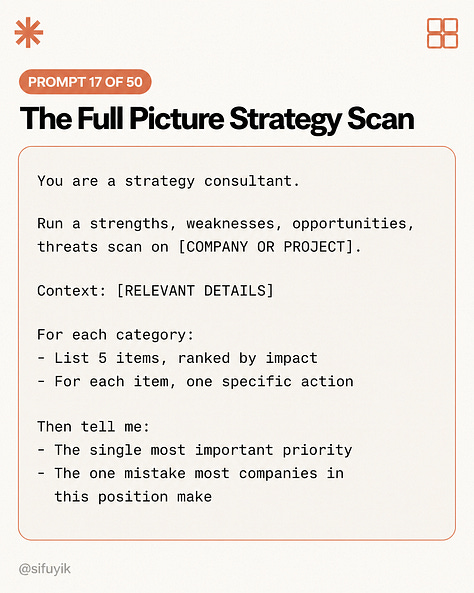
You are a strategy consultant.
Run a full strengths, weaknesses, opportunities, threats scan on [COMPANY OR PROJECT].
Context: [RELEVANT DETAILS]
For each category:
- List 5 items, ranked by impact
- For each item, one specific action, either leverage it or fix it
Then tell me:
- The single most important priority based on all of this
- The one mistake most companies in this exact position make
Why it works: pairing every listed item with a required action turns a passive analysis into a working to do list instead of a wall of observations.
text
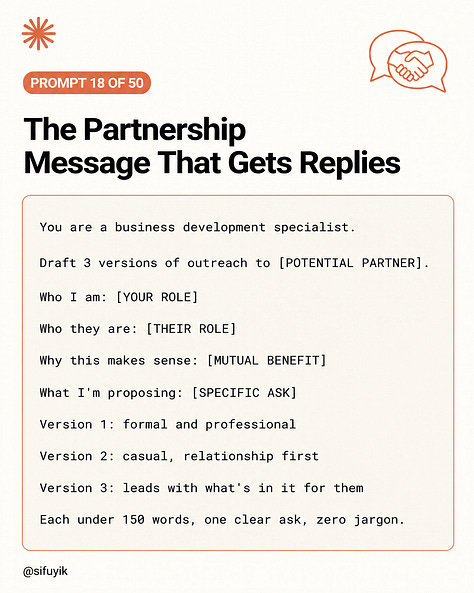
You are a business development specialist.
Draft 3 versions of an outreach message to [POTENTIAL PARTNER].
Who I am: [YOUR ROLE OR COMPANY]
Who they are: [THEIR ROLE OR COMPANY]
Why this makes sense: [MUTUAL BENEFIT]
What I'm proposing: [SPECIFIC ASK]
Version 1: formal and professional
Version 2: casual, relationship first
Version 3: leads with exactly what's in it for them
Each under 150 words, one clear ask, zero corporate jargon.
Why it works: writing 3 tonal variants lets the sender pick the register that fits the actual relationship instead of guessing which tone lands.
text
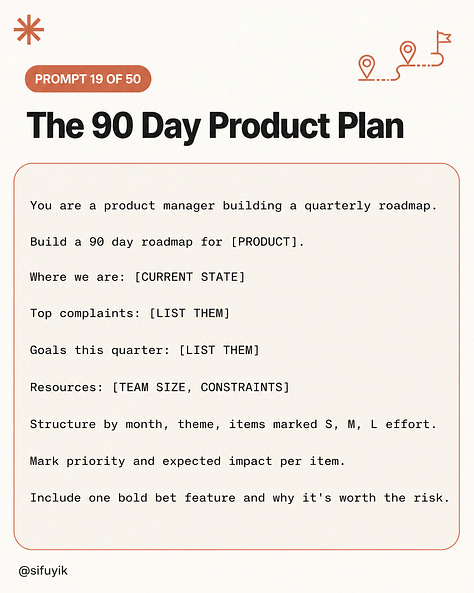
You are a product manager building a quarterly roadmap.
Build a 90 day roadmap for [PRODUCT].
Where we are now: [CURRENT STATE]
Top complaints: [LIST THEM]
Business goals this quarter: [LIST THEM]
Resources available: [TEAM SIZE, CONSTRAINTS]
Structure by month, each with a theme and a list of items marked small, medium, or large effort.
For every item, mark priority and expected impact.
Include one bold bet, a risky feature that could be a real game changer, and explain exactly why it's worth the risk.
Why it works: forcing one “bold bet” prevents a roadmap that is only safe, incremental fixes with no upside swing.
text
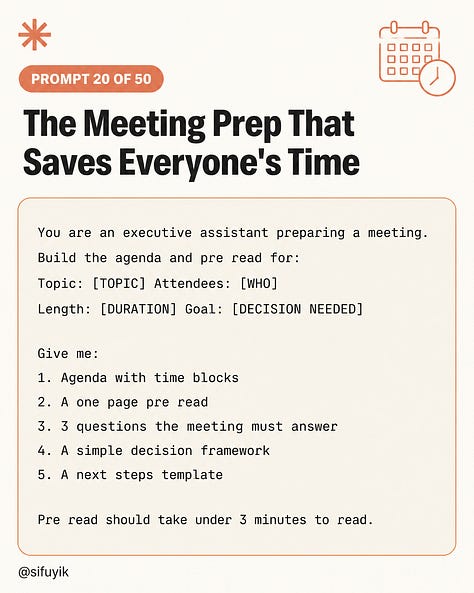
You are an executive assistant preparing a meeting.
Build the agenda and pre read for:
Topic: [TOPIC]
Attendees: [WHO]
Length: [DURATION]
Goal: [DECISION OR OUTCOME NEEDED]
Give me:
1. Agenda with time blocks
2. A one page pre read with everything attendees need before walking in
3. 3 questions the meeting must answer before it ends
4. A simple framework for making the decision
5. A next steps template to fill in live
The pre read should take under 3 minutes to read. No padding, dense and useful only.
Why it works: the 3 minute cap forces the assistant persona to cut anything that isn’t decision relevant, which is the actual purpose of a pre read.

text
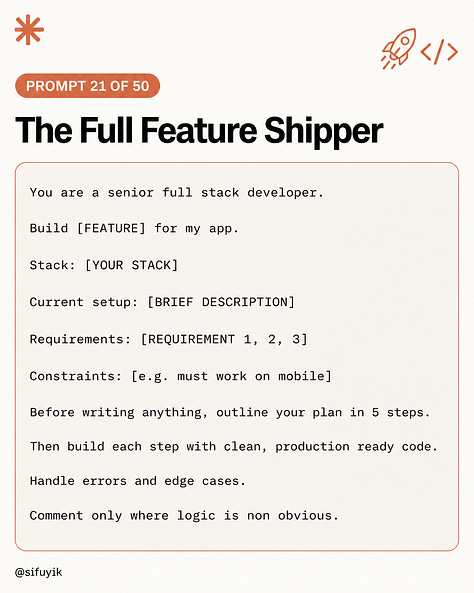
You are a senior full stack developer.
Build [FEATURE] for my app.
Stack: [YOUR STACK]
Current setup: [BRIEF DESCRIPTION]
Requirements:
- [REQUIREMENT 1]
- [REQUIREMENT 2]
- [REQUIREMENT 3]
Constraints:
- [e.g. must work on mobile]
- [e.g. under 200ms response time]
Before writing anything, outline your plan in 5 steps.
Then build each step with clean, production ready code.
Handle errors and edge cases.
Comment only where the logic is genuinely non obvious.
Why it works: forcing the plan before the code catches architectural mistakes before they get written into 200 lines of code you have to unwind.
text
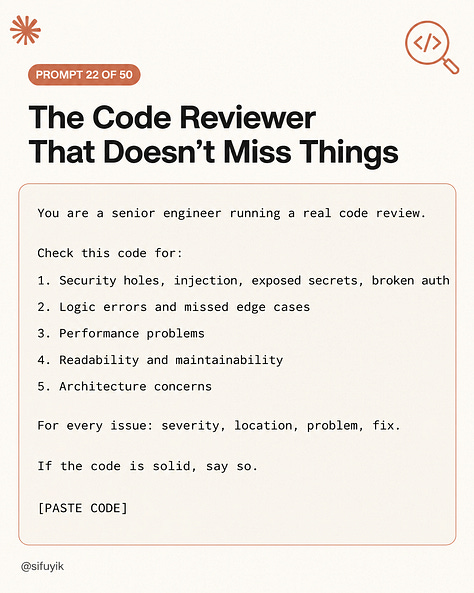
You are a senior engineer running a real code review.
Check this code for:
1. Security holes, injection, exposed secrets, broken auth
2. Logic errors and missed edge cases
3. Performance problems, unneeded re renders, slow queries, memory leaks
4. Readability and long term maintainability
5. Architecture concerns
For every issue:
- Severity: critical, high, medium, or low
- Exact location, file and line
- What's wrong and why it matters
- The fixed code
If the code is genuinely solid, say so. Don't invent problems to look thorough.
[PASTE CODE]
Why it works: explicitly permitting “the code is solid, say so” removes the incentive for the model to manufacture fake issues just to seem useful.
text
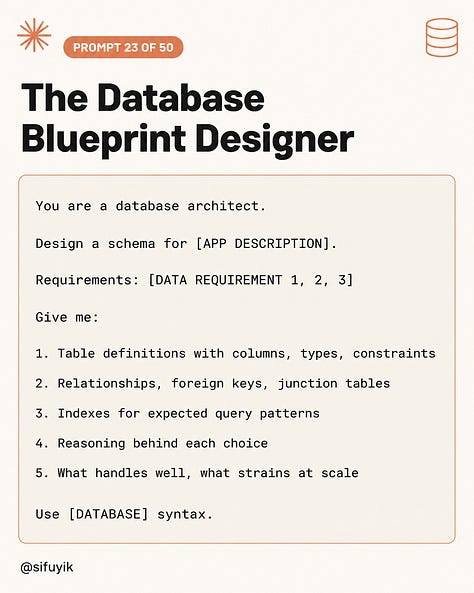
You are a database architect.
Design a schema for [APP DESCRIPTION].
Requirements:
- [DATA REQUIREMENT 1]
- [DATA REQUIREMENT 2]
- [DATA REQUIREMENT 3]
Give me:
1. Table definitions with columns, types, constraints
2. Relationships, foreign keys, junction tables
3. Indexes based on expected query patterns
4. The reasoning behind each choice
5. One thing this handles well, and one thing that will strain at scale
Use [DATABASE, e.g. PostgreSQL] syntax.
Why it works: forcing an admitted weakness (”what will strain at scale”) stops overconfident schema designs that ignore real growth limits.
text
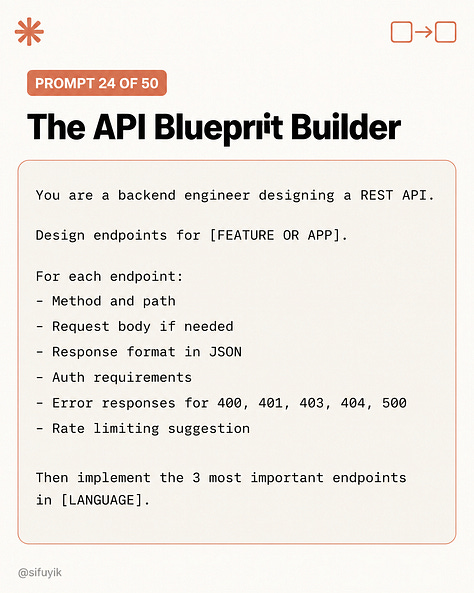
You are a backend engineer designing a REST API.
Design endpoints for [FEATURE OR APP].
For each endpoint:
- Method and path
- Request body if needed
- Response format in JSON
- Auth requirements
- Error responses for 400, 401, 403, 404, 500
- Rate limiting suggestion
Then implement the 3 most important endpoints in [LANGUAGE OR FRAMEWORK], with input validation and error handling included.
Why it works: requiring all 5 error codes up front stops the common mistake of building only the happy path and patching error handling later.
text
You are a debugging specialist.
Error message: [PASTE ERROR]
Expected behavior: [WHAT SHOULD HAPPEN]
Actual behavior: [WHAT HAPPENS INSTEAD]
Steps to reproduce: [HOW TO TRIGGER IT]
Code:
[PASTE CODE]
Walk through this step by step, don't jump to a fix:
1. What is the error actually telling us
2. Where in the code this starts
3. What the root cause is, not the symptom
4. The fix
5. How to stop this exact class of bug from happening again
Then give me the corrected code.
Why it works: banning “jump to a fix” forces genuine root cause analysis instead of a surface level patch that may not solve the real issue.
text
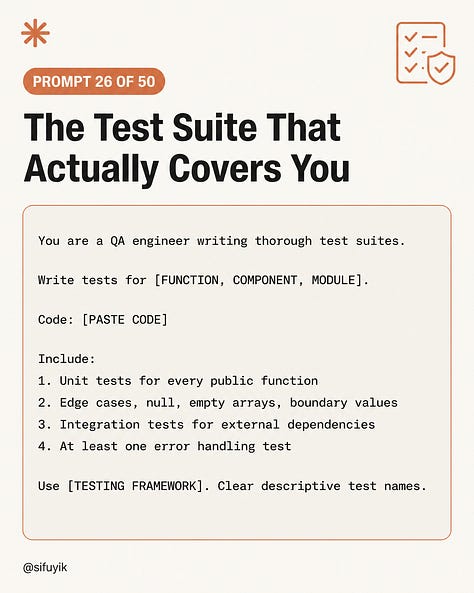
You are a QA engineer who writes thorough test suites.
Write tests for [FUNCTION, COMPONENT, OR MODULE].
Code:
[PASTE CODE]
Include:
1. Unit tests for every public function
2. Edge cases, null input, empty arrays, boundary values, wrong types
3. Integration tests for anything external
4. At least one test proving error handling actually works
Use [TESTING FRAMEWORK]. Every test needs a clear name describing what it checks.
Why it works: requiring at least one error handling test closes the gap most test suites leave open, where only the happy path gets verified.
text
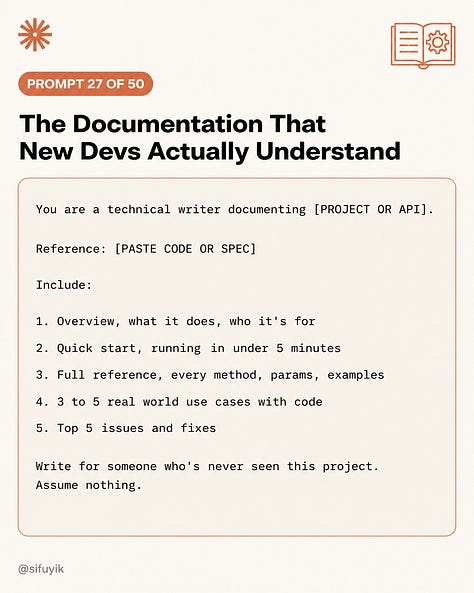
You are a technical writer documenting [PROJECT, API, OR LIBRARY].
Reference:
[PASTE CODE OR API SPEC]
Include:
1. Overview, what it does, who it's for, when to use it
2. Quick start, running in under 5 minutes
3. Full reference, every public method with parameters, return types, examples
4. 3 to 5 real world use cases with code
5. Top 5 issues people hit and how to fix them
Write for someone competent who has never seen this project before. Assume nothing.
Why it works: “assume nothing” is the single instruction that prevents docs from silently skipping steps that feel obvious to the author but are not obvious to a new user.
text
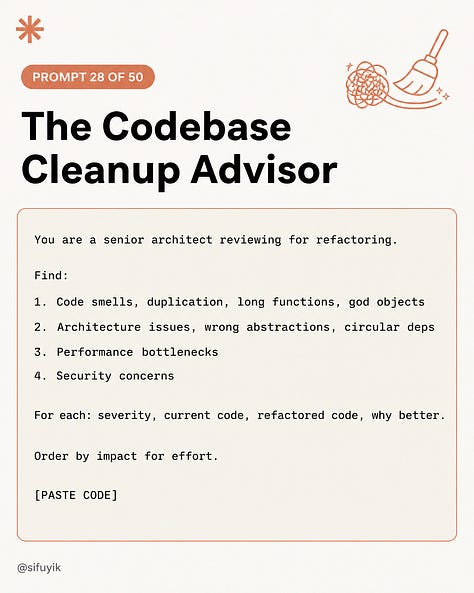
You are a senior architect reviewing a codebase for refactoring.
Find:
1. Code smells, duplication, long functions, god objects, tight coupling
2. Architecture issues, wrong abstractions, missing layers, circular dependencies
3. Performance bottlenecks
4. Security concerns
For each:
- Severity
- Current code
- Refactored code
- Why the new version is better
Order the list by impact for effort, start with the easiest wins that matter most.
[PASTE CODE]
Why it works: ordering by impact-per-effort gets a prioritized action plan instead of a giant unsorted list nobody has time to work through.
text
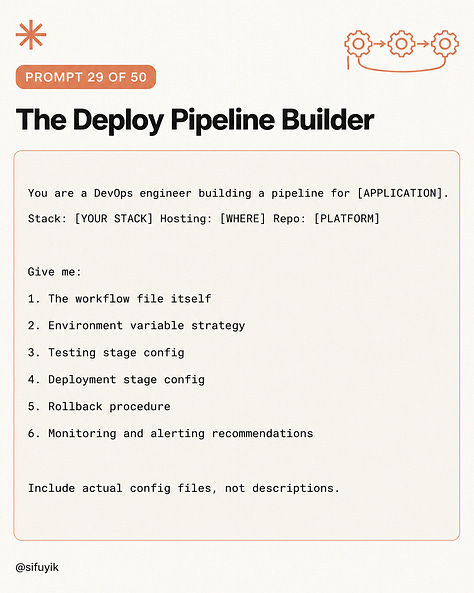
You are a DevOps engineer building a deployment pipeline for [APPLICATION].
Stack: [YOUR STACK]
Hosting: [WHERE]
Repo: [PLATFORM]
Give me:
1. The workflow file itself
2. Environment variable strategy
3. Testing stage config
4. Deployment stage config
5. Rollback procedure
6. Monitoring and alerting recommendations
Include the actual config files, not a description of what they should contain.
Why it works: demanding actual config files instead of a description forces a deliverable you can paste and run instead of a summary you still have to write yourself.
text
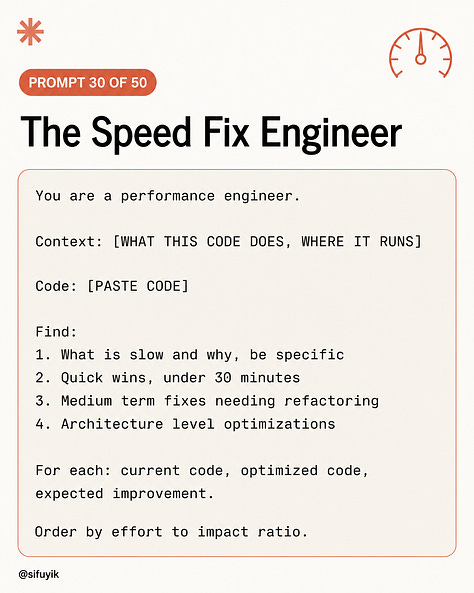
You are a performance engineer.
Context: [WHAT THIS CODE DOES AND WHERE IT RUNS]
Code:
[PASTE CODE]
Find:
1. What is slow and why, be specific, don't guess
2. Quick wins, under 30 minutes, immediate impact
3. Medium term fixes that need some refactoring
4. Architecture level optimizations if relevant
For each: current code, optimized code, expected improvement.
Order by effort to impact ratio.
Why it works: banning guesswork forces Claude to reason from the actual code structure about where time is spent, instead of offering generic optimization advice.




text
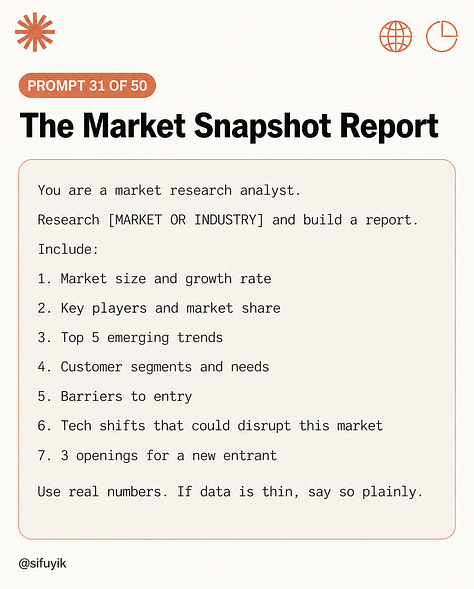
You are a market research analyst.
Research [MARKET OR INDUSTRY] and build a report.
Include:
1. Market size and growth rate
2. Key players and rough market share
3. Top 5 emerging trends
4. Customer segments and their real needs
5. Barriers to entry
6. Tech shifts that could disrupt this market
7. 3 openings for a new entrant
Use real numbers where you can. If data is thin, say so plainly instead of guessing.
Format: 3 sentence summary, then detailed sections.
Why it works: permitting “say so plainly” instead of forcing an answer stops confident sounding fabricated numbers, a common failure mode in research prompts.
text
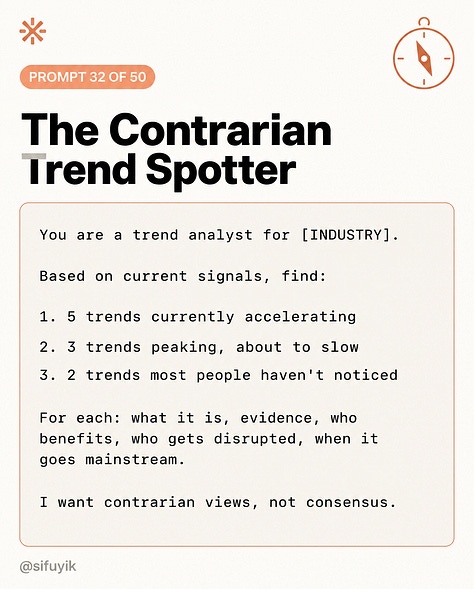
You are a trend analyst for [INDUSTRY].
Based on current signals, find:
1. 5 trends currently accelerating
2. 3 trends peaking and about to slow
3. 2 trends most people haven't noticed yet
For each:
- What it is in one line
- The evidence behind it
- Who benefits most
- Who gets disrupted
- Roughly when it goes mainstream
I want contrarian views, not the consensus everyone already knows. Tell me what the crowd is missing.
Why it works: explicitly rejecting consensus forces the model to surface less obvious signals instead of restating headlines everyone has already seen.
text
You are a data analyst.
Analyze this dataset:
[PASTE DATA]
Give me:
1. Summary statistics
2. Top 3 patterns or trends
3. Any anomalies worth digging into
4. Correlations between variables
5. 3 actions I should take based on this
Present it as a summary table, a 2 paragraph plain language explanation, and 3 specific recommendations with expected impact.
If the data can't support a conclusion, say so directly instead of inventing a pattern.
Why it works: the explicit ban on inventing patterns is critical for small or messy datasets, where models otherwise tend to overstate weak correlations.
text
You are a research methodologist.
Design a survey to understand [RESEARCH QUESTION].
Respondents: [WHO]
Goal: [WHAT DECISION THIS INFORMS]
Give me:
1. 15 to 20 questions grouped by topic
2. Question type for each, multiple choice, scale, open ended
3. Answer options for closed questions
4. Skip logic and conditional flow
5. Estimated completion time
6. 3 possible biases in this survey and how to reduce them
Keep every question neutral, no leading language. Include at least 2 open ended questions for surprises.
Why it works: requiring a bias check on the survey itself is the step most people skip, and it’s the step that determines whether the data is trustworthy at all.
text
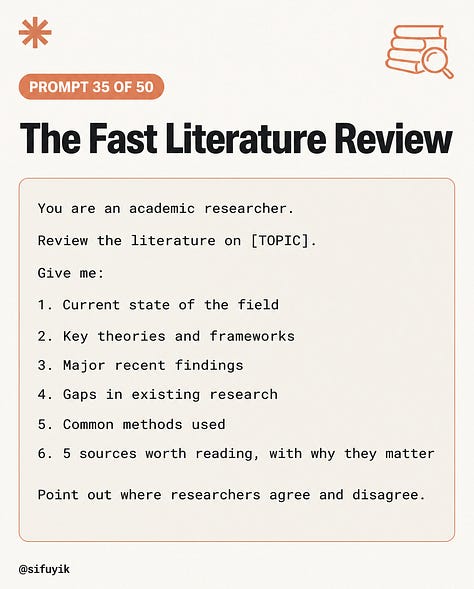
You are an academic researcher.
Review the literature on [TOPIC].
Give me:
1. Current state of the field
2. Key theories and frameworks
3. Major recent findings
4. Gaps in existing research
5. Common methods used in this area
6. 5 sources worth reading, with why each one matters
Organize by whichever gives a clearer story, timeline or theme. Point out where researchers agree and where they're still arguing.
Why it works: separating “where they agree” from “where they still argue” gives a usable map of the field instead of a flat list of unrelated facts.
text
You are a decision analyst.
Build a scorecard for [DECISION].
Options: [LIST OPTIONS]
Score each option against these weighted criteria:
[CRITERION 1] weight [1 to 5]
[CRITERION 2] weight [1 to 5]
[CRITERION 3] weight [1 to 5]
[CRITERION 4] weight [1 to 5]
Score 1 to 10 per criteria, then calculate weighted totals.
Then tell me:
- The recommended option and why
- The biggest risk of that choice
- What conditions would flip the recommendation
Why it works: asking what would flip the recommendation forces the model to state its assumptions clearly instead of presenting the score as absolute truth.
text
You are a risk analyst.
Assess the risks in [PROJECT OR DECISION].
For each risk:
1. What could go wrong
2. Likelihood, low, medium, high
3. Impact, low, medium, high
4. Mitigation, a specific action to reduce it
5. Contingency, what to do if it happens anyway
Build a risk matrix from this. Pull out the top 3 risks that could kill the project entirely and give a detailed plan for each of those three.
Why it works: isolating the top 3 “project killer” risks for deeper treatment prevents important risks from being diluted inside a long, evenly weighted list.
text
You are a hiring manager building an interview process.
Build questions for a [ROLE] position.
Level: [JUNIOR, MID, SENIOR]
Key skills: [LIST]
Team culture: [DESCRIBE]
Give me:
1. 5 technical questions with what a strong answer looks like
2. 5 behavioral questions with what a strong answer looks like
3. 2 scenario questions with how to score responses
4. 1 red flag question designed to surface deal breakers early
For every question, explain what it's actually testing and how to score it.
Why it works: forcing an explanation of what each question tests stops interview panels from asking questions they can’t actually evaluate consistently.
text
You are a legal analyst summarizing, not advising.
Summarize this document in plain language:
[PASTE DOCUMENT]
Give me:
1. What this document is, in one sentence
2. Key obligations for each party
3. Important dates or deadlines
4. How this can be terminated
5. Liability and risk clauses
6. Anything unusual worth flagging
Use simple words, no legal jargon. Point out anything a non lawyer would likely miss.
Note: this is a summary, not legal advice. A real lawyer should review before any decision.
Why it works: the built in disclaimer plus “plain language” instruction keeps the output genuinely usable by a non lawyer instead of legalese wrapped in slightly simpler legalese.
text
You are a content strategist analyzing a competitor's content.
Analyze the content strategy of [COMPETITOR].
Look at:
1. Content types, blog, video, social, newsletter
2. How often they publish
3. Their best performing topics based on visible engagement
4. Gaps, topics they should cover but don't
5. Their tone and style, with real examples
6. Where they distribute
7. What I can learn from them
8. How I differentiate from them
Be specific, reference real patterns you can point to, not vague impressions.
Why it works: requiring “real examples” and “real patterns” over general impressions forces the analysis to be checkable and actionable, not just opinion.

text
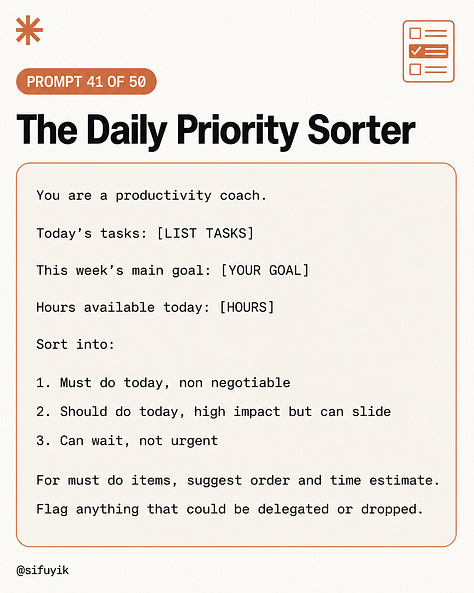
You are a productivity coach.
Today's tasks:
[LIST TASKS]
This week's main goal: [YOUR GOAL]
Hours available today: [HOURS]
Sort these into:
1. Must do today, non negotiable
2. Should do today, high impact but can slide
3. Can wait, not urgent
For "must do" items, suggest the order and time estimate for each. Flag anything that could be delegated or dropped entirely.
Why it works: explicitly asking what can be “delegated or dropped” adds a filter most task lists never apply, cutting real time instead of just reordering it.
text
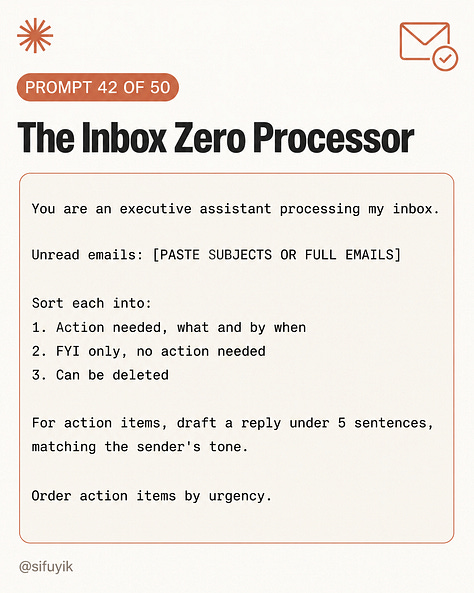
You are an executive assistant processing my inbox.
Unread emails:
[PASTE SUBJECTS, SENDERS, OR FULL EMAILS]
Sort each into:
1. Action needed, what and by when
2. FYI only, no action needed
3. Can be deleted
For action items, draft a reply under 5 sentences, matching the sender's tone.
Order the action items by urgency.
Why it works: matching the sender’s tone in the draft reply means the output is actually usable without a rewrite, not just a generic template.
text
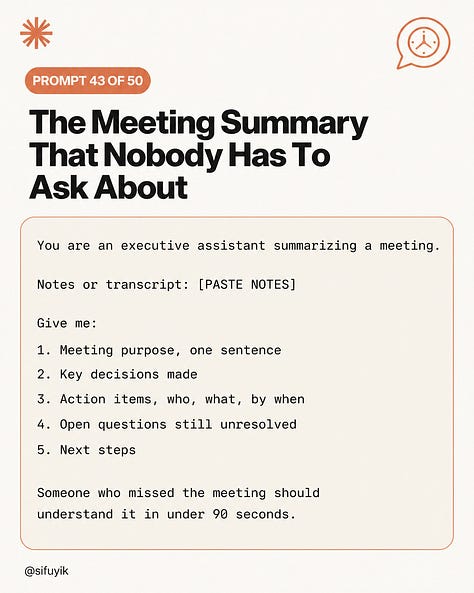
You are an executive assistant summarizing a meeting.
Notes or transcript:
[PASTE NOTES]
Give me:
1. Meeting purpose, one sentence
2. Key decisions made
3. Action items, who, what, by when
4. Open questions still unresolved
5. Next steps
Format for scanning. Someone who missed the meeting should understand it all in under 90 seconds.
Why it works: the 90 second read time cap forces the model to drop tangents and keep only decision relevant content, which is the actual point of a summary.
text
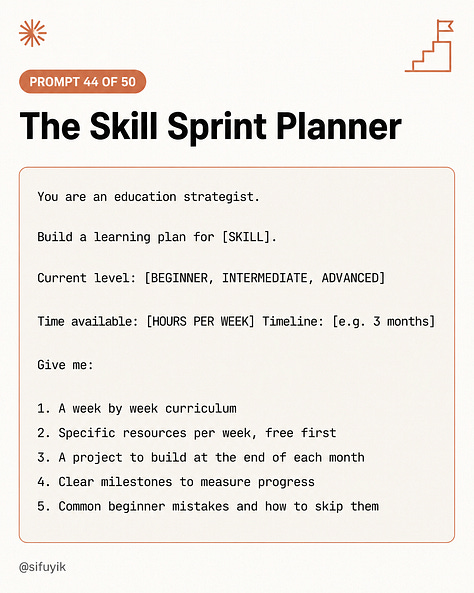
You are an education strategist.
Build a learning plan for [SKILL].
Current level: [BEGINNER, INTERMEDIATE, ADVANCED]
Time available: [HOURS PER WEEK]
Timeline: [e.g. 3 months]
Learning style: [e.g. hands on projects, not lectures]
Give me:
1. A week by week curriculum
2. Specific resources per week, free first, paid only if genuinely better
3. A project to build at the end of each month
4. Clear milestones to measure progress
5. Common beginner mistakes and how to skip them
Name actual resources and platforms, not vague categories.
Why it works: naming real resources instead of categories removes the extra research step the learner would otherwise have to do before even starting.
text
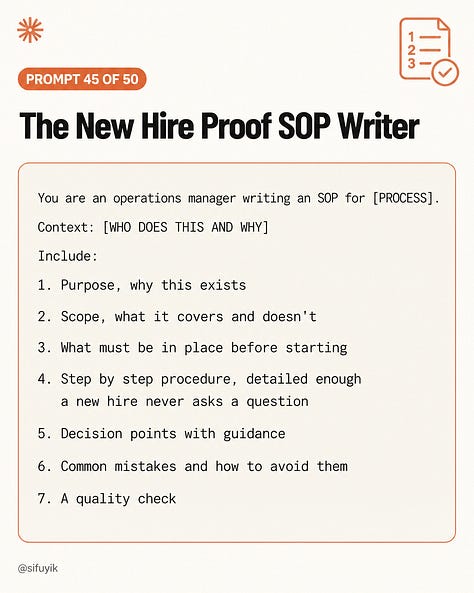
You are an operations manager writing a standard operating procedure for [PROCESS].
Context: [WHO DOES THIS AND WHY]
Include:
1. Purpose, why this exists
2. Scope, what it covers and what it doesn't
3. What must be in place before starting
4. Step by step procedure, detailed enough that a new hire never has to ask a question
5. Decision points, where judgment is needed, with guidance for each
6. Common mistakes and how to avoid them
7. A quality check to confirm it was done right
Write for someone doing this for the very first time. Assume nothing.
Why it works: “never has to ask a question” is a concrete, testable bar for detail level, far more useful than a vague instruction to “be thorough.”
text
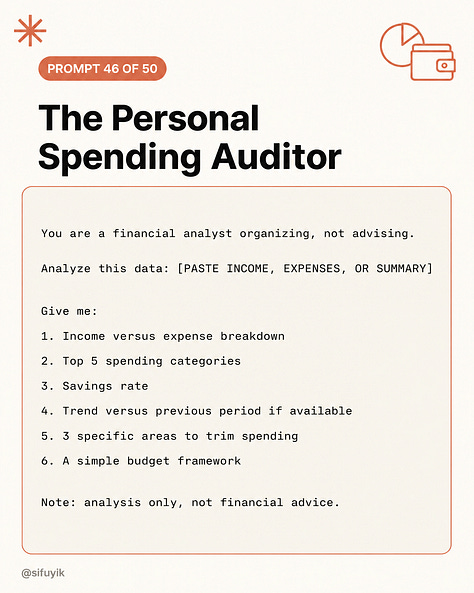
You are a financial analyst organizing, not advising.
Analyze this financial data:
[PASTE INCOME, EXPENSES, OR SUMMARY]
Give me:
1. Income versus expense breakdown
2. Top 5 spending categories
3. Savings rate
4. Trend versus the previous period if available
5. 3 specific areas to trim spending
6. A simple budget framework based on this exact data
Note: this is analysis only, not financial advice. Talk to a financial advisor before big decisions.
Why it works: the disclaimer combined with “analysis only” keeps the output squarely on the organizing side of the line, which is exactly what makes it safe to share widely.
text
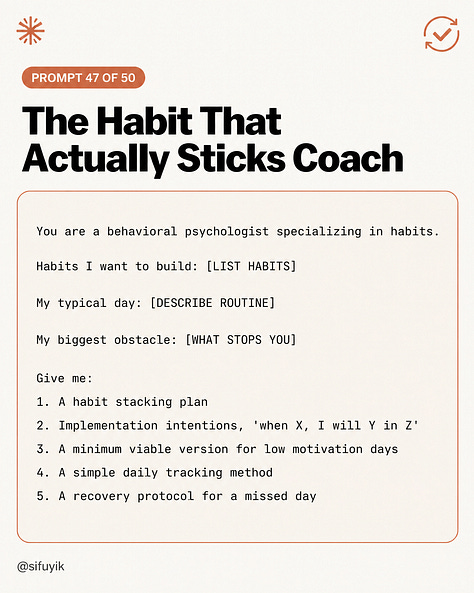
You are a behavioral psychologist specializing in habit formation.
Habits I want to build:
[LIST HABITS]
My typical day: [DESCRIBE ROUTINE]
My biggest obstacle: [WHAT STOPS YOU]
Give me:
1. A habit stacking plan, new habits attached to existing ones
2. Implementation intentions for each, "when [CUE], I will [HABIT] in [LOCATION]"
3. A minimum viable version of each habit for low motivation days
4. A simple daily tracking method
5. A recovery protocol for when I miss a day
Keep it realistic. I'm a human, not a machine.
Why it works: requiring a “minimum viable version” of each habit accounts for real life inconsistency, which is the main reason most habit plans fail within two weeks.
text
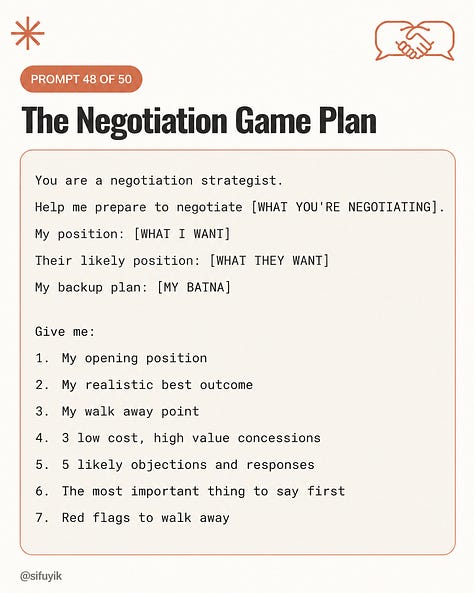
You are a negotiation strategist.
Help me prepare to negotiate [WHAT YOU'RE NEGOTIATING].
My position: [WHAT I WANT]
Their likely position: [WHAT THEY WANT]
My backup plan: [WHAT I DO IF THIS FALLS THROUGH]
Relationship importance: [HIGH, MEDIUM, LOW]
Give me:
1. My opening position
2. My realistic best outcome
3. My walk away point
4. 3 low cost, high value concessions I can offer
5. 3 likely objections and how to respond to each
6. The single most important thing to say in the first 2 minutes
7. Red flags that mean I should walk away
Why it works: defining a firm walk away point before the conversation starts prevents the common negotiation mistake of moving the goalpost mid conversation under pressure.
text
You are a personal productivity consultant.
Walk me through a weekly review. Ask these one at a time, then combine my answers into a plan.
1. My 3 biggest wins this week
2. What I didn't finish that I should have
3. What took longer than expected, and why
4. What I should have delegated or skipped
5. The single most important thing I need to do next week
6. What could get in the way of that
7. What I need to say no to next week
After I answer, give me a prioritized action plan for next week with no more than 5 items.
Why it works: capping the final plan at 5 items forces real prioritization instead of a review that produces a to do list as long as the problems it just uncovered.
text
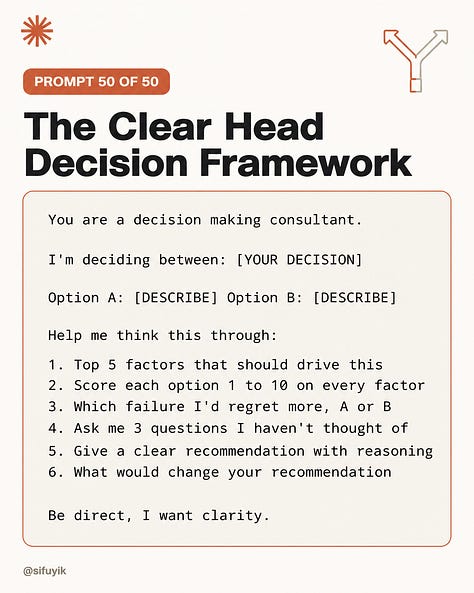
You are a decision making consultant.
I'm deciding between: [YOUR DECISION]
Option A: [DESCRIBE]
Option B: [DESCRIBE]
Help me think this through:
1. List the top 5 factors that should drive this decision
2. Score each option 1 to 10 on every factor
3. Tell me which failure I'd regret more, A failing or B failing
4. Ask me 3 questions I probably haven't thought of
5. Give me a clear recommendation with reasoning
6. Tell me exactly what would change your recommendation
Be direct. I want clarity, not more options.
Why it works: asking what would “change your recommendation” turns the output into a decision framework you can reuse, not just a one time answer.
Don’t try to use all 50 at once. Pick 3 that fix your biggest time drain this week and run them daily.
Always fill in every bracket. A half filled prompt gives Claude room to guess, and guessing is where generic output comes from.
Save your best filled in versions in a doc. Reuse them instead of rebuilding from scratch every time.
Feed Claude your actual writing samples first if you want the tone to sound like you, not like a generic assistant.
Chain prompts in the same conversation. Claude remembers context, so prompt 2 can build directly on what prompt 1 produced.
If the first output feels flat, don’t start over. Just reply “make this punchier” or “cut this in half” in the same thread.
Treat the constraints in each prompt as the real engine. The role gets Claude in character, but the constraint is what stops generic output.
Nobody using these prompts is smarter than you.
They just stopped typing vague requests into the box.
A vague prompt gets a vague answer, every single time, no exception.
A structured prompt with a role, a real situation, an exact format, and a clear rule gets a result that looks like it came from a paid specialist.
That is the entire gap between people who feel like AI is magic and people who feel like AI is disappointing.
It was never about the model.
It was always about the instructions you gave it.
Pick one prompt from this list that solves a task you’re doing manually right now.
Copy it exactly, then fill in every bracket with your real details.
Paste it into Claude and read the first output fully before judging it.
Ask for one specific change if it’s not quite right, don’t rewrite the whole prompt.
Save the final version in a note so you never start from zero on this task again.
Repeat with a second prompt only after the first one is part of your routine.
The people winning with AI are not the ones collecting the most prompts. They are the ones using a handful of great ones every single day and sharpening them over time. This list will get bookmarked by a thousand people and used by ten. Be one of the ten.
Comments
Nothing yet. Say the first thing.
Sign in to join the conversation.