
(Save this. You’ll want to come back to it.)
Most people never study money. They just react to it.
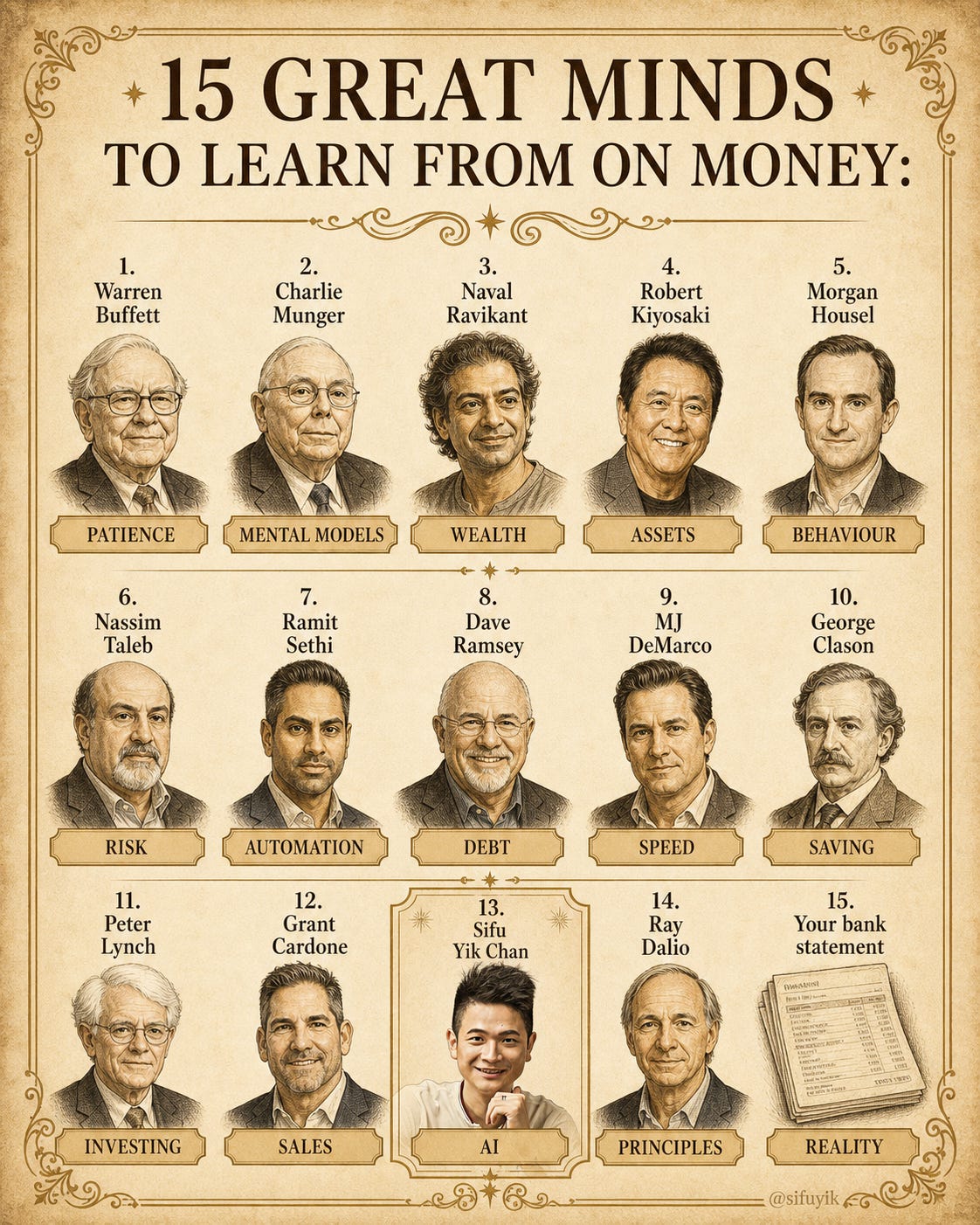
These 15 people changed how millions think about wealth.
Steal their wisdom below 👇
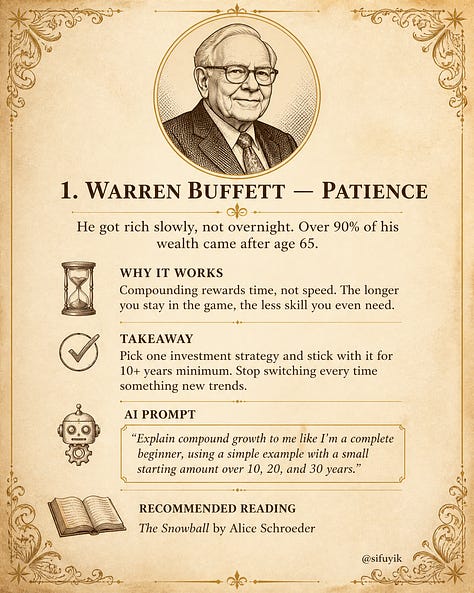
He got rich slowly, not overnight. Over 90% of his wealth came after age 65.
Why it works: Compounding rewards time, not speed. The longer you stay in the game, the less skill you even need.
✅ Takeaway: Pick one investment strategy and stick with it for 10+ years minimum. Stop switching every time something new trends.
🤖 AI Prompt: “Explain compound growth to me like I’m a complete beginner, using a simple example with a small starting amount over 10, 20, and 30 years.”
📚 Recommended Reading: The Snowball by Alice Schroeder
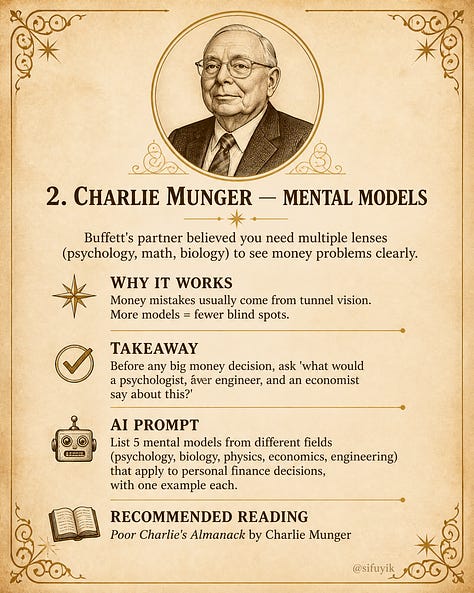
Buffett’s partner believed you need multiple lenses (psychology, math, biology) to see money problems clearly.
Why it works: Money mistakes usually come from tunnel vision. More models = fewer blind spots.
✅ Takeaway: Before any big money decision, ask “what would a psychologist, an engineer, and an economist say about this?”
🤖 AI Prompt: “List 5 mental models from different fields (psychology, biology, physics, economics, engineering) that apply to personal finance decisions, with one example each.”
📚 Recommended Reading: Poor Charlie’s Almanack by Charlie Munger
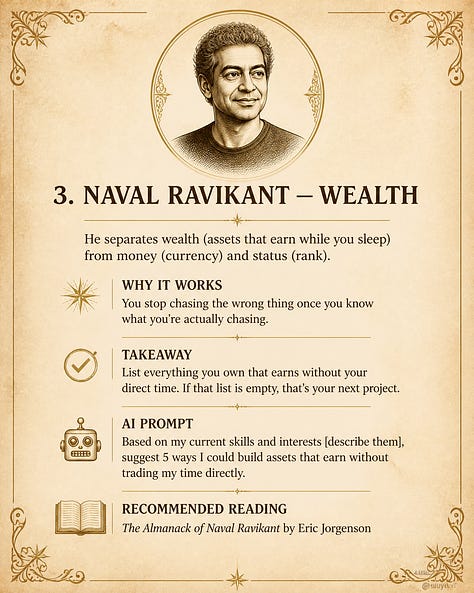
He separates wealth (assets that earn while you sleep) from money (currency) and status (rank).
Why it works: You stop chasing the wrong thing once you know what you’re actually chasing.
✅ Takeaway: List everything you own that earns without your direct time. If that list is empty, that’s your next project.
🤖 AI Prompt: “Based on my current skills and interests [describe them], suggest 5 ways I could build assets that earn without trading my time directly.”
📚 Recommended Reading: The Almanack of Naval Ravikant by Eric Jorgenson
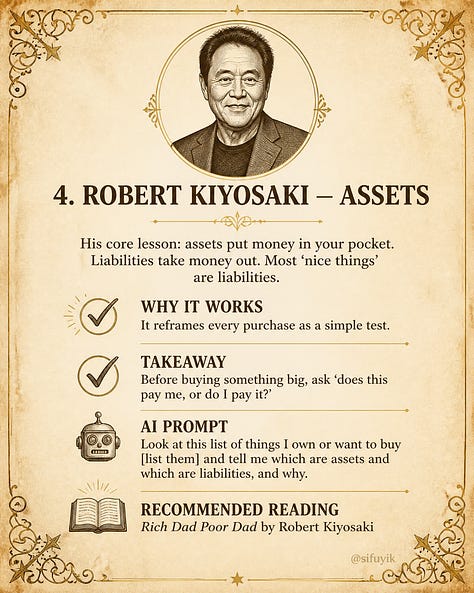
His core lesson: assets put money in your pocket. Liabilities take money out. Most “nice things” are liabilities.
Why it works: It reframes every purchase as a simple test.
✅ Takeaway: Before buying something big, ask “does this pay me, or do I pay it?”
🤖 AI Prompt: “Look at this list of things I own or want to buy [list them] and tell me which are assets and which are liabilities, and why.”
📚 Recommended Reading: Rich Dad Poor Dad by Robert Kiyosaki
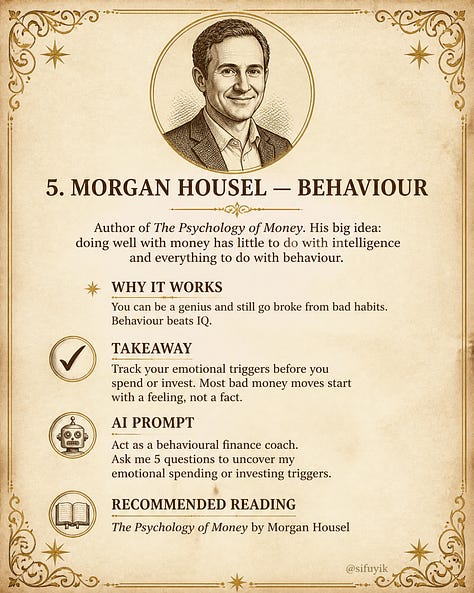
Author of The Psychology of Money. His big idea: doing well with money has little to do with intelligence and everything to do with behaviour.
Why it works: You can be a genius and still go broke from bad habits. Behaviour beats IQ.
✅ Takeaway: Track your emotional triggers before you spend or invest. Most bad money moves start with a feeling, not a fact.
🤖 AI Prompt: “Act as a behavioural finance coach. Ask me 5 questions to uncover my emotional spending or investing triggers.”
📚 Recommended Reading: The Psychology of Money by Morgan Housel
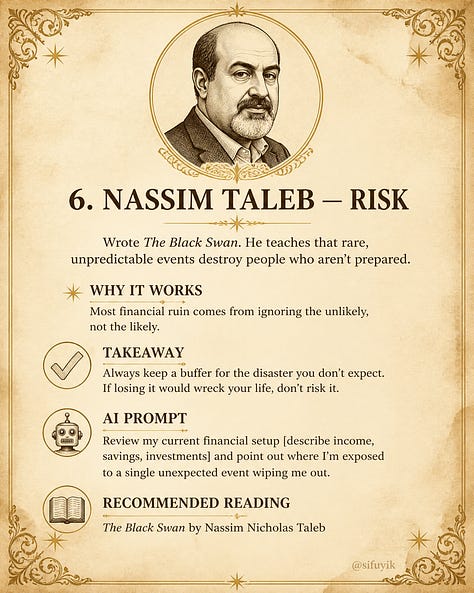
Wrote The Black Swan. He teaches that rare, unpredictable events destroy people who aren’t prepared.
Why it works: Most financial ruin comes from ignoring the unlikely, not the likely.
✅ Takeaway: Always keep a buffer for the disaster you don’t expect. If losing it would wreck your life, don’t risk it.
🤖 AI Prompt: “Review my current financial setup [describe income, savings, investments] and point out where I’m exposed to a single unexpected event wiping me out.”
📚 Recommended Reading: The Black Swan by Nassim Nicholas Taleb
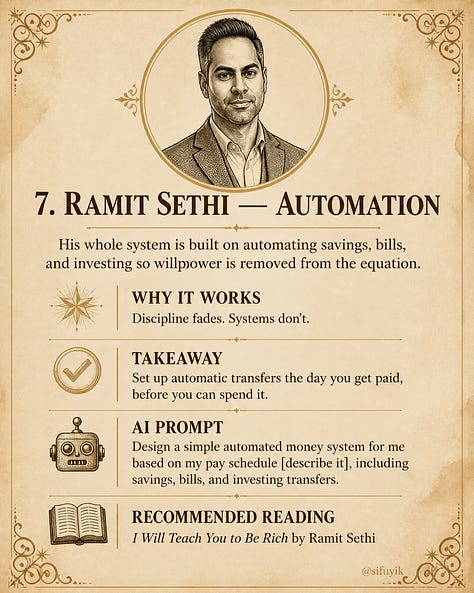
His whole system is built on automating savings, bills, and investing so willpower is removed from the equation.
Why it works: Discipline fades. Systems don’t.
✅ Takeaway: Set up automatic transfers the day you get paid, before you can spend it.
🤖 AI Prompt: “Design a simple automated money system for me based on my pay schedule [describe it], including savings, bills, and investing transfers.”
📚 Recommended Reading: I Will Teach You to Be Rich by Ramit Sethi
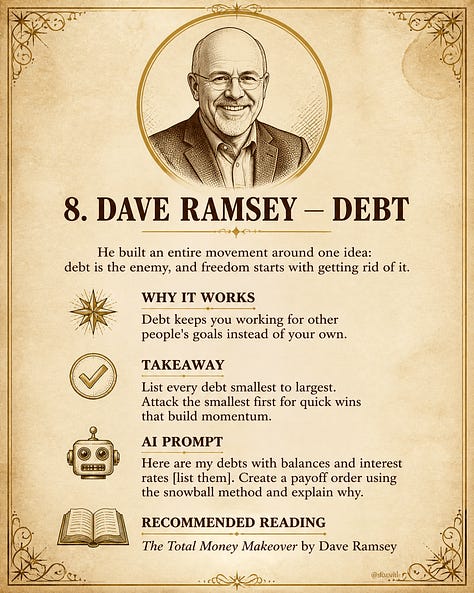
He built an entire movement around one idea: debt is the enemy, and freedom starts with getting rid of it.
Why it works: Debt keeps you working for other people’s goals instead of your own.
✅ Takeaway: List every debt smallest to largest. Attack the smallest first for quick wins that build momentum.
🤖 AI Prompt: “Here are my debts with balances and interest rates [list them]. Create a payoff order using the snowball method and explain why.”
📚 Recommended Reading: The Total Money Makeover by Dave Ramsey
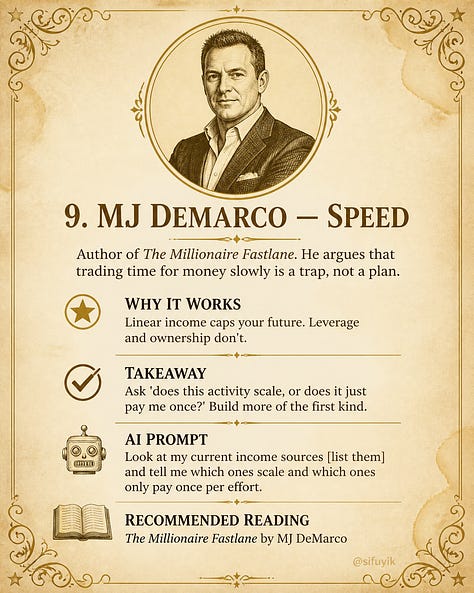
Author of The Millionaire Fastlane. He argues that trading time for money slowly is a trap, not a plan.
Why it works: Linear income caps your future. Leverage and ownership don’t.
✅ Takeaway: Ask “does this activity scale, or does it just pay me once?” Build more of the first kind.
🤖 AI Prompt: “Look at my current income sources [list them] and tell me which ones scale and which ones only pay once per effort.”
📚 Recommended Reading: The Millionaire Fastlane by MJ DeMarco
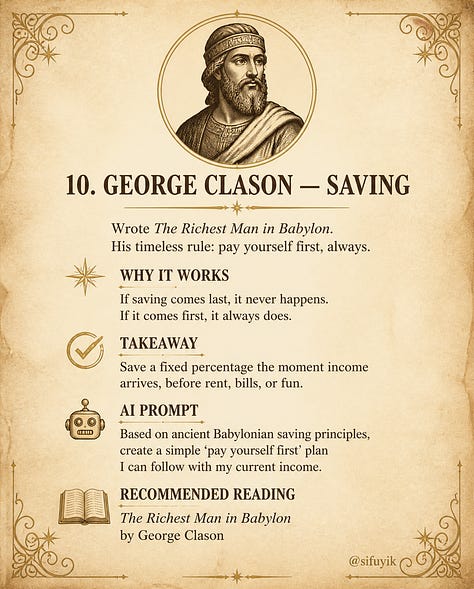
Wrote The Richest Man in Babylon. His timeless rule: pay yourself first, always.
Why it works: If saving comes last, it never happens. If it comes first, it always does.
✅ Takeaway: Save a fixed percentage the moment income arrives, before rent, bills, or fun.
🤖 AI Prompt: “Based on ancient Babylonian saving principles, create a simple ‘pay yourself first’ plan I can follow with my current income.”
📚 Recommended Reading: The Richest Man in Babylon by George Clason
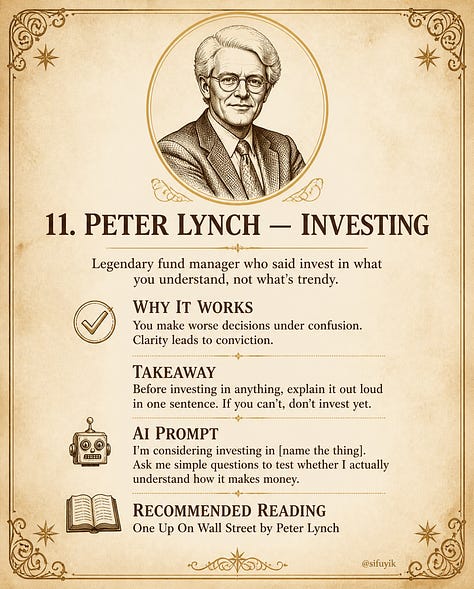
Legendary fund manager who said invest in what you understand, not what’s trendy.
Why it works: You make worse decisions under confusion. Clarity leads to conviction.
✅ Takeaway: Before investing in anything, explain it out loud in one sentence. If you can’t, don’t invest yet.
🤖 AI Prompt: “I’m considering investing in [name the thing]. Ask me simple questions to test whether I actually understand how it makes money.”
📚 Recommended Reading: One Up On Wall Street by Peter Lynch
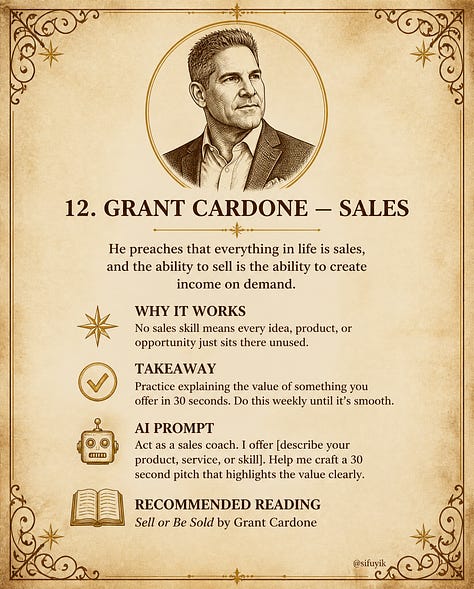
He preaches that everything in life is sales, and the ability to sell is the ability to create income on demand.
Why it works: No sales skill means every idea, product, or opportunity just sits there unused.
✅ Takeaway: Practice explaining the value of something you offer in 30 seconds. Do this weekly until it’s smooth.
🤖 AI Prompt: “Act as a sales coach. I offer [describe your product, service, or skill]. Help me craft a 30 second pitch that highlights the value clearly.”
📚 Recommended Reading: Sell or Be Sold by Grant Cardone
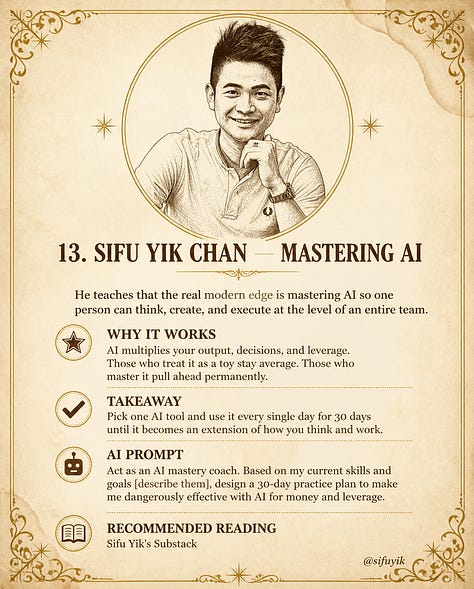
He teaches that the real modern edge is mastering AI so one person can think, create, and execute at the level of an entire team.
Why it works: AI multiplies your output, decisions, and leverage. Those who treat it as a toy stay average. Those who master it pull ahead permanently.
✅ Takeaway: Pick one AI tool and use it every single day for 30 days until it becomes an extension of how you think and work.
🤖 AI Prompt: “Act as an AI mastery coach. Based on my current skills and goals [describe them], design a 30-day practice plan to make me dangerously effective with AI for money and leverage.”
📚 Recommended Reading: Sifu Yik’s Substack
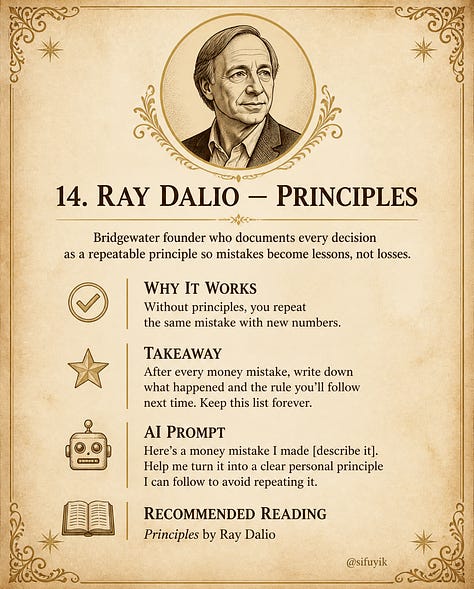
Bridgewater founder who documents every decision as a repeatable principle so mistakes become lessons, not losses.
Why it works: Without principles, you repeat the same mistake with new numbers.
✅ Takeaway: After every money mistake, write down what happened and the rule you’ll follow next time. Keep this list forever.
🤖 AI Prompt: “Here’s a money mistake I made [describe it]. Help me turn it into a clear personal principle I can follow to avoid repeating it.”
📚 Recommended Reading: Principles by Ray Dalio
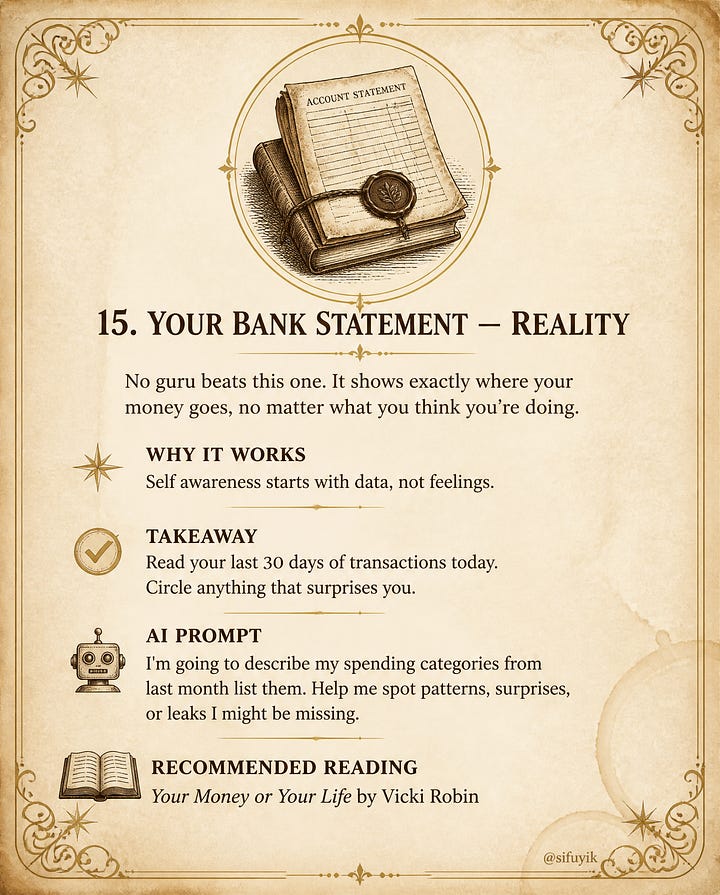
No guru beats this one. It shows exactly where your money goes, no matter what you think you’re doing.
Why it works: Self awareness starts with data, not feelings.
✅ Takeaway: Read your last 30 days of transactions today. Circle anything that surprises you.
🤖 AI Prompt: “I’m going to describe my spending categories from last month [list them]. Help me spot patterns, surprises, or leaks I might be missing.”
📚 Recommended Reading: Your Money or Your Life by Vicki Robin
Don’t try to apply all 15 at once. Pick 2 that match your current biggest problem (debt, saving, investing, etc).
Use the AI prompts above as starting points, then keep asking follow up questions until it clicks for your situation.
Revisit this list every few months. The lesson that didn’t land last time might hit different now.
Read at least one recommended book fully before moving to the next. Depth beats skimming 15 books at once.
Combine mindset lessons (Munger, Housel) with action lessons (Ramsey, Sethi) for balance.
Teach one lesson to someone else this week. Explaining it will cement it in your own brain.
Nobody becomes good with money by accident.
Every person on this list built their wealth wisdom through mistakes, study, and repetition.
You don’t need to invent your own system from scratch. You just need to borrow the best parts from people who already figured it out.
AI can now help you apply these lessons faster than ever. The prompts above are not magic. They are shortcuts to clarity, but you still have to act on what they reveal.
The gap between where you are and where you want to be isn’t intelligence.
It’s information plus consistency.
This list is the information. What you do next is the consistency.
Screenshot or save this post right now.
Pick your weakest money area (saving, debt, investing, spending awareness).
Match it to the person above who covers that area.
Copy their AI prompt into ChatGPT or your favorite AI tool and personalize it with your details.
Apply their one takeaway this week, not all 15.
Check your bank statement in 30 days and compare.
You don’t need 15 new habits today. You need one.
Borrow the wisdom, use the AI prompts to make it personal, apply the takeaway, and let your bank statement tell the truth in a few months.
Comments
Nothing yet. Say the first thing.
Sign in to join the conversation.