
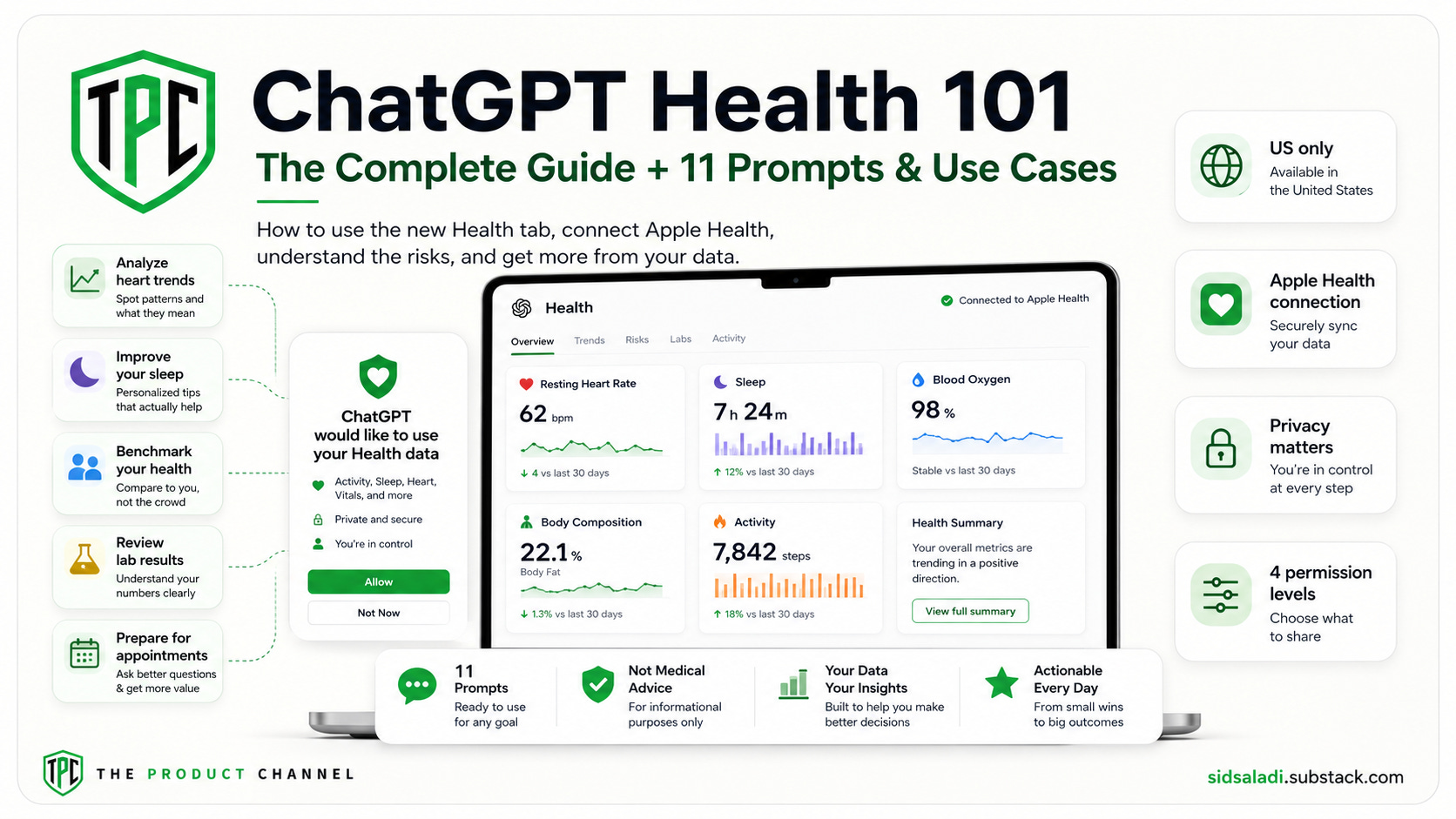
I connected Apple Health to ChatGPT, opened the new Health tab, and watched it pull up eleven months of my resting heart rate, sleep, body composition and blood oxygen in about four seconds.
Then I asked what stood out in my heart data. Before answering, it stopped and asked permission — a card reading “Allow ChatGPT to use Health? ChatGPT will call Health’s Summary tool.” Four buttons: always allow, allow for this conversation, allow once, deny.
That card is the whole product in miniature: enormously capable, and quietly asking how much of your medical life you want to hand over. This product is like an end-to-end guide on how we set up ChatGPT Health with 11+ use cases that will help you better manage your health.
One line before we start, and I mean it: I’m not a doctor, this isn’t medical advice, and ChatGPT is not a diagnostic tool. OpenAI says so in small grey text under the box.
Health isn’t a niche corner of ChatGPT. By OpenAI’s own numbers, one in four of its 800M+ weekly users asks a health question every week — 40 million people daily — and that weekly count grew from 230 million in January 2026 to 300 million by July.
Independent surveys back it up. KFF found 32% of US adults used AI chatbots for health info in the past year, and Rock Health found usage doubled year over year. The number that matters most: 18% of those users adjusted a medication afterwards. Hold onto that one.
And here’s the part I keep thinking about. OpenAI reports 7 in 10 health conversations happen outside clinic hours, with US “hospital deserts” generating 580,000+ health messages a week. That’s not people replacing their doctor. That’s people at 11pm with nobody to ask.
🌟 Some of our popular newsletter editions
🥊 Opus 5 Vs Fable 5 vs Kimi K3 vs GPT-5.6 Sol vs GLM 5.2 + The Complete Opus 5 101
🧠 GPT-5.6 101: The Complete Guide + 40 Use Cases for OpenAI’s New ChatGPT Model
🚀 Kimi K3 101: The Complete Guide to Moonshot’s Benchmark-Topping Open Model
💻 How to Run Kimi K3 Locally (The Simple Guide)
🎨 Claude Design 101: The Complete Guide with 40+ Worked Examples
🤖 Agent Frameworks 101: The Complete Guide to Building AI Agents in 2026
⚙️ Claude Code Agents 101: Build Your First AI Agent from Scratch (+ 75 Copy-Paste Prompts)
💸 Free LLM API (2026): NVIDIA Gives You 100+ Frontier Models for $0
🔓 The Open-Weight Stack: How to Build an AI Setup That Can’t Be Banned
🔀 OpenRouter 101: Slashing Your AI Agent Costs by 90% + 80 Prompts & Workflows
⚡ GLM 5.2 101: First Look at Zhipu’s Cheap, Thinking Open-Weight Challenger
🛠️ How to Run Open-Source AI Models: Own Your AI Stack
💰 AI Pricing Strategy 101: How to Use ChatGPT, Claude & Perplexity for Pricing Research
🖥️ Claude Cowork 101: The AI That Actually Does Your Work (100+ Prompts & Use Cases)
There’s a version of this story that goes: most of the world can’t get a doctor, so an AI that’s usually right beats nothing. I believe some of that. Here are the numbers on both sides.
The need is real and staggering. The WHO says 4.6 billion people lacked full coverage of essential health services in 2023, and projects a shortfall of 11 million health workers by 2030. And it isn’t only a poor-country story — 92.3 million Americans live in a designated primary care shortage area.
Here’s the part that gets left out. When this idea was rigorously tested, it failed. A randomized trial across 16 Kenyan clinics (9,691 patients, Nature Medicine) found no significant benefit from LLM assistance. Another trial of 1,298 lay people found they did no better than a control group with no AI at all — even though the models alone identified the right condition 94.9% of the time. The tool works; people using the tool don’t.
And there’s a geography problem: Health in ChatGPT is US-only, 2.2 billion people are still offline, and accuracy drops roughly 18% outside English. The people who need it most can’t reach it.
Honest framing: the need is real. The evidence that this tool meets it is thin — and where it was tested, null. That doesn’t make it useless. It makes it a tool with a job description.
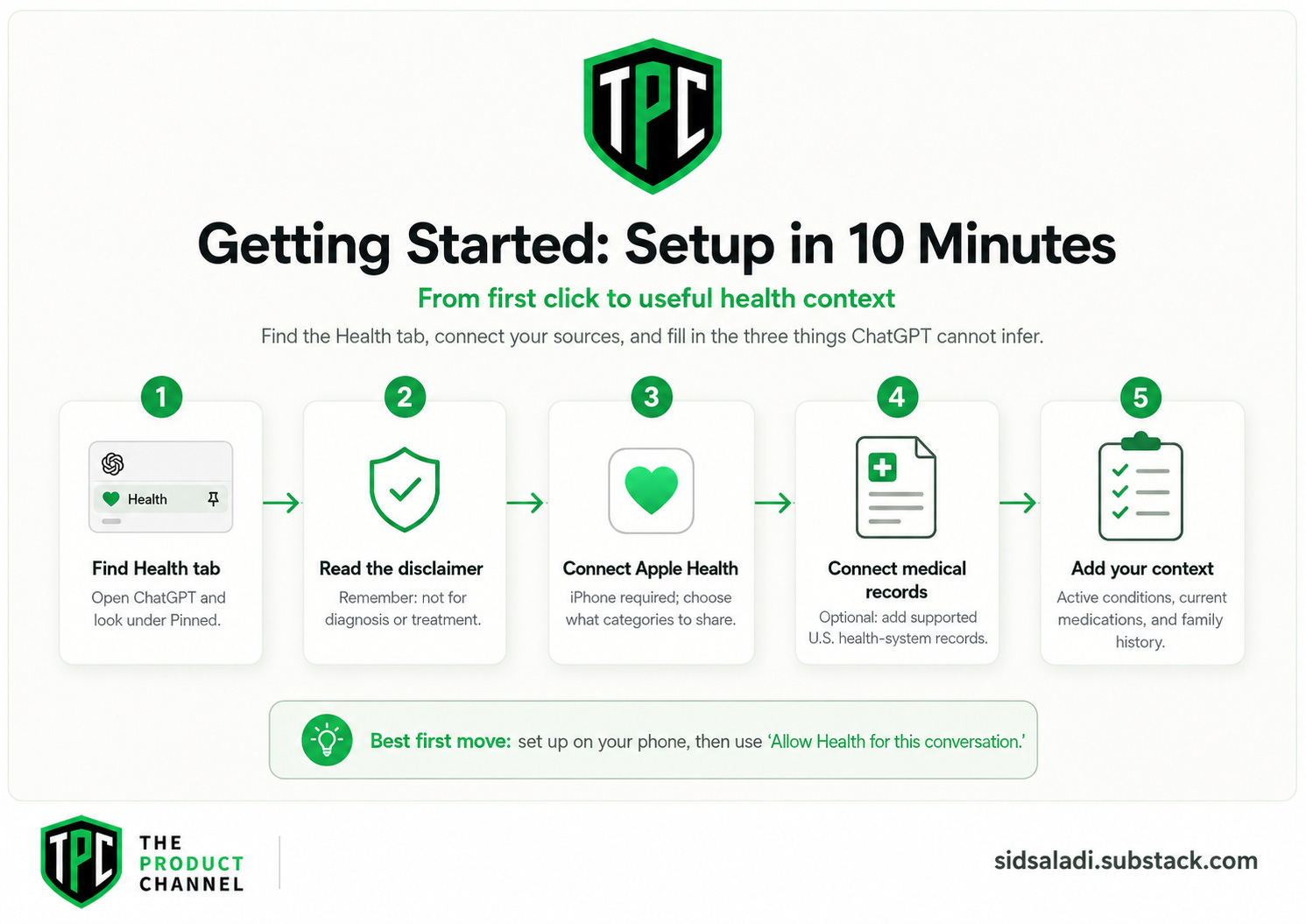
Quick practical stuff before we go deeper. As of August 3, 2026, this is US only, 18 and up, on web and iOS no Android yet. Every plan gets it, free included, but if you want to connect Apple Health you’ll need an iPhone.
There’s no special health model under the hood. Free users get GPT-5.5 Instant, paid users get GPT-5.6 Sol, which OpenAI calls its strongest model for health. So notice the play here: the feature is free, the better health model is the paywall. That’s the $20/month pitch.
The privacy part that actually matters: anything you connect medical records, Apple Health data, the conversations that use them is never used to train OpenAI’s models or target ads. Doesn’t matter what your training setting says; health data overrides it. That clause is doing real work.
And here’s the thing nobody puts in the marketing. Health in ChatGPT is not covered by HIPAA. You have every legal right to pull your records out of your hospital’s portal but HIPAA doesn’t travel with the data. The moment it lands in ChatGPT, the only things protecting it are OpenAI’s terms and whatever your state’s privacy laws say. That’s not a dealbreaker. It’s just something you should know before you connect anything.
Comments
Nothing yet. Say the first thing.
Sign in to join the conversation.