
Congrats! You have finished all the Improv Levels at your improv school! Now what? If you are lucky, you have already been cast in a house team or a mainstage production; however, if you are like the majority of people, you did not get cast. Suddenly, there is a three-hour hole in your schedule every week. Even worse, one of your classmates did make it, and they keep inviting you to see that show or troupe. It is easy to feel dejected at this point. Here is what you can do.
Firstly, realize that you are in good company. Even though classes are presented as a way to get into house teams, there is a sizeable skill gap between the typical graduation showcase and house teams. I have heard people refer to this as the “missing middle problem.” The hard truth is that only so many people can make it onto house teams, and the number of improv class graduates greatly exceeds this. The six to twelve months it takes to go through the improv curriculum is usually not enough time to reach house team level, especially if you are starting without any theatre experience. The good news is you can get there.
For fun, I have ranked all the strategies into a tier list with these possible grades:
S Tier - Everyone should do this
A Tier - A very good idea
B Tier - Good with some drawbacks
C Tier - Can’t hurt
D Tier - Avoid this unless you have a good reason
F Tier - Nobody should do this
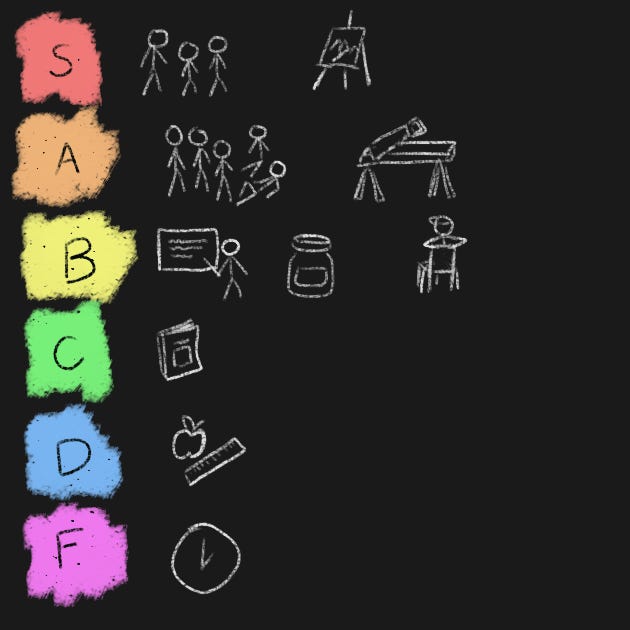
While this is an expensive option, it is an easy way to keep practicing. Taking the classes at another theatre or with another teacher will help you see a different perspective on improv. Many theatres even offer a discounted price for retaking a class. The drawback is that there are diminishing returns on improv classes, since most of the material will overlap. If it were not such an expensive option, I would rank it higher. There is certainly no shame in taking a class again if you feel like it would benefit you; however, it is B Tier because there are better options.
Many people ask me for improv book recommendations, and I have none. I think improv books are more helpful for improv teachers than improv students. If you truly enjoy reading about improv, go ahead; however, it is no substitute for practice. Reading an anatomy book will not help you build muscle, but it is nice if your coach has read it.
You should absolutely replace your class time with troupe practices. I have written before explaining how. This is the best way to maximize the amount of practice you get, and the cost of occasionally hiring a coach is much less than taking a class. It does require some planning and organization, but this is the gold standard. You can start a troupe before graduation, and hopefully, your improv teacher encourages this in the upper levels.
How does a practice group differ from a troupe? There is overlap, but a practice group focuses more on practice while a troupe focuses more on performing. Practice groups are usually larger. That means hiring a coach is cheaper per person, and you can be more lenient on attendance. Many people still call these troupes, but it is hard to do shows with so many people. The lack of stage time is the only reason practice groups are not S Tier.
I am a fan of jams, and I think they get too much hate; nevertheless, jams are a poor way to get practice. Jams can often be crowded, so each person gets very little stage time. When jams are more sparsely attended, it is usually because it is not a good jam. I think the benefit of jams is networking. Jams are the place to find people to join your troupe or practice group. Every so often, someone proposes “a new type of jam” that would fix these issues, and they usually end up reinventing the practice group.
Workshops are a great way to get the benefit of additional classes in less time. Whenever an improviser comes in from out of town to teach a workshop, they are usually providing a fresh new perspective that might be missing from your improv community. The reason workshops are not S Tier is that some workshops are bad or not worth the money. Some workshops are very expensive, and it is a bit of a gamble on how beneficial they will be for you. The workshop might be too low-level or high-level for you, and it is very difficult to know that ahead of time. I think the good workshops I have experienced far outweigh the occasional bad ones, so I rank workshops very high. If you are a fresh graduate of an improv program, you are probably the intended audience of most workshops, so I encourage checking them out.
It does not happen often, but once in a while, I will meet students who quickly want to start teaching improv. Once they have finished the classes, they are eager to get into the teaching program or to start their own improv classes. Most improv teachers have been performing regularly for several years before they start teaching. I have found that teaching improv has made me a better performer, but you need to be a good performer before you can teach. Teaching is not the pathway to escape “the middle.”
Being a teaching assistant is a great way to retake the classes for free. You will not get as much out of it as if you were a student, but you do not have to pay for it. Therefore, I think TA-ing is in the same tier as taking more classes. Not every improv school has TAs, and TA slots are limited. Do not be discouraged if you do not get picked to be a TA. It is not a required part of getting better at improv, so I almost put it at C Tier.
Take acting classes. Write a screenplay. Learn to freestyle rap. Perform for children. Learn dance choreography from YouTube or TikTok. Volunteer in your community. Learn to do a Jeff Goldblum impression. Read a history book. Go to the gym. Design a board game.
Do these things in addition to the direct improv practice, but do not be so fixated on the improv ambitions that you forget to enrich yourself in other ways. Improv is about bringing your experiences to the stage. Once you have completed the improv classes, start looking for related areas you can work on (which I have written about before).
There will be house team auditions next year. You can try again then. Time to take a year-long break from improv, right? Of course not. I am not against taking breaks, but if your goal is to escape “the middle”, you do need to keep practicing. Take a month or two off if you need to, but then try to set up a regular troupe or practice group.
As improv teachers, we often discuss the missing middle problem and what we can do about it. Theatres can organize jams and community events to help, but I do not believe it is a problem for the theatres to solve. It is in the theatre’s interest for you to spend more money on classes and workshops, but my advice to students is to leave the nest and start their own troupes. My advice to theatres is to have ample “troupe night” shows to allow the students to get stage time on their own terms.
If you disagree with my rankings, let me know in the comments. Also, let me know what strategies I missed. Are there other ways to solve the missing middle problem?
No posts
Comments
Nothing yet. Say the first thing.
Sign in to join the conversation.