
This is a continuation of last week’s post. Read Part 1 here. The Improv Basics Table of Contents is here.
So far, we’ve discussed how to avoid tilting the scene, but what about when we do want to tilt? For that, it’s all about framing. Consider the following scene:
[In the platform, we’ve established that Cody and Dave are brothers. They haven’t met in over two years, and they are getting dinner in their hometown. Meeting up was Cody’s idea.]
Dave: I remember Ma used to love this place. We used to come here all the time.
Cody: Yeah, every week. At least. You remember, they gave you those little brownies if it was your birthday?
Dave: Yeah, and Ma said it was our birthday like every month, ha!
A beat.
Cody: Ma’s not doing too good, Davey.
Dave: Excuse me?
Cody: She’s sick. They— the doctors, in the hospital, they got her on some new meds, and it’s good, but—
Dave: You tell me this now?
Cody: I didn’t think you’d come if—
Dave: Ma was in the hospital, and you didn’t tell me? I didn’t get one phone call!
There are a few things that happen to indicate we’ve reached the tilt. Let’s go through them in order:
First, there’s a beat of silence. Perhaps this was an intentional choice to add a dramatic moment, or perhaps the improvisers just ran out of things to say. In either case, the improvisers realize this is a good moment for a change in the story.
Cody delivers some new information, and it’s obviously a big deal. The change of tone and the gravity of the situation are the strongest indicators that this is the First Significant Event (FSE).
Being a good improviser, Dave notices this change and also shifts tone. In the story, Dave is processing this new information, but on stage, Dave and Cody are both signaling to each other that the tilt is happening and that they’ve noticed it.
Cody gives more details about their mother, leaning into the anxious energy.
Dave leans into the emotion of anger.
Then, importantly, they both bring it back to their relationship. How does this affect Cody and Dave?
If we had already outlined the plot, the tilt would be obvious; however, in improv, we need to figure it out live on stage. This means one player is going to initiate a tilt, and the other player(s) will frame it with their reactions. Having a big reaction to something indicates to the audience and the rest of the cast that an important event has occurred.
Suppose Dave had not realized that Cody’s line could be the FSE. If Dave were still in platform mode, how might that have played out?
Cody: Ma’s not doing too good, Davey.
Dave: Yeah, she’s been sick as long as I can remember. She’ll pull through. She always does.
Cody: I dunno. It seems kind of serious this time.
Dave: Cody, you’re always worrying. Get that mopey stuff outta here. This is Ma we’re talking about.
Dave uses “always” to diffuse the situation. It’s not a denial of Cody’s offer, but if Cody’s intention was to bring the story to a tilt, then Dave has blocked it. Because Dave didn’t react to the new information, there is no shake-up of the platform. Cody tries to reiterate, but Dave still doesn’t pick up on the tilt. It seems obvious when it’s written out, but from within the scene, it can be very easy to miss a potential tilt. Noticing and framing tilts gets easier with practice.
Exercise: “It’s Tuesday”
Do a short two-person scene that follows this format:
A: <any opening line>
B: <a very mundane piece of information, such as “It’s Tuesday.”>
A: <a big emotional reaction; then, a justification for the emotion>
B: <a response; be affected by the emotion>
Player A should choose an emotion before the scene even starts. When in doubt, choose one of the four basic emotions: mad, sad, glad, afrad (AKA afraid)1. Avoid choosing emotions like apathy or nonchalance, which are really the lack of emotion. Really overdo it with the emotional noise. Make it big and loud, and make it last 3 full seconds. That should give you some time to think about a justification. Don’t worry if the justification is silly. It’s supposed to be.
Player B doesn’t have to copy the emotion, but they cannot remain neutral. Player A’s emotion should compel them to some emotion, whether it’s mirrored, opposite, or complementary in some way.
This exercise works best when the reactions are loud and exaggerated. In an actual scene, the reaction may be more subtle, but it still needs to be noticeable to your scene partners. When first learning platform-tilt, it’s best to stick to the obvious, over-the-top reactions. With practice, especially if you’re playing with the same troupe over and over again, you can experiment with more subtle signals.
The “It’s Tuesday” exercise shows that anything can be a tilt. It has little to do with the line being said as the FSE and everything to do with the reaction that comes after. Often, the line that triggers the emotional reaction is not actually describing the inciting incident of the story. Player B might say, “I bought some blueberries.” Player A responds with fear, and then has to justify it: “Get those away from me! Don’t you know that one in ten blueberries has a spider in it?” This story is probably not about spiders and blueberries (though it could be). What’s important is that Player A is easily panicked and doesn’t feel supported by Player B.
Even in the example with Cody and Dave, their mother’s health was the FSE, but the tilt was really about Dave feeling hurt that Cody didn’t tell him sooner. It always comes back to the relationship.
The change in relationship is the other essential component of the tilt. Once we’ve identified the FSE with an emotional reaction, we also need to show how this affects the relationships we’ve established in the platform. This is simply a matter of choosing how we feel about the FSE and dialing up that emotion. For example:
FSE: Abby gets a promotion.
Abby decides she is excited.
Brian decides he’s sad.
Abby gets more excited. → She starts dreaming of all the things she can do now.
Brian gets sadder. → He starts thinking of all the things he’ll have to do alone.
Relationship changes: Abby wants to prioritize work, and Brian wants to spend more time together. This causes a strain in their relationship.
FSE: Cody reveals Ma is sick.
Cody decides he’s scared.
Dave decides he’s angry.
Cody gets more scared. → He gets really anxious as he tries to explain himself.
Dave gets angrier. → He’s upset with Cody for not telling him sooner.
Relationship changes: The family drama brings up old drama between the two brothers. They are forced to confront their feelings now.
Note that the relationship doesn’t necessarily have to be between two characters. The most significant relationship in this story may be “man vs nature” or “man vs self” (as they are often phrased in English classes). However, due to the nature of improv, the vast majority of scenes focus on the relationship between two characters. I have seen the other types of conflict done in improv. It just puts a lot of pressure on the one player playing the protagonist.
If we say the tilt must affect a relationship, then it is fair to ask, “The relationship between which characters?” The answer is simple: the characters currently on stage. Kenn Adams says the FSE must be direct, on stage, and in the present. Remember that even though everything is improvised, we are pretending to perform a scene as if it were already written. Why would our imaginary playwright place the inciting incident—one of the most important story beats—somewhere off stage? The best way to experience the event is from the viewpoint of our protagonist(s). When improvising, you must assume that the playwright is very competent and chose this way of telling the story for a very good reason.2
In the scene above, one could ask, “Why not have the main relationship be between Cody and his mother?” Well, if it were, then the playwright would have shown us the moment Cody visits Ma in the hospital. Instead, the playwright chose to focus on Cody and Dave, so they want the audience to focus on that relationship. Of course, the playwright doesn’t exist. The real reason is that the improvisers felt the energy in the room, decided—through improv—that it was a good time for a tilt, and the characters on stage at the time were Cody and Dave. Thus, they wove the story to be about Cody and Dave. Nevertheless, I find it easier to think about the imaginary playwright.
When teaching new students how to do platform scenes, I always have to coach them away from tilting. Their initial instincts tell them to make big, flashy story moves, lest the story become boring. Then, when we cover tilts, the opposite happens. It can be scary to really lean into emotional moments, so students often play a toned-down version. This makes the framing of the tilt unclear for their fellow improvisers, and it makes the story seem meandering and hard to follow. Before, they were tilting too often, and after, they don’t tilt hard enough. A good, sharp tilt makes the story seem focused, as if someone could have planned it out and written it.
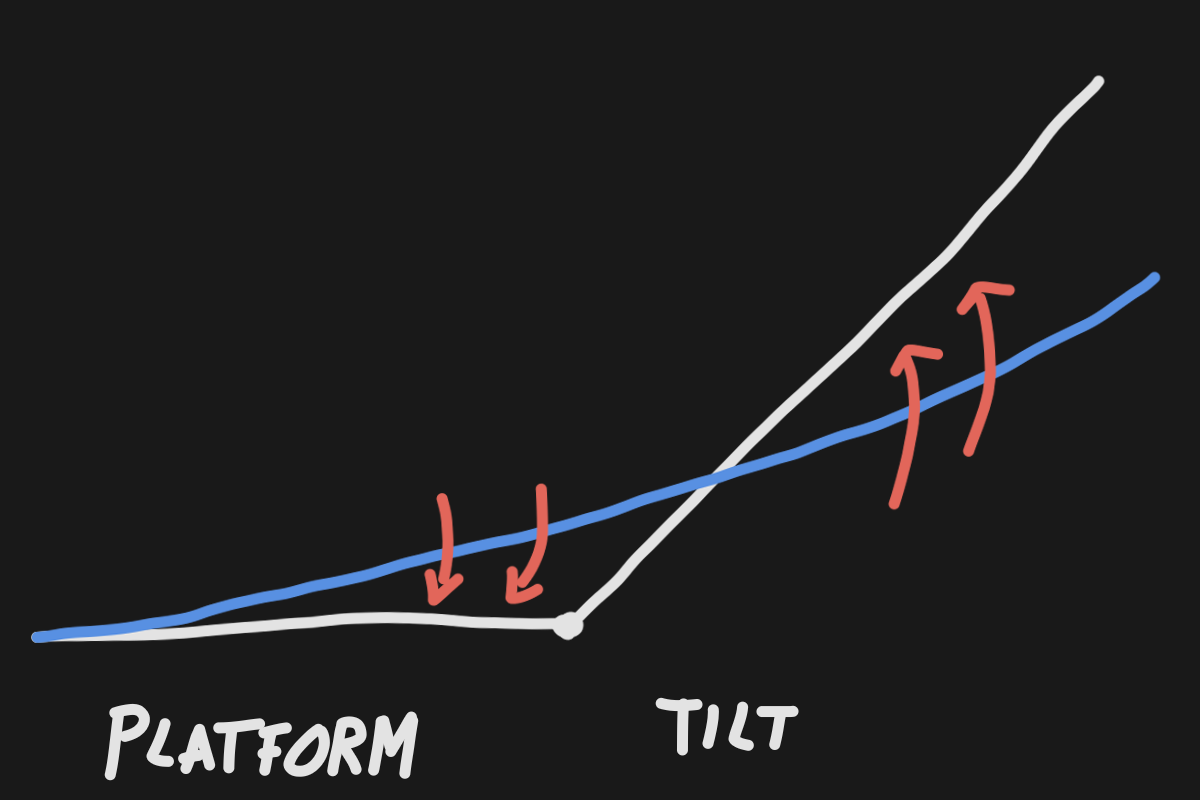
The other pitfall is that new students will want to fix the problem too soon. After Cody and Dave’s initial disagreement, they could easily say, “Sorry, I got angry. I’m just dealing with a lot of emotions right now. You’re my brother, and I shouldn’t be mad at you.” This is clearly the emotionally mature response. It is also boring. Real people do not behave rationally all the time, especially in tense moments. Let your characters be real people. Let them make mistakes. These moments of tension are what drive the story forward.
Exercise: Tilts on paper
I have two students do a platform scene in front of the class. I will side-coach them if they get too tilt-y. Then, when I think they have a sufficient platform, I jot down the FSE on a piece of paper and hand it to one of them. They must say the line verbatim and react to it as a tilt.
This removes all the pressure of identifying the FSE. I mostly choose lines that are dramatic or surprising. This forces the students to tilt big and to just focus on feeling the difference in the scene before and after.
Platform-Tilt is a framework for thinking about Act 1 of a story. In the platform, we are introduced to our main characters. We learn about their past history, present philosophy, and future aspirations. We establish how they feel about each other and the everyday routine, which gives us something to contrast against when the tilt occurs. The tilt is a moment of high drama that changes something about the routine. We can identify a tilt because our main characters will be strongly affected by it. They will have a noticeable reaction, and it changes all the main relationships in the story. This event sets the stage for Act 2 of our story.
As I mentioned in the Story Spine article, the goal isn’t to be thinking about all of this during a show. Instead, practice until these concepts are internalized. Specifically, you should be able to feel the change in the story between Act 1 and Act 2. If the show goes off the rails, then afterwards, you can refer back to this article and analyze. Figure out which areas need more practice. Then, practice.
I like to play Previously On in the class where I first introduce tilts. Since the Previously On segment of a soap opera is usually a collection of previous cliffhangers, it is, in a way, a compilation of previous tilts. This short-form game is a fun way to practice those emotional reactions.
I’m pretty sure Jill Bernard invented “mad, sad, glad, afrad”. She mentions it in Jill Bernard’s Small Cute Book of Improv.
I’m sure there are examples of stories with inciting incidents that are not “direct, on stage, and in the present.” However, the writer should have a good reason for breaking these rules. Perhaps telling the story indirectly or non-linearly is a bold stylistic choice. These sorts of stories are very hard to tell in improv. It’s best to default to Adams’s criteria in improv. Otherwise, framing the tilt can be needlessly difficult.
No posts
Comments
Nothing yet. Say the first thing.
Sign in to join the conversation.