
This post is part of the Improv Basics series.
“The first rule of improv is ‘Yes, and’.” Even if you have never taken an improv class, you have probably heard this phrase.1 It is so ubiquitous that people often say it without really understanding it. “Yes, and” is succinct and easy to remember, but more descriptive terms would be “agreement and collaboration,” the principles at the core of improv.

To improvise a scene, players must agree upon several details. In a writer’s room, this process involves brainstorming several options and then, perhaps after some deliberation, choosing the best one. This is normally how we think about storytelling; however, in an improv scene, there is no time to consider multiple ideas. We must accept the first idea presented so the scene can move on.
Thus, we create a rule: “Say yes.” No matter what your scene partner says, you will always accept it, even if you had a better idea. What even is a “better” idea? It is quite arrogant to think that your idea is better than your scene partner’s. Perhaps their idea is actually amazing, and we should let it play out. In fact, we should always have faith in our scene partners to have amazing ideas. We are building the scene together, and that collaboration is impossible without trust.
Creating a scene requires us to establish lots of details about our characters, their current situation, the backstory, the setting, etc. To make it easier, everyone should contribute to the storytelling. It is not sufficient to simply agree with our scene partners. We should offer up some contribution to the story ourselves. These contributions are commonly known as offers. An offer can be a spoken line, a nonverbal action, or anything else so long as it establishes something new about the story.
Thus, we amend our rule: “Say yes, and then add something.” The addition should make sense with the reality of the scene established so far. In other words, “accept the offer, and make a new offer.” If everyone follows this rule, we can construct a shared reality that everyone agrees upon.
Exercise 1 — “Yes, And” Scenes: Begin every line with “Yes, and…” This makes the agreement explicit, and prompts you to add something each time. Go back and forth with your scene partner to construct a shared reality. I let students know ahead of time that this is a “training wheels” exercise. The dialogue will not sound very natural. It is meant to be clunky. This exercise trains our brains to consider agreement as the default response.
When a player says something that contradicts a previous offer, this is known as a denial (sometimes called a block). Sometimes, a denial can be very funny.
Anton: These last three years have been the happiest of my life. I love you, and I want to spend the rest of my life with you.
Bryn: We only met last Tuesday.
This line would probably get a laugh, especially if Anton really earnestly sold the proposal. However, now the scene has nowhere to go. It is a cheap laugh because it comes at the expense of the reality of the scene. At this point, neither the audience nor the players know what is true about this scene. Is Anton deluded? Is Bryn misremembering? Are they confusing each other with someone else? We have more questions than answers.
Furthermore, this kind of denial is also disrespectful to your scene partner. If Anton has put in the energy to create this proposal scene, Bryn should utilize this energy to make an interesting scene. A denial throws Anton’s energy away. Agreement utilizes the energy to create an interesting scene. Note that Bryn does not need to reciprocate Anton’s feelings to agree with the reality of the scene. She can reject the proposal without refuting what Anton has said. Indeed, doing so would create an interesting relationship dynamic.
Many new improv students will find that their first thought is a denial. That impulse comes from wanting to create an exciting subversion. Practicing agreement is important because it trains our brains to value the reality of the scene more than a quick joke. As you do more scenes, you will find that saying the obvious logical thing is better for the scene than a clever subversion.
I use the analogy of making a sandcastle. It is always exciting to knock down a sandcastle (a denial), but it is much more difficult to build a sandcastle one scoop of sand (offer) at a time. Little kids will often build a small sandcastle and then knock it down. Then, they repeat this over and over. Older kids realize that building a bigger sandcastle is more fun than knocking over a bunch of tiny ones.
Some lines are not outright denials, but still slightly violate “yes, and.” These should be avoided in most cases, but there are sometimes good reasons to employ them. For beginners, these are off-limits. You should practice “yes, and” until that becomes your default response. Once you are comfortable with “yes, and,” you can be more lenient, allowing these partial “yes, and” responses when it suits the scene.
A “yes, but” is when a player accepts the offer, but their new offer does not build on the existing scene. It is not quite a denial, but it is not as strong as a “yes, and.” Too many “yes, buts” can make the scene get stuck in a loop.
Chirag: I just got a new pool table for the loft.
Deja: Yes, but I think we should keep it in the garage.
Chirag: Yes, but then one of us will have to park outside.
Deja: Yes, but…
A scene about the logistics of their home probably does not lead to an interesting scene. Saying “yes, and” is a more active choice, and it usually leads to more interesting stories.
Sometimes a player says, “yes,” but forgets to say, “and.” This can happen even if you explicitly say, “yes, and.”
Elena: The internet is down again. They’re still doing repairs.
Futoshi: Yes, and I can’t connect to it.
Here, Futoshi does not offer any new information. Even though he says, “and,” he is simply reiterating what Elena said. This doesn’t derail the scene, but it puts more pressure on Elena to add detail.
Questions also put pressure on your scene partner. It makes responding with “yes, and” difficult, and then they are put on the spot to come up with something. Here is a list of questions starting with the worst offenders and getting more acceptable down the list.
“Where are we?”
This question puts all the pressure on the other person. Instead, just make a statement establishing the location. Answer the question instead of asking it.
“The thieves entered from the window, but how did they get up to the fifth floor?”
This question at least adds some detail to the scene; however, it is a hard question. The scene partner must now invent a plausible explanation for a complex situation.
“What is your favorite color?”
This puts the other person on the spot, but it is an easy question to answer. They can name any color, and the scene can move on without too much difficulty.
“So you’re telling me that this castle is haunted?”
The answer to this question is clearly, “yes,” and therefore “yes, and” is still possible. This question hardly puts any pressure on the scene partner.
If you find yourself wanting to ask a question, try just answering the question instead. It will be a stronger offer. Sometimes, students will say, “But my character wouldn’t know this.” However, one can just as easily play a character who would know this information. If you find yourself asking a lot of questions, that can be fixed by choosing to play characters who are more competent (see Happy, Healthy, Sexy).
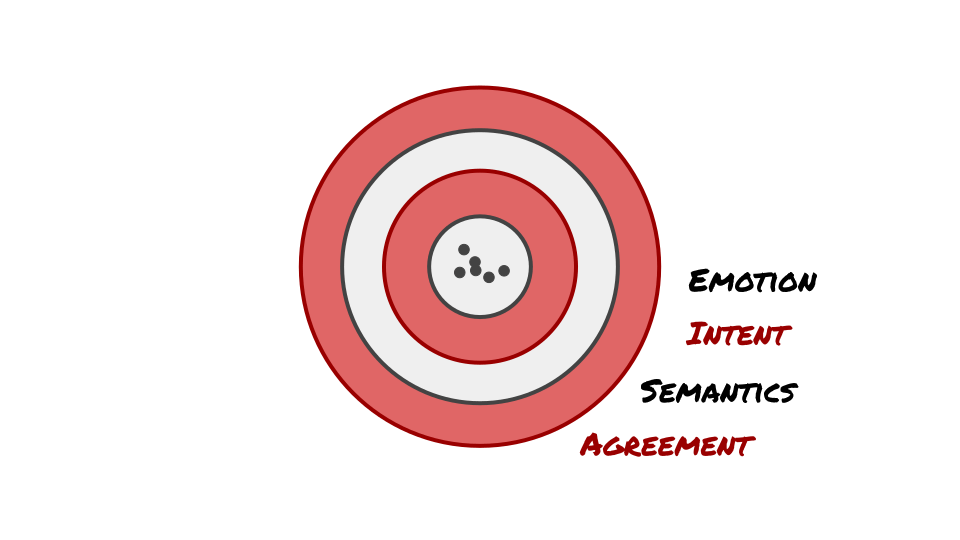
We have established how denials can make a scene fall apart, but we need to do more than just avoid denials. Surface-level agreement is sufficient to make the scene logical, but we want scenes to be watchable, theatrical, and entertaining, which requires a deeper level of agreement.
To explain, I will invoke the idea of the imaginary playwright. Though the scene is improvised, our goal is for it to seem like a scene from a real play. Our playwright has spent lots of time editing and revising the script to reach this final version. Treat every line as if it is very intentional and brilliant. If your scene partner says a line, agree not only with the words on the page, but also with their intent.2
Exercise 2 — “F*** Yeah!” Scenes: The same as exercise 1, but replace “yes” with “f*** yeah” (or “heck yeah” for a class where the expletive would be inappropriate). Besides being a bit of fun, the players in these scenes end up agreeing with each other on a deeper, more emotional level than in the simple “yes, and” scenes. Even without the expletives, this deeper connection is what we want from agreement.
Every rule has exceptions. Here are times when it is acceptable or even encouraged to break “yes, and.”
Respecting people’s boundaries is even more important than “yes, and.” Some people call safety “rule number zero,” which makes sense. It sits outside of improv. It is a rule about interpersonal interactions, not improv itself. If someone makes an offer that crosses a line physically or content-wise, players should not feel obligated to say “yes". Clarify your boundaries if needed. If that ends up breaking the scene, so be it.
Following the “yes, and” rule too didactically can lead to some unrealistic situations. If a character is fired unexpectedly from their job, the normal thing to do would not be to agree with the decision. A more grounded, realistic decision would be to rebel a little bit.
Boss: “We’re making some cuts. As you know, your performance has been the lowest on the team. I’m sorry, but we will have to let you go.”
A Denial: “No, my numbers have consistently been the highest. Greg should be fired.”
Not a Denial: “No, my numbers are low because I spend all my time fixing Greg’s mistakes. He should be fired, not me.”
Note that this still creates conflict in the scene. In later chapters, we will discuss how and when to bring conflict into scenes. (see Platform, Tilt) Nevertheless, in the second version, the employee does not refute the facts. Saying “no” here is actually an example of “yes, and” because he accepts the offer that he is being fired and builds upon it.
The only time a denial might be okay is at the very end of a scene. If the scene is over anyway, it does not really matter whether we break the scene. Of course, there are lots of ways to end a scene besides a denial, but sometimes the funniest thing to do is for a character to walk on and establish that everything was just a dream. There is nowhere to go after that, so the scene ends immediately. I do not recommend doing this kind of thing very often, but it is ultimately up to you whether you want to leave your audience with the image of your completed sandcastle or the image of you tearing it all down.
Agreement and collaboration are the foundation of all improv, so it is worth thinking about these principles in detail. Remember that the theory is not useful without practice. The real goal is to make “yes, and” the default response your brain jumps to when you are in a scene.
Different Levels of Agreement
·
June 6, 2024
If you’ve found this blog, you’ve already heard of “yes, and”—the first rule of improv: Players in a scene must agree about the reality of the scene. Even people that have never taken an improv class have heard of “yes, and.” Nevertheless, students in a level one class will constantly be contradicting each other, what we call a
People cannot seem to agree on the origin of “yes, and.” Neither Viola Spolin nor Keith Johnstone says the phrase explicitly in their books, though they both talk about agreement in other words. By the time Del Close and Charna Halpern started Yes And Productions in the 1980s, it seems the phrase was already being used in the improv community.
In an older article, I tried to break down the different levels of agreement. It might be helpful for some people to break it down in this way.
No posts
Comments
Nothing yet. Say the first thing.
Sign in to join the conversation.