
This article (after the lengthy preface) was originally published on Bitch Flicks in 2016, a contribution I wrote as part of a mini-series on sisterhood. Bitch Flicks ran from 2008 to 2018 as a celebration of women-centric cinema. The original post is available here.
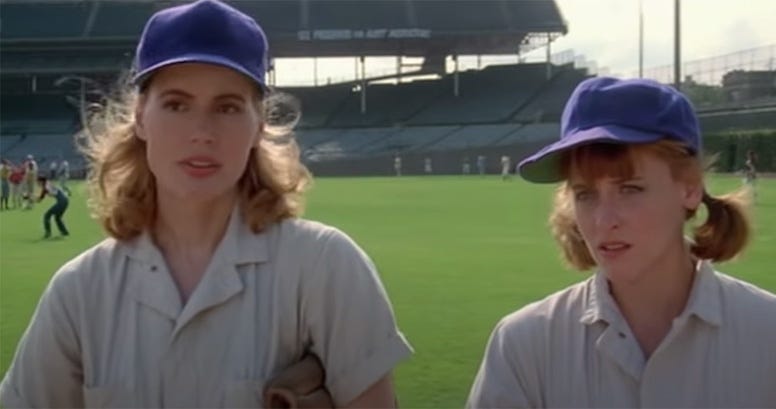
Preface (February 2026): A League of Their Own is my villain origin story. I don’t remember the circumstances of me watching it for the first time, but we had it on video, taped off the TV (I remember the Diet Coke ad featuring prominently in the breaks, and I guess it was around the time they started using hot men and perspiring cans as the basis of their campaigns, so like… 1994).
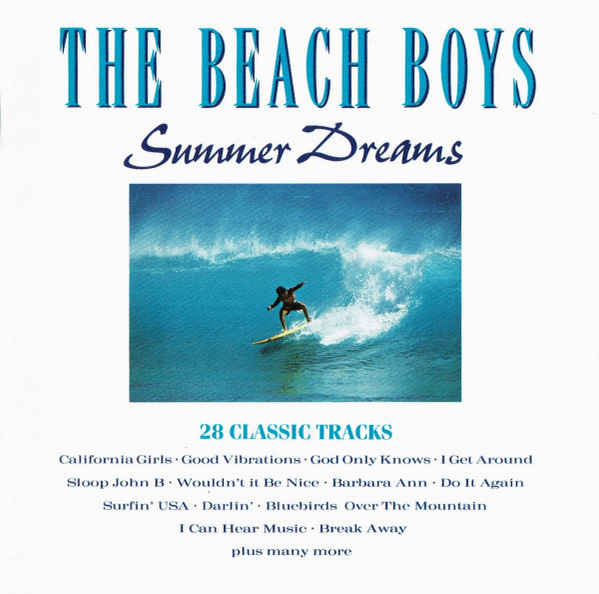
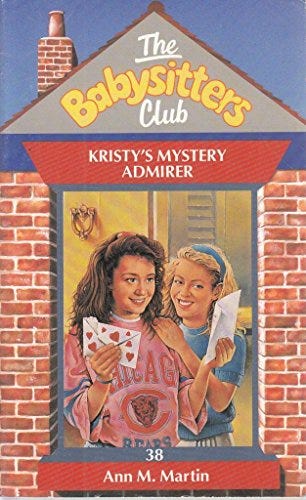
I was already low-key fascinated with American culture (this was the height of cool in 1994, not borderline problematic as it is now, in 2026). This fascination was driven, at the time, by Exhibit A: a copy of The Beach Boys’ compilation album Summer Dreams that my dad taped for me from the library (yes, all my audio-visual media was secondhand in those days: YOU WOULDN’T STEAL A CAR, but you absolutely would guard those precious blank TDKs with your life), and Exhibit B: any Babysitters’ Club books I could get my hands on. I owned a scrappy handful of the latter, the first and favourite of which was #38, Kristy’s Secret Admirer, which coincidentally (OR NOT) featured a lot of chat about softball.1
Into this heady mix of surf music and wildly underage childcare, chuck a film that was not only intensely American (baseball! the Midwest! earnest renditions of the national anthem!) but also intensely female, not as in girly (I was a Bermuda-shorts-and-dungarees kind of kid2 ) but as in it’s about girls doing cool stuff, which in the early 90s was actually pretty hard to come by, unless the cool stuff the girls were doing was setting up unregulated businesses looking after actual babies and also solving racism.
So I loved A League of Their Own. There was a point at which I could recite the whole damn thing off by heart. I can’t do that anymore, but the rhythm of it is still familiar, and the cadence of certain lines (“Has anyone seen my new red hat?”) will live in my bones long after I’ve forgotten everything except the exquisite rug pull of Would?3 and the way Frasier says “A rug? Where a rug doesn’t belong? It’s that kind of advice that leads to shag carpeting!” When Marla’s dad tells her that “you gotta go where things happen”, my ten-year-old brain - forged in a medium-sized town where things did not happen, at least nothing good - adopted that as a manifesto that powered me through a clutch of angsty teenage years.4 League is the film that is responsible for the ferocity with which I wore an Oakland Athletics t-shirt in the mid-90s (see aforementioned Bermuda-shorts-and-dungarees); for the Tasmanian-Devil-themed baseball glove I counted among my prized possessions; for the hope that someone would truncate my very common and ordinary name into an impossibly cool ‘Kit’; but also, ultimately, an early catalyst that would culminate in the decision, ten years later, to move to Hull (uh, you gotta go where things happen) and take up with a “newfangled” degree in American Studies that was probably even worse (ha!) than media studies.5 All roads lead from Hull, both geographically and metaphorically, and so here I am. Racine for life.
Original article (September 2016):
Early in Penny Marshall’s A League of Their Own (1992), Marla Hooch (Megan Cavanagh) is coaxed by her father into leaving him – and their small town – behind for a shot at a place in the newly-established All-American Girls Professional Baseball League (AAGPBL). “Nothing’s ever gonna happen here,” he tells a tearful Marla, as they wait for her train. “You gotta go where things happen.” It is a sentiment that drives many women in the film, not least Kit Keller (Lori Petty). Unlike Marla, however, Kit cannot count on the support of her own parents. Instead, she turns to her older sister Dottie (Geena Davis) in her desperate bid to leave their sleepy Oregon farm life behind, forcing Dottie to make a decision about her own life in the process. Dottie’s sisterly sacrifice paves the way for both women to become part of the inaugural intake of the AAGPBL.
Sisterhood is central to A League of Their Own, and the film does not shy away from depicting its less grateful, more fractious elements. From the beginning, Kit strives to prove herself against an older sister who is always, it seems, a little bit faster, a little bit prettier, a little bit better. “Can’t you even let me walk faster than you?” Kit snaps as they walk home from a baseball game in which Kit has struck out, only to see her sister hit the winning run and secure the team’s victory. As the younger sister, Kit is doomed always to play catch up. “You ever hear Dad introduce us to people? ‘This is our daughter Dottie. And this is our other daughter, Dottie’s sister.’” Later, news reporters refer to Kit as Dottie’s “kid sister”; Kit fumes that their parents “should have had you and bought a dog.” It is perhaps particularly galling for Kit that, despite her own evident passion for the sport, it is Dottie who excels on the baseball field without seeming to break a sweat. It is testament to A League of Their Own that this sisterly rivalry is confined almost entirely to sports; refreshing that it is Dottie’s killer swing that Kit covets most of all. While Dottie is around, Kit is relegated to being the scrappy sidekick – the sister who will always struggle to measure up.
Though the simmering sibling rivalry between Kit and Dottie is a thread that runs through the entire film, the importance of sisterhood goes far beyond this. For both women, sisterhood becomes a ticket to another world: a ticket out, but also a ticket in; to friendship, to competition, and to independence. As such, sisterhood exists as a source of empowerment. It is only as sisters that Dottie and Kit ever make it out of Oregon and to the baseball diamonds of the Midwest.
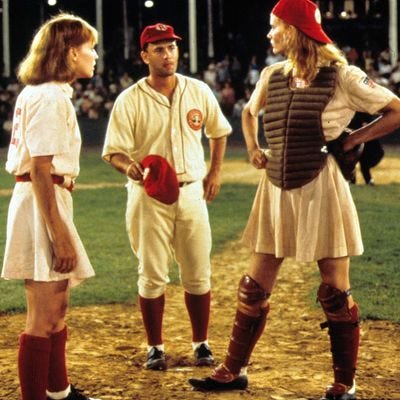
Most obviously, it is Dottie who offers this alternative life to her younger sister. Their mother and father are nothing more than a barely-glimpsed spectre of parenthood in the film. Only their mother speaks; when she does, it is to chastise her daughters for running, and to tell Kit to keep her voice down. At home, Kit knows she will always be stifled. It is to her sister whom she turns to facilitate her escape. “Please, Dottie,” she pleads, as the two of them prepare dinner in the Kellers’ claustrophobic kitchen. “I gotta get out of here. I’m nothing here.” Dottie is able to save her sister from a life where the best she has to look forward to is huddling around the wireless with her parents and fending off men like Mitch Swaley (Gregory Sporleder), who Kit declares is “one step up from a pig.” When the scout Ernie Capadino (Jon Lovitz) refuses to take Kit to the try outs in Chicago unless Dottie comes along too, Dottie realizes she holds her sister’s future in her hands: to refuse would preserve her own quiet life, but would crush Kit in the process.
Inevitably, Dottie’s sisterly sacrifice becomes a weapon with which to hurt Kit when the two fight over Kit’s trade from Rockford to Racine towards the end of the season. “I got you into this league, goddamn it!” Dottie hurls at her sister, to the frantic whispers of their teammates. For all that Dottie has done to aggravate Kit – being hailed as the league’s ‘Queen of Diamonds,’ pulling Kit from the pitcher’s mound in a crucial game – this is the one that cuts Kit the deepest. Her sister may have facilitated her escape, but she will always be there to remind Kit of that fact.
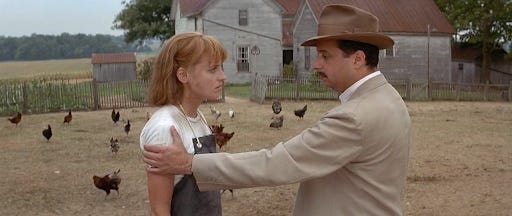
If sisterhood saves Kit, however, it also saves Dottie. At first glance this is perhaps less obvious. Unlike Kit, Dottie feels no need to “go where things happen.” “I’m married. I’m happy. That’s what I want. Let’s not confuse things,” she counters, when Kit begs her to try out. Kit, however, is unrepentant. Though Dottie is apparently happy with her neat, conventional existence – once her husband returns from overseas, they will settle down, have their children, and settle into an unremarkable, if pleasant, life – Kit urges her sister to take advantage of the opportunity being presented to them. “But can’t you just have this first? Just so you can say you once did something? Something special?” she asks.6 Dottie’s desire not to “confuse things” does not convince Kit, who pushes her sister to seek something that will belong only to her – not to her husband Bob (Bill Pullman), not to their future children, but to Dottie.
Being married is a defining aspect of Dottie’s character, both before and after she joins the league. Her first reaction to Capadino’s attempts to recruit her to the league is to tell him she is a married woman, and therefore has no need of the opportunity he offers. News coverage of the Rockford Peaches reminds viewers that although Dottie “plays like Gehrig, and looks like Garbo,” she is romantically off-limits: “Uh-uh fellas, keep your mitts to yourself. She’s married.” She turns down an invitation to join some of the other players at a local roadhouse because – you guessed it – “I’m married.” Kit’s determination to have Dottie join the league is not an attempt to erase this identity, but rather to supplement it. Kit serves to remind Dottie that sure, she can be married to Bob, but she can have this, too. She can be Bob’s wife Dottie, but she can also be – as Coach Jimmy Dugan (Tom Hanks) might have – “a goddamn Peach.”
Kit’s conviction is borne out in Dottie’s decision to return to the league to play in the World Series, despite earlier leaving with Bob to resume their married life together. For all her words to the contrary, the competition and the camaraderie has left its mark on Dottie. In this instance, her kid sister was right. “You are gonna miss this,” Kit insists as the sisters say goodbye following the Belles’ victory. “I don’t care what you say.” Though Dottie demurs, she does admit that she will miss the girls, and Kit most of all. There is an undeniable poignancy here, as the sisters say goodbye, as it seems clear that, as they climb onto different coaches outside the baseball ground, this will be the last time they will ever be together in the same way.
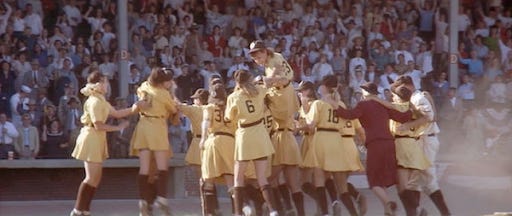
Yet there is also a quiet triumph, for Dottie, as she witnesses Kit finally get what she wants. If Dottie is happy to go back to Oregon with Bob and have children, Kit is equally thrilled to be staying in Racine with some of the other girls and carving out a slice of independence for herself. At the beginning of the film, the local crowd chant Dottie’s name, much to Kit’s disappointment; this is reversed at the end of the film, when Kit’s winning home run has her own name echoing around the stands. It is the moment when Kit finally steps out of Dottie’s shadow, and the moment when Dottie can rescind credit for Kit’s success:
Kit: Thank you for getting me into the league, Dottie.
Dottie: You got yourself in the league. I got you on the train.
Dottie and Kit, it seems, do not maintain a close relationship over the ensuing years. The bookends of the film – older Dottie’s journey to the Baseball Hall of Fame, to see the induction of the women’s league – make this clear; Dottie grumbles to her adult daughter that Kit “probably won’t even be there,” and their surprise at coming face to face hints at limited contact since the days of “dirt in the skirt.” And yet their tearful embrace is a testament to the power of sisterhood, and an acknowledgement not simply of time spent apart, but of gratitude for the life they – however briefly – gave each other as young women.
Never mind Mary Anne and Logan, Kristy and Bart were the goal, no? No?
And yes, if you know me in real life, a Bermuda-shorts-and-dungarees kind of adult.
When Layne is launching into that first “Am I wrong…” (2:40) will always feel like the bit where the rollercoaster dips. It is the greatest final third of a song I have ever encountered and I once told Pete Paphides that on Twitter, back when Twitter was the kind of place where you did that.
See also: the music of Bruce Springsteen and the reason why I possess an outsize amount of affection for Gurinder Chadha’s Blinded By the Light (2019).
My dentist, Dr al-D, was particularly vocal about this decision c.2002, although I found it difficult to justify my choice of degree while having a scale and polish, so he remained sceptical.
The desperation with which Lori Petty delivers this line is exquisite.
No posts
Comments
Nothing yet. Say the first thing.
Sign in to join the conversation.