
on Noam Chomsky’s Epstein connections, and where this leaves us
The release of millions of Epstein files and documents has further implicated the worst people in the world. From Donald Trump to Elon Musk to Bill Gates to Peter Mandelson to Richard Branson to Andrew Mountbatten-Windsor, nobody on the left is losing sleep over the inclusion of such ghouls.
But there’s one revelation which has been a source of tension for many, myself included: the prominent linguist and political philosopher Noam Chomsky.
left origin story
If you ask a leftist who radicalised them or helped shift their thinking beyond liberalism, apart from people they know personally, they will likely point to revolutionaries (Marx, Engels, Lenin, Rosa Luxemburg) and/or prominent intellectuals (Howard Zinn, Michael Parenti, Angela Davis, Edward Said). And undoubtedly, Noam Chomsky often tops that list.
Chomsky has been one of the most articulate and vocal critics of U.S empire, gaining notoriety for his early opposition to the Vietnam War and for developing the ‘propaganda model’ with Edward S. Herman, which showed how corporate media is structured to ‘manufacture consent’ for elite interests, instead of serving the public.
He revolutionised the field of linguistics, he tirelessly amplified the cause of Palestine to Western audiences. His achievements are numerous and his fingerprints are all over global progressive movements of the 20th and 21st century.
My path to left politics was not unique. I always had a left-liberal bent, but was more social-democrat than revolutionary. At my undergraduate studies, I dabbled in politics: I joined the Marxist society and probably attended like two events of theirs, I studied protest movements, I read (some) Marx. But what I did most, in typical antisocial student fashion, was watch endless hours of political lectures and debates online: Parenti and Norman Finkelstein were my heavy-hitters. And certainly Chomsky.
This accelerated when I moved to Denmark, and studied the history of the American left. Nerd alert: I downloaded a bulk of Сhomsky lectures: on Israel-Palestine, on capitalism, on linguistics, on the deception of mass media, on the Vietnam War, and the other crimes of every U.S president. I used to ride my Dutch bike through the fairytale city of Odense and listen to Chomsky’s somewhat droning voice for hours on end from my iPod. That was my happy place.
I even emailed him about the dangers of a potential Trump presidency (lol) and got a reply – I wasn’t special, he was notorious for replying to almost any email.
Chomsky’s imprint always remained with me. I didn’t agree with him on everything, but he articulated a critique of U.S empire and consumer capitalism which, without exaggeration, shaped my outlook on the world profoundly.
manufacturing consent
This makes the revelations of the extent of Chomsky’s relationship with the world’s most infamous pedophile and sex trafficker Jeffrey Epstein, as well as other dubious figures like arch-rightist Steve Bannon, all the more devastating.
The release of correspondence between Chomsky and Epstein from 2019, plus photo evidence of him with these demons, taints his legacy as a trusted and principled intellectual. Epstein gave him financial advice, and their exchanges reveal a wide-ranging friendship.

I find it highly doubtful that Chomsky was entirely ignorant or naive when it came to understanding what kind of man he was dealing with. There were news reports from as far back as 2008 on Epstein being jailed for soliciting sex from minors, and Chomsky is known to be a voracious news-reader.
There’s no doubt that Epstein liked to court prestigious academics and intellectuals, perhaps as an ego thing or power trip. It should also be noted that Chomsky was 87 years old when he met Epstein. But even if Epstein exploited him as a ‘mark’, as some more sympathetic writers have suggested, this does not absolve him. It seems more likely that he just didn’t care.
It is also telling that, when pressed by reporters on his relationship in 2023, Chomsky was combative: “First response is that it is none of your business. Or anyone’s. Second is that I knew him and we met occasionally.”
who rules the world?
More than this, Chomsky was complementary, deferential even, to Epstein in numerous email conversations.
In an email from February 2019, Chomsky apparently wrote to Epstein: “… the horrible way you are being treated in the press and public. It’s painful to say, but I think the best way to proceed is to ignore it.”
He later wrote, “That’s particularly true now with the hysteria that has developed about abuse of women, which has reached the point that even questioning a charge is a crime worse than murder.”
It truly seemed the two had rapport – over the worst things.
Even if you suppose that Chomsky was unaware of the nature of the crimes that Epstein had committed, why would he associate with someone who was clearly a ruthless and capitalistic financier, a friend of Israel (a country Chomsky had previously been denied entry into), and a billionaire with numerous ties to the global ruling class?
Epstein and his associates are the epitome of the power structures that Chomsky spent his career critiquing. So why associate at all? This was the more ‘establishment’ part of Chomsky. I get the feeling from the email exchanges, that he was charmed by Epstein to some degree, and swept up by his connections. In other words, he bought into some of the elements of power he had spent a lifetime warning the public about.
“For the powerful, crimes are those that others commit.” – Noam Chomsky, Imperial Ambitions: Conversations on the Post-9/11 World

hegemony or survival
Chomsky’s wife Valeria, who speaks for him since he had an incapacitating stroke in 2023, has issued a public statement on the matter, which blamed his overly trusting nature for this lapse in judgement. Though there’s no indication that Chomsky or his wife took part in Epstein’s crimes, at the very least this association shows he had a huge blind spot, one which has left a stain on his legacy as an important political theorist.
It does not make me regret relying on Chomsky’s analyses as one of the foundations of my belief system. And it doesn’t invalidate everything he ever said or did. The ideas he propagated hold weight, regardless of these actions. But it makes me think twice about my reliance on his work, or any one person’s work for that matter.
Everyone is still a product of capitalism: they fail and lapse. No one is infallible. Individual thinkers and leaders hold value, but we can’t wait for heroes to take us forward. Learn what we can from others, but don’t idolise or put them on a pedestal. It’s difficult because we tend to rally around people over ideas: charismatic personalities are more of a draw to humans than the best-laid plans. We need to cross that threshold to embrace collective purpose over following leaders.
If the Epstein scandal shows us anything beyond the corruption of power and how patriarchal violence spreads like an infection, it’s that people in positions of influence begin to operate in a morally grey zone by virtue of their place in the system. Leftists are no exception to this. Chomsky was an MIT Professor, he had ties to the establishment and other parts of the cultural and academic elite.
Unlike the amount of cope over at /r/Chomsky, I will make no excuses for him, or any other figure, on the left or otherwise, proven to be involved in this sordid affair, even tangentially. It’s not about guilt-by-association, but what does it say about your moral character if the charm offensive of this monster worked on you, and you felt the need to defend a billionaire in the slightest instead of the victims of his predation.
As Chris Hedges put it, “The closer you get to these vampires the more you become enslaved. Our role is not to socialize with them. It is to destroy them.”
Burn your heroes down: no more idols.
~ Tommy
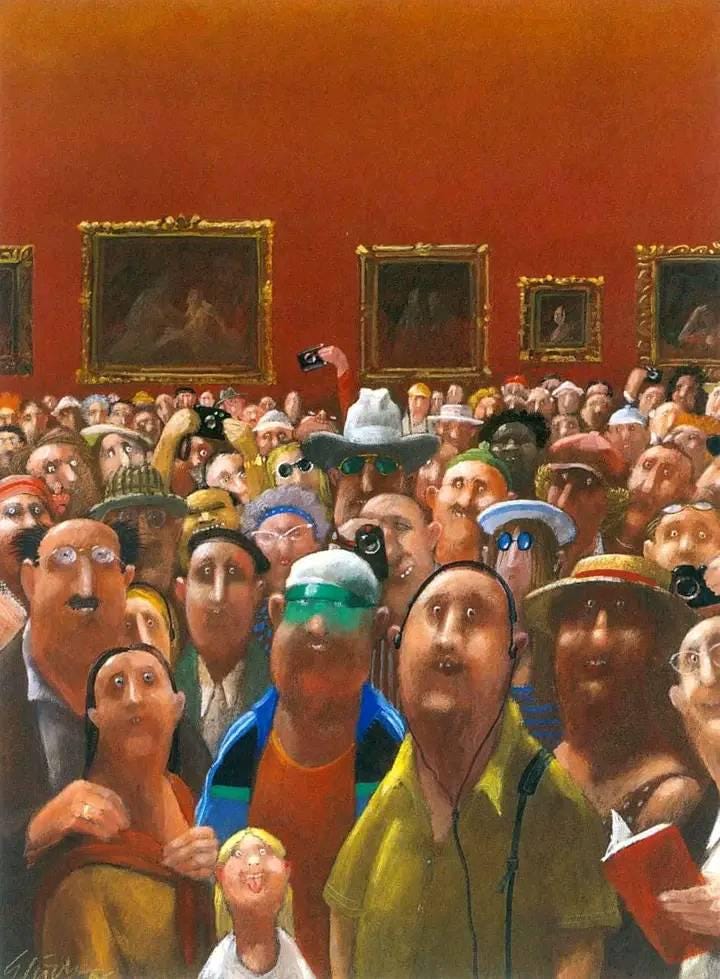
Gerhard Glück - An Ordinary Day for Mona Lisa (2008)
The mushrooms that make you see tiny people

A friend in my bookclub made me aware of these fascinating mushrooms from Yunnan, China. When ingested raw or undercooked, they give people the exact same bizarre visions: “pint-sized, elf-like figures – marching under doors, crawling up walls and clinging to furniture.”
Ok, so Borrowers syndrome?
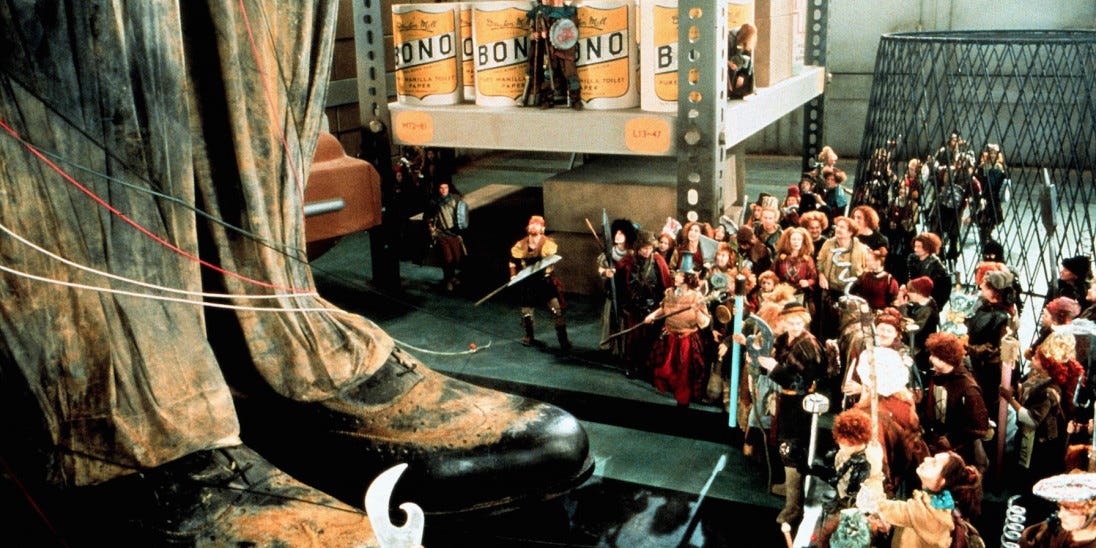
Although mushrooms causing hallucinations is well-studied, the same phenomenon happening to multiple people across different geographies is something new. And psilocybin, the psychedelic molecule found in magic mushrooms, is not causing the effects of these L. asiatica mushrooms: “current tests suggest it is not likely related to any other known psychedelic compound.”
The mystery remains, but there’s something kind of comforting in the fact that, if you ever trip balls on this mushroom, anyone who has ever taken them is seeing the same exact thing. Lots of tiny people running around like mad. #wholesome
The Pierce Perspective – The Dark Psychology of The Black British Man
A thoughtful analysis by The Pierce Perspective on how the environment, culture and upbringing of Black British men has influenced their identity and development, a topic which is massively under-discussed. It frames the struggles particular to the younger generation as stemming from emulating the precarity and alertness of their elders, as migrants in the often unfriendly UK.
It’s notable that Pierce discusses the particulars of Black British masculinity, and how a sense or an expectation of bravado leaves many boys ill-prepared for the greater societal challenges of adulthood, leading to cycles of missed opportunities.
Yasmine Hamdan – Reminiscence غروب
The legendary Lebanese alternative singer, Yasmine Hamdan, had one of my favourite records of 2025: I remember I forget, an album which improves with every listen. It’s a dark and often synthy production, accentuated by Hamdan’s sultry vocals over various creeping orchestral strings and drums. The result is haunting, and its themes of memory and displacement reflect the current psychology of the Arabic-speaking world.
Reminiscence غروب is the last song off the LP and one of my favourite cuts, which slowly draws you in before the drums and voice transports you to somewhere more profound, coming together in a symbiotic rhythm that is alluring to a fault.
Weird Little Guys – To Catch a Fascist: An Interview with Christopher Mathias
A great interview with Christopher Mathias, who discusses the anti-fascist activists working undercover to infiltrate and unmask the growing Neo-Nazi groups in the United States. Mathias’ on-the-ground reporting paints a vivid picture of the unseen war by resourceful citizens to stop the far-right violence on American streets.
The host, anti-fascist researcher and journalist Molly Conger, brings her own intense experience of facing up to the far-right to this illuminating conversation, which is so pressing now.
Marina Abramović’s shocking Rhythm 0 performance shows why we still cannot trust people in power by Katy Hessel
When artist Marina Abramović performed her controversial piece ‘Rhythm 0’ in Naples in 1974, she declared herself as the object. She stood still and instructed the audience to do what they wished with her body using props: lipstick, a candle, chains, knives.
What started as passive and perhaps amusing turned sinister, as members of the crowd got more confident and crude, with people cutting her skin, ripping her clothes and generally humiliating her: men laughed and ogled at her body as she stood with tears in her eyes.
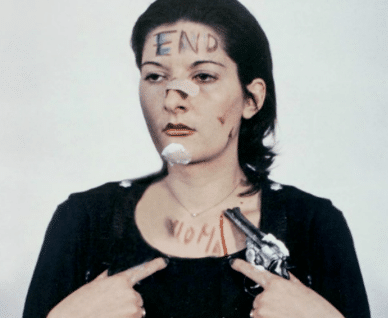
The performance was stunning: not only in its methodology but what it told us about the perils of trusting people in positions of power. Abramović handed control of her body over to complete strangers for six hours, and the culture of misogyny permeated the performance directly, precisely illustrating what she was trying to demonstrate about the flaws in our culture.
It correlates directly to the unaccountable sexual abuse of Epstein and his ilk, including the many enablers of his despicable behaviour. The inherent violence towards women by men in power has seemingly not faltered since this landmark piece of art debuted.
Try a ZeroWaste recipe generator, if you’re feeling uninspired in the kitchen
I have a love/hate relationship with cooking: sometimes I just fall back into familiar modes of making the same thing. Websites like Supercook help get over this rut, and make use of what you already have in your kitchen without the need to do a massive shop. Try it to save time, money and inject some creativity back into your cooking!
Comments
Nothing yet. Say the first thing.
Sign in to join the conversation.