
Peter Thiel always asks variants of the question: “What are you not allowed to say?” in a given environment. In the Evangelical South it’s dangerous to be gay and liberal. On college campuses it’s dangerous to be conservative.
In Silicon Valley the dogma that’s not allowed to be questioned is meritocracy of talent.
Silicon Valley has historically thrived on meritocracy. Outsiders with no access or network could show up, build generational businesses, and be rewarded for their labor. The industry prided itself on being 2,851 miles removed from Washington DC, an industry notorious for lobbyists and insider connections required to get anything done.
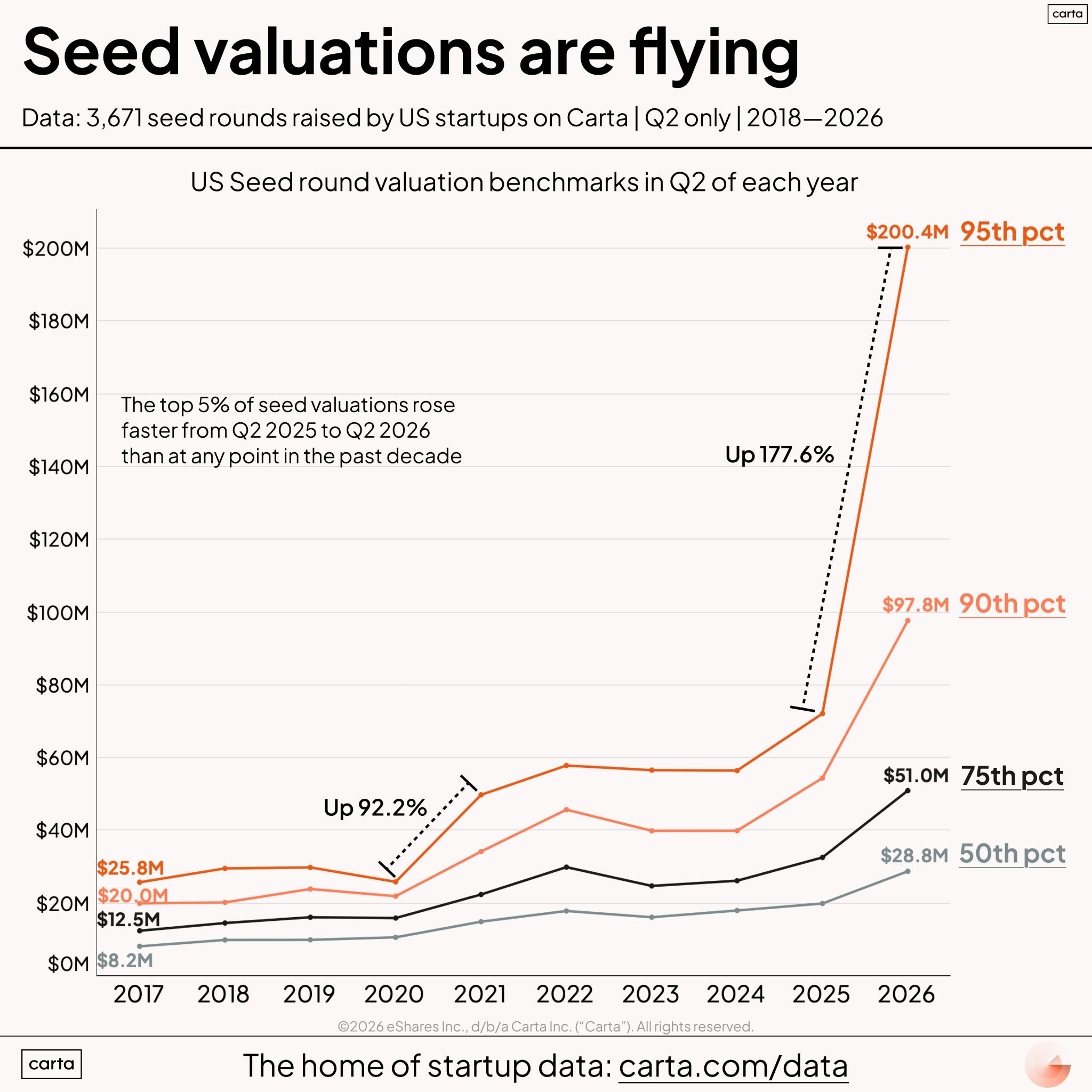
Today, Silicon Valley outcomes depend on who you know and how willing they are to kingmake you.
This is not unlike how any other old money industry works. In East Coast high finance it’s about going to the right elite schools. In English politics it’s about having the right family surname.
How did Silicon Valley go from meritocracy to kingmaking?
It’s no secret that Silicon Valley thinking has become extremely consensus over the past few years. This is largely due to 1) AI distorting expectations for growth 2) LP capital concentration and 3) professionalization of venture capital.
First, AI has completely distorted expectations for revenue growth. For the first time in history we’re seeing startups go from $0->$100M ARR in a year or two. Contrast this with the SaaS era when tripling your revenue consistently year-over-year puts your company on the path to IPO. Moreover, we have never seen revenue growth at scale before with Anthropic. To go from $9B ARR in Dec 2025 to $47B ARR in May 2026 (adding Palantir’s, Snowflake’s, and CoreWeave’s annual revenue along the way) is unheard of.
Prominent VCs are now saying don’t ever invest in diamonds in the rough. Either wait to see inflection and try to get into the hottest companies, or try to pattern match what’s worked in the past and kingmake a new company early on. The former is the correct strategy for growth investing; the latter is a mistake. More on why and how that affects founders later.
Second, LP capital has concentrated into a handful of established multi-stage franchise funds. 12 VC firms captured 50% of all LP dollars in the first half of last year. This is largely in response to an overallocation to the venture asset class in 2021-2022, and a flight to the “quality” brand names that institutional allocators don’t have to take career risk defending in IC meetings. Family office LPs, in particular, tend to care a lot about getting access to the hot Silicon Valley companies regardless of entry valuation. If it takes paying up for tiny ownership in hot companies in order for VC funds to get LP capital, so be it.
Third, there’s been a culture shift in the VC industry from a boutique cottage industry into an established career path. Over a decade ago venture capital was a craftsmanship. Like medieval guilds, VCs followed the apprenticeship model of older experienced GPs training younger junior VCs the art and science of having good taste for founder quality and good feel for market timing.
Over time the VC industry has professionalized into another standard career path. Instead of 2 years investment bank → 2 years business school → private equity, it’s now 2 years big tech → 2 years high-growth startup → venture capital. Once there’s a standard career path it attracts the excellent sheep NPCs who follow the herd, not the highly disagreeable independent thinkers that the industry depends on for contrarian investments.
Given the time to IPO has gotten longer than ever and thus extending feedback cycles, getting into the hot companies (not necessarily the best companies!) is a better strategy for getting promoted internally at the VC firm. Mid-career VCs would rather get a quick easy markup from a safe consensus bet instead of taking the risk for a potential fund returner. Turnover at the big VC firms is higher than ever too, so they may not be at the firm anyways in a few years to get deal attribution for the fund returning investment.
One would think the typical startup founder is a highly disagreeable renegade who carves their own path in the world and doesn’t give a fuck about what the establishment thinks. These founders are often polarizing to their peers, don’t follow instructions from their bosses, and get fired from structured corporate jobs. But that’s not so true anymore.
Startups are becoming more of a standard career option, not unlike big tech or consulting. One contributing factor is the unemployment rate is high right now for new college grads seeking entry-level white-collar jobs that are shrinking due to AI. Rather than grind through the job search, an alternative is applying to a startup accelerator, treating it like an internship program while burning through $500k having fun and figuring out adulting.
The Stanford Review has written before about how YC is for cowards. With YC increasing from 2 to 4 batches annually (~800 startups annually!), coupled with the explosion in the number of other accelerator programs, it’s no surprise that the typical startup founder is becoming more cookie-cutter and less unorthodox outlier.
Accelerators put pressure on startups to be legible to VCs by demo day, so startups pivoting around in the idea maze trying to find product-market fit naturally gravitate towards building in the most obvious crowded categories that are already working. 81% of YC’s current batch is building AI for XYZ. Crypto startups are building stablecoin neobank for XYZ region or prediction market for XYZ niche. Consensus VCs fund these consensus ideas because they feel safe and familiar and can be easily pattern matched to what’s already working. But the truth is the best companies define new categories and are started years before the category became obvious or even had a name.
For founders who don’t go through accelerators, having good pedigree is becoming more important than ever. Anyone who went to Stanford will get funded. Anyone who spins out of OpenAI will get funded. The check size and valuation are a function of how good the credentials are and how well networked the founder is among VC circles.
On top of that, the big multi-stage funds are handing a central cast of characters (a.k.a. those who have the best credentials) $10-50M war chests to kingmake categories before their companies have traction, making it difficult for anyone else who is not central casting to win those markets.
Thus it’s no longer “can you build a great business?”. It’s “can you fit the mold of what the big VC firms want to fund?”
A soulless insider cabal where those with pedigree and connections get favorable treatment is antithetical to the idea of meritocracy where any entrepreneur who has skill and works hard wins. Meritocracy is historically what’s given Silicon Valley its aura, the one place in America where the American Dream is still alive and works. Today Silicon Valley is becoming more like Wall Street or K Street.
Founders outside the network now feel that they have to play “the game” to be one of the central cast of characters. This means hanging out with VC associates at happy hours and dinners and acting slightly autistic to manufacture FOMO and momentum for their fundraise. Normally it’s a waste of time for founders to be networking with VCs; they should instead be laser focused on building their companies and talking to customers. Now it’s all part of the game and an extra skill founders have to develop.
To be fair, kingmaking does work to an extent. Raising a ton of capital gives you a massive war chest to loss lead on customer acquisition cost (i.e. acquire users unprofitably until your competitors go bankrupt or pivot). It scares away other teams from entering your market and competing.
However, kingmaking also creates moral hazard for bad behavior. Companies are getting ~creative~ about reporting revenue, and founders are selling secondaries very early on.
Kingmaking creates pressure for companies to show revenue growth at all costs in order to be legible to VCs. This has led to some companies outright lying about their revenue (securities fraud), or getting creative with their methodology. One example is taking one-off contracts and annualizing them as ARR. Often times these contracts are just pilot pricing with an opt-out clause, so they’re somehow ironically none of “annual”, “recurring”, nor even “revenue”. Another example is rebranding ARR from “annual recurring revenue” to “annual run rate”, and calculating ARR as last week’s revenue * 52 or even last day’s revenue * 365. It’s not quite securities fraud, but it’s not a good look to anyone who does their diligence.
VCs trying to kingmake competitive rounds will often allow founders to sell secondaries in order to win deals. Apparently 10% of the round in founder secondaries for hot companies is common practice now. The downstream effect of founder secondaries is it attracts grifters. Those who can play “the game” described earlier very well to manufacture VC FOMO at the Series A, and leverage that to sell millions of dollars in founder secondaries (often more than the company’s lifetime revenue) and then slow rug afterwards.
The pendulum has swung so far towards consensus today that I’m betting there will be a mean reversion back to contrarianism.
History has shown repeatedly that the hottest theme in any given year is not the same category as the most valuable company started that year. I have no reason to believe this time is different.
I’d rather back the outsider who has a chip on their shoulder all day over the insider who’s been prematurely anointed by VCs. I believe there is a huge blind spot of great founders outside the Silicon Valley groupthink bubble who are not pedigreed, are out of distribution, and are not legible to most VCs.
I’m optimistic that meritocracy will eventually win, and those who chase momentum playing the kingmaking game will be left licking their wounds.
Follow the herd, get slaughtered.
No posts
Comments
Nothing yet. Say the first thing.
Sign in to join the conversation.