
Frasier is an unusual sitcom, architecturally speaking.
The main set of Frasier’s living room has a split-level design; his home has no staircases (such as The Nanny), but does possess a balcony more seen than used (like Friends), while doors and halls lead to oft-mentioned, occasionally-seen rooms.
Meanwhile, Frasier’s radio station set uses windows and doors to do more ‘stage-y’ bits, like today’s gag-heavy scene from 3.16 “Look Before You Leap.”
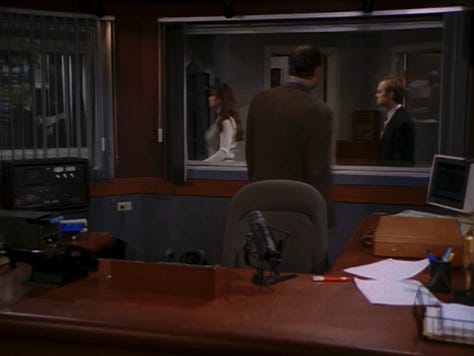
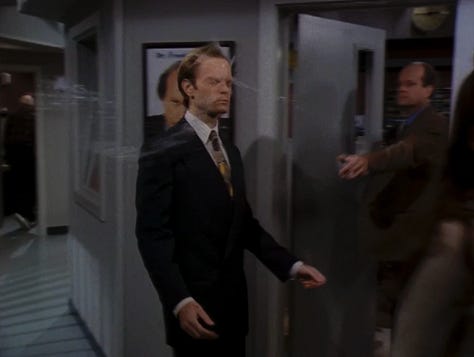
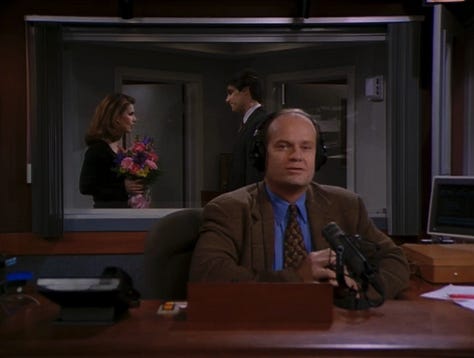
What we mean by ‘stage-y’ is specifically a type of gag with a long and storied history in theatre: through artifice of the set, a character is blithely unaware of events mere feet away, to the point of comedy; then, they become aware of and interact with said events. In this case (as often on stage as well) both obfuscation and interaction involve window glass and doors.
So while the scene involves camera movement and editing, it still maintains a sense of ‘stage-y-ness.’
(Pardon our technical terms. ‘It acts as a proscenium’ — there, feels more formal.)
Watch, and we’ll break it down!
Frasier (Kelsey Grammer) exhorts Niles (David Hyde Pierce) not to give in to his current state of heightened concupiscence. Niles agrees, leaving the office, at which point the camera follows Frasier walking back to his desk.
In the background, Niles walks the hallway just ahead of Frasier; so, we can see them both, and we know Frasier can see Niles.
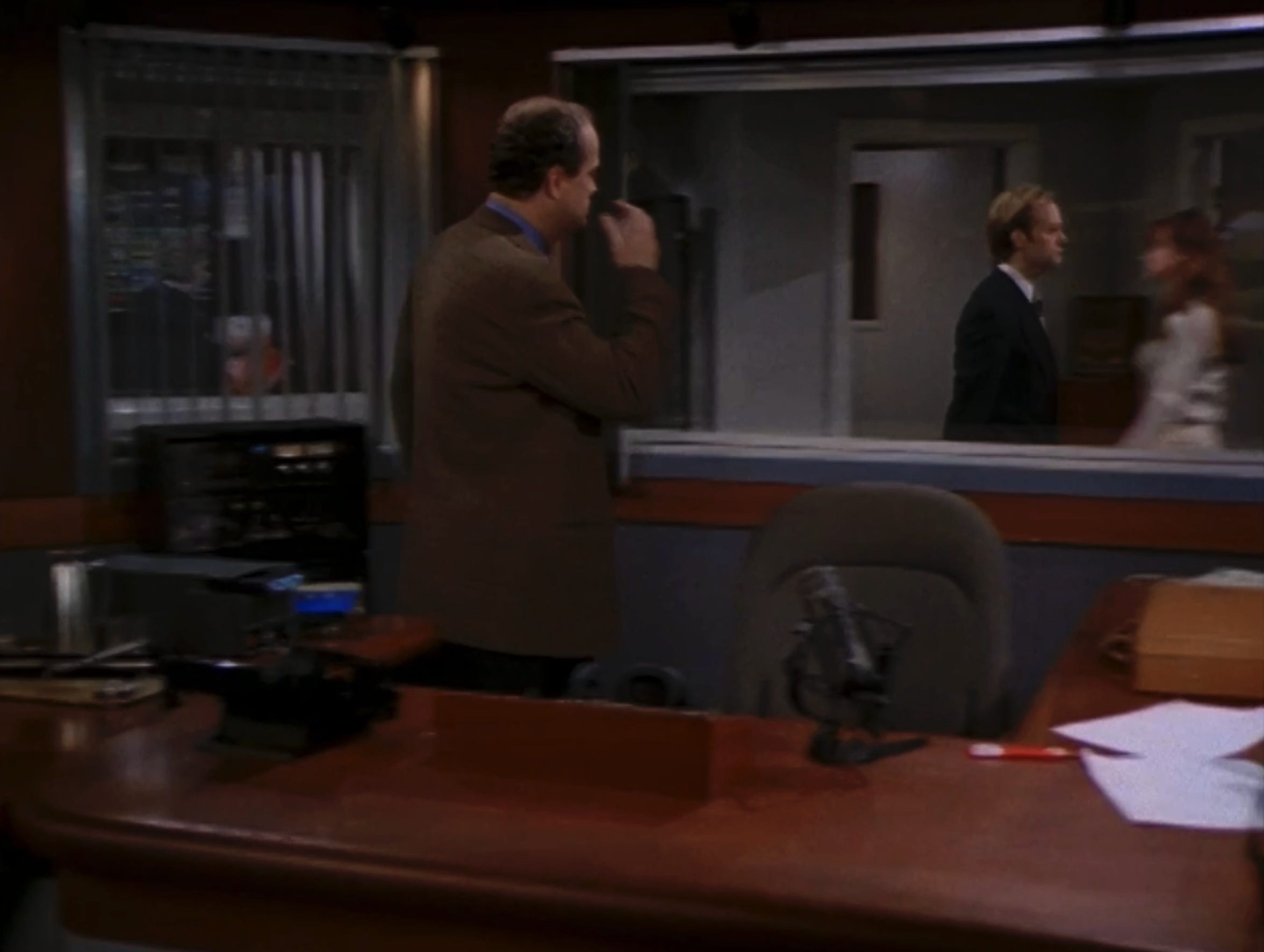
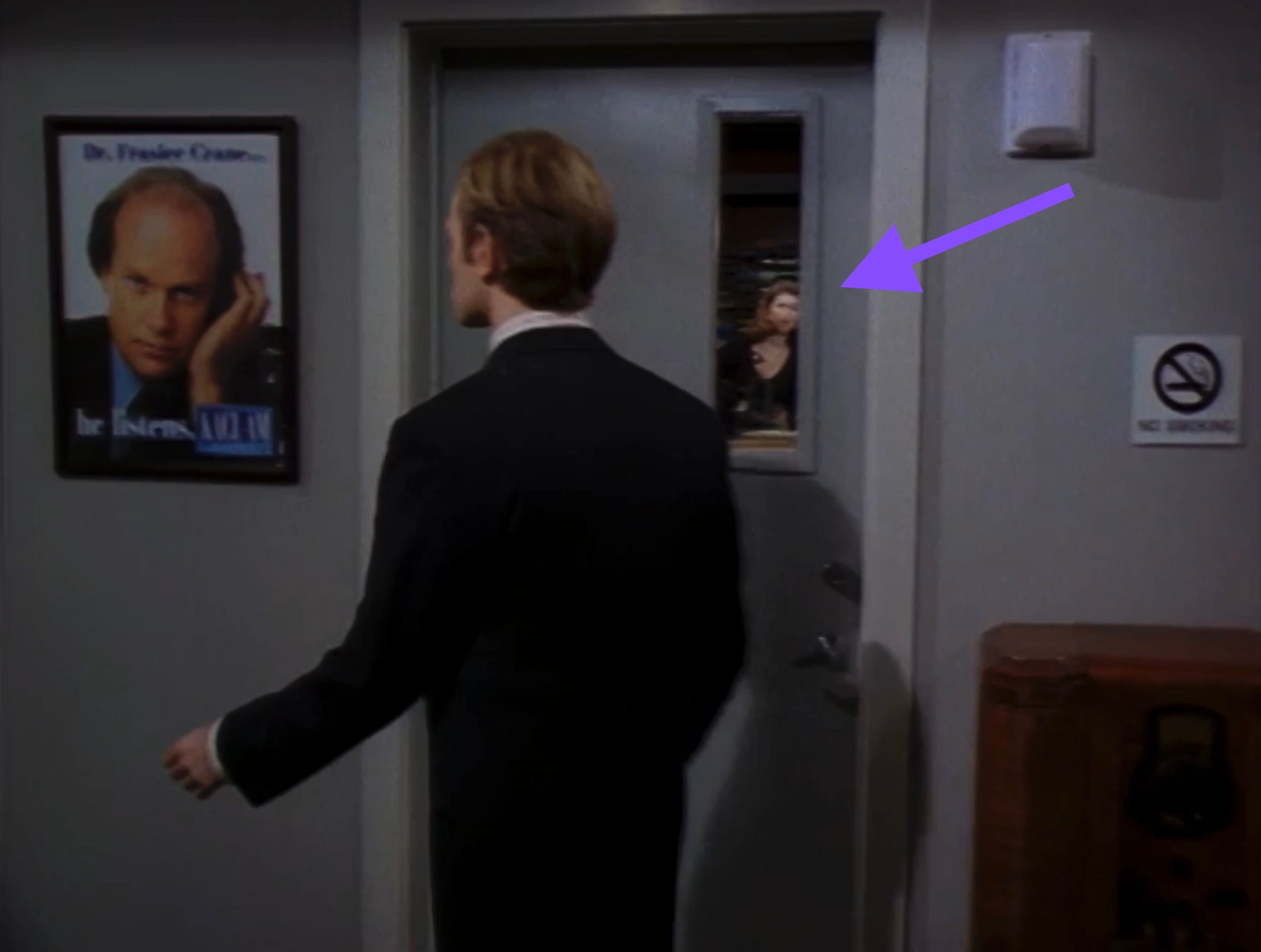
A woman enters frame (camera frame, but also Frasier’s-office-window-frame), and walks past Niles . . . who takes a step, does a 180° turn, and follows her.
Frasier also turns and walks back from whence he came, and the camera follows.
Frasier’s radio studio is soundproof, so there’s no use in Frasier calling out, but as he walks to the door he picks up a water glass . . .
As Frasier steps into the doorway, we have a clear idea of where Niles is: considering he and Frasier were tracing the same arcs, he’s approximately on the other side.
Frasier was filmed multicam, in front of a live studio audience, which also adds to the stage-y feel here; you can hear the laughter grow as the audience realizes what is about to happen . . .
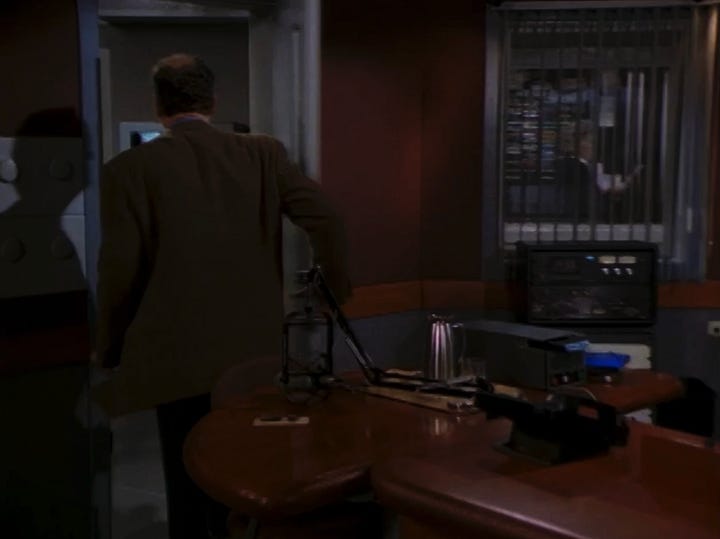
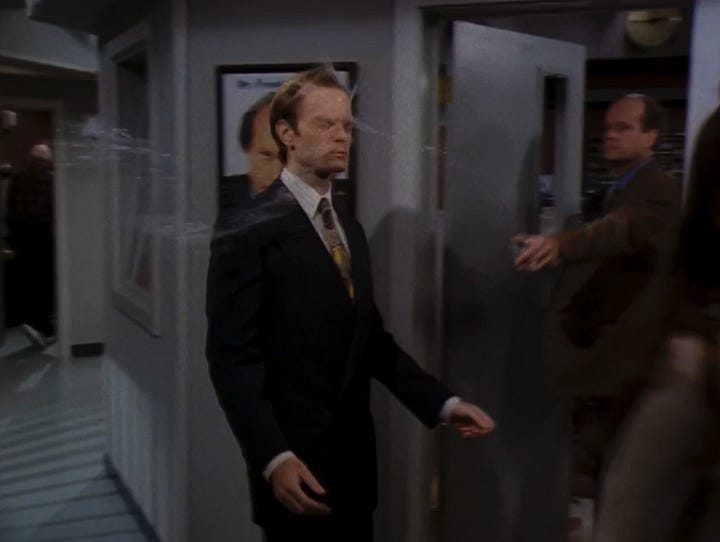
The water hits its target, Frasier retreats without another word, and Niles turns BACK around, libido sufficiently dampened.
The scene cuts back into Frasier’s office, where Frasier sits down at his desk, while Roz (Peri Gilpin) comes in, beginning to set up the second gag.
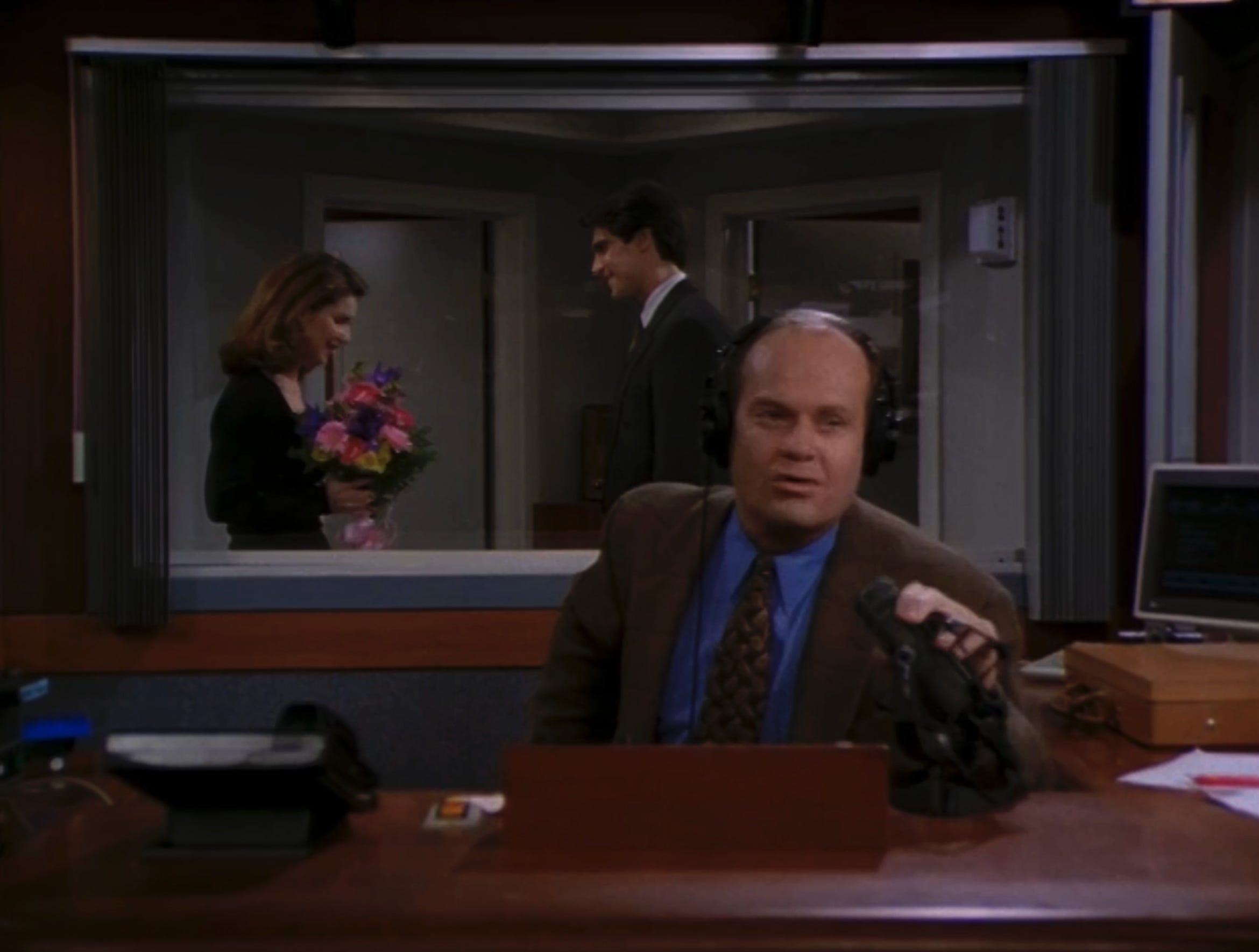
As Roz talks to Frasier, the camera settles into a wide shot encompassing the desk and the window behind them. This shot will run until the end, because the blocking and the dramatic irony — what we can see through the window, but what, at first, Frasier remains blithely unaware of — is what lands the second joke.
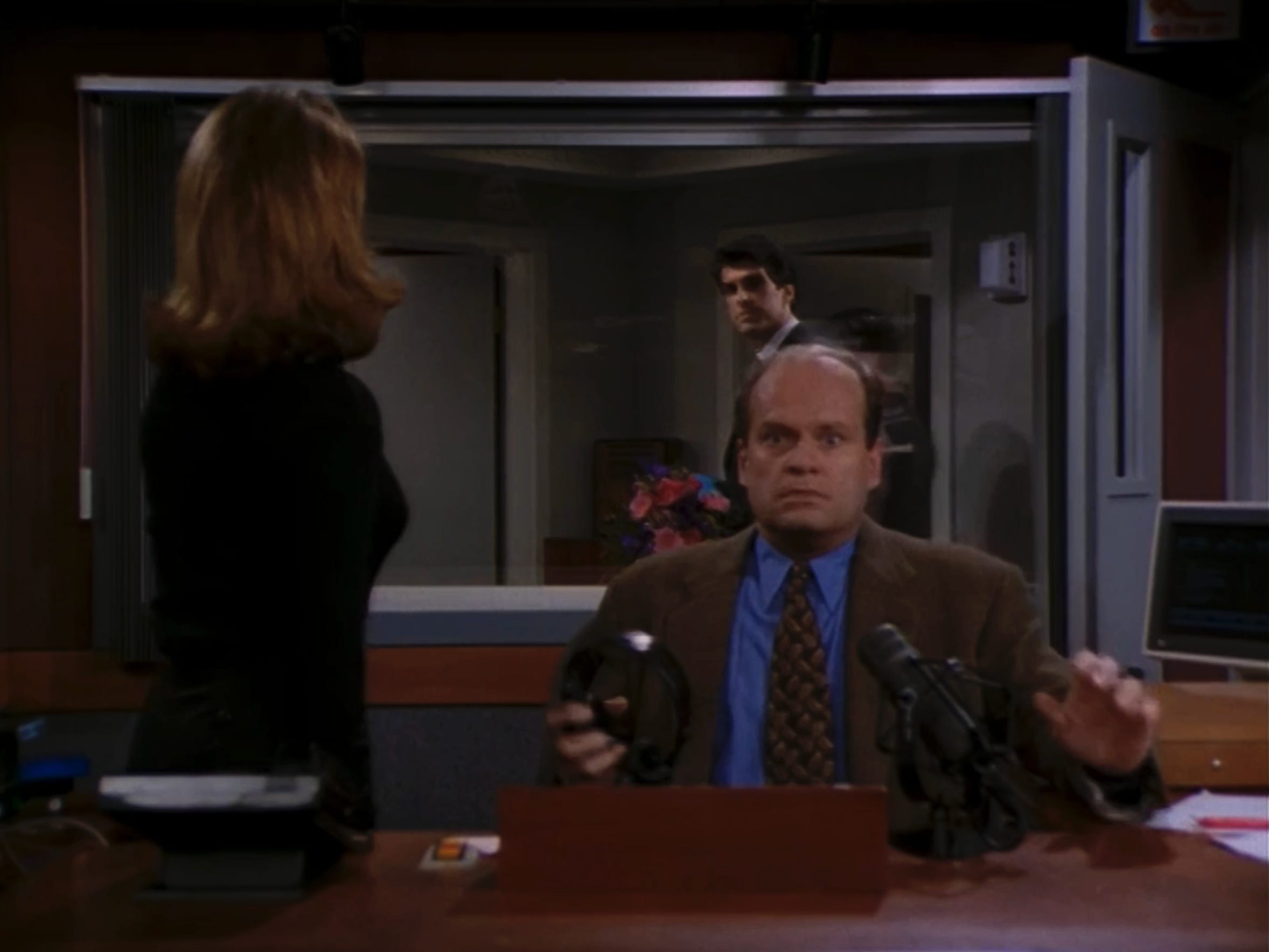
As Frasier prattles on about “ninnies and their hormones!” Roz’s ‘missed connection’ Gary (Justin Gorence) walks into the hallway, where Roz and we — but not Frasier — can see him.
After this, Frasier turns back to his desk and rambles to his radio audience in words which stand in stark contrast to the events unfolding between Roz and Gary, but that’s more about the verbally dexterous dramatic irony than purely physical gags, so we will leave the scene here.
One of the keys to the scene working is constant character motion, across both sections or depths of the set.
Frasier and/or Niles and/or Rox are always in motion, even if they are standing or sitting in one place, but there’s also extras!
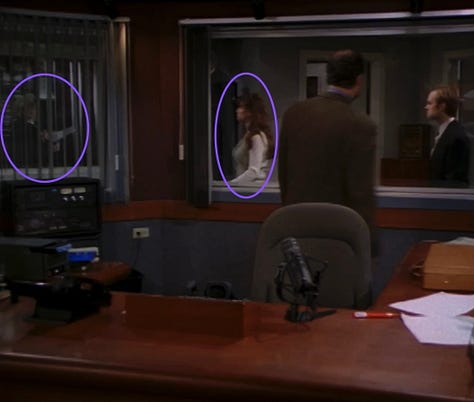
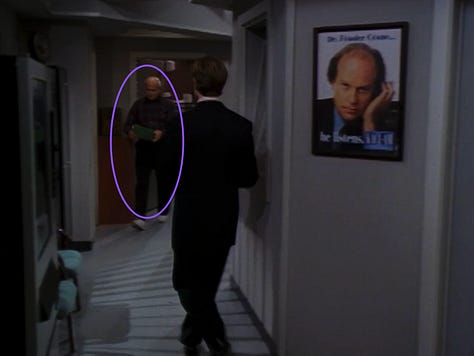
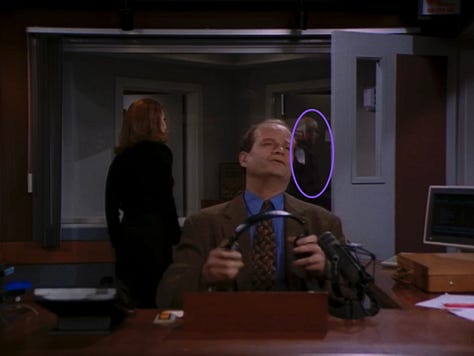
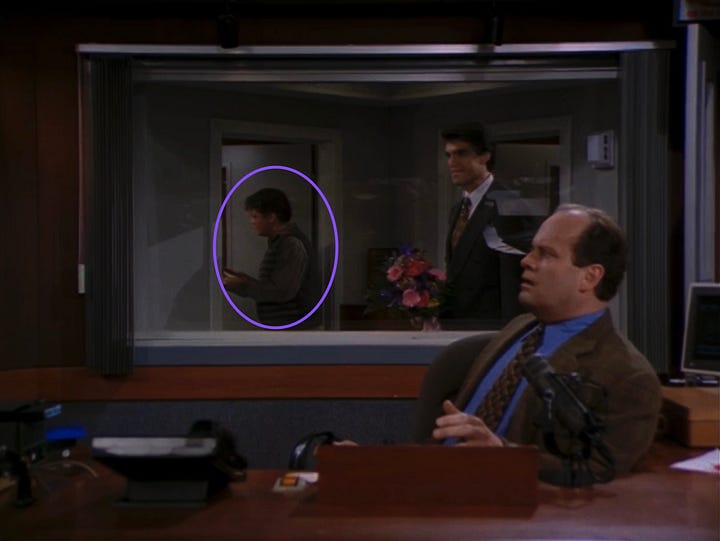
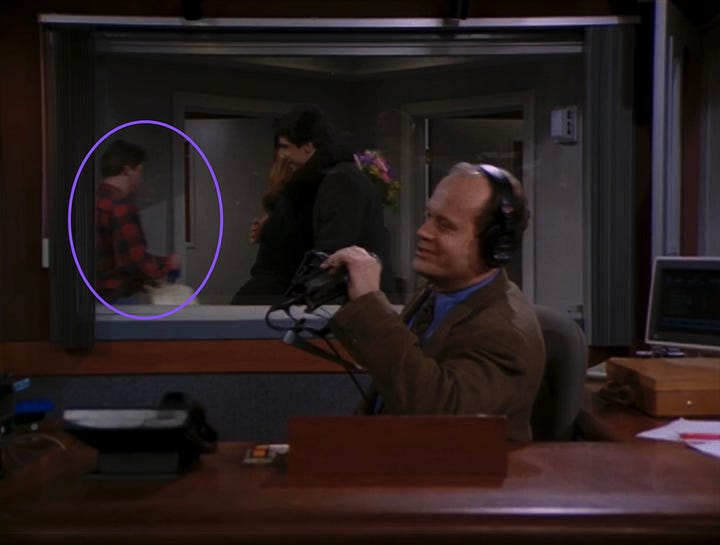
Obviously the white-suited-woman is key to Niles’s gag, but the rest are ancillary to the plot, but important to the feel. They create additional motion and colour to keep the scene feeling kinetic.
This is something you can’t always do on an actual stage; often stage plays have only the primary characters available to use in blocking, having a lot of extras every night is expensive and unwieldy, and those characters may need time between scenes to change costume or set up for something upcoming.
A network sitcom, even one as popular as Frasier, certainly falls into the lower-budget TV show category, but attention to details matter. For this scene, they paid to have multiple background actors, the director and 3rd AD took the extra time to thoroughly choreograph movement and cues with everyone.
And it makes a notable difference.
Finally, notice that even when Roz isn’t actively engaged in the scene, Peri Gilpin is still in character and reacting, and it pays off big time:
Choreographing, staging, coordination, timing, all take trial and error, and lots of practice.
Stillness has its place, but when you’re going for a lot of visual gags, consider kinetic motion along multiple planes, and background actors!
Frasier 3.16 “Look Before You Leap”
Director: James Burrows
Cinematographer: Ken Lamkin
Comments
Nothing yet. Say the first thing.
Sign in to join the conversation.