
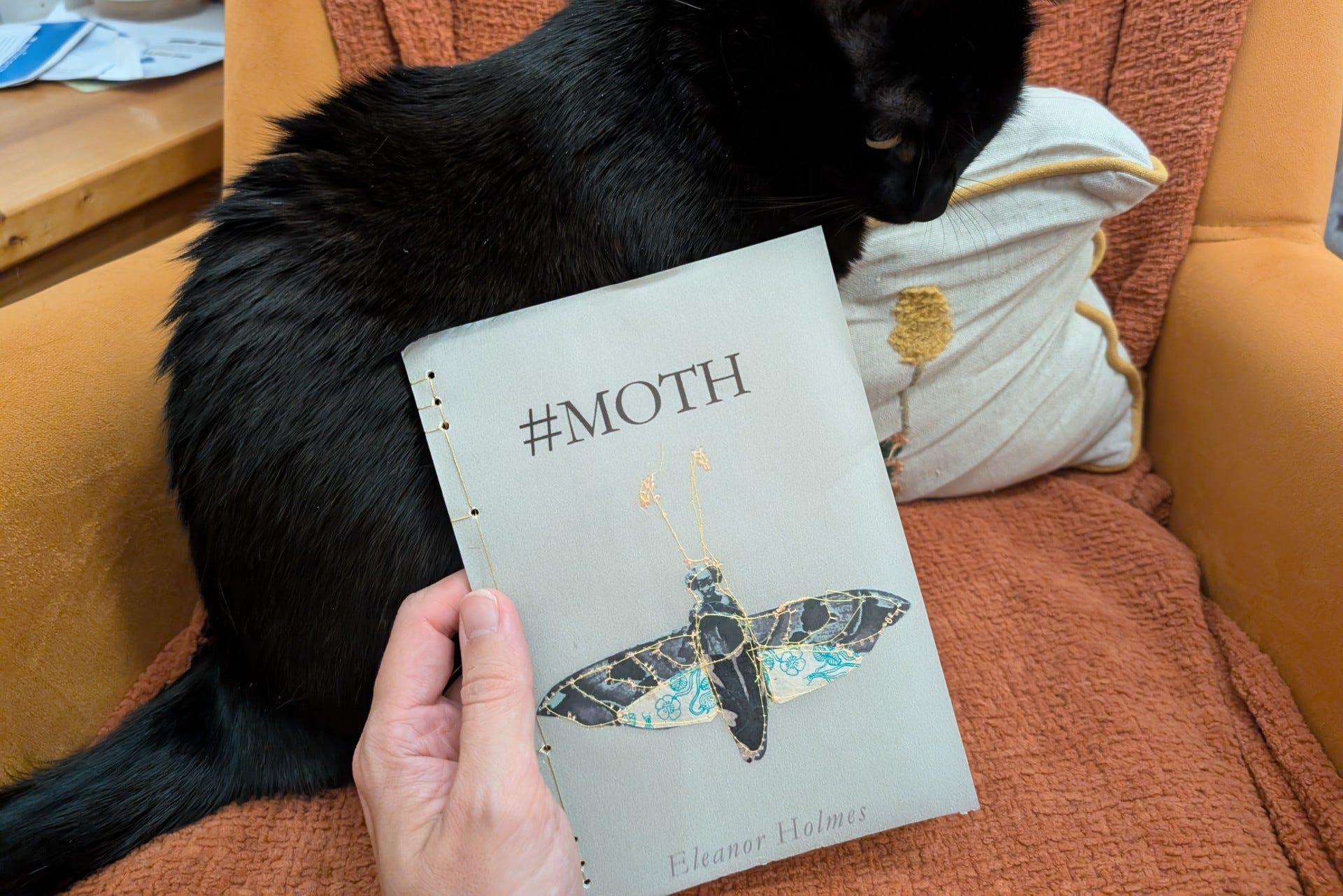
Be warned: if your usual method of reading, like mine, is to carry a book with you in your backpack everywhere you go, digging it out on train journeys and in sandwich queues, you will need to take extra care with #Moth (published by Ethel Zine and Micro Press). It’s a hand-stitched booklet, and as well as gold stitching it sports a delicate cover of silver paper, with thread used to add a textured filigree to the moth’s wing pattern and antennae. This is in keeping with the content of the book, which — at least initially — seems focused on the fragility of the human mind, in that it moves from a bus stop setting to a psyche ward in the first two pages, the transition implicitly triggered by the folding door of the bus, or some other simple act this motion approximates.
Holmes describes #Moth as a ‘hybrid text’, and it is — part poetry, part short fiction (it definitely advances toward an ending), utilising a mixture of clinical and lyrical language. There’s no contents page and it’s not always clear where poems begin and end, as there are a few different styles of heading and subheading. It also features a hybrid character at its centre — a woman who is part-moth, or perceived as part-moth by those she unwittingly charms:
brazen midriff, miniskirt:
body hair fine copper fuzz.wings jostle inside his chest
Once it settles in, there’s a steady alternation between pieces which record fragments of doctor/patient conversation (verso) and miniature monologues by different moth species (recto), the latter preceded by images of the species in question on semi-transparent pages. It’s something of a power struggle; each monologue acts as a different guise worn by the main character — a response to the attempts of the doctor to categorise and contain her. The fragments of conversation and note-taking are at first framed by guidance the doctor is acting on: “Gently steer them, keep them on track” and “a patient’s behaviours may provide insight into their current mental state”, for instance. This falls by the wayside as the patient resists, or rather complies in a manner that brings the doctor no closer to a diagnosis.
Sometimes the patient seems to tease or probe in return. For example, after an extensive examination of her appearance, clothes and possessions, she replies (at this point in the character of an Imperial moth):
it matters not where you look,
i host in splendournever outshone, this autumn leaf gone gold
mistress of reinvention
Later, as a Gypsy moth, she is more forceful:
my name strikes mortal fear
into the very heart of men.
i’ve made many enemies,
all for what, my lack of house?
It’s an intriguing, beguiling dance of personae, with allusions to creation myth (‘dirt sack of earth / from which I grew’), the colours and markings on wings (‘my four eyes are watching / from inside their leathered shell’) and habitat, the patient seemingly shifting from one form to another in order to avoid the pin through the thorax and — eventually — to turn the tables. There are elements, too, of film noir — the doctor’s name is Holmes (‘Like Sherlock, yes’) and he looks on his patient, at points, in the manner of a private gumshoe sizing up a femme fatale, nothing that “When we sat down in that small consulting room, I knew that we had met before”, then lingering on her ‘elaborate fountain pen’, the tips of her fingers, the fine hair on her ears.
This is an intriguing feature of the work that slightly gets lost in the mix, or certainly left me wondering what to make of it. My best guess is it operates as a representation of how established approaches to treatment tend to view female patients as hostile, or at least unforthcoming. Other parts of the text are suggestive of ways in which women have been mistreated en masse: the line ‘mouthparts removed’, for example, recalls genital mutilation, while an early section on eggs (‘know that I was born with my eggs / already counted’) nods in the direction of fertility-based expectations and constraints.
Sometimes my imagination went a little astray. I really wanted to spot a Mothra reference and thought this section, from ‘Emperor Gum (Opodiphthea eucalypti)’, might be alluding to her ‘poison scales’ attack:
…nursing
simmered rage, how it seeps
slow at first, then fast inflating,
a surprise for all the doubting foolsmy life-breath expanded,
sticky substance, sweet revenge,
blown up in all your faces.
But I’m overcomplicating what is, at its heart, an elegant subversion of the ‘woman-as-caught-butterfly’ trope — one that permits its protagonist to leverage her lepidopteral mystique in service of avoiding being reduced to the subject of another’s expertise.
By page number my first contribution to Sidekick’s Aquanauts anthology from 2017 was a 2:1 scale (as printed) calligram of a lesser waterboatman:
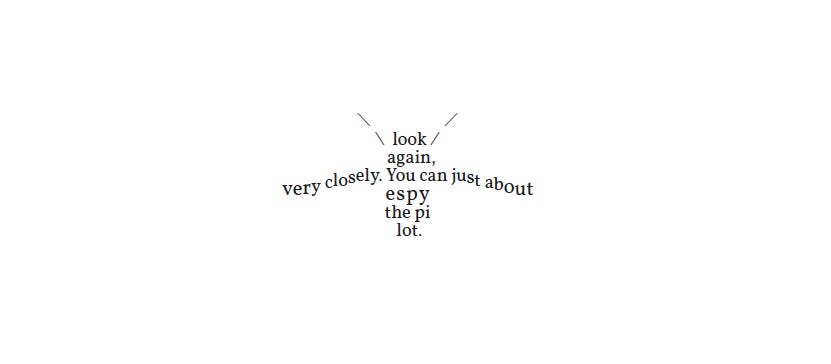
For even longer than that I’ve been working on-off, every now and then, on a sequence called ‘Paper Light Trap’: 1:1 scale colour calligrams of UK moth species. I’ve never quite managed to get on top of this project, despite multiple attempts to sprint to the finish line — too many of the pieces are either visually imbalanced or linguistically rough-edged. There’s also the colours — striking the right balance, that is, between a somewhat accurate representation of the moth and stylised neatness. So the majority are in a folder called ‘Further adjustment needed’.
But I did send a few to Bending the Arc magazine for their Spring issue, including one of my favourites, ‘Herald’:
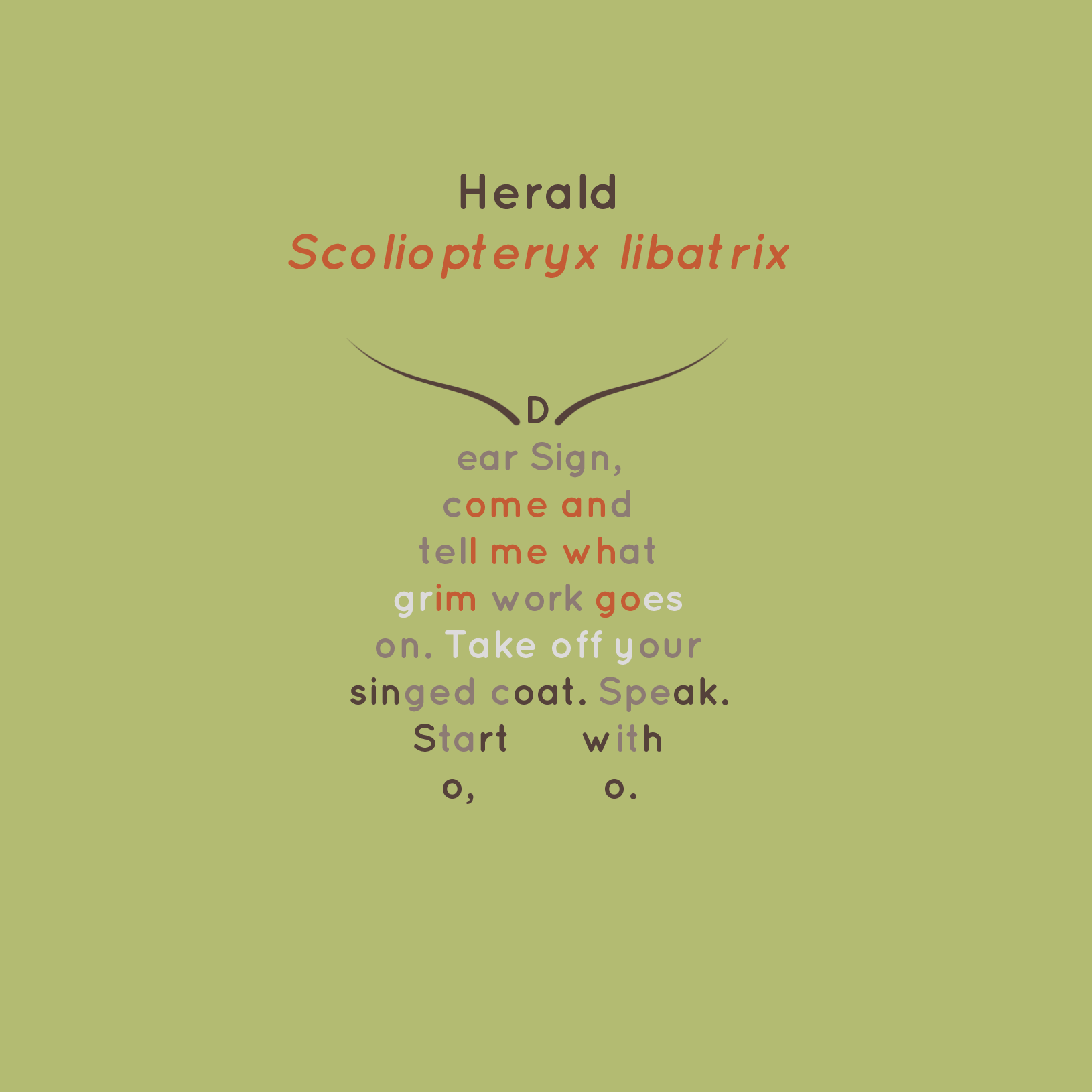
The other two that BtA took are The Vestal and Brimstone Moth.
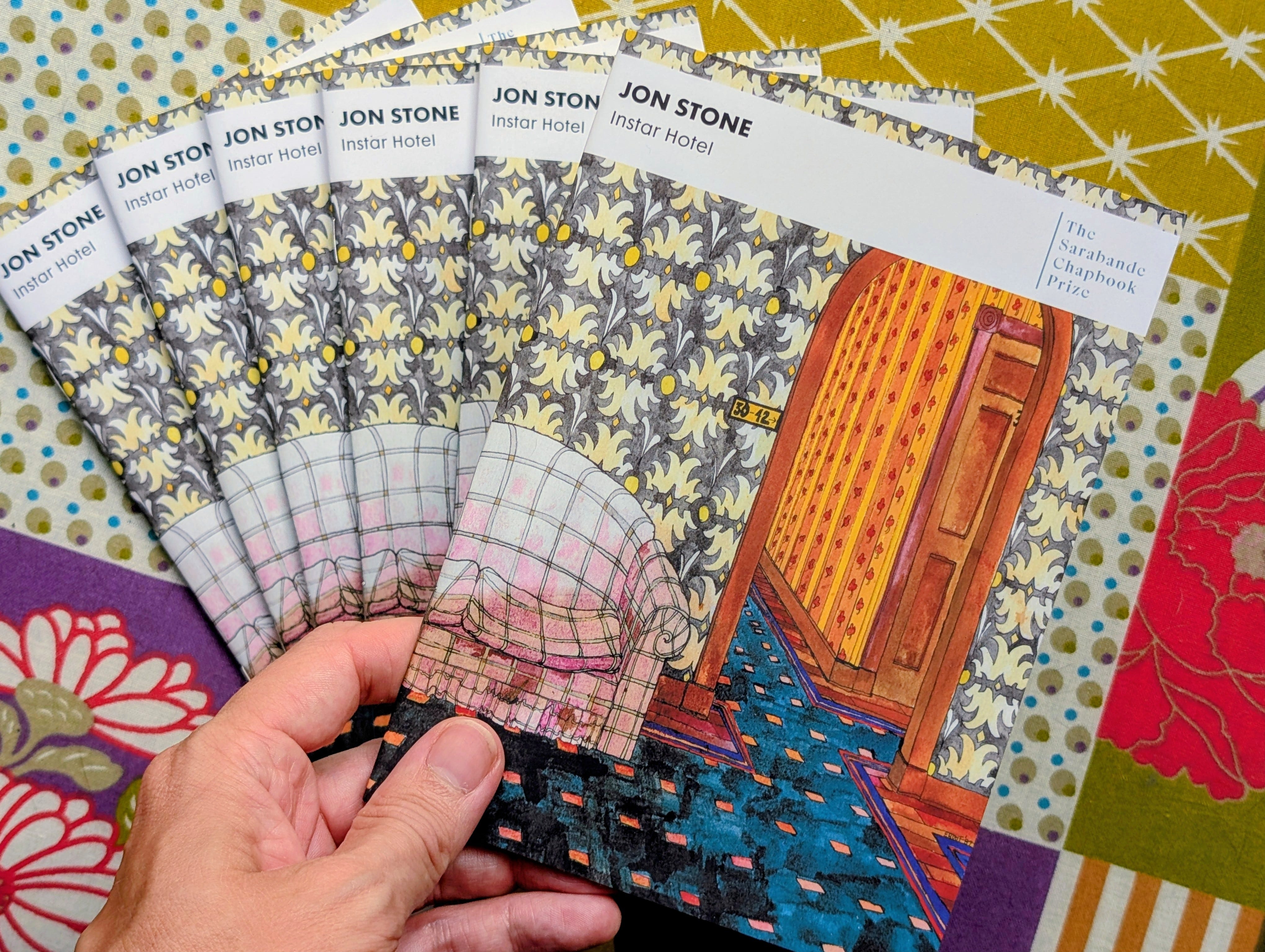
‘Paper Light Trap’ will emerge some other day. For now, what I should be talking about hotly and endlessly is the arrival of Instar Hotel, my latest short book, which is available to Americans and Canadians from the publisher, Sarabande, and to UK residents via the London Review Bookshop. (EU residents — get in touch if you want a copy!)
As noted in a previous post featuring an audio preview, Instar Hotel’s poems all happen at the same time and place but in different rooms. In each of those rooms are arthropod-people — an earwig, a silverfish, a flea, a bumblebee, a cricket, and another waterboatman, to name a handful. Each of them is dealing with a different problem — though none of them are especially worried about being bugs.
No posts
Comments
Nothing yet. Say the first thing.
Sign in to join the conversation.