
Medicus curat, Natura sanat
(the physician treats while nature heals)
In his book,Bee Venom Therapy, Dr. Bodog F. Beck, M.D., wrote,
“Since the events and facts of the past were recorded in the oldest existing annals and chronicles of the world, we find there has been a universal and generally accepted belief that people suffering from rheumatoid ailments, when repeatedly stung by bees, have remarkably and rapidly improved or have been completely cured. This creed has been conveyed and handed down like a heritage from one generation to another, from ancestors to descendants, from fathers to sons, from well-recognized fact that beekeepers during their occupation, continuously exposed to bee stings, gradually become accustomed to their effects and likewise never suffer from rheumatism, arthritis or gout. If they were afflicted with any of these ailments prior to their occupation, they are cured without experiencing any recurrence.”
It would be truly wonderful if degenerative joint diseases were a thing of the past but sadly, they are pervasive the world over. Those who suffer from chronic conditions affecting the joints, primarily osteoarthritis, rheumatoid arthritis (RA), and gout, experience pain on a daily basis for which there is no cure, or so we are told. Arthritis affects the joints where swelling and tenderness result in joint pain and stiffness, impairing mobility to where certain actions are compromised. RA is described as an autoimmune condition where the body’s own immune system attacks the joints resulting in inflammation and tissue damage. The joints thicken and the underlying bone and cartilage are also adversely affected. Gout occurs when elevated levels of uric acid in the blood deposit in the joints, tendons and surrounding tissues, resulting in severe attacks of pain, most often in the big toe.
Conventional medical treatments consist of pain medications, steroids (glucocorticoids like hydrocortisone and prednisone), and NSAIDs, (non-steroidal anti-inflammatory drugs). Pain is relieved to some degree with these drugs but the report card is abysmal. The cure rate is zero and they all come with a number of side-effects, many of them causing devastating long-term damage. In his book, Bee Venom: The Natural Curative for Arthritis and Rheumatism, Dr. Joseph Broadman, M.D., spoke to the medical use of hormone steroids for arthritis and RA, and cited a convention hosted by the AMA in 1952 where the head of the medical department of Armour Laboratories discussed a study conducted on 4000 people who had been treated by their new steroid product. Dr Broadman wrote:
“This was indeed the first study on that subject. The results showed a large variety of complications, or so-called side effects, the existence of which caused consternation among the hearers. Some of these complications ran as high as 44%, all the way down to less than 1%. The complications included mental changes, edema, hypertension, heart failure, potassium deficiency, spontaneous infections, impaired wound healing, diabetes, peptic ulcers, hypothyroidism, thrombophlebitis, moon faces, “buffalo hump,” menstrual irregularities, osteoporosis, and many others . . . The profession was advised to go right on using the drugs, but to reduce the size of the dosage. It was claimed that when this was done improvement of the situation would follow.”
Today, steroids are still in use for RA, arthritis and many other conditions. The author of the Substack column, “A Midwestern Doctor” writes that the so-called “low dose” for these drugs has gradually shifted over time to where patients are now regularly prescribed doses that had been considered toxic back in the 60’s. For example, the current dosage in the US for prednisone varies between 5-60mg per day, yet in 2016, Europe’s Rheumatology group published their conclusion that a dosage over 5mg a day for long-term use is unsafe.
NSAID’s are available over the counter and include aspirin, ibuprofen, diclofenac and naproxen. Depending on which drug is used along with how much and for how long, there is an increased risk of kidney disease, heart attack, stroke, and gastrointestinal ulcers and bleeds. These drugs actually impair healing, particularly of ligaments, according to the author behind A Midwestern Doctor.
Pain meds run the gamut from highly addictive Opioids to Tylenol. The repercussions of over-consumption of Tylenol lead to liver toxicity and include an average of 56,000 ER visits, 2600 hospitalizations and 500 deaths annually in the US due to Tylenol toxicity.
It is heartbreaking to think of the millions of people who suffer tremendous pain that affects every aspect of their lives. Very few people have any idea of the potential healing and relief that is possible for very little cost if any. Nature has provided an extraordinary natural medicine by way of the honeybee (apis mellifera), whose venom has been used for 5000 years as a curative for arthritic and rheumatic conditions, chronic pain, skin disorders and other inflammatory conditions. Wasps, hornets and other types of bees do not have the same components in their venom, it is only the honeybee that provides this for us. The ancient Egyptians, Greeks and Chinese utilized bee stings medicinally through a practice known today as “apitherapy.” It includes the medicinal use of bee venom, raw honey, propolis, pollen and beeswax. Bee venom therapy is referred to as BVT.
While many pharmaceutical drugs suppress the immune system, bee venom stimulates it through the hypothalamus, pituitary and adrenal glands. The sting from a bee stimulates the adrenals to release cortisol, which is the primary stress-hormone produced by the body. Cortisol is a natural anti-inflammatory agent that is crucial for the body’s stress response whether that stress is acute or chronic. Through this action, the body’s defense mechanisms are increased to where it can effectively respond to an external threat. Bee venom turns on the body’s own healing mechanisms by triggering a series of responses that stimulate repair and regeneration with profound results.
In his book, Health and the Honeybee, author, Charles Mraz writes,
“BVT is a classic example of the homeopathic principle which states that a substance that produces the symptoms of a disease is a cure for that disease. Rheumatic diseases result in swelling, pain and inflammation. A bee sting causes the same symptoms. The sting stimulates the immune system to relieve the inflammation caused by the bee venom while relieving the symptoms of the rheumatic disease at the same time.”
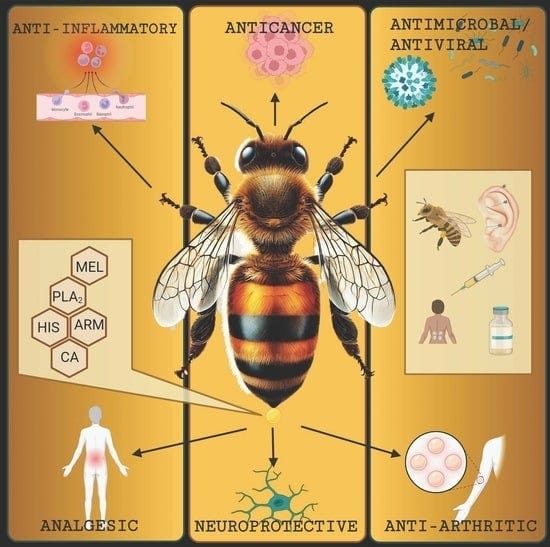
Also known as “apitoxin,” bee venom is a pharmacologically active and complex mixture of peptides, enzymes and bioactive compounds with anti-inflammatory, antimicrobial and immune-modulating effects. Of the numerous active components in venom, the main constituent is the peptide, mellitin, which induces pain and prompts an immune response in the body. This is followed by the activation of inflammatory mediators that produce the symptoms associated with a bee sting - redness, great swelling and a hot, peppery pain, all of which is a healthy immune response that lasts for a few hours to a couple of days. Mellitin has anti-inflammatory, antimicrobial and anticancer properties and it has the ability to target specific cancer cells, displaying potential in treating infectious diseases and cancer. It has been found to increase collagen production by over 30%, which leads to improved joint function. It reduces inflammation in conditions like arthritis and RA and has shown itself to be highly effective in the management of chronic pain.
As well, the peptide, apamin, facilitates nerve transmission, which enhances neural activities. It improves the conductivity of degenerated nerve sheaths, which is a huge assist for those suffering from MS and other nerve disorders. The peptide, adolapin, has anti-inflammatory and analgesic properties that are effective against neural sheath inflammation, and it assists in the reduction of pain.
The application of bee stings to either side of the spine will send the venom along neural pathways from the spine outward to trigger points and compromised areas of the body that require nerve damage repair and restoration of mobility. Stings applied to points lateral to the lower half of the spine will address complaints in the lower extremities while stings applied lateral to the upper half of the spine will reach the upper extremities, head and chest. Stings can also be applied to acupuncture/acupressure points with excellent results. Yes, the stings hurt like hell for a few minutes but the after-effects are well worth it, as I can personally attest.
In the early 1940’s, Dr. Beck expressed his frustration that despite the plethora of accounts detailing the extraordinary curative effects of bee stings for degenerative joint conditions, including his own success on his arthritic and rheumatic patients, the medical establishment has ignored and dismissed the information. He wrote that, “the issue has always received a rather cold reception, mingled with a certain amount of doubt, ridicule, even utter contempt.” Fortunately, over the last 60 years there has been growing interest in the subject and today there are over 1600 scientific research articles on the efficacy of bee venom that can be found on Pubmed on the National Institute of Health website. The articles hail from scientific journals from around the world detailing the efficacy of bee venom therapy not only for arthritis, RA and gout but also cancer, Parkinson’s, Alzheimer’s, MS, neuralgia and postherpetic neuralgia (shingles pain), Fibromyalgia, Lyme Disease, Bell’s Palsy and even depression. In addition, bee venom has been used successfully for bursitis, frozen shoulder, tendonitis, tennis elbow, carpal tunnel syndrome, neck pain and whiplash, low back pain and sciatica, Raynaud’s disease, Eczema, asthma, surgical scars and internal scarring, ankylosing spondylitis and degenerative disc disease.
Of the few intrepid and determined physicians who paved the way for the recognition of bee venom’s healing efficacy, Dr Philip Terc provided an impressive body of research and application. Dr. Terc was a general practitioner in the small provincial town of Marburg, Austria in the 19th century. He himself was suffering with a stubborn case of rheumatism until one day he was accidentally stung by a number of honeybees. The after-effects took him entirely by surprise when he realized his condition had disappeared entirely. Like his fellow physicians, he too had always ridiculed such notions but this event changed his life. In 1879 he was contacted by a woman suffering from severe neuralgia in the head and deafness. Her condition persisted despite the efforts of numerous doctors she’d sought out for help. Dr Terc was unsuccessful using his regular remedies, which elicited a stern lecture from the frustrated woman who said she thought with his sterling reputation he would utilize a more novel technique to alleviate her suffering. This inspired him to experiment with bee stings.
Over the next few days Dr Terc applied around 90 bee stings to her head yet there was no change. In fact, the woman displayed no swelling or any ill effects at all from the stings. His final treatment consisted of 15 stings on her neck and shoulders and later that day he was called to her hotel where he found her with a horribly swollen face including eyes that were swollen shut. Despite that, she was jubilant and told him her pain of many years had vanished and she had just heard the sound of church bells. The venom did its job and the woman was permanently cured.
This case was instructive and suggested that the longer a patient has been living with a condition the more stings required to get the body to react with a full-blown swelling response, which later became known as the “reactive phase.” This phase initiates a fundamental shift in the condition to where it is mitigated or altogether cured. Up to that point, Terc’s patient was unresponsive to the stings and her condition remained unchanged. It was only when the big response occurred that her condition was cured.
Dr. Terc continued his experiments and treated thousands of arthritic patients over many years. Many endured weeks of stinging with no effects whatsoever, as their immune systems simply weren’t responding. Once that reactive phase occurred it was imperative that the individuals push through to the other side, as this is a critical stage in the treatment. Once this stage is reached, it’s a difficult time where swelling at the site along with increased itching and redness can continue for several days. The swelling is actually bringing the blood and its healing agents to the site where the cortisol, interferon, T-cells and B-cells can do their work. Some of his patients would quit when they reached the reactive phase and by aborting the process, they were unable to obtain relief of their condition. Dr. Terc observed that mild cases required far fewer stings while chronic, long-term conditions could require hundreds of stings to get to that reactive phase that resulted in a cure.
Dr. Terc made 3 important discoveries:
1. Arthritic and rheumatic patients do not respond to bee stings in the way that a healthy person does. A normal individual will have a very intense immune response while an afflicted person displays an apparent immunity, (a pathological immunity) to the effects of the stings.
2. When the body fails to create a response to bee sting therapy no matter how intensely it is applied, this is an indication of the duration and extent of the offending condition.
3. It is only actual rheumatism and arthritis that respond to bee venom, meaning that certain patients thought they were arthritic and received bee stings, which provoked a severe reaction far exceeding that of a normal person. For that individual, the treatment had to be aborted immediately. It turned out that those patients were afflicted with either syphilis, gonorrhea or tuberculosis, and bee venom showed itself to be contra-indicated for those conditions.
Dr. Philip Terc came to be known as the “Father of Bee Venom Therapy.” Despite the fact that he was ridiculed, berated and harshly treated by the medical community throughout those years, his efforts proved the efficacy of bee venom therapy for arthritic and rheumatic conditions as well as neuralgia and other afflictions. At that time only live bees were used and the treatment logistics were often very difficult. Many times, patients had to be carried to the beehive or the beehive transported to their home or hotel. Stinging could only happen during the summer months and acquiring bees was circumstantial and could be expensive. Treatments were time-consuming and the venom levels and aggressiveness of the bees varied, which made accuracy of dosage challenging. Dr. Terc was undaunted and firmly committed and the results of his efforts have inspired a great many to continue assisting the suffering with this powerful medicine.
Injections:
Today, one can use either live bees or find a qualified practitioner/doctor who treats with the use of bee venom injections. Injections of pure bee venom are administered just beneath the skin (intradermally), which has the same effect as an actual bee sting. There are notable advantages to this method. Firstly, injections are painless compared to a live bee sting. Secondly, one doesn’t have to sit out the winter and wait for spring to continue the therapy, injections can be taken year-round. As well, the concentration of the venom solution can be adjusted so that high or low doses can be injected and the individual doesn’t have to grit their teeth through hundreds of live bee stings. Depending on the nature of the afflicting condition, dosage and frequency of injections are determined accordingly by the practitioner.
Topical Applications:
Topical bee venom products like ointments and creams will provide some relief for sore muscles and they can promote healing of certain skin conditions, but topical applications are not the same as actual bee stings. The healing process is initiated inside the body by a bee sting or venom injection only. Be aware that the use of bee venom ingestibles will do nothing to eradicate the offending condition as digestive enzymes in the stomach break down the pills or tablets, which effectively cancels out the effects.
Ultimately, live bees provide the most potent venom and the treatment can be done by a trained and experienced practitioner or doctor who understands the risks of possible anaphylactic reaction and how to safely counter such an occurrence. Of course, one can administer stings to oneself but thorough study along with common sense is an absolute must. I will list some excellent books along with my references at the bottom of this article.
BEE VENOM THERAPY (BVT) HOW TO:
Before embarking on a bee venom protocol, you must be sure that you or the person you’ll be stinging isn’t allergic. A bee sting can induce great swelling that looks damn scary and we’ve all seen images of people who’ve been stung displaying a grossly enlarged hand or foot. This, and the accompanying intense itching is often mistaken for an allergy but it is actually a proper immune response from a healthy body. It means the immune system is awake and doing its job. An allergy is another thing altogether and I’ll discuss that below.
Before any stings are administered, it is imperative that we have a “Bee Sting Kit” on hand. This consists of a bottle of liquid Benadryl, which is an oral antihistamine that will decrease the effects of a bee sting. Also include the homeopathic, Apis Melifica, which will help to decrease the effects. Finally and VERY importantly, we must have an epinephrine auto-injector known as an epi-pen, which must be obtained via prescription by a doctor. It is to be stored in the fridge and will be viable for one year.
Vitamin C is a MUST
While stinging, it is very important to ingest adequate amounts of vitamin C daily. The recommended dose is 2-3000mg of vitamin C per day, which assists the adrenals in producing cortisol.
No Alcohol
Alcohol has been shown to void the healing effects of bee stings altogether. Bee expert, Amber Rose, shared of one case of a man who’d been drinking heavily who went into anaphylactic shock upon receiving bee stings. Best to leave the alcohol alone and focus on healing the condition.
Reactions
There are four types of reactions to a bee sting.
Generalized Immediate - THIS IS A LIFE-THREATENING TRUE ALLERGIC RESPONSE -
A generalized reaction is systemic, which means the sting occurs in one part of the body and the reaction happens elsewhere instead of at the sting site. This is called a “Generalized Immediate” reaction, which is life-threatening and it expresses in the following way:
(Keep the sting kit nearby.)
Within the first 5 minutes after stinging, the person may begin to feel uneasy or uncomfortable, and express symptoms of itchy palms and scalp, body rash and watery eyes. In her instructive book, Bee in Balance, Amber Rose writes that although the symptoms aren’t yet life-threatening, this is when she will administer liquid Benadryl. If the person develops symptoms such as difficulty breathing, confusion, swelling of the eyes and lips, a drop in blood pressure, passing out - this is anaphylactic shock, which generally occurs 6-10 minutes after the sting. The epi-pen must be injected immediately to stop the reaction, so it is absolutely essential that before stinging, we not only read the instructions on how to use it but also watch a video on Youtube demonstrating how to do so.
Localized Immediate
This is where one feels the sting as soon as it enters the skin. The sensation is a hot fiery burning that hurts like hell along with swelling of the area but it’s not life-threatening. The sting site can be numbed prior to stinging with ice or ice can be applied after the sting to mitigate the pain.
Generalized Delayed
This is also not life-threatening. After being stung there is no immediate response for an hour or more and then the effects arrive. They can express as general discomfort, fatigue, nausea, light-headedness, stiffness, itching or hives. Amber Rose advises to rest and let the body take care of itself.
Localized Delayed
This is where the site of the bee sting doesn’t respond right away, in fact it might take a few hours. The symptoms finally arrive as redness, swelling, itching, heat or blisters near the area that was stung. Amber Rose says this is a positive sign indicating that the body’s immune system is waking up.
Healing Crisis
When embarking on a bee sting protocol a healing crisis can occur sometime during the first few treatments where flu-like symptoms appear in the form of achy muscles, stiffness, nausea, fatigue or a high fever. The symptoms last for 3-4 days at the most. This is perfectly normal and indicates that toxins are being flushed out through the bloodstream. Decrease the number of stings for a few sessions and the body will continue to heal. This is similar to doing a cleanse where you hit a healing crisis after a certain point and feel absolutely awful. If you stop the cleanse you stop the detox process and the body doesn’t shed the toxins.
The Test Sting
Before launching into a series of stings, a test sting providing a light dose of venom is administered to the knee, as it’s far away from the heart. Don’t sting any further down as you’ll be on the extremities, which tend to swell considerably. As soon as the knee is stung, the stinger is removed. Wait 15-20 minutes and observe. If the person feels fine then proceed with another 2-5 stings.
Dont’s
Stay below the neck and do not sting the head and face region. (Yes, Dr. Terc cured his first patient by stinging her head but this is very risky so it’s best to focus below the neck).
Do not sting pregnant women or young children.
Do not sting heavily inflamed areas or areas still recovering from prior stings. Give them time to recover.
Do not consume alcohol while undergoing bee venom therapy.
Do not sting individuals with heart and cardiovascular conditions.
Stinging
In BVT a live bee is placed on the skin at the desired point, pressing the base of the bee’s abdomen against the surface to provoke a sting. The barbed stinger attaches intradermally and the venom is injected. The effects are felt almost immediately in the form of acute pain and redness followed by swelling of the area. The bee can sting only once and dies thereafter. Note that there are tens of thousands of bees in a single hive so the loss of a couple hundred bees each week will not have an adverse effect on the colony.
It’s good to start with the sides of the spine and gradually work your way down the arms to the hands, the legs and the feet, otherwise the reaction can be too intense and possibly frighten or discourage further treatments. When stinging, the stinger is left in for ten minutes in order to receive all the venom being pumped into the site. Stinging is usually done 3X per week or every 2-3 days because the venom leaves the body after 2.5 days. Each week the dose can be increased by 2-5 stings. A large jump in the number of stings can be too much too soon. You want to become immunized and that is done gradually. If the sting protocol stops for more than 2 weeks, it is advised to start over and do a test sting, just to be sure, then start from the beginning, not from where you left off. This ensures steady progress forward. Depending on the condition, the number of stings depends on the extent of the inflammation and the number of joints affected.
The Process
I catch my bees by holding a pint-sized Mason jar at the hive entrance where I let however many bees I need fly in, then attach the cover. For those who don’t have a hive, you can acquire bees from a local beekeeper or order bees specifically for stinging and I will list a couple of mail-order places below the article along with a link for bee tweezers.
Inside my house I place the jar next to my sliding glass doors so if the bees get loose they will fly to the window where they’ll be easy to catch. I have a spray bottle filled with water at the ready, along with tweezers to grip the bee, and a folded paper towel. I turn the Mason jar upside down so the bees move to the top of the jar and lift the jar slightly for a bee to crawl out. I immediately spritz the bee with water so it can’t fly, then grasp it by the mid-section with the tweezers and apply the base of its abdomen to the site I want to sting. After doing so, I place the bee on the paper towel and fold it over quickly and crush the bee, sending it into the ethers with my great thanks. After ten minutes, I remove the stinger carefully with the tweezers moving sideways along the skin so it doesn’t break off. Stings can be applied to either side of the spine as I discussed earlier, as well as directly on the area where the pain is occurring, and also to sting points that are away from the area of pain. All of this will stimulate the body’s healing mechanisms and bring about relief either immediately or over a period of time. I highly recommend reading a few of the books on BVT listed below for more thorough instruction.
BVT will break down scar tissue and adhesions, which will deliver better blood flow to the area. You can sting directly and on either side of the scar. I had a friend sting a large scar on my back several times and it has noticeably decreased in size. BVT also dissolves cysts. Years ago, I stung a cyst the size of a quarter for someone where I put a few stings directly on the cyst maybe seven or eight separate times and it dissolved entirely. I have heard of people with the big “C” stinging tumors close to the skin that completely dissolved. I am currently stinging my hands to clear arthritis and the relief I’m getting is just incredible. Finally, BVT can create an increase in energy and mental clarity as well as mood elevation. I would definitely recommend it for depression. To support the healing process during BVT make sure to exercise, stretch and eat healthy.
I hope and pray this article can help those who are suffering.
My new book, The Wisdom of Honeybees, is now widely available. I would be deeply grateful for some good reviews on Amazon, as they help authors in many ways. Thank you for your support!
Recommended Books:
Bee Venom Therapy, It’s Nature and Its Effect on Arthritic and Rheumatoid Conditions by Bodog F. Beck, M.D., 1935
Health and the Honeybee by Charles Mraz, 1995
Bee in Balance: A Guide to Healing the Whole Person with Honeybees, Oriental Medicine and Common Sense by Amber Rose, L.Ac., L.C.S.W. Forever Amber Publishing, 2013
Bee Venom: The Natural Curative for Arthritis and Rheumatism by Joseph Broadman, M.D., G.P. Putnam’s Sons, 1962
Bees Don’t Get Arthritis by Fred Malone, 1979
Curative Properties of Honey and Bee Venom by N. Yoirish, 1977
Mail-Order Bees for BVT:
https://millheimhoneycompany.com/products/apitherapy-bees-10-12-worker-bees
https://meyerbees.com/product/apitherapy-bee-venom-therapy-bees/
BVT Tweezers:
https://meyerbees.com/product/apitherapy-self-closing-tweezers/
References:
https://www.mayoclinic.org/diseases-conditions/arthritis/symptoms-causes/syc-20350772
https://en.wikipedia.org/wiki/Nonsteroidal_anti-inflammatory_drug
https://www.rheumatologyadvisor.com/features/eular-consensus-on-long-term-use-of-glucocorticoids/
https://www.drugs.com/medical-answers/considered-high-dose-prednisone-3561211/
https://steroidsandme.com/articles/a-brief-history-of-steroids
Bee venom for post-herpetic neuralgia: https://rapm.bmj.com/content/32/6/533
https://www.medicaldaily.com/honey-bee-venom-could-heal-depression-dementia-230959
https://www.sciencedirect.com/science/article/abs/pii/S0143417924000507
https://www.ebi.ac.uk/pdbe/articles/buzz-behind-bee-venom-therapy
No posts
Comments
Nothing yet. Say the first thing.
Sign in to join the conversation.