
The most important technology trend in a generation is bottlenecked by some of the oldest industries on earth. AI is changing everyone’s lives from “answer engines” to “autonomous assistants” to eventually “digital twins.” But in order for AI to proliferate, there are physical bottlenecks that need to be solved: EUV machines, lasers, copper, rare earth materials, energy. The world is fundamentally short compute and the only way to get that compute is to solve for atoms.
In the S&P 500, energy is currently <5% of market cap, up from <3% last year. Materials are 2.5% of the index. Industrials are 8%. Technology is ~50%. Technology is now dependent on that <15% of market cap to power its future. That mismatch is the opportunity.
I pay a lot of attention to the public markets and right now the macro has been the toughest I’ve seen. On the one hand, you have AI which will help companies become more efficient, have higher margins, and is spurring massive investment into the global ecosystem. The flip side is AI may lead to job losses especially in “white collar” jobs which could impact the shape of the K economy the US has right now. Geopolitical dynamics also make it hard for costs of goods to go down meaning we may have higher and stickier inflation for coming years.
A lot of market economists talk about how the rest of the world is outperforming the US stock market. They talk about how rest of the world is much heavier industrials, financials, and energy vs the US and so it’s not a tech story. But look closer.
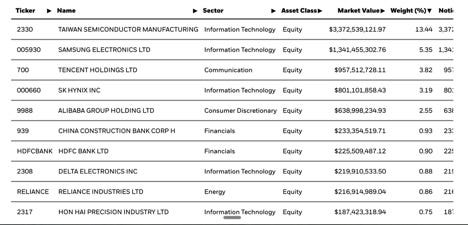
Here’s the top 10 holdings of EEM, the largest emerging markets ETF. Notice the top 5 companies with a weight of 30%. Taiwan Semiconductor, Samsung, Tencent, SK Hynix, and Alibaba are all directly tied to AI. Delta Electronics and Hon Hai (Foxconn) are as well. AI is a global tailwind not just a US story.
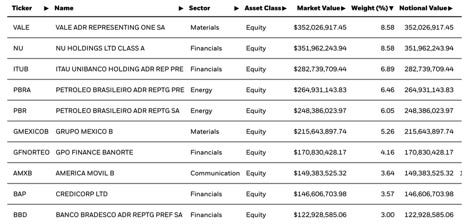
ILF, the Latin America ETF, also outperformed US markets over the last year. This tells a different story, it is all mining, energy, and finance. So on the one hand you have direct AI companies outperforming and on the other hand you have commodities. Both are winning. That’s not a coincidence.
Just like tech is finding the need to be more and more involved with politics, so too do investors need to start factoring in geopolitics. If energy and materials are the bottlenecks to reaching abundance on AI, space exploration, robotics and much more, then we should be doing everything possible to expand our access to those areas right? Well the geopolitical reality is exactly the opposite.
The Strait of Hormuz is currently closed, restricting 20% of total global oil consumption. Energy infrastructure across the Middle East is being attacked. The US is deploying the Strategic Petroleum Reserve to tamp down prices. Meanwhile, weapons stockpiles are being depleted and so too are the stockpiles of mission critical raw materials that both AI and defense depend on. This is why the DoD is focused on the Defense Production Act to secure these materials and the ability to process them.
Destruction of critical energy assets is not an easy thing to just restart. It’s not just mitigating further damage and removing damaged assets but also rebuilding and the time it takes to get these back to fully operational while the supply side is already short. It used to be attacking critical infrastructure like that was considered a global war crime. Now we’re seeing it in Ukraine/Russia, Iran, Israel, and it will likely only continue since it’s being “normalized.”
And this isn’t just a Western problem. A lot of articles seem to point to China as being free from any of these issues. That’s not true. They have a heavy dependence on oil from Russia and Iran. They ship nat gas from those places and Qatar. China is nationally focused on building nuclear power, solar plants, and other forms of clean energy to address the bottleneck they clearly see coming. Everyone is scrambling.
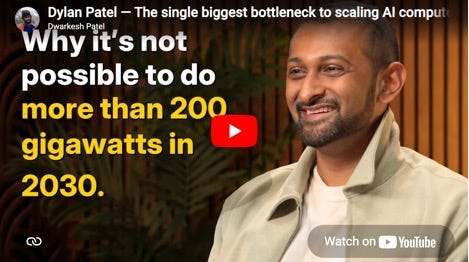
In a recent podcast, Dylan Patel talks with Dwarkesh about how energy is a short term bottleneck for the advancement of AI. Maybe that proves true and AI finds a clever workaround. But energy constraints don’t just affect AI. Energy costs rising means more inflation, less people can afford basic shelter, industrial output slows. Energy is a bottleneck for life, not just for model training.
Datacenters are connected to the grid but increasingly being told to limit strain on the grid and deliver behind the meter power. The common solutions are nat gas turbines, solar & battery storage, nuclear, and fuel cells. Every one of these solutions has its own supply chain problem.
Take nickel. It’s used heavily in turbine blades and combustors. It’s critical for industrial batteries. It’s in the stainless steel that data centers are built with. Indonesia controls roughly half of global nickel production, and their export policies shift with domestic politics. Russia, the other major producer, is sanctioned. The London Metal Exchange (LME) nickel market already had a near-collapse in 2022 when prices spiked 250% in a single day. And this is just one metal. Cobalt, tungsten, lithium, copper, silver, terbium, everywhere you look the same pattern repeats: concentrated supply, rising demand, geopolitical risk sitting on top.
First we need more mining. Then we need more processing. Then we need more manufacturing. This is not just an “American Dynamism” thing although of course we need that for America to continue thriving. It’s a “World Dynamism” thing. And given we are moving away from globalism into nationalism across the world, the urgency is only increasing.
In previous eras, there was always a thought process that defense spending, tech spending, and manufacturing were cyclical. Shortages would be addressed by overages. Wars would get everyone concerned and then back down into distant memory.
What’s different this time is the trend of globalization is being reversed across the world. It used to be that when these shortages would happen, you could rely on other countries to fill the gap. Now that is no longer the case. Everyone will be looking at leverage and sovereign needs first.
There are walls of money coming into the space that didn’t come before as a result. In defense, the US is spending the most in its history. This comes as Europe has awakened with Germany even going into debt to fund defense spending specific to Europe. After this war with Iran, the Middle East will certainly continue to ramp spending. So at the same time as AI spending ramps, defense spending is also rising all over the world.
Governments also realize how reliant they are on other partners and what that exposes them to. Europe is hit by Iran not allowing oil through the Strait of Hormuz. This should bring about a renaissance in the nuclear energy movement as well as alternative forms of energy in Europe. The US is mobilizing in every area possible around raw materials, critical manufacturing, and even pharmaceuticals. Japan is increasing their military spend and Taiwan is investing in defense against a potential China invasion.
Unlike software, AI is dependent on all of these variables. If you don’t have enough raw materials, chips can’t be made. If you don’t have enough energy, compute can not be deployed. If you do not have enough manufacturing, shortages can not be readily addressed. The globe is short all of these.
Perhaps the biggest confirmation of this fact is the asset light Magnificent 7 companies are all turning asset heavy and will likely be showing no to negative free cash flow in the next year as they work to bring atoms online. I can promise you these companies would not do this if they didn’t have to. It’s much easier to continue to grow rapidly while not having to expend much in capital expenditures. But they realize that in order to stay relevant in the future, something needs to change.
Geopolitical and real physical bottlenecks are making it so that atoms businesses are not hard to invest in but rather essential. We can not have bits proliferating if we do not have atoms. The world is short a lot of atoms.
It’s common now for investors in the VC community to say “everyone is a hard tech investor these days.” That couldn’t be further from the case. We are only just getting started on the wave.
The companies that will define this era are not just building better software. They are building the physical infrastructure that everything else depends on. And they are doing it at a moment when the geopolitical landscape is making that infrastructure more valuable, not less.
Comments
Nothing yet. Say the first thing.
Sign in to join the conversation.