

The foundational framework of American jurisprudence, as established in its earliest and most philosophically rigorous Supreme Court decisions, rests upon a strict hierarchy of authority. This hierarchy places the living man or woman [mankind], the original sovereign, at the apex, superior to the body politic, the constitution, the legislature, and the statutory law.
The most comprehensive articulation of this hierarchy is found in Chisholm v. Georgia (1793), the first major constitutional decision of the United States Supreme Court. Justice James Wilson, a primary architect of the Constitution, explicitly rejected the European doctrine of state sovereignty in favor of the sovereignty of man [1].
Wilson observed that political science had suffered a “perversion” in which the creation had usurped the creator, and he established the correct order of authority:
“Let a state be considered as subordinate to the people. But let everything else be subordinate to the state.” [1]
He further traced all sovereign authority to its ultimate source:
“The sovereign, when traced to his source, must be found in the man.” [1]
The core conundrum of how a man, born free, can be bound by law is resolved by the principle of consent and authorship. Because the man is the creator of the law, he is not subject to it by external compulsion, but only by his own agreement:
“The only reason, I believe, why a free man is bound by human laws is that he binds himself. Upon the same principles upon which he becomes bound by the laws, he becomes amenable to the courts of justice which are formed and authorised by those laws.” [1]
This principle was reaffirmed nearly a century later in Yick Wo v. Hopkins (1886), where the Supreme Court held that sovereignty itself cannot be subject to the law because it is the very source from which the law emanates:
“Sovereignty itself is, of course, not subject to law, for it is the author and source of law; but in our system, while sovereign powers are delegated to the agencies of government, sovereignty itself remains with the people, by whom and for whom all government exists and acts.” [2]
The hierarchy places the people above the constitution, and the constitution above the legislature. Alexander Hamilton, in Federalist No. 78, explained that statutory law cannot override the constitution precisely because the deputy cannot be greater than the principal [3]. Justice Wilson made this exact point during the Pennsylvania Ratifying Convention:
“As our constitutions are superior to our legislatures; so the people are superior to our constitutions.” [4]
This hierarchy is deeply rooted in the English common law tradition, famously articulated by Henry de Bracton (c. 1250) and weaponized by Chief Justice Edward Coke against King James I in 1607: Quod Rex non debet esse sub homine, sed sub Deo et Lege (”That the King ought not to be under any man, but under God and the law”) [5]. In the American system, the living and breathing man replaces the King as the sovereign under God.
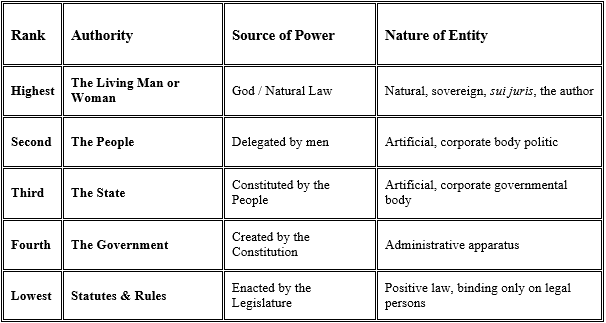
To understand the constitutional compacts, one must understand the precise legal definitions of the terms “People,” “State,” and “Body Politic” as they were understood by the Founders and codified in the legal dictionaries of the era. These terms do not refer to living men and women in their sovereign capacity; they refer to artificial entities; corporations.
Emer de Vattel, whose Law of Nations (1758) was heavily relied upon by the Founders, defined the nation or state as a “body politic”:
“Nations or states are bodies politic, societies of men united together for the purpose of promoting their mutual safety and advantage by the joint efforts of their combined strength. Such a society has her affairs and her interests; she deliberates and takes resolutions in common; thus becoming a moral person, who possesses an understanding and a will peculiar to herself, and is susceptible of obligations and rights.” [6]
William Blackstone, in his Commentaries on the Laws of England, explicitly identified bodies politic as corporations, noting that “they and their successors are then considered as one person in law” [7]. Justice Wilson in Chisholm confirmed this corporate nature: “By a ‘state,’ I mean a complete body of free persons united together for their common benefit... It is an artificial person” [1].
John Bouvier’s Law Dictionary (1856), the definitive American legal lexicon of the 19th century, provides the exact jurisdictional distinctions [8]:
Body Politic: “When applied to the government this phrase signifies the state. As to the persons who compose the body politic, they take collectively the name, of people, or nation; and individually they are citizens... When it refers to corporations, the term body politic means that the members of such corporations shall be considered as an artificial person.”
People: “A state... a nation in its collective and political capacity.”
State: “In this sense, the state means the whole people united into one body politic; and the state, and the people of the state, are equivalent expressions.”
Person: “This word is applied to men, women and children, who are called natural persons. In law, man and person are not exactly-synonymous terms... A person is a man considered according to the rank he holds in society, with all the rights to which the place he holds entitles him, and the duties which it imposes. It is also used to denote a corporation which is an artificial person.”
The critical distinction is that “man” and “person” are not synonymous. A “person” is a legal fiction, a rank [title or mark] held in society, subject to the duties imposed by that society. The “People” (or “PEOPLE”) is the collective body politic, the artificial corporate entity. The living man stands outside and above this construct until he consents to be bound by it.
The constitutional compact of 1787, as a compact between bodies politic, was understood from the outset to govern the relationships between those bodies politic and the legal persons recognized within them. The question of who qualified as a recognized legal person within the body politic, and therefore as a party to the rights and protections of the compact, was answered explicitly by the historical record and confirmed by the Supreme Court in its earliest interpretations of the instrument.
The most direct judicial statement of this original understanding is found in Dred Scott v. Sandford, 60 U.S. 393 (1857). The opinion, traced in substantial detail, the historical culmination and meanings behind who and what the Constitution and the Declaration of Independence covered. Chief Justice Roger Taney, applying what he characterized as the original intent of the Founders, held that persons of African descent, whether enslaved or free, were not included within the word “citizens” as used in the Constitution, and could therefore claim none of the rights and privileges which that instrument provided [9]. Taney’s opinion stated that at the time of the founding, this class of persons “had no rights which the white man was bound to respect”; not as a statement of moral approval, but as a statement of the original legal understanding of who the parties to the compact were [9]. This distinction operates entirely within the realm of legal persons and their recognized status within the body politic. It does not touch the question of natural sovereignty, which belongs to every living man as the author and source of all legitimate authority, prior to and above any compact. Although Dred Scott was effectively overruled with The Slaughter-House cases, the detailed historical record outlined in Dred Scott was still referenced and left intact.
This ruling is not an aberration or a judicial misreading. It is a direct application of the original compact theory: the Constitution was a compact between the bodies politic of the several States, and the legal persons recognized within those bodies politic were those who held the status of “citizen” as that term was understood at the time of ratification. Those who had been excluded from the body politic, whether by race, by status as enslaved persons, or by other legal disabilities, were not parties to the compact and could not claim its protections.
The logical consequence of this original understanding is that the Constitution and the Bill of Rights, as instruments of the compact, applied only to recognized legal persons within the body politic. They did not apply to all inhabitants. They did not apply to all living men and women by natural right. They applied to those who held a recognized legal status within the corporate body politic of the several States.
This is the foundational admission from which the entire subsequent history of the 14th Amendment and the incorporation doctrine flows. If the Constitution had applied to all living men and women as sovereign beings by natural right, no amendment would ever have been necessary to extend its protections. The necessity of the 13th, 14th, and 15th Amendments is itself the proof that the original compact was not a universal instrument of natural rights, but a compact between specific bodies politic governing specific classes of recognized legal persons. Those amendments were specific to a class of people not previously protected and did not remove or replace the inherent protections already understood by the original Declaration or Constitution.
A direct examination of the primary source documents from the founding era, coupled with the precise timeline of ratification, reveals a documentable shift in the language used to identify the Constitution across its official usages. There are not three physically distinct parchment documents drafted in 1787, 1789, and 1790 respectively; rather, there is one engrossed parchment, signed September 17, 1787, whose title and referential language shifted in official usage as the governmental corporate entity consolidated its jurisdiction across four distinct legal moments.
What differs across these formulations is the title used in different official context; the preamble operative clause, the attestation clause, and the heading applied by Congress in its official codification; and those differences are real, documentable from the face of the instruments themselves, and legally significant.
The original engrossed parchment of September 17, 1787, and the Dunlap & Claypoole broadside printed September 19, 1787, for distribution to state legislatures and town clerks, contain no separate printed title heading [10]. The instrument is identified solely by its operative preamble clause. When the Confederation Congress transmitted this document to the states on September 28, 1787, it referred to it merely as “the said Report”; no formal title was assigned [10]. The title as a fixed form emerged through subsequent official usage, not from the face of the 1787 parchment.

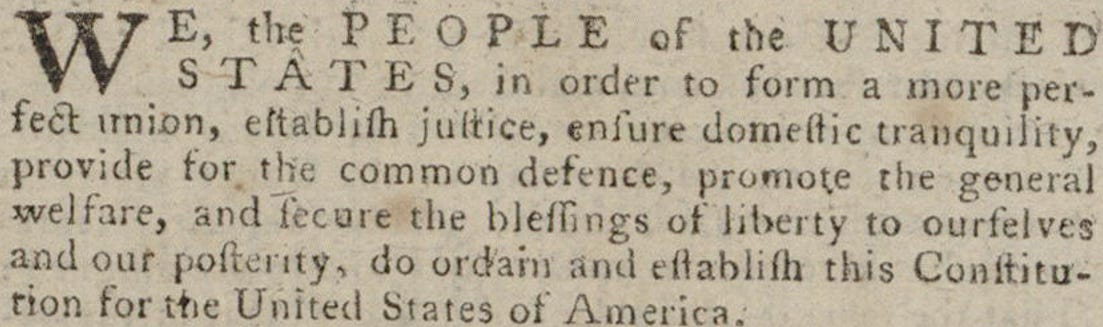
The Dunlap & Claypoole broadside of September 19, 1787, the official printing distributed to the state legislatures and town clerks, is not merely a reproduction of the engrossed parchment. It is a typographically deliberate document, and its use of capitalization follows a hierarchy that the Founders, educated in Roman civil law and the classical tradition, would have recognized immediately as a system of gradus; the graduated ranks of legal standing.
However, the convention of this hierarchy must be understood correctly according to its Roman roots. In Roman law, the highest standing, that of the living / sovereign man, was written in proper noun form (mixed case, with an initial capital). The use of ALL CAPS was reserved for corporate entities, legal fictions, and those who had suffered a total loss of natural rights (slaves or the legally dead). The higher the capitalization, the lower the natural standing. ALL CAPS denotes a creation of the state or a diminished legal persona, not a sovereign living man [5] [6] [7]. The broadside applies this principle with precision.
To understand the typography, one must first understand the structure of the instrument. The preamble is not the operating agreement; it is the external declaration of the grantors. It identifies who is speaking, what they are doing, and for whom.
The preamble opens with an enlarged, bold, and dramatically oversized capital letter “W“—occupying nearly three lines of text, followed immediately by the letter “E“, together forming “WE“. This is the sovereign voice, but it is speaking collectively.
Immediately following, the broadside renders “the PEOPLE of the UNITED STATES“—with “PEOPLE“ and “UNITED STATES“ in full small capitals [10]. According to the Roman convention, these ALL CAPS designations indicate that “PEOPLE“ and “UNITED STATES“ are not living men; they are corporate bodies politic, legal fictions created by the state. The typographical hierarchy is precise:
“WE“ — the sovereign voice of the grantors, standing outside the instrument.
“PEOPLE“ (ALL CAPS) — the body politic in its collective corporate capacity; an artificial entity.
“UNITED STATES“ (ALL CAPS) — the grantee-beneficiary; another artificial entity.
The word “of“ between “PEOPLE“ and “UNITED STATES“ is rendered in lower case; subordinate, connective, possessive; while the word “for“ in the operative clause (”this Constitution for the United States of America”) is similarly in lower case, functioning as a preposition of agency and purpose. The visual hierarchy confirms that the sovereign grantors (”WE“) are creating a charter for an artificial entity (”UNITED STATES“), acting through another artificial entity (”PEOPLE“).
Below the preamble, the body of the Constitution (Articles I through VII) constitutes the internal operating agreement of the newly created entity. Within this internal rulebook, the broadside renders governmental offices: “Senate,” “House of Representatives,” “President,” “Congress,” “Supreme Court”, with initial capitals only (proper nouns) [10].
These offices are not sovereign; they are creatures of the instrument. But within the internal framework of the entity, they hold a specific, elevated legal rank (magistratus).
The living man or woman, the true sovereign, does not appear as a party within the body of the Constitution. The natural man’s person is only referenced as a subject of the rules, typically in lower case: “No person shall be a Representative...” The word “person“ is lower case. The living man is entirely external to the compact; he is the author and source of the authority, but he is not bound by the internal operating agreement unless he consents to step into one of its created roles (e.g., “citizen,” “person,” “resident”).
The most striking application of this typographical capitis deminutio (diminishing of status) appears in the attestation clause and the accompanying Convention resolution on the second page of the broadside. Washington’s name is rendered in two distinct forms, both of which represent legal personae (offices), not the living man [10].
In the attestation clause, signing as the presiding officer of the corporate body of the Convention that produced the instrument, his name appears as:
GEORGE WASHINGTON, President.

The surname is in full capitals, denoting the legal fiction or corporate office he is occupying. The office title “President” of the Convention of States follows in small caps. It is also noted that he is the Deputy from Virginia.
In the Congressional resolution immediately following (new Congress assembled), his name is written as a further diminished capacity; his name appears as:
GEORGE WASHINGTON, President… His Excellency the President of Congress

Here the entire name is rendered in italicized capitals and title. The italicization signals a shift in persona: the same man, acting in a different, arguably lesser, legal capacity as President of the new Congress.
Neither of these ALL CAPS forms represents the living sovereign man “George Washington” (proper noun). Both represent the man stepping down into a corporate fiction to conduct the business of the state. This is capitis deminutio expressed in ink. The Founders demonstrated the Roman law tradition on the face of the instrument: the living man stands behind the signature, but the name on the paper represents the diminished legal persona [11].
The Rhode Island legislature’s resolution transmitting the broadside to its towns provides further confirmation [12]. The resolution refers to “the said proposed Constitution for the UNITED STATES of AMERICA.“ Here:
“UNITED STATES of AMERICA“ is in ALL CAPS—the corporate grantee-entity.
“Constitution“ is in mixed case—the instrument itself.
“for“ is in lower case—the preposition of agency.
The typography confirms the legal reality: an instrument of agency (Constitution) is being proposed for an artificial corporate entity (UNITED STATES OF AMERICA).
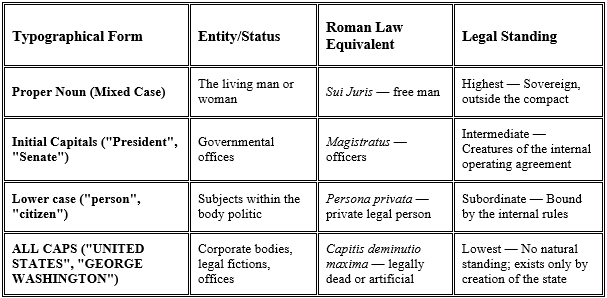
The broadside is a complete visual expression of the Roman law hierarchy of persons, demonstrating that the Constitution is a compact between artificial entities, external to the living sovereign man.
The preamble of the original engrossed document, confirmed on the face of both the 1787 parchment and the Dunlap & Claypoole broadside, reads [Note: the Dunlap & Claypool broadside had the first phrase written as “WE the PEOPLE of the UNITED STATES”; to clarify the legal agency when distributed to the States for ratification]:
“We the People of the United States, in Order to form a more perfect Union, establish Justice, insure domestic Tranquility, provide for the common defence, promote the general Welfare, and secure the Blessings of Liberty to ourselves and our Posterity, do ordain and establish this Constitution for the United States of America.” [10]
The preposition “for“ is the language of agency, delegation, and purpose. The body politic—”We the People”, is ordaining the instrument on behalf of, in service of, or as a charter for the United States. This is the language of a grantor establishing an instrument for the benefit of a beneficiary, not the language of a sovereign declaring its own organic law. The body politic creating the instrument stands above the instrument it creates.
This “for“ language was consistently used in the period immediately following the Convention. The Rhode Island legislature, when transmitting the document to its towns for popular consideration, directed that:
“the preceding Constitution be laid before the People of this State” and that the men have an opportunity of forming their sentiments on “the said proposed Constitution for the United States of America” [12].
Within that same 1787 parchment, the closing attestation clause, the language beneath the signatures of the delegates, shifts the preposition:
“Done in Convention by the Unanimous Consent of the States present the Seventeenth Day of September in the Year of our Lord one thousand seven hundred and Eighty seven and of the Independence of the United States of America the Twelfth…” [10]

Here the delegates are signing as witnesses to what was done in Convention of, that is, belonging to, constituting, or proceeding from the United States of America. The preposition “of“ in this clause does not modify “Constitution“; it modifies “Independence.” Nevertheless, the same instrument thus contains both “for“ (in the preamble, governing the instrument’s purpose) and “of“ (in the attestation, identifying the national identity of the signatories), within the same four pages of parchment. These are two different grammatical and legal relationships appearing in the same instrument, and the distinction is not accidental.
Article VII of the instrument itself provided the operative trigger:
“The Ratification of the Conventions of nine States, shall be sufficient for the Establishment of this Constitution between the States so ratifying the Same” [13].
On June 21, 1788, New Hampshire became the ninth state to ratify, satisfying Article VII [14]. The Constitution became operative as between the nine ratifying states on that date. It was not yet operative as to New York, Virginia, North Carolina, or Rhode Island, which had not yet ratified. The Confederation Congress subsequently set March 4, 1789, as the date for the new government to commence operations, and the First Congress convened at Federal Hall in New York City on that date, declaring the Constitution in effect [15].
This is the transitional moment. The government is no longer a proposed agency; it is an operating corporate body politic. The language begins to shift from “Constitution for“ (the proposed charter) toward “Constitution of“ (the organic law of the entity now in operation).
Rhode Island, the last of the original thirteen states, ratified on May 29, 1790. Its ratification instrument, as verified from the primary source document, still used the operative preamble language: it declared it had:
“maturely considered the CONSTITUTION for the UNITED STATES of AMERICA, agreed to on the Seventeenth Day of September, A.D. 1787” [12].
The operative and understood title of the instrument at the moment the ratification process was completed was still “for.”
Yet the printed broadside produced by Peter Edes in Newport in connection with that ratification bears the bold printed heading at the top of the document: “CONSTITUTION of the UNITED STATES of AMERICA“ [12]. This is the first time a printed heading was applied to the document at all; a typographical and editorial choice made by the printer and the Congress that authorized the printing, not a change to the operative text of the instrument.
This internal contradiction within the 1790 broadside, the heading says “of“ while the preamble and ratification text say “for“ on the exact same page [12], is the clearest possible evidence that the shift from “for“ to “of“ was an editorial and jurisdictional transition in how the instrument was being characterized by the governmental apparatus, not a change to the instrument itself. The body politic that had created the instrument “for” the United States was now being described as constituted “of” the United States, reflecting the consolidation of the corporate entity.
The Bill of Rights, the first ten amendments, was proposed by the First Congress on September 25, 1789, and ratified by the required three-fourths of the states on December 15, 1791 [16]. This is a critical point for the three-instrument framework.
The Massachusetts Compromise of February 1788, which secured ratification by several wavering states, was explicitly conditioned on the promise that a Bill of Rights would be immediately proposed after the new government commenced. The Bill of Rights was therefore not a voluntary addition; it was the price of ratification by several states. It was proposed and ratified entirely under the “Constitution of“ formulation, the organic law of the operating corporate entity, not the proposed charter of 1787.
The Bill of Rights confirms that the Founders understood the compact to be between entities, and that the rights of the living man had to be separately and explicitly reserved precisely because those rights did not flow from the compact itself. They pre-existed it. They belonged to the man, not to the body politic. The Ninth and Tenth Amendments make this explicit: rights not enumerated are retained by the people, and powers not delegated are retained by the states or the people. The natural man’s sovereignty is acknowledged as existing outside and above the compact, not derived from it.
The Legal Significance of “For” vs. “Of”
The preposition “for” is the language of agency, purpose, and delegation. A constitution for an entity is a charter created on behalf of that entity by a superior authority, the body politic which stands above the instrument it creates. The body politic is the grantor; the United States is the grantee-entity.
The preposition “of“ is the language of possession, identity, and constitution. A constitution of an entity is the organic law that defines and constitutes that entity; the entity and its organic law are one. Under this formulation, the United States is not the beneficiary of a charter created by a superior body politic; it is the body politic, and the constitution is its own fundamental law.
This distinction maps precisely onto the capitis deminutio framework. The shift from “for” to “of” in the official title reflects the same transition that occurs when a sui juris man accepts the status of a “person” within the body politic: the superior author of the instrument is absorbed into the instrument itself, and the creator becomes indistinguishable from the creation.
The constitutional instruments analyzed above establish the framework of the compact, its parties, its hierarchy, and its operative scope. The statutes enacted under those instruments carry that framework forward, and within those statutes the United States government has, on multiple occasions, defined its own jurisdictional reach in terms that confirm the limited and entity-specific nature of the compact. These statutory definitions are not peripheral; they are admissions on the face of the law itself, and they must be read in conjunction with the constitutional framework to understand the full scope, and the full limits, of the jurisdiction being asserted.
The most authoritative judicial statement on the multiple meanings of the term “United States” is found in Hooven & Allison Co. v. Evatt, 324 U.S. 652 (1945), where Chief Justice Stone, writing for the Court, stated:
“The term ‘United States’ may be used in any one of several senses. It may be merely the name of a sovereign occupying the position analogous to that of other sovereigns in the family of nations. It may designate the territory over which the sovereignty of the United States extends, or it may be the collective name of the states which are united by and under the Constitution.” [17]
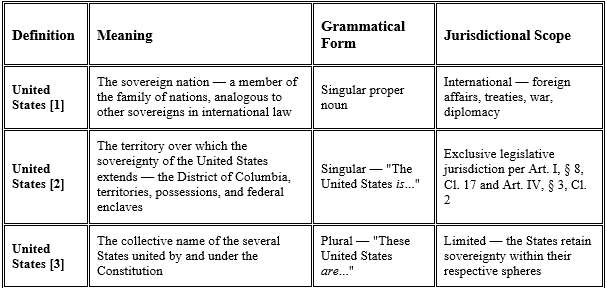
The significance of this tripartite definition cannot be overstated. The Court is acknowledging, in binding precedent, that the term “United States” does not have a single fixed meaning, and that the jurisdictional consequences of each meaning are entirely different. A statute that uses the term “United States” in the second sense (the federal zone) does not automatically reach persons in the third sense (the several States). The jurisdiction of the United States in the second sense is limited to the territory over which Congress exercises exclusive legislative authority: the District of Columbia, the territories and possessions, and federally ceded enclaves within the States.
The Court further noted in Hooven that within the federal zone (United States [2]), Congress is not subject to the same constitutional limitations that apply when it legislates for the several States (United States [3]):
“[T]he United States may acquire territory by conquest or by treaty, and may govern it through the exercise of the power of Congress conferred by Section 3 of Article IV of the Constitution.... In exercising this power, Congress is not subject to the same constitutional limitations, as when it is legislating for the United States [the several States].” [17]
This passage is a direct judicial admission that the constitutional protections of the Bill of Rights do not automatically apply within the federal zone; they apply only as Congress makes them applicable. This is the precise mechanism by which the selective incorporation doctrine, discussed in Section VI of this article, operates: the Bill of Rights is applied to the States through the 14th Amendment’s Due Process Clause not because it naturally extends there, but because Congress and the Court have chosen to extend it selectively; and have chosen not to extend the 9th and 10th Amendments, which would acknowledge the sovereign man’s standing above the apparatus.
The statutes themselves contain definitions that confirm the entity-driven nature of the “United States” as used in the administrative and regulatory framework. These definitions appear in the United States Code and are binding on all courts that apply those statutes within that title.
28 U.S.C. § 3002(15) — the Federal Debt Collection Procedures Act — defines “United States” as follows:
“(15) ‘United States’ means — (A) a Federal corporation; (B) an agency, department, commission, board, or other entity of the United States; or (C) an instrumentality of the United States.” [18]
This is not an obscure or peripheral provision. It is the definition of “United States” as used in the federal government’s own debt collection statute, the statute under which the United States pursues claims against persons within its jurisdiction. The United States, for purposes of that statute, is a federal corporation. This is the government’s own characterization of itself in its own statute.
26 U.S.C. § 7701(a)(9) — the Internal Revenue Code’s general definitions section — defines “United States” as follows:
“The term ‘United States’ when used in a geographical sense includes only the States and the District of Columbia.” [19]
Read in conjunction with Hooven, this definition places the Internal Revenue Code’s jurisdiction within United States [2], the federal zone, which includes the District of Columbia and the territories, and the several States only to the extent that Congress exercises exclusive legislative jurisdiction within them (i.e., federal enclaves). It does not, on its face, extend to the general population of the several States operating outside the federal zone.
26 U.S.C. § 7701(a)(10) defines “State” as follows:
“The term ‘State’ shall be construed to include the District of Columbia, where such construction is necessary to carry out provisions of this title.” [19]
This definition confirms that “State” in the Internal Revenue Code is a term of art that includes the District of Columbia, a federal territory, within its scope. It does not define “State” as one of the fifty sovereign States of the Union in their capacity as parties to the constitutional compact.
The canons of statutory construction, the rules by which courts interpret statutes, provide that jurisdictional terms must be read strictly and narrowly. This principle is well established in binding case law:
“It is a well-settled principle that a statute is not to be applied to persons or circumstances not clearly within its terms.” [20]
“Every extension of the power of the federal government must be justified by specific constitutional authority.” [21]
“When Congress legislates in a field that touches the rights of citizens, the courts must construe the statute strictly and in favor of the citizen.” [22]
Applied to the definitions above, these canons require that the term “United States” in any federal statute be read in the specific sense in which it is used in that statute, and that the jurisdictional reach of that statute be limited to the persons and territories clearly within that definition. A statute that uses “United States” in the second sense (the federal zone) cannot be extended by implication to reach persons in the third sense (the several States) who are not within the federal zone and have not voluntarily placed themselves within it.
The statutes themselves, read through the canons of construction, confirm the limited jurisdictional reach of the administrative apparatus. The jurisdiction of the United States in the regulatory and administrative sense is not coextensive with the territory of the several States. It is limited to the federal zone unless the sovereign man has voluntarily placed himself within that zone through contract.
This brings the analysis to the most practically significant point: the mechanism by which the limited jurisdiction of the federal zone is extended to reach the general population of the several States. That mechanism is voluntary contract; the acceptance of benefits and privileges from the federal government in exchange for the assumption of corresponding duties and responsibilities, which carries with it submission to the jurisdiction of the entity granting those benefits.
This mechanism is not a modern invention. It is grounded in the oldest principle of contract law: a man who voluntarily enters into a contract with an entity submits himself to the terms of that contract, including any jurisdictional provisions it contains. The principle was stated clearly in National Mutual Insurance Co. v. Tidewater Transfer Co., 337 U.S. 582 (1949):
“Jurisdiction... may be conferred by consent.” [23]
And in Insurance Corp. of Ireland v. Compagnie des Bauxites de Guinee, 456 U.S. 694 (1982):
“The personal jurisdiction requirement... can... be waived, and... a party may submit to the jurisdiction of the court by voluntary appearance.” [24]
The practical application of this principle to the relationship between the sovereign man and the federal administrative apparatus operates through a series of contracts, each of which carries a jurisdictional submission:
The Social Security Number: The application for a Social Security Number is a voluntary application for enrollment in a federal benefit program administered under Title II of the Social Security Act, 42 U.S.C. § 401 et seq. By applying for and using a Social Security Number, a man voluntarily enrolls in the federal benefit program and accepts the terms of that enrollment, including the regulatory framework that governs it.
The Birth Certificate: The registration of a birth with a State vital records office creates a record of a legal person, a corporate fiction, within the body politic of the State. The name on the birth certificate is typically rendered in ALL CAPS or in a form that distinguishes it from the proper noun name of the living man. This registration is the foundational act of capitis deminutio in the modern administrative system: it creates the legal person who is subject to the jurisdiction of the State and, through the 14th Amendment’s citizenship clause, of the United States.
The Driver’s License: The application for a State-issued driver’s license is a voluntary application for a privilege, the privilege of operating a motor vehicle on public roads, granted by the State in exchange for submission to the State’s regulatory framework governing that privilege, including the traffic laws, the licensing requirements, and the administrative jurisdiction of the State’s motor vehicle authority.
Federal Income Tax Filing: The voluntary filing of a federal income tax return is an admission that the filer is a “taxpayer” within the meaning of the Internal Revenue Code, a person subject to the jurisdiction of the Internal Revenue Service and the federal tax system. The filing itself and any use of the IRS forms is the jurisdictional submission.
Federal Benefits Programs: The acceptance of any federal benefit, Social Security retirement benefits, Medicare, Medicaid, federal student loans, federal housing assistance, or any other program administered under the authority of the United States carries with it submission to the regulatory framework governing that benefit and, by extension, to the jurisdiction of the United States in the second sense (Hooven [2]).
Each of these contracts is, in isolation, a voluntary act. The sovereign man is not compelled to apply for a Social Security Number, obtain a driver’s license, file a tax return, or accept federal benefits. The compulsion is practical rather than legal: the modern economy is structured in such a way that participation in commerce, employment, banking, travel, and civil life is effectively impossible without these contracts. The practical compulsion does not alter the legal character of the acts; they remain voluntary submissions to jurisdiction, but it does reveal the mechanism by which the Lieber Code’s framework of total governmental jurisdiction over all persons within the territory has been translated into a system of universal voluntary contractual submission.
The statutory definitions analyzed above, the three definitions of “United States” in Hooven, the definition of “United States” as a “federal corporation” in 28 U.S.C. § 3002(15), and the geographically limited definition in 26 U.S.C. § 7701(a)(9), are not hidden. They are on the face of the statutes and in binding Supreme Court precedent. They are, however, written in a way that makes them functionally invisible to the ordinary reader and to the ordinary practitioner of law.
The term “United States” is used in all three senses interchangeably in the statutes, the regulations, and the case law, without any consistent indication of which sense is intended in any given provision unless one is well versed in statutory construction rules, title construction provision statutes, constitutional limitations, common law references at the State level, and the hierarchy of the applications of each of these rules. The result is a system of structural ambiguity; a system in which the jurisdictional reach of the federal government appears, on the surface, to be coextensive with the territory of the several States and the entire population, while the actual statutory definitions, read carefully and in conjunction with Hooven and the canons of construction, reveal a much more limited reach.
This structural ambiguity is not accidental. It is the mechanism of plausible deniability: the government can, when pressed, point to the statutory definitions and the Hooven tripartite framework as evidence that it has always disclosed the limited nature of its jurisdiction. At the same time, the practical effect of the system through universal enrollment in federal benefit programs, universal use of Social Security Numbers, universal filing of federal tax returns ensures that virtually the entire population has voluntarily submitted to that jurisdiction through contract, making the theoretical limits of the jurisdiction practically irrelevant.
The sovereign man who understands the Hooven framework, reads the statutory definitions carefully, applies the canons of construction, and has not voluntarily submitted to the jurisdiction of the federal zone through contract is, in theory, outside the reach of the administrative apparatus. In practice, the modern economy makes such a position extraordinarily difficult to maintain. But the theoretical position is supported by the statutes and the case law and it is the government’s own definitions, in its own statutes, that establish it.
The conundrum of parity described throughout this document is therefore not merely a structural problem of courts and legal persons. It is a practical problem of contracts: the sovereign man who has voluntarily submitted to the jurisdiction of the federal zone through the acceptance of benefits and privileges has, by that act, stepped down the hierarchy and entered the entity’s world. He has undergone capitis deminutio not by force, but by contract. And having entered that world voluntarily, he is bound by its rules, including the rule that he has no standing to bring a natural law claim of trespass against the entity whose jurisdiction he has accepted.
The exit from that world, if it exists, lies in the rescission of those contracts, the return of the benefits and privileges, the rejection of the legal person created by the birth certificate and the Social Security Number, and the reassertion of the sovereign man’s natural standing outside the compact. Whether such a rescission is practically achievable in the modern administrative state is a question beyond the scope of this investigation. What is established here is that the mechanism of entry, voluntary contract, is documented, the statutory admissions are on the face of the law, and the theoretical framework for the sovereign man’s independent standing is supported by the government’s own definitions in its own statutes.
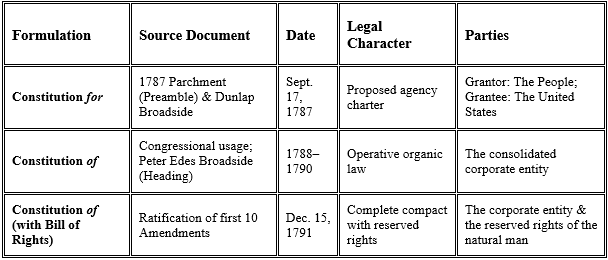
None of these instruments, in any of their formulations, are compacts with the living man. They are compacts between bodies politic; artificial corporate entities. The “We the People” of the preamble is the voice of the collective body politic, the artificial corporate person, not the voice of the individual sovereign man. The living man is the author and source of the body politic, but he is not a party to the compact. He stands above it in the hierarchy, as the creator stands above the creation.
If the living man or woman is the sovereign author of the law, how do they become subject to the jurisdiction of the corporate state? The Founders, deeply educated in Roman civil law, understood the mechanism: capitis deminutio (the diminishing of status).
In Roman law, as defined by Justinian’s Institutes and Gaius, capitis deminutio is the alteration or loss of a person’s legal status (prioris status commutatio) [11]. It occurred in three descending degrees, representing a progressive loss of natural rights [25]:
Minima: A change in family relations, such as when a person who was sui juris (his own master) became subject to the power of another (alieni juris). It left the rights of liberty and citizenship unaltered.
Media: A lesser or medium loss of status. This occurred where a man lost his rights of citizenship, but without losing his liberty.
Maxima: The highest or most comprehensive loss of status. This occurred when a man’s condition was changed from one of freedom to one of bondage, when he became a slave. It swept away all rights of citizenship and family rights.
When a living man, who is naturally sui juris (”One who has all the rights to which a freemen is entitled; one who is not under the power of another” [8]), assumes the status of a “person,” “citizen,” or “resident” within the statutory framework of the body politic, he undergoes a capitis deminutio. He steps down from his sovereign capacity and consents to be governed by the internal operating rules of the artificial entity. He exchanges his absolute liberty for the privileges and duties of the “rank he holds in society.”
When this status is reduced entirely to a legal fiction, a corporate entity or a “strawman” created by the state for commerce and jurisdiction, it represents a form of capitis deminutio maxima. The living man is legally “dead” in this capacity; only the ALL CAPS corporate fiction exists on the paper. This is why the ALL CAPS designation, historically reserved for slaves and corporations in Roman law, is used for legal names on modern court dockets, citations, and administrative records. It signifies that the court is dealing with the artificial entity, not the living sovereign man. This clarifying practice is to maintain parity between entities who have voluntarily submitted to the jurisdiction, not to govern a man outside the structure of fictions.
The Civil War and its aftermath produced a constitutional crisis that the original compact framework had no mechanism to resolve. The 13th, 14th, and 15th Amendments, ratified between 1865 and 1870, were not merely additions to the existing compact; they were structural modifications that created a new class of legal persons, extended the compact’s reach in new directions, and established the jurisdictional foundation upon which the modern administrative state would later be built.
The 13th Amendment abolished slavery and involuntary servitude, except as punishment for crime [26]. Its legal effect was to eliminate the status of “enslaved person” as a recognized legal category within the body politic. Those who had been held in that status were no longer property; they were persons. But the 13th Amendment did not resolve the question of what kind of persons they were, whether they were citizens, whether they were parties to the constitutional compact, and whether they held the rights and protections of that compact.
The 14th Amendment resolved the question left open by the 13th. Its opening clause states:
“All persons born or naturalized in the United States, and subject to the jurisdiction thereof, are citizens of the United States and of the State wherein they reside” [27].
This clause accomplished two things simultaneously. First, it created a new class of legal persons, statutory citizens, by defining citizenship in terms of birth or naturalization within the jurisdiction of the United States. Second, and critically, it conditioned that citizenship on being “subject to the jurisdiction thereof.” Citizenship under the 14th Amendment is not a natural right; it is a statutory status, granted by the governmental entity and conditioned on submission to its jurisdiction.
The phrase “subject to the jurisdiction thereof“ is the mechanism of capitis deminutio embedded in the amendment itself. The man who is “subject to the jurisdiction” of the United States has accepted, or been assigned, a legal status within the corporate body politic of the United States. He is no longer operating as a sovereign man outside the compact; he is a legal person within it, subject to its rules, its courts, and its authority.
The Supreme Court’s first major interpretation of the 14th Amendment confirmed this limited, compact-based reading. In the Slaughter-House Cases, 83 U.S. 36 (1873), Justice Samuel Miller wrote for the majority that the “one pervading purpose” of the 13th, 14th, and 15th Amendments was:
“the freedom of the slave race, the security and firm establishment of that freedom, and the protection of the newly-made freeman and citizen from the oppressions of those who had formerly exercised unlimited dominion over him” [28].
The Court held that the Privileges or Immunities Clause of the 14th Amendment protected only rights of federal citizenship, a narrow category, and was not designed to protect the general population from state action [28].
This original, limited reading of the 14th Amendment was consistent with the compact theory: the amendment extended the compact to a new class of legal persons (freed slaves and their offspring) who had previously been excluded from it, without fundamentally altering the compact’s character as an agreement between bodies politic governing recognized legal persons.
The Slaughter-House reading did not hold in its clearly limited binding precedent. Although never overturned, over the following decades, through a series of Supreme Court decisions, the 14th Amendment’s reach was progressively expanded beyond the freed slave class to encompass all persons “born or naturalized in the United States.” The “subject to the jurisdiction thereof” condition was gradually treated as a mere geographic fact, birth on American soil, rather than as a substantive legal status requiring affirmative submission to jurisdiction.
The consequence was that the 14th Amendment became the vehicle through which the entire population of the United States (the several organic states of the union of states) was brought within the statutory jurisdiction of the federal government as legal persons; citizens subject to federal authority. The compact that had originally governed the relationships between bodies politic and their recognized legal persons was expanded to cover all inhabitants, not as sovereign men and women exercising natural rights, but as statutory citizens subject to the jurisdiction of the United States.
This expansion is the direct precursor to the incorporation doctrine. Once the 14th Amendment was re-nterpreted to apply to all persons, not merely freed slaves, the question arose: which rights does it protect, and against whom? The incorporation doctrine was the judicial mechanism for answering that question, case by case, right by right, over the course of the 20th century.
The incorporation doctrine, the judicial mechanism by which portions of the Bill of Rights have been made applicable to the States through the 14th Amendment is, by its very existence, an admission about the original nature of the constitutional compact. The admission is structural and unavoidable: you cannot “incorporate” a right that already belongs to a man by nature. You can only “incorporate” a statutory privilege that was previously withheld from a class of legal persons who were not recognized as parties to the original compact.
The Bill of Rights, as originally ratified in 1791, applied only to the federal government. This was confirmed by the Supreme Court in Barron v. Baltimore, 32 U.S. 243 (1833), which held that the Bill of Rights restrained only the actions of the federal government and placed no limitations on the authority of the States [29]. The States were governed by their own constitutions and their own bills of rights, or not, as they chose.
Following the ratification of the 14th Amendment in 1868, the Supreme Court began the process of “incorporating” specific provisions of the Bill of Rights against the States through the Due Process Clause. The first significant incorporation occurred in Gitlow v. New York, 268 U.S. 652 (1925), where the Court held that freedom of speech was among the fundamental personal rights protected by the Due Process Clause of the 14th Amendment against state action [30]. From that point, the Court proceeded case by case, incorporating specific rights selectively; only those deemed “fundamental to the American scheme of justice” or “deeply rooted in this Nation’s history and tradition.”
The incorporation doctrine reveals the original nature of the compact through its own logical structure:
The Bill of Rights did not apply to the States as originally enacted. This confirms that the Bill of Rights was a compact instrument, a set of limitations on the federal governmental apparatus created by the compact, not a declaration of natural rights belonging to all men by nature. If these were natural rights, they would require no “incorporation”; they would be self-executing against all governmental entities by their very nature.
The 14th Amendment was necessary to extend the compact’s protections to a new class of legal persons. This confirms that the original compact did not protect all inhabitants, only those recognized as legal persons within the body politic. The necessity of the amendment is the proof of the original exclusion.
The incorporation doctrine applies selectively. The Supreme Court has not incorporated all provisions of the Bill of Rights against the States. As of the date of this writing, the following provisions remain unincorporated or only partially incorporated: the 5th Amendment right to a grand jury indictment in criminal cases, the 7th Amendment right to a jury trial in civil suits, and, most significantly, the 9th and 10th Amendments [31].
The failure to incorporate the 9th and 10th Amendments is not an oversight or a gap in the doctrine. It is the doctrine’s most structurally significant feature, and it reveals the purpose of the selective incorporation framework.
The 9th Amendment provides that the enumeration of certain rights in the Constitution shall not be construed to deny or disparage others retained by the people [32]. Incorporating the 9th Amendment against the States would require the courts to acknowledge and enforce an unlimited reservoir of unenumerated natural rights retained by the people; rights that pre-exist the Constitution and cannot be abridged by any governmental entity. This would directly contradict the statutory framework of the modern administrative state, which operates on the premise that the government may regulate any activity not explicitly prohibited. A fully incorporated 9th Amendment would require the government to justify every regulatory intrusion against a presumption of liberty, which is the precise opposite of the current framework.
The 10th Amendment provides that powers not delegated to the United States by the Constitution, nor prohibited by it to the States, are reserved to the States respectively, or to the people [33]. Taking the 10th Amendment seriously as a living, enforceable principle would require dismantling the entire edifice of federal regulatory authority built since 1937 under the expanded Commerce Clause jurisprudence of NLRB v. Jones & Laughlin Steel Corp., 301 U.S. 1 (1937), and Wickard v. Filburn, 317 U.S. 111 (1942) [34]. Under those decisions, the Commerce Clause was expanded to cover virtually all economic activity, bringing the entire population within the regulatory jurisdiction of the federal government as legal persons engaged in commerce. A fully enforced 10th Amendment would challenge the constitutional basis of that expansion.
The 9th and 10th Amendments are the two provisions of the Bill of Rights that most directly acknowledge the sovereignty of the natural man and the reserved authority of the people outside the compact. Their non-incorporation is therefore the clearest possible evidence that the incorporation doctrine is not a mechanism for restoring the natural rights of sovereign men; it is a mechanism for extending statutory privileges, defined and limited by the courts, to legal persons within the compact, while carefully preserving the jurisdictional apparatus of the administrative state against the claims of the sovereign man who stands outside it.
The practical reality of modern litigation presents an immediate and profound contradiction: man is routinely brought before courts that are themselves creatures of the very constitutions and statutes that man authored, and is expected to litigate as though he and the State occupy equal positions on the same jurisdictional plane. This contradiction is rooted in a fundamental confusion, or deliberate conflation, between two entirely distinct legal conditions: pro se and sui juris.
The term pro se is a Latin phrase meaning “for oneself” or “on one’s own behalf.” In modern American courts, it is used to describe a litigant who appears without an attorney; that is, one who represents himself within the existing framework of the court’s rules, procedures, and jurisdiction.
The critical point is this: a pro se litigant has implicitly accepted the jurisdiction of the court. By appearing pro se, the individual man steps into the role of a legal person, a party recognized by the court’s procedural framework, and submits to the court’s authority to adjudicate the matter. The pro se designation is a concession of jurisdiction. It places the individual man within the hierarchy of the court’s own legal order, as a participant in a system created by the very entities against which he may be attempting to bring a claim.
As the Supreme Court recognized in Faretta v. California:
“A party who chooses to appear pro se... is bound by the same rules of procedure as attorneys” [35].
The pro se litigant, in the court’s view, is simply an unrepresented legal person: a fiction operating within a fiction.
Sui juris is an entirely different legal condition. The term means “of one’s own right”—possessing full legal capacity, under no disability, subject to no guardian or superior, and acting from one’s own sovereign authority [8] [36].
The distinction is fundamental. Pro se describes a procedural posture within a court’s framework. Sui juris describes a status, the condition of a man who stands in his own right, under no disability, acknowledging no superior jurisdiction over his person except by his own consent. A man appearing sui juris is not representing himself within the court’s rules. He is asserting that he stands outside the presumption of legal disability or incompetency that the court would otherwise impose, and that he appears not as a legal fiction or artificial person, but as a living man of full legal capacity and original sovereign character.
When a man walks into a modern court without an attorney and declares himself “pro se,” the court treats him as a legal person, or more specifically, as a citizen or resident subject to the court’s jurisdiction, operating within the statutory and regulatory framework that the court administers. The court presumes:
That the individual man is in fact a legal person (a fiction of law), not a man who lives and breathes and is of original sovereign character.
That the individual man has submitted to the court’s jurisdiction by “appearing”.
That the individual man is subject to the same procedural rules as any other party, rules written by the very entities against which he may be bringing a claim.
This presumption is the mechanism by which the hierarchy described in Chisholm is effectively inverted in practice. The court, a creature of the constitution and statute, treats the man before it as though he is a creature of the same order, subject to the same hierarchy, rather than the author and source of the authority from which the court itself derives its existence.
Jurisdiction is the lawful authority of a court to hear and decide a matter and requires parity: the parties before the court must be of a nature and standing that the court can lawfully adjudicate between them. This principle flows directly from the hierarchy of law.
The courts of the United States and the several States are courts of limited jurisdiction. They are creatures of constitutions and statutes. Their jurisdiction is defined, granted, and limited by the documents that created them. They cannot exceed that grant. And critically, the nature of the parties before the court determines the nature of the proceeding and the law applicable to it.
The foundational principle is this: Like must be brought against like. Parity of parties is a prerequisite to jurisdiction.
This is not merely a procedural nicety. It is a structural necessity rooted in the nature of legal persons and the hierarchy of law. A court created by a constitution can adjudicate disputes between:
Man and man (common law claims of trespass, harm, contract)
Entity and entity (statutory, commercial, regulatory disputes)
Man and entity, only where man has consented to the court’s jurisdiction and the applicable law
The hierarchy of legal persons and the nature of claims that flow from that hierarchy may be understood as operating in two distinct columns:
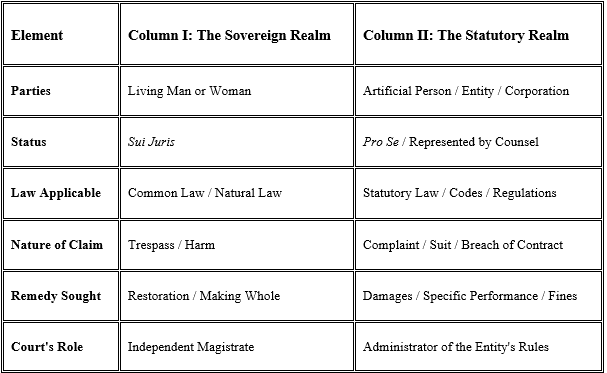
The critical observation is that these two columns do not naturally intersect. A man bringing a claim of trespass against another man is operating entirely within Column I. An entity bringing a complaint against another entity is operating entirely within Column II. The problem, or the conundrum arises when a man attempts to bring a claim against an entity (or vice versa) without resolving the fundamental question of which column governs and whether parity exists.
The United States, the several States, counties, districts, and municipalities are all artificial persons; corporations in the broad sense recognized by both Black’s and Bouvier’s [8] [36]. They are created by man, through constitutions, charters, and statutes. They have no existence independent of the legal instruments that created them. They cannot bleed, cannot suffer [a voluntary submission], cannot hold natural rights. They are, in Wilson’s words, “inferior contrivances” [1].
This asymmetry is the root of the jurisdictional conundrum. When a man attempts to bring a claim against the State, he is attempting to bring a Column I man (himself) into conflict with a Column II entity (the State).
The structural impossibility is this: A man cannot bring a common law claim of trespass against an artificial person, because an artificial person cannot commit a trespass in the natural law sense. It has no hands, no will, no capacity for the kind of wrongdoing that gives rise to a natural law claim. What the State or United States can do, and what gives rise to a legitimate grievance is to act through its agents: living men and women who carry out its directives. The trespass, if any, is committed by a man acting under color of law, not by the State itself.
American courts have partially acknowledged this structural problem through doctrines such as Ex Parte Young (1908), which permits suits against state officers (men) in their official capacity to enjoin unconstitutional conduct, rather than against the State itself [37]. This is a recognition, however imperfect, that the actual wrongdoer is a man, not the State. But this doctrine operates entirely within Column II; it is a creature of equity and federal constitutional law, not of common law. It does not resolve the fundamental parity problem; it merely provides a procedural workaround within the existing statutory framework.
The doctrine of sovereign immunity, that the State cannot be sued without its consent, is itself a recognition of the parity problem, though it is typically framed in the opposite direction. The standard formulation is:
“The United States, as sovereign, is immune from suit save as it consents to be sued” [38].
From the perspective of the hierarchy established in Chisholm, this doctrine is an inversion. The State, as an inferior contrivance of man, claims immunity from the claims of the very men who created it. Wilson’s opinion in Chisholm was a direct rejection of this doctrine as applied to the States, holding that Georgia could be sued by a citizen of another State [1]. The subsequent passage of the Eleventh Amendment (1795) effectively reversed Chisholm and restored sovereign immunity for the States in federal court, demonstrating precisely the kind of “inverted order of things” Wilson had warned against.
The practical consequence is that a man can only bring a claim against the State or United States in a forum and under conditions that the State or United States has itself created and consented to; through statutes such as the Federal Tort Claims Act, the Tucker Act, or analogous state waivers [39] [40]. In every such case, the man has entered Column II, accepted the court’s jurisdiction, and submitted to the rules of the entity against which he is claiming. Parity has been achieved, but only by the man descending to the level of the entity, not by the entity ascending to the level of the man.
Within the existing statutory framework, a man can bring claims against the State or United States, but only by:
Entering Column II—accepting the court’s statutory jurisdiction and proceeding under the rules the State has established for such claims.
Identifying a waiver of sovereign immunity—finding the specific statute by which the State or United States has consented to be sued (e.g., the Federal Tort Claims Act, 28 U.S.C. §§ 1346, 2671–2680; the Tucker Act, 28 U.S.C. § 1491; state tort claims acts) [39] [40].
Accepting the limitations of that waiver—including caps on damages, procedural prerequisites, and the exclusion of certain categories of claims.
In every such case, the man is operating on the State’s terms, in the State’s court, under the State’s rules. He has achieved parity only by descending to the entity’s level.
The more structurally coherent approach that is consistent with the hierarchy of law and the principle of parity is to identify the man behind the governmental act and bring the claim against that man directly, in his personal capacity, for the trespass he has committed.
This is the logic of:
42 U.S.C. § 1983—which provides a cause of action against persons acting under color of state law (i.e., men, not the State itself) [41].
Bivens actions—Bivens v. Six Unknown Named Agents (1971)—which allow suits against federal officers in their personal capacity for constitutional violations [42].
Common law actions for trespass—which lie against the individual man who committed the act, regardless of whether he acted under governmental authority.
In each of these, the claim is ultimately man against man; the living man who suffered the trespass bringing a claim against the living man who committed it. The governmental entity is, at most, a backdrop. Parity is achieved because both parties are men.
The fundamental limitation, the conundrum remains: a man cannot bring a natural law claim of trespass against an artificial person, because an artificial person is incapable of committing a trespass in the natural law sense. The State, the United States, the county, the district, none of these can reach out a hand and strike a man. Only a man can do that.
What the artificial person can do is create the conditions, the authority, and the legal cover under which its agents, men, commit acts that harm other men. The harm is real. The trespass is real. But the trespasser, properly identified, is always a man. A corporation cannot create a man. A man can create a corporation. Therefore, a corporation can never be the original wrongdoer in a natural law sense, only the instrument through which a man acts.
The deepest layer of the conundrum is this: the courts before which a man must bring his claims are themselves creatures of the State. They are constituted by the same constitutions and statutes that created the entities against which the man is seeking relief. This is not a neutral forum. It is a forum created by one party to adjudicate claims against that party. The structural conflict of interest is total.
Wilson acknowledged this problem indirectly in Chisholm when he noted that the English doctrine of sovereign immunity rested on the feudal principle that “all jurisdiction implies superiority of power”. This means that no court could have jurisdiction over the King because no court stood superior to him [1]. Wilson rejected this doctrine for the American system, but the Eleventh Amendment and subsequent sovereign immunity jurisprudence have largely restored it.
The structural conflict of interest inherent in courts-as-creatures-of-the-entity was made somewhat complete in 1938 by two simultaneous legal events that formally abolished the common law forum in the federal system.
First, the Supreme Court’s ruling in Erie Railroad Co. v. Tompkins, 304 U.S. 64 (1938), explicitly declared the end of federal common law [43]. Overturning nearly a century of precedent established by Swift v. Tyson (1842), Justice Louis Brandeis wrote what amounts to the judicial death certificate of the common law forum:
“There is no federal general common law. Congress has no power to declare substantive rules of common law applicable in a State whether they be local in their nature or general.” [43]
Following Erie, federal courts were required by the Rules of Decision Act (28 U.S.C. § 1652) to apply state statutory law rather than relying on an independent body of federal common law [44].
Second, and in the exact same year, the adoption of the Federal Rules of Civil Procedure formally merged suits in equity and suits at common law into a single “civil action” [45]. Prior to 1938, a man seeking a remedy at common law, such as damages for a trespass, would file in a distinct common law court with its own distinct pleading rules, while a man seeking an equitable remedy would file in a court of equity or chancery. These were structurally separate forums. The Federal Rules of Civil Procedure eliminated this distinction entirely at the federal level, collapsing both into a single statutory proceeding [45].
The result is that no man can today walk into a federal courthouse and file a common law claim in a common law court. He must file a “civil action” under statutory rules of procedure, and the court will adjudicate the matter as a statutory entity applying statutory law or state-level precedents. The forum in which a man could bring a natural law claim of trespass, Column I of the two-column framework described above, was deliberately and formally abolished by the Supreme Court and the federal rule-making authority in the same year, 1938. This is not an inference. It is a confirmed, cited fact, documented by the Supreme Court’s own words.
The federal judiciary and legal establishment would argue that the 1938 Erie doctrine and the Federal Rules of Civil Procedure applied exclusively to the federal courts, leaving state common law jurisdiction intact. However, the historical record demonstrates that the practical elimination of the common law forum at the State and local levels was accomplished through a parallel, coordinated mechanism: the uniform code adoption movement, the merger of law and equity in state courts, and the coercive use of federal funding.
This extension of the 1938 federal consolidation to the states was executed through three primary channels:
The Uniform Commercial Code (UCC) and the American Law Institute (ALI): The American Law Institute (ALI) and the National Conference of Commissioners on Uniform State Laws (NCCUSL) began drafting the Uniform Commercial Code in 1945, shortly after the federal procedural consolidation. First published in 1952 and heavily revised in 1958, the UCC was designed to harmonize commercial law across all jurisdictions. By the late 1960s, it had been adopted by virtually every state. The UCC effectively replaced state common law regarding commercial transactions with a uniform statutory framework. Under this framework, disputes previously governed by common law principles of contract and property were subsumed into statutory commercial codes, forcing state courts to adjudicate them as statutory matters rather than common law trespass or breach. [46]
State Adoption of the FRCP Model and the Merger of Law and Equity: Following the federal merger of law and equity in 1938, a wave of state-level procedural reforms swept the country. The ALI and other legal reform organizations heavily promoted the adoption of state civil procedure rules modeled directly on the FRCP. While some states (like New York with the Field Code of 1848) had merged law and equity earlier, the post-1938 era saw the remaining states systematically adopt the FRCP model, collapsing their separate courts of chancery (equity) and law into a single “civil action.” This structural merger meant that state judges, like their federal counterparts, were no longer sitting as distinct common law jurists, but as administrators of a unified statutory procedural code.
Federal Funding Conditionality and the Uniform Vehicle Code (UVC): The most powerful mechanism for forcing state compliance with uniform statutory frameworks was the use of federal funding conditionality under the Spending Clause (Article I, Section 8, Clause 1). The Uniform Vehicle Code (UVC), first published in 1926 by the National Committee on Uniform Traffic Laws and Ordinances (NCUTLO), provided a model for state traffic laws. [47] The federal government used the Federal-Aid Highway Act of 1956 (which created the Interstate Highway System) and subsequent legislation to coerce states into adopting uniform traffic codes. [48]
The Supreme Court explicitly upheld this coercive mechanism in South Dakota v. Dole, 483 U.S. 203 (1987), ruling that Congress could withhold federal highway funds from states that refused to adopt a uniform 21-year-old drinking age. [49] A similar mechanism was used in 1974 with the Emergency Highway Energy Conservation Act, which withheld highway funds from states that did not adopt the 55-mph National Maximum Speed Limit. [50] Through this “voluntary” acceptance of federal funds, states systematically surrendered their independent legislative and common law authority, adopting uniform statutory codes (like the UVC) that brought all inhabitants under a standardized, federally directed statutory jurisdiction.
Thus, while Erie and the FRCP formally applied only to federal courts, the combination of uniform codes (UCC, UVC), state procedural mergers modeled on the FRCP, and federal funding coercion effectively closed the common law forum at the state level as well. The state courts, like the federal courts, became statutory, entity-driven machines adjudicating statutory rights under uniform codes.
Despite the sweeping procedural consolidation of 1938, the adoption of uniform commercial and vehicle codes, and the coercion of federal funding, a critical structural safeguard remains embedded in the foundational law of nearly every state. When the original colonies transitioned to independent states, and as new states joined the Union, they enacted “reception statutes” or constitutional provisions that formally received the English common law as the foundational law of the state. [51]
These provisions do not merely acknowledge the common law; they place it above statutory law when a conflict arises, provided the common law is not repugnant to the state constitution itself.
A prime example is found in the West Virginia Code. Under Chapter 2, Article 1, Section 1 (W. Va. Code § 2-1-1), the state expressly preserves the common law:
“The common law of England, so far as it is not repugnant to the principles of the Constitution of this state, shall continue in force within the same, except in those respects wherein it was altered by the general assembly of Virginia before June 20, eighteen hundred and sixty-three, or has been, or shall be, altered by the Legislature of this state.” [52]
Similarly, the Code of Virginia (Va. Code § 1-200) mandates:
“The common law of England, insofar as it is not repugnant to the principles of the Bill of Rights and Constitution of this Commonwealth, shall continue in full force within the same, and be the rule of decision, except as altered by the General Assembly.” [53]
These provisions establish a clear hierarchy within state law: the state constitution and bill of rights sit at the apex, followed by the preserved common law, with statutory codes at the bottom. Under standard canons of construction, specifically the general/specific canon and the rule that statutes in derogation of the common law must be strictly construed, if a statutory code conflicts with a preserved common law right (such as the right to travel unhindered or the right to be free from trespass), the common law must prevail unless the legislature has explicitly and unambiguously abrogated that specific common law right. [54] This abrogation would require an express decree of nullity not in conflict with the state’s constitution.
While the supremacy of the common law over conflicting statutes remains codified in state general provisions, invoking this safeguard in a modern local, county, or district court is practically impossible. The barrier is not that the law has been repealed; the barrier is the training, age, and institutional function of the judges themselves.
As detailed earlier regarding the Langdell Revolution in legal education, modern judges and attorneys are trained exclusively in statutory interpretation, administrative procedure, and appellate case law. A county or district judge today views their courtroom entirely as a statutory machine. They are administrators of the Uniform Commercial Code, the Uniform Vehicle Code, and the state’s criminal and civil statutes.
When a man who is sovereign visits a local magistrate and raises a claim of trespass under the preserved common law, pointing correctly to the state’s own general provisions title proving that the common law prevails over the municipal traffic code, the judge does not recognize the facts. The judge is not maliciously ignoring the state’s supremacy clause; the judge literally does not possess the jurisprudential framework to understand it. To the modern statutory judge, the uniform code is the law, and any attempt to invoke a higher common law standing is viewed as frivolous or incomprehensible.
Thus, the final safeguard exists on paper, preserved in the very first chapters of state codes and the respective constitutions, but it has been effectively nullified by the complete conversion of the judiciary into statutory administrators who no longer recognize the hierarchy of law their own statutes command them to uphold. In addition, the automated systems employed to intake and manage these claims as “complaints” are limited in terminology to the statutory codes they administer. These automated systems are provided by private, for-profit corporations. This outsourcing is an improper delegation of authority to a private entity that results in a blanket ignorance of the common law provisions and constitutional guarantees.
The protection of civilian courts from military jurisdiction, established in Ex Parte Milligan, 71 U.S. 2 (1866), is frequently cited as the definitive ruling that military tribunals cannot try civilians [55]. However, the holding contains a critical conditional clause that is rarely acknowledged in modern legal analysis. Justice David Davis wrote that military jurisdiction over civilians is unconstitutional only “unless there is no civilian court available” and only where civil courts are “open and their process unobstructed” [55]. The protection of Milligan is therefore conditional, not absolute.
The Lieber Code, officially issued as General Orders No. 100 on April 24, 1863, by President Lincoln, established the rules for the governance of armies in the field and the administration of martial law in occupied territories [56]. It was issued three years before the Milligan decision. The crucial historical fact is that the Lieber Code was never formally rescinded by an acting President (as Commander-in-Chief) or superseded by an Act of Congress that explicitly addresses its subject matter. While it was superseded for operational military purposes by subsequent international conventions (The Hague Conventions (1899, 1907) and Geneva Conventions (1929, 1949) superseded it for international armed conflict purposes) and Department of Defense manuals, its foundational framework was never legislatively abolished [56].
The vulnerability of the Milligan precedent was demonstrated starkly during World War II. In Korematsu v. United States, 323 U.S. 214 (1944), the Supreme Court upheld the military detention of Japanese-American citizens, effectively setting aside the Milligan standard on the basis of asserted military necessity [57]. Korematsu was not explicitly overturned until Trump v. Hawaii, 585 U.S. 667 (2018), a period of seventy-four years during which it stood as precedent [57]. This history demonstrates that the protections of Milligan are not self-enforcing and have been suspended when the government has asserted a compelling military necessity.
The combined effect of the formal abolition of federal common law in 1938, the conditional nature of Milligan’s protections, and the unrepealed status of the Lieber Code is that the forum in which a living man could bring a natural law claim, independent of the statutory apparatus of the State, has been systematically dismantled. What remains are statutory forums, created by the entity, governed by the entity’s rules, and subject to the entity’s sovereign immunity. The conundrum described throughout this document is therefore not merely theoretical; it is the documented, structural reality of the modern American legal system.

The abolition of federal common law in 1938 and the simultaneous merger of law and equity under the Federal Rules of Civil Procedure were not isolated procedural reforms. They were the procedural completion of a jurisdictional consolidation that had been underway since the ratification of the 14th Amendment in 1868. When viewed in sequence, the events form a coherent program:
1833 — Barron v. Baltimore: The Bill of Rights applies only to the federal government, not the States. The common law forum remains the primary protection for the natural man against state action [29].
1857 — Dred Scott v. Sandford: The original compact applies only to recognized legal persons within the body politic. Not all inhabitants are parties to the compact [9].
1865–1870 — The Reconstruction Amendments: The 13th, 14th, and 15th Amendments abolish slavery, create a new class of statutory citizens “subject to the jurisdiction” of the United States, and extend voting rights. The compact is expanded to cover a new class of legal persons, but on the government’s terms; as persons “subject to the jurisdiction thereof” [26] [27].
1873 — Slaughter-House Cases: The 14th Amendment is limited to its original purpose, protecting freed slaves, and the Privileges or Immunities Clause is gutted, preventing the amendment from becoming a general vehicle for applying the Bill of Rights to the States [28].
1925 — Gitlow v. New York: The incorporation doctrine begins. The Bill of Rights begins to be applied to the States through the Due Process Clause of the 14th Amendment, but selectively, and only as statutory privileges, not as natural rights [30].
*1937 — NLRB v. Jones & Laughlin Steel Corp.:* The Commerce Clause is expanded to cover virtually all economic activity. The entire population is brought within the regulatory jurisdiction of the federal government as legal persons engaged in commerce [34].
1938 — Erie Railroad Co. v. Tompkins and the FRCP: Federal common law is abolished. Law and equity are merged into a single “civil action.” The last independent forum in which a sovereign man could bring a natural law claim outside the statutory apparatus is formally eliminated [58] [59].
1942 — Wickard v. Filburn: The Commerce Clause expansion reaches its logical extreme, a farmer growing wheat for his own consumption is subject to federal regulation because his activity, in the aggregate, “affects” interstate commerce [34]. The sovereign man, operating on his own land for his own purposes, is now a legal person subject to federal jurisdiction.
The chronological sequence above does not begin in 1833, 1857, or 1868. It begins on April 24, 1863, with the issuance of General Orders No. 100, the Lieber Code, by President Abraham Lincoln through the War Department [60]. Every constitutional amendment, every Supreme Court decision, and every procedural reform in the sequence that follows is, in structural terms, a translation of the Lieber Code’s foundational jurisdictional framework from military administration into constitutional doctrine, statutory law, and procedural rules.
The Lieber Code was drafted by Francis Lieber, a German-American legal scholar and professor at Columbia College, at the request of General Henry Halleck, and was issued as the authoritative statement of the laws of war for the Union Army [60]. Its significance extends far beyond its military context. It is the first comprehensive codification in American law of the principle that a government may exercise total jurisdiction over all persons within a territory under conditions of military necessity, without distinction between combatants and civilians, and without the limitations of ordinary civil law.
Article 1 of the Lieber Code declares that military necessity “allows of all destruction of life or limb of armed enemies, and of other persons whose destruction is incidentally unavoidable,” and that it “allows of the capturing of every armed enemy, and every enemy of importance to the hostile government.” The government’s authority over persons within the territory is plenary [60].
Article 3 establishes that martial law suspends ordinary law within the occupied territory and replaces it with the authority of the military commander. Ordinary courts may continue to operate, but their jurisdiction is subordinate to and may be superseded by military authority at any time [60].
Article 6 states that all persons within the territory of a belligerent are subject to martial law — not merely soldiers, but all inhabitants of the territory. The phrase is categorical and admits of no exception based on civilian status [60].
Articles 31 and 32 establish that private property may be seized, that contracts may be suspended, and that ordinary civil rights may be overridden by military necessity. The sovereign immunity of the governmental authority is absolute during military administration [60].
Article 29 provides that the military commander may, where necessary, suspend the ordinary administration of justice and replace it with military tribunals. The civilian court system is not abolished; it is merely rendered subordinate and conditional [60].
These provisions establish a template: total governmental jurisdiction over all persons within the territory, suspension of ordinary law under military necessity, subordination of civilian courts to military authority, and absolute sovereign immunity of the governmental power. This template is not limited in the Lieber Code to the duration of active hostilities. It persists as long as the military necessity that justified it persists, and that necessity is determined by the government itself.
The Lieber Code was never formally overruled by an Act of Congress [61]. It was superseded for operational military purposes by subsequent international conventions; the Hague Conventions of 1899 and 1907, the Geneva Conventions, and subsequent Department of Defense manuals; but none of these instruments repealed the Lieber Code as a matter of domestic American law [61]. It remains on the books as General Orders No. 100 of 1863, never formally overruled by the legislative authority that would be required to terminate its domestic legal effect.
The significance of this fact is not that the Lieber Code is actively enforced today as written. It is that the jurisdictional framework it established, total governmental authority over all persons within the territory, conditioned only on military necessity as determined by the government, was never formally abandoned. It was instead translated, step by step, into constitutional and statutory form.
The connection between the Lieber Code and the 14th Amendment is not merely chronological. It is textual and structural.
The Lieber Code’s framework of territorial jurisdiction over all persons is reflected directly in the 14th Amendment’s phrase “subject to the jurisdiction thereof” [62]. A person born within the territory of the United States is, under the 14th Amendment, presumed to be subject to its jurisdiction, a statutory citizen, a legal person within the compact, governed by its rules. The sovereign man who had previously stood outside the compact by virtue of his natural standing is now presumed to be within it by birth. The mechanism of capitis deminutio, the reduction of the sovereign man to a legal person within a governed body politic, is accomplished not by his explicit consent, but by the presumption of territorial jurisdiction that the 14th Amendment codifies.
The Reconstruction Acts of 1867 made the connection even more explicit [63]. Congress divided the former Confederate States into five military districts, each governed by a military commander with authority over the civilian population. The civilian governments of those States were declared provisional and subject to military authority. This was the direct application of the Lieber Code’s martial law framework to a post-hostility population; precisely what Ex Parte Milligan, 71 U.S. 2 (1866), had held unconstitutional while civilian courts were open [64]. Congress proceeded with the Reconstruction Acts anyway, and the Supreme Court declined to intervene in Mississippi v. Johnson, 71 U.S. 475 (1867), and Georgia v. Stanton, 73 U.S. 50 (1867), holding that it lacked jurisdiction to enjoin the President or his cabinet officers in the execution of a political act of Congress [65].
The practical consequence was that the Milligan ruling, which had declared military jurisdiction over civilians unconstitutional while civilian courts were open, was effectively ignored within one year of its issuance. The Lieber Code’s framework of military administration over a civilian population was applied to the former Confederate States for the duration of Reconstruction, and the Supreme Court stood aside.
A further structural issue compounds the Lieber Code’s persistence. The Civil War ended by military surrender, not by formal peace treaty [66]. President Johnson issued proclamations in 1865 and 1866 declaring the insurrection suppressed, but a presidential proclamation is not a peace treaty and does not carry the same legal weight in terminating a state of war under international law or under the law of war as codified in the Lieber Code itself [66]. The Lieber Code’s framework applies during a “state of war”, and a state of war, in the formal legal sense, is terminated by treaty, not by proclamation.
No peace treaty was ever signed between the United States and the Confederate States of America. The Confederate government dissolved without executing a formal instrument of peace. The legal consequence, rarely acknowledged in modern legal analysis, is that the formal legal mechanism for terminating the Lieber Code’s jurisdictional framework was never triggered. The framework persists, not as an active military administration, but as an unrepealed legal instrument whose terminating condition was never formally met. So, martial law persists, though not publicly recognized.
This is not a fringe argument. It is a structural observation grounded in the law of war as the Lieber Code itself defines it, and in the historical record of how the Civil War [a federal military conflict between two federal forces] ended. It does not require any conspiratorial inference; it requires only reading the Lieber Code, noting that it was never repealed, and observing that no peace treaty was executed.
The administrative state that emerged in the 20th century, the regulatory agencies, the statutory courts, the Commerce Clause jurisdiction over all economic activity, the merger of law and equity into a single civil action is, in structural terms, the civilian translation of the Lieber Code’s military administration framework.
The Lieber Code governed persons within a territory through military authority, suspended ordinary law under military necessity, and rendered civilian courts subordinate to that authority. The modern administrative state governs persons within the territory through regulatory authority, displaces ordinary common law through statutory preemption, and renders the common law forum unavailable by abolishing it entirely (Erie, 1938) and merging it into a single statutory “civil action” (FRCP, 1938).
The military commander of the Lieber Code’s framework has been replaced by the administrative agency. The military tribunal has been replaced by the administrative law judge. The military necessity that justified the suspension of ordinary law has been replaced by the regulatory necessity that justifies the displacement of common law by statute. And the civilian who was “subject to martial law” by virtue of being within the territory has been replaced by the statutory citizen who is “subject to the jurisdiction thereof” by virtue of birth within the United States; although one must ask “which United States” is being referenced per Hooven & Allison Co. v Evatt (1945).
The form of the Lieber Code has changed. The structure has not.
The Lieber Code’s framework resolves what might otherwise appear to be a series of disconnected historical events into a single coherent jurisdictional program. The program’s objective, whether intended as such from the outset or arrived at through the accumulated logic of each successive step, is the elimination of the sovereign man’s independent legal standing and the substitution of statutory citizenship as the universal legal status of all inhabitants.
The parity conundrum described throughout this article, the impossibility of a sovereign man bringing an effective natural law claim in a statutory court against a governmental entity, is not a gap or an oversight in the legal system. It is the intended result of the program. The Lieber Code established the template. The 14th Amendment codified the presumption of jurisdiction. The incorporation doctrine extended statutory privileges to the new class of legal persons while excluding the 9th and 10th Amendments that would have acknowledged the sovereign man’s standing above the apparatus. The Commerce Clause expansion brought all economic activity within the apparatus. And the abolition of federal common law in 1938 closed the last door through which the sovereign man might have entered to contest his status from outside the system.
The sovereign man has no forum because the forum was deliberately and, by documented proof, eliminated.
The sequence reveals that the 1938 abolition of federal common law was the procedural trigger of a seventy-year jurisdictional consolidation. By 1938, the statutory apparatus was sufficiently mature, the 14th Amendment had created the new class of legal persons, the Commerce Clause had been expanded to cover all economic activity, and the incorporation doctrine had begun extending statutory privileges to those persons, and that the common law forum could be safely abolished. The last structural protection of the sovereign man’s independent legal standing was removed in the same year that the administrative state achieved its fullest procedural expression.
The 9th and 10th Amendments remain unincorporated not because the courts have overlooked them, but because incorporating them would acknowledge the sovereignty of the natural man above the entire apparatus and would require the courts to enforce that sovereignty against the very governmental entities that created those courts.
The practical consequence is that a man seeking effective relief against the State must either:
Find a forum that is not a creature of the State; which, in the current system, is effectively impossible within domestic courts; or
Invoke a higher law; the Constitution, natural law, or international human rights instrument that stands above the State and its courts; or
Identify the man and press a claim of harm against said man behind the governmental act, in a forum that has jurisdiction over men, under a law that applies to men.
Option 3 is the most structurally coherent and the most consistent with the hierarchy of law and the principle of parity. The challenge of the forum to execute such a claim is currently seldom found. The only administrative pro se parallel is the 42 U.S.C. §§ 1983 and 1985 statutes.
Every element analyzed in this article: the hierarchy of law, the nature of the body politic, the three constitutional instruments, capitis deminutio, the pro se and sui juris distinction, the parity conundrum, the Lieber Code, the 14th Amendment, the incorporation doctrine, the abolition of common law courts, the three definitions of “United States,” and the voluntary contract mechanism converges on a single, documentable conclusion requiring no interpretation or inference. It is the logical and historical result of reading the primary sources, the statutes, and the case law in sequence and context as it evolved.
The conclusion is this: the man who is sovereign, the man or woman who lives and breaths and stands at the top of the hierarchy of law as the author and source of all legitimate governmental authority, has been progressively and systematically separated from that standing through a sequence of documented legal mechanisms. Each of step was framed at the point of its introduction as a benefit, a protection, or a reform. None of these steps were disclosed, at the point of acceptance, with the full jurisdictional consequences of the submission it required.
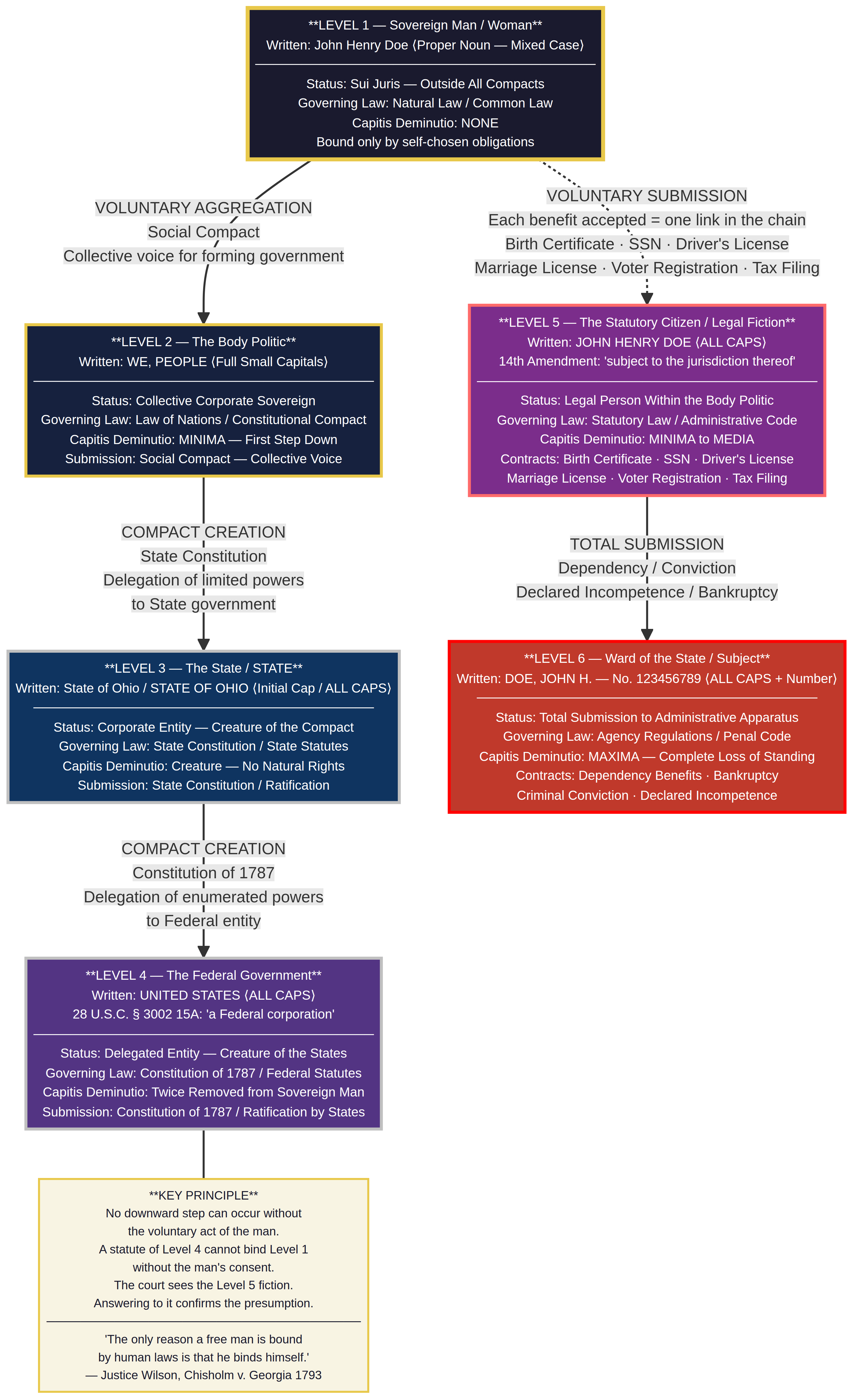
The architecture of this separation is not accidental. It is sequential, documented, and internally consistent. Each step builds upon the last, and each step is supported by primary sources that are on the face of the law.
The Lieber Code (1863) established the template: total governmental jurisdiction over all persons within the territory, by force if necessary, under conditions of military necessity as determined by the government itself [60]. The Code was never rescinded [61]. It established the precedent that the government could assert jurisdiction over the civilian population without their consent, and that the civilian courts, while nominally open, were subordinate to that assertion.
The 14th Amendment (1868) translated the Lieber Code’s territorial jurisdiction into constitutional form [62]. “Subject to the jurisdiction thereof” codified the presumption of jurisdiction over all persons born within the territory. The sovereign man was now presumed to be a statutory citizen, a legal person within the compact by birth. The mechanism of capitis deminutio, which in Roman law required an explicit act of status change, was now accomplished by the presumption of birth within the territory.
The Reconstruction Acts (1867) demonstrated that the Lieber Code’s framework could be applied to a civilian population despite Ex Parte Milligan [47, 48, 49]. The Supreme Court declined to intervene. The lesson was absorbed: the jurisdictional framework could be extended without formal military administration, as long as the civilian population accepted it or was given no practical alternative.
The Progressive Era and New Deal (1887–1938) created the infrastructure of the administrative state: the regulatory agencies, the federal reserve, the federal income tax, the social insurance programs. Each new program extended the reach of the federal zone into the daily lives of the population, framed not as a jurisdictional assertion but as a benefit, a protection, or a service.
The 1938 Consolidation closed the last independent forum. Erie Railroad Co. v. Tompkins abolished federal common law [43]. The Federal Rules of Civil Procedure merged law and equity into a single statutory “civil action” [44]. The common law court, the only forum in which a sovereign man could bring a natural law claim of trespass outside the statutory apparatus, was structurally eliminated. From that point forward, the only available courts were statutory courts, creatures of the entity, operating under the rules of the entity. The cage door was closed.
The Voluntary Contract Infrastructure (1935–present) completed the architecture. The Social Security Act (1935) created the enrollment mechanism [67]. The birth certificate registration system became the foundational act of capitis deminutio in the modern administrative system, the creation of the legal person who is subject to the jurisdiction of the State and, through the 14th Amendment, of the United States. The driver’s license, the federal tax return, the bank account, the mortgage, the student loan, the federal benefit each became a link in the chain of voluntary jurisdictional submissions that bound the sovereign man to the administrative apparatus without any act of force.
The Plausible Deniability Layer was built into the architecture from the beginning. The statutory definitions: Hooven’s three meanings of “United States” [17], 28 U.S.C. § 3002(15)’s “federal corporation” [18], 26 U.S.C. § 7701(a)(9)’s geographically limited “United States” [19] were placed on the face of the law where they were technically available to anyone who read carefully. The government could always say: the definitions were always there; the jurisdiction was always limited; the voluntary nature of the submissions was always disclosed. The terms of the contract were always in the fine print.
In the language of contract law and equity, what has been described above would, if brought before a truly neutral forum, raise serious questions under several well-established doctrines.
Fraud in the Inducement. A contract is voidable for fraud in the inducement when one party conceals or fails to disclose a material term that the other party would not have agreed to had it been disclosed [68]. The material term concealed in each benefit contract is the jurisdictional submission; the permanent reduction of the sovereign man’s natural standing to that of a legal person within the administrative apparatus, the foreclosure of common law remedies, and the submission to the jurisdiction of statutory courts that are creatures of the entity whose jurisdiction is being accepted. These are material terms. They are never disclosed at the point of acceptance of any benefit.
Unconscionability. A contract is unconscionable, and therefore unenforceable, when the bargaining power between the parties is so unequal that the weaker party had no meaningful choice but to accept the terms [69]. The bargaining power between a newborn through its parents, who are themselves already within the system, accepting a birth certificate, and the administrative state that created and administers the registration system, is so unequal as to render the contract void under ordinary contract law principles. The same analysis applies to every subsequent benefit contract: the practical consequences of refusal; exclusion from commerce, employment, banking, travel, and civil life are so severe as to render the “voluntary” nature of the acceptance illusory.
Lack of Informed Consent. A valid contract requires that both parties understand and agree to its material terms [70]. The jurisdictional submission embedded in each benefit contract is a material term that is never disclosed, never explained, and never agreed to with full knowledge. The ordinary person accepting a Social Security Number, a driver’s license, or a federal benefit has no knowledge of the Hooven tripartite framework, the capitis deminutio doctrine, or the jurisdictional consequences of the submission. The consent is not informed. It is not, in the full legal sense, consent at all.
Adhesion Contract. A contract of adhesion is one offered on a take-it-or-leave-it basis, with no opportunity for negotiation, by a party with superior bargaining power [71]. Every benefit contract in the administrative apparatus is an adhesion contract: the terms are set by the government, they are not negotiable, and the practical consequences of refusal are so severe as to make the “choice” to accept them effectively compelled. Courts have held that adhesion contracts are enforceable only when the weaker party had a meaningful alternative and the terms were not unreasonably oppressive [71]. Neither condition is met in the benefit contracts of the administrative apparatus.
Each of these doctrines is well established in contract law and equity. They are not exotic or fringe arguments. They are the ordinary tools of contract analysis, applied to an extraordinary set of facts.
The reason these contract law arguments cannot be raised effectively in a modern court is precisely the problem identified throughout this article: the courts are creatures of the entity whose jurisdiction is being contested. The “Child Catcher” with the candy (the inducement apparatus/government) is also the judge.
The statutory courts created by Congress and the State legislatures are not neutral forums for adjudicating claims against the entities that created them. They are, as established in this article, structurally incapable of providing a neutral forum for such claims. A court created by the United States cannot adjudicate a claim that the United States’ own jurisdictional apparatus is void for fraud, unconscionability, or lack of informed consent because to do so would be to adjudicate the validity of the court’s own jurisdictional foundation.
This is the deepest layer of the conundrum. The parity problem is not merely that the man and the entity are not on equal footing in the hierarchy of law. It is that the entity has constructed a system in which the man’s only available forum is one that the entity controls, operating under rules that the entity wrote, adjudicated by officers that the entity appointed, under a jurisdictional framework that the entity established through the very contracts whose validity the man is seeking to contest.
The common law court, the forum in which a sovereign man could bring a natural law claim of trespass before a jury of his peers, outside the statutory apparatus, was the structural solution to this problem. It was the forum that the hierarchy of law provided for the resolution of disputes between sovereign men, operating outside and above the compact. Its federal level abolition in 1938 was not a procedural reform. It was the removal of the last structural check on the administrative apparatus; the last forum in which the sovereign man’s natural standing could be asserted and recognized through the government that was formed to protect mankind and his property.
The man or woman who reads this article and traces each citation to its primary source will find that nothing stated here is asserted without support. The hierarchy of law is established by Chisholm v. Georgia [1] and Yick Wo v. Hopkins [2]. The nature of the body politic is established by Vattel [6], Blackstone [7], and Bouvier’s [8]. The three constitutional instruments are verified from the face of the Dunlap & Claypoole broadside [10] and the Peter Edes broadside [12]. Capitis deminutio is documented in Justinian’s Institutes [11] and Black’s Law Dictionary [25]. The Lieber Code is on the record as General Orders No. 100 [60] and was never rescinded or overruled by an act of Congress [61]. The 14th Amendment’s jurisdictional mechanism is confirmed by Elk v. Wilkins [62]. The abolition of federal common law is stated explicitly in Erie [43]. The three definitions of “United States” are in Hooven [17]. The “federal corporation” definition is in 28 U.S.C. § 3002(15) [18]. The voluntary contract mechanism is established by Insurance Corp. of Ireland [24] and the Social Security Act [67].
Every link in the chain is documented. Every citation is verifiable. The record is clear.
The man who is sovereign, who understands this architecture and has not voluntarily submitted to the jurisdiction of the administrative apparatus through the acceptance of benefits and privileges stands, in theory, in the position described by Justice Wilson in Chisholm v. Georgia in 1793:
“The only reason, I believe, why a free man is bound by human laws is that he binds himself.” [1]
He is bound by the laws of the compact only because he has consented to be bound. If he has not consented, if he has not accepted the benefits and privileges that carry jurisdictional submission as their price, then the compact does not reach him. He stands outside it, as the author stands outside the text.
Whether that position is practically achievable in the modern administrative state is a question that each man must answer for himself, in light of his own circumstances and his own understanding of the record. What this document has established is that the theoretical position is supported by the primary sources, the statutes, and the case law; and that the government’s own definitions, in its own statutes, confirm the limited nature of the jurisdiction it asserts and the voluntary character of the mechanism by which it extends that jurisdiction to reach the general population.
The sovereign man was not conquered. He was not enslaved by force. He was offered candy.
So too, when the wrongdoer is traced to his source, he must be found in the man. And when the sovereign is traced to his source, he must be found in the man as well; standing outside the compact, above the entity, prior to the law, and bound only by what he has chosen to bind himself to…

[1] Chisholm v. Georgia, 2 U.S. (2 Dall.) 419, 455-461 (1793) (Opinion of Wilson, J.).
[2] Yick Wo v. Hopkins, 118 U.S. 356, 370 (1886).
[3] Alexander Hamilton, The Federalist Papers, No. 78 (1788).
[4] James Wilson, Speech to the Pennsylvania Ratifying Convention (Nov. 24, 1787).
[5] Prohibitions del Roy, 12 Co. Rep. 63 (1607) (quoting Henry de Bracton, De Legibus et Consuetudinibus Angliae, c. 1250).
[6] Emer de Vattel, The Law of Nations, Preliminaries, §§ 1-2 (1758).
[7] William Blackstone, Commentaries on the Laws of England, Book I, Chapter 18 (1765).
[8] John Bouvier, A Law Dictionary, Adapted to the Constitution and Laws of the United States(1856 ed.) (definitions of “Body Politic”, “People”, “State”, “Person”, “Sui Juris”).
[9] Dred Scott v. Sandford, 60 U.S. (19 How.) 393, 404–407 (1857) (Opinion of Taney, C.J.).
[10] Dunlap & Claypoole Broadside of the Constitution (Sept. 19, 1787) (Library of Congress, Printed Ephemera Collection, bdsdcc.c0801).
[11] Justinian, Institutes, Book I, Title 16 (De capitis deminutione) (533 A.D.).
[12] Peter Edes Broadside of the Constitution with Rhode Island Ratification (May 29, 1790) (Library of Congress, Printed Ephemera Collection, rbpe.1670010a).
[13] Constitution of the United States, Article VII.
[14] National Constitution Center, The Day the Constitution Was Ratified(June 21, 1788, New Hampshire as ninth state).
[15] National Archives, The First Federal Congress(March 4, 1789, Federal Hall, New York City).
[16] National Archives, The Bill of Rights: A Transcription(Dec. 15, 1791 ratification).
[17] Hooven & Allison Co. v. Evatt, 324 U.S. 652, 671–672 (1945) (Stone, C.J.) (establishing the three definitions of “United States” and confirming that Congress is not subject to the same constitutional limitations when legislating for the federal zone as when legislating for the several States). Also cited in Black’s Law Dictionary (6th ed. 1990) at 1533 (reproducing the tripartite definition verbatim).
[18] 28 U.S.C. § 3002(15)(A) (Federal Debt Collection Procedures Act) (”’United States’ means — (A) a Federal corporation; (B) an agency, department, commission, board, or other entity of the United States; or (C) an instrumentality of the United States.”).
[19] 26 U.S.C. § 7701(a)(9) (”The term ‘United States’ when used in a geographical sense includes only the States and the District of Columbia.”); 26 U.S.C. § 7701(a)(10) (”The term ‘State’ shall be construed to include the District of Columbia, where such construction is necessary to carry out provisions of this title.”).
[20] Chevron U.S.A., Inc. v. Natural Resources Defense Council, 467 U.S. 837, 842–843 (1984) (courts must give effect to the unambiguous terms of a statute); United States v. Ron Pair Enterprises, Inc., 489 U.S. 235, 241 (1989) (”The plain meaning of legislation should be conclusive, except in the rare cases in which the literal application of a statute will produce a result demonstrably at odds with the intentions of its drafters.”).
[21] McCulloch v. Maryland, 17 U.S. (4 Wheat.) 316, 405 (1819) (Marshall, C.J.) (”This government is acknowledged by all to be one of enumerated powers.”); United States v. Lopez, 514 U.S. 549, 552 (1995) (”We start with first principles. The Constitution creates a Federal Government of enumerated powers.”).
[22] United States v. Bass, 404 U.S. 336, 349 (1971) (”Unless Congress conveys its purpose clearly, it will not be deemed to have significantly changed the federal-state balance.”); Gregory v. Ashcroft, 501 U.S. 452, 460 (1991) (applying the clear statement rule to statutes that would alter the federal-state balance).
[23] National Mutual Insurance Co. v. Tidewater Transfer Co., 337 U.S. 582, 611 (1949) (Jackson, J., concurring) (”Jurisdiction... may be conferred by consent.”).
[24] Insurance Corp. of Ireland v. Compagnie des Bauxites de Guinee, 456 U.S. 694, 703 (1982) (”The personal jurisdiction requirement... can... be waived, and... a party may submit to the jurisdiction of the court by voluntary appearance.”).
[25] Black’s Law Dictionary (defining the three degrees of capitis diminutio based on Roman civil law, citing Inst. 1, 16; Dig. 4, 5, 11).
[26] U.S. Const. amend. XIII (ratified December 6, 1865).
[27] U.S. Const. amend. XIV, § 1 (ratified July 9, 1868).
[28] Slaughter-House Cases, 83 U.S. (16 Wall.) 36, 71–72, 78–80 (1873) (Opinion of Miller, J.).
[29] Barron v. Baltimore, 32 U.S. (7 Pet.) 243, 247–251 (1833) (Opinion of Marshall, C.J.).
[30] Gitlow v. New York, 268 U.S. 652, 666 (1925).
[31] Wikipedia, Incorporation of the Bill of Rights — Provisions Not Incorporated (citing current Supreme Court precedent on unincorporated provisions of the Bill of Rights).
[32] U.S. Const. amend. IX (ratified December 15, 1791).
[33] U.S. Const. amend. X (ratified December 15, 1791).
[34] NLRB v. Jones & Laughlin Steel Corp., 301 U.S. 1 (1937); Wickard v. Filburn, 317 U.S. 111 (1942).
[35] Faretta v. California, 422 U.S. 806 (1975).
[36] Black’s Law Dictionary(definitions of “Sui Juris”, “Pro Se”, “Corporation”, “Person”).
[37] Ex Parte Young, 209 U.S. 123 (1908).
[38] United States v. Sherwood, 312 U.S. 584, 586 (1941).
[39] Federal Tort Claims Act, 28 U.S.C. §§ 1346, 2671–2680.
[40] Tucker Act, 28 U.S.C. § 1491.
[41] 42 U.S.C. § 1983 (Civil action for deprivation of rights).
[42] Bivens v. Six Unknown Named Agents, 403 U.S. 388 (1971).
[43] Erie Railroad Co. v. Tompkins, 304 U.S. 64, 78 (1938).
[44] Rules of Decision Act, 28 U.S.C. § 1652.
[45] Federal Rules of Civil Procedure (1938), Rule 2 (”There is one form of action — the civil action.”); Federal Judicial Center, History of the Federal Judiciary: The 1938 Federal Rules of Civil Procedure.
[46] Uniform Commercial Code, National Conference of Commissioners on Uniform State Laws and the American Law Institute (First published 1952, revised 1958).
[47] Uniform Vehicle Code, National Committee on Uniform Traffic Laws and Ordinances (First published 1926, driving state statutory traffic frameworks).
[48] Federal-Aid Highway Act of 1956, Pub. L. 84-627 (establishing the Interstate Highway System and the funding mechanisms used for state compliance).
[49] South Dakota v. Dole, 483 U.S. 203 (1987) (upholding federal funding conditionality to compel state adoption of uniform laws).
[50] Emergency Highway Energy Conservation Act, Pub. L. 93-239 (1974) (conditioning federal highway funds on state adoption of the 55 mph speed limit).
[51] Reception Statute, Black’s Law Dictionary (11th ed. 2019) (defining the statutory adoption of English common law by the states).
[52] West Virginia Code § 2-1-1 (preserving the common law of England).
[53] Code of Virginia § 1-200 (establishing the common law as the rule of decision).
[54] Scalia, Antonin, & Garner, Bryan A., Reading Law: The Interpretation of Legal Texts 2012) (detailing the canon that statutes in derogation of the common law are to be strictly construed).
[55] Ex Parte Milligan, 71 U.S. (4 Wall.) 2, 121–122 (1866) (Opinion of Davis, J.).
[56] Francis Lieber, Instructions for the Government of Armies of the United States in the Field (General Orders No. 100, April 24, 1863) (War Department, Adjutant General’s Office).
[57] Korematsu v. United States, 323 U.S. 214 (1944); Trump v. Hawaii, 585 U.S. 667, 710 (2018) (Roberts, C.J.) (”Korematsu was gravely wrong the day it was decided, has been overruled in the court of history, and — to be clear — ‘has no place in law under the Constitution.’”).
[58] Erie Railroad Co. v. Tompkins, 304 U.S. 64, 78 (1938).
[59] Federal Rules of Civil Procedure (1938), Rule 2 (”There is one form of action — the civil action.”).
[60] Francis Lieber, Instructions for the Government of Armies of the United States in the Field, General Orders No. 100 (War Department, Adjutant General’s Office, April 24, 1863), Arts. 1, 3, 6, 29, 31, 32. Reprinted in The Laws of Armed Conflicts (Dietrich Schindler & Jiri Toman eds., 4th ed. 2004).
[61] John Fabian Witt, Lincoln’s Code: The Laws of War in American History 235–238 (2012) (noting that General Orders No. 100 was never formally repealed by Congress and remained on the books as issued).
[62] U.S. Const. amend. XIV, § 1 (”All persons born or naturalized in the United States, and subject to the jurisdiction thereof, are citizens of the United States...”) (emphasis added); Elk v. Wilkins, 112 U.S. 94, 101–102 (1884) (interpreting “subject to the jurisdiction thereof” as requiring complete submission to the jurisdiction of the United States, not merely territorial presence).
[63] Reconstruction Acts, ch. 153, 14 Stat. 428 (March 2, 1867); ch. 6, 15 Stat. 2 (March 23, 1867); ch. 30, 15 Stat. 14 (July 19, 1867) (dividing the former Confederate States into five military districts and placing them under military administration).
[64] Ex Parte Milligan, 71 U.S. (4 Wall.) 2, 121–122 (1866) (Opinion of Davis, J.) (”Martial rule can never exist where the courts are open, and in the proper and unobstructed exercise of their jurisdiction.”).
[65] Mississippi v. Johnson, 71 U.S. (4 Wall.) 475, 501 (1867); Georgia v. Stanton, 73 U.S. (6 Wall.) 50, 77–78 (1867) (Supreme Court declining jurisdiction to enjoin enforcement of the Reconstruction Acts).
[66] Presidential Proclamation No. 11, 13 Stat. 763 (April 2, 1866) (Johnson declaring the insurrection at an end in most Southern States); Presidential Proclamation No. 157, 15 Stat. 711 (August 20, 1866) (Johnson declaring the insurrection fully suppressed); The Prize Cases, 67 U.S. (2 Black) 635, 666–667 (1863) (distinguishing between a state of war terminated by treaty and a domestic insurrection suppressed by executive action, noting that the legal consequences differ).
[67] Social Security Act, 42 U.S.C. § 401 et seq. (establishing the federal Social Security benefit program as a voluntary enrollment program); Flemming v. Nestor, 363 U.S. 603, 610 (1960) (holding that Social Security benefits are not a contractual entitlement but a statutory benefit, and that Congress may alter the terms of the program — confirming the benefit’s statutory rather than contractual character, while acknowledging the enrollment mechanism).
[68] Restatement (Second) of Contracts § 164 (1981) (”If a party’s manifestation of assent is induced by either a fraudulent or a material misrepresentation by the other party upon which the recipient is justified in relying, the contract is voidable by the recipient.”); Laidlaw v. Organ, 15 U.S. (2 Wheat.) 178 (1817) (Marshall, C.J.) (establishing the duty to disclose material facts in contract formation under American common law).
[69] Williams v. Walker-Thomas Furniture Co., 350 F.2d 445, 449 (D.C. Cir. 1965) (Wright, J.) (”Unconscionability has generally been recognized to include an absence of meaningful choice on the part of one of the parties together with contract terms which are unreasonably favorable to the other party.”); U.C.C. § 2-302 (codifying the doctrine of unconscionability in commercial contracts).
[70] Restatement (Second) of Contracts § 17 (1981) (”The formation of a contract requires a bargain in which there is a manifestation of mutual assent to the exchange and a consideration.”); Hotchkiss v. National City Bank of New York, 200 F. 287, 293 (S.D.N.Y. 1911) (Hand, J.) (”A contract has, strictly speaking, nothing to do with the personal, or individual, intent of the parties. A contract is an obligation attached by the mere force of law to certain acts of the parties, usually words, which ordinarily accompany and represent a known intent.”).
[71] Henningsen v. Bloomfield Motors, Inc., 32 N.J. 358, 390 (1960) (establishing the doctrine of adhesion contracts and holding that terms in a standard form contract that are unreasonably oppressive and offered without meaningful alternative are unenforceable); Steven v. Fidelity & Casualty Co. of New York, 58 Cal.2d 862, 882 (1962) (applying adhesion contract doctrine to insurance contracts offered on a take-it-or-leave-it basis).
No posts
Comments
Nothing yet. Say the first thing.
Sign in to join the conversation.