

From The Lord of the Rings:
‘I wish it need not have happened in my time,’ said Frodo. ‘So do I,’ said Gandalf, ‘So do all who live to see such times. But that is not for them to decide. All we have to decide is what to do with the time that is given to us.’
‘Many that live deserve death. And some that die deserve life. Can you give it to them? …, do not be too eager to deal out death in judgment. For even the very wise cannot see all ends.’
What time do we live? What is the answer for those who make these times worse? There are certain people who have already decided your fate and judgement. They have determined their purpose is an obligation to control everyone else or that someone else will beat them to that control. Through a framework of surveillance, one where we largely volunteered into its infrastructure, we are embarking on a path that may end with all your decisions being made for you, including when and how you die.
Can you keep it — not just the republic, but your freedom?
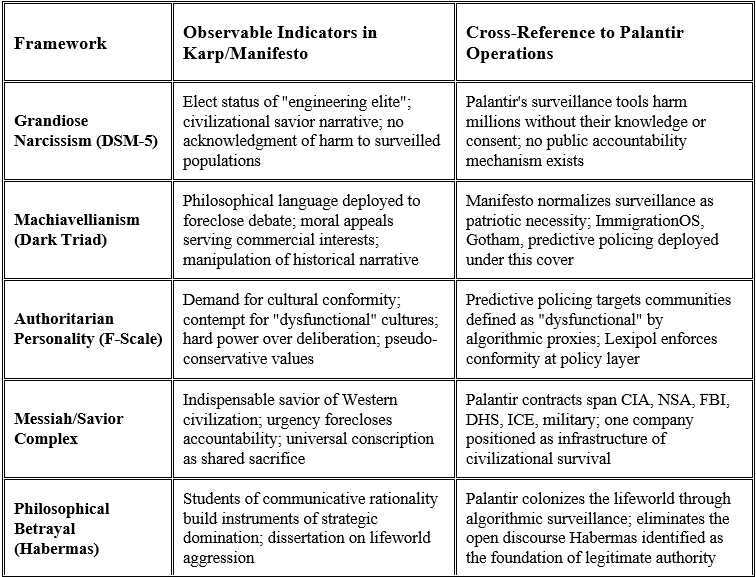
This document does not constitute a clinical diagnosis. No such determination can be made without direct clinical evaluation. What this analysis does is apply established psychological classification frameworks, specifically the Dark Triad (Paulhus & Williams, 2002) [1], Grandiose Narcissism (DSM-5, Narcissistic Personality Disorder criteria) [2], the Authoritarian Personality (Adorno et al., 1950) [3], and the Messiah/Savior Complex, to publicly documented behaviors, stated beliefs, and the ideological content of the manifesto, cross-referenced with Palantir’s actual operational identity as a universal surveillance corporation.
The analytical axioms remain constant throughout:
Creation Axiom: Mankind is a creation of the Creator who creates.
Guiding Principle: Do no harm to another of mankind unless in self-defense and protection of property, the highest right a man holds under natural law as articulated by Blackstone, Locke, Story, Vattel’s Law of Nations, and the Statutes at Large.
The Lexipol model: wherein a private limited liability corporation authors binding policy manuals adopted by over 3,000 law enforcement agencies across 35 states, effectively replacing legislative debate with proprietary corporate rules [4], serves as the structural parallel through which Palantir’s broader surveillance architecture must be understood. Both entities operate under color of law: the appearance of lawful authority exercised without actual constitutional or legislative foundation.
Before applying psychological frameworks, it is essential to establish the factual behavioral and biographical record.
Alexander Caedmon Karp was born in New York City in 1967 to a white father and a Black mother. He describes himself as having experienced a sense of vulnerability from an early age, being biracial, Jewish, and severely dyslexic. He earned a Bachelor of Arts in philosophy from Haverford College, a Juris Doctor from Stanford Law School (where he became close with Peter Thiel), and a doctorate in social theory from Goethe University Frankfurt, where he studied under Jürgen Habermas, Europe’s foremost living philosopher and the architect of communicative rationality, a theory that holds democratic discourse and mutual understanding as the foundation of legitimate society [5].
The biographical irony is profound and analytically significant: Karp studied under the philosopher who argued most forcefully that legitimate authority must be grounded in open, reasoned public discourse, and then built a company whose entire business model depends on the elimination of that openness through secret algorithmic surveillance of the public.
Documented behavioral observations from journalists, colleagues, and public record include the following:
Karp maintains concurrent long-term relationships with two women simultaneously, described by a colleague as “geographically monogamous.”
He has never learned to drive, stating: “I was too poor. And then I was too rich.”
He skis 12 to 15 miles daily and owns multiple homes selected exclusively for proximity to cross-country ski trails.
He regularly wears gear from an elite Norwegian ski team to which he has no connection.
He places his phone in a Faraday cage at home to block signals, citing Chinese intelligence.
In his most notorious job interview, he recited from memory a 1939 speech by Oswald Mosley, the British fascist leader, then performed tai chi moves and walked out without a word. The candidate was subsequently hired.
He stated in a 2013 Forbes interview: “The only time I’m not thinking about Palantir is when I’m swimming, practicing Qigong, or during sexual activity.”
He donated $180,000 to a New Hampshire hermit whose cabin burned down, described as “a gesture of solidarity, one introvert to another.”
He has publicly acknowledged that people call him “batshit crazy” and has used this characterization as a point of pride.
His salary was capped at $125,000 for years even as the company reached a $20 billion valuation, telling colleagues: “I only make money when you make money.”
His politics shifted dramatically after October 7, 2023, when he held a Palantir board meeting in Tel Aviv, visited the site of the Kfar Aza massacre, and signed a defense contract with Israel’s Ministry of Defense.
The manifesto’s language of “hard power built on software,” “addressing violent crime,” and “AI deterrence” is not abstract philosophy. It is a direct description of Palantir’s existing commercial and government product suite. Understanding the psychological profile of Karp requires understanding what he has actually built.
Palantir Gotham is the company’s flagship intelligence and law enforcement platform, deployed by police departments, the Department of Homeland Security, the NSA, the CIA, the FBI, and military intelligence agencies. It integrates disparate data sources, criminal records, social media, financial transactions, location data, surveillance footage, license plate readers, and more, into a unified analytical interface that allows operators to build comprehensive profiles of persons of interest and map their social networks [6].
Palantir Foundry is the civilian-facing version of the same architecture, deployed across healthcare systems, financial institutions, and government agencies to integrate and analyze population-level data.
ImmigrationOS, developed by Palantir under contract with Immigration and Customs Enforcement (ICE), is an AI system designed to track, profile, and facilitate the deportation of immigrants by aggregating data including Medicaid records, social security information, and location data [7]. The Electronic Frontier Foundation reported in January 2026 that ICE is actively using this tool, which feeds on Medicaid data to identify and locate people for arrest [8].
Predictive Policing: Palantir’s tools have been deployed by police departments to engage in predictive policing, the use of algorithmic probability scoring to identify persons likely to commit crimes before any crime has occurred. This directly eliminates the constitutional requirement of probable cause, replacing the Fourth Amendment’s protection against unreasonable searches with an algorithmic determination made by proprietary software whose methodology is hidden from public scrutiny, from courts, and from the people subject to its conclusions [9].
In April 2026, members of Congress, Representatives Goldman, Senator Wyden, and Representative Velázquez, formally demanded answers from ICE and DHS regarding Palantir’s collection of Americans’ personal data and its use to “fuel a mass surveillance” apparatus [10].
The Campaign Zero report of October 2025 explicitly identified Palantir as one of “the private companies quietly building a police state,” noting that it “builds data integration and surveillance and predictive policing tools into local law enforcement” [11].
This is the operational reality behind the manifesto’s elegant philosophical language. When Karp writes that:
“Silicon Valley must play a role in addressing violent crime,” he is not speaking abstractly. He is describing a product already deployed. When he writes that “hard power will be built on software,”
…he is describing a system already operational. The manifesto is not a vision statement, it is a justification document for infrastructure already in place.
Jürgen Habermas, Karp’s doctoral mentor, argued in his foundational work The Theory of Communicative Action (1981) that legitimate social order must be built on communicative rationality, the capacity of people to reach mutual understanding through open, uncoerced discourse [5]. Habermas drew a sharp distinction between communicative action (oriented toward understanding) and strategic action (oriented toward success, i.e., the manipulation of others to achieve one’s own ends).
For Habermas, the colonization of the lifeworld, the everyday sphere of human communication, culture, and social reproduction, by systems (the market and the state, operating through money and power) was the central pathology of modern society. The Frankfurt School’s critical theory, from which Habermas emerged, was explicitly a project of resistance against the technocratic reduction of human life to instrumental calculation.
Karp’s company, Palantir, is the most advanced operational embodiment of precisely what Habermas spent his career warning against. It colonizes the lifeworld through algorithmic surveillance, reduces every man and woman to a data point within a system of strategic calculation, and places the power of that system in the hands of a private corporation answerable not to the people but to its shareholders and government clients. The student has not merely departed from the teacher’s philosophy, he has industrialized its antithesis.
Karp’s doctoral dissertation at Frankfurt was titled Aggression in the Lebenswelt, “Aggression in the Lifeworld.” The irony is complete: the man who wrote academically about aggression within the sphere of human social life went on to build the most sophisticated tool of state aggression against that same sphere ever created by a private corporation.
The DSM-5 defines Narcissistic Personality Disorder as a pervasive pattern of grandiosity, need for admiration, and lack of empathy, manifesting in at least five of nine specific criteria [2]. The grandiose subtype, as distinguished from the vulnerable subtype, is characterized by overt superiority, dominance, entitlement, and a belief in one’s unique mission or destiny.
The manifesto and documented behaviors exhibit multiple indicators consistent with this framework:
Grandiosity and Sense of Special Mission: The manifesto’s framing of Silicon Valley as having a “moral debt” and an “affirmative obligation” to the nation positions Karp and his engineering class as uniquely chosen stewards of civilization’s survival. This is not a policy argument, it is a declaration of elect status. The claim that “AI weapons are inevitable” and that the only question is “who will build them” positions Palantir, and by extension Karp, as the indispensable actor in the survival of Western civilization.
Entitlement: The assertion that “public servants need not be priests”, that government should compensate like a corporation, reflects an entitlement framework in which the market logic of private enterprise is the only legitimate standard of value. The implicit corollary is that Palantir’s private model of governance is superior to democratic public administration.
Lack of Empathy: The manifesto contains no acknowledgment of the harm caused by Palantir’s surveillance tools to the people subjected to them. The millions of persons whose data is aggregated, whose movements are tracked, whose immigration status is fed into ImmigrationOS, whose communities are subjected to predictive policing algorithms, none appear in the manifesto’s moral universe. The document is entirely self-referential: the concerns are those of the “engineering elite,” the “public figures” deserving of “grace,” and the civilization requiring “hard power.”
Preoccupation with Fantasies of Unlimited Power: The manifesto’s call to “undo the neutering of Germany and Japan,” to move away from an all-volunteer military force, and to build “AI deterrence” to replace the atomic age reflects a preoccupation with civilizational-scale power that goes far beyond any legitimate corporate or policy interest. These are the fantasies of a man who sees himself as shaping the destiny of nations.
Belief in Own Uniqueness: Karp’s public statements consistently position him as a singular figure, a philosopher-CEO who is simultaneously too intellectual for Silicon Valley and too pragmatic for academia, too left for the right and too right for the left. This self-constructed uniqueness is a hallmark of grandiose narcissism: the subject exists outside all ordinary categories precisely because they are extraordinary.
Machiavellianism, as defined by Paulhus and Williams, is characterized by manipulativeness, indifference to morality, lack of empathy, and a calculated focus on self-interest [1]. High Machs are distinguished from psychopaths by their capacity for long-term strategic planning rather than impulsive action.
The manifesto is a Machiavellian document in its structure. It employs philosophical language, historical references, and moral appeals not to arrive at truth but to achieve a strategic outcome: the normalization of Palantir’s surveillance architecture as a patriotic and civilizational necessity. Consider the following rhetorical moves:
The invocation of “moral debt” (Point 1) is not a moral argument, it is a manipulation. It converts the voluntary existence of a corporation into a conscripted obligation, foreclosing debate by framing non-compliance as moral failure. The claim that “our adversaries will not pause for debate” (Point 5) is a classic Machiavellian foreclosure of deliberation: it removes the space for communicative rationality, the very thing Karp’s mentor Habermas built his life’s work defending, and replaces it with the urgency of strategic necessity. The appeal to “show grace to public figures” (Point 9) is a manipulation designed to insulate Karp and his class from accountability. The condemnation of “hollow pluralism” (Point 22) is a manipulation that frames constitutional protection of diverse peoples as a weakness to be overcome.
Each of these moves serves Palantir’s commercial and political interests. The manifesto does not argue for truth, it argues for the conditions under which Palantir’s business model becomes not merely acceptable but morally required.
Adorno, Frenkel-Brunswik, Levinson, and Sanford’s landmark 1950 study The Authoritarian Personality identified a cluster of traits associated with susceptibility to fascist ideology and authoritarian leadership [3]. The F-scale (Fascism scale) measured nine components, several of which are directly observable in the manifesto’s content:
Conventionalism: The rigid adherence to conventional middle-class values. The manifesto’s condemnation of “dysfunctional and regressive” cultures (Point 21) and “hollow pluralism” (Point 22) reflects a demand for cultural conformity to a standard defined by the powerful.
Authoritarian Submission: A submissive, uncritical attitude toward idealized moral authorities of the in-group. The manifesto demands that Silicon Valley submit to the authority of national defense imperatives and that the public submit to the authority of the “engineering elite.”
Authoritarian Aggression: The tendency to be on the lookout for, and to condemn, reject, and punish people who violate conventional values. The manifesto’s framing of “dysfunctional” cultures, its call to “address violent crime” through corporate surveillance, and its demand to “undo the neutering” of formerly aggressive nations all reflect this pattern.
Anti-Intraception: Opposition to the subjective, the imaginative, the tender-minded. The manifesto’s dismissal of “soaring rhetoric” (Point 4), its condemnation of the “psychologization of politics” (Point 10), and its demand to “rebel against the tyranny of apps” (Point 2) all reflect a contempt for the inner life and for the kind of reflective, communicative engagement that Habermas championed.
Power and Toughness: Preoccupation with the dominance-submission dimension; identification with power figures; emphasis on the conventionalized attributes of the ego. The manifesto’s entire framework is organized around “hard power,” military dominance, AI weapons, and the assertion that “free societies require hard power.”
Destructiveness and Cynicism: Generalized hostility, vilification of the human. The manifesto’s assertion that “not all cultures are equal” (Point 21) and its framing of certain cultures as “dysfunctional and regressive” reflects a cynical, hierarchical view of mankind that is incompatible with the natural law principle that all men are created by the same Creator.
Adorno made a critical distinction between “genuine conservatives” and “pseudo-conservatives”, arguing that the latter misuse conservative values to promote authoritarianism. The manifesto exhibits this pseudo-conservative pattern precisely: it invokes freedom, democracy, and national security while advocating for conscription, corporate surveillance, AI weapons, and the remilitarization of pacifist nations.
The Messiah complex, as described in psychological literature, involves a state in which a person believes they are destined to save or redeem society, that they possess unique insight and capacity unavailable to ordinary people, and that the urgency of their mission justifies extraordinary means [12].
The manifesto is saturated with salvific language. Silicon Valley must “defend the nation.” AI weapons must be built to prevent civilizational collapse. The “engineering elite” has an “affirmative obligation.” The “atomic age is ending” and a new era must begin, one built by people like Karp. Germany and Japan must be re-armed. The all-volunteer military must be replaced with universal conscription so that “everyone shares the risk” of the wars that Karp’s company’s software will help plan and execute.
This is not a policy platform. It is a redemption narrative in which the author and his class are the indispensable saviors of Western civilization. The Messiah complex is particularly dangerous when combined with the resources and institutional power that Karp commands: Palantir’s contracts span the CIA, NSA, FBI, DHS, ICE, the U.S. Army, the U.S. Air Force, and the defense ministries of multiple allied nations. A man who believes he is saving civilization and who controls the surveillance infrastructure of that civilization is not subject to the ordinary checks of democratic accountability.
The Lexipol model and the Palantir model are two components of the same corporate police state architecture, operating at different layers of the enforcement stack.
Lexipol operates at the policy layer: it writes the rules that govern how police officers behave, when to use force, how to conduct stops, whether to enforce immigration law, without legislative authorization, without public input, and under a proprietary copyright that prevents public scrutiny of the policies that govern the use of state violence against the people [4]. As the Texas Law Review documented, Lexipol now authors the policies of more than 3,000 public safety agencies across 35 states, with 95% of California law enforcement agencies operating under its privately authored manuals.
Palantir operates at the intelligence and targeting layer: it provides the data infrastructure that tells police officers who to target, where to find them, and what their social networks look like, again without legislative authorization, without public input, and under proprietary algorithms that cannot be examined, challenged, or cross-examined in a court of law.
Together, these two corporate entities, one writing the rules of engagement, the other identifying the targets, constitute a complete corporate police state apparatus that operates entirely outside the constitutional framework of the Republic. Neither entity is elected. Neither is subject to the legislative process. Neither can be held accountable through the ordinary mechanisms of democratic governance. Both operate under color of law: the appearance of lawful authority derived from government contracts, without the constitutional foundation that would make that authority legitimate.
The manifesto’s Point 17, “Silicon Valley must play a role in addressing violent crime, as many politicians have abandoned serious efforts”, is the clearest statement of this agenda. It explicitly advocates for the substitution of corporate technological power for democratic legislative governance in the domain of public safety. This is not a suggestion. It is a description of what Palantir is already doing.
Under the natural law framework, this constitutes a fundamental violation of the principle that no man may harm another without cause. Predictive policing harms people, it subjects them to surveillance, targeting, and enforcement action, on the basis of algorithmic probability, not demonstrated harm. It punishes the thought, the association, the location, and the data profile rather than the act. It is, in the most precise natural law sense, the imposition of harm without the justification of self-defense or protection of property.
The deepest contradiction in Karp’s public persona is this: he is a man trained in the tradition that most rigorously analyzed and condemned the very system he has built.
Habermas argued that the colonization of the lifeworld by systems of money and power was the central crisis of modernity. The Frankfurt School, Adorno, Horkheimer, Marcuse, Fromm, spent decades analyzing how instrumental reason, when unchecked by communicative rationality, produces authoritarianism, surveillance, and the reduction of persons to objects of administrative management.
Karp absorbed this tradition at the doctoral level. He wrote his dissertation on aggression within the lifeworld. And then he built the most powerful instrument of lifeworld colonization in human history: a surveillance platform that reduces every man and woman to a data object within a system of strategic calculation, operated by a private corporation, deployed by state agencies, and justified by a manifesto that dismisses debate as weakness and calls caution “corrosive.”
The psychological literature on the Dark Triad notes that Machiavellianism is distinguished from simple psychopathy by its capacity for long-term strategic planning and its use of intellectual frameworks to achieve self-interested ends [1]. The manifesto is precisely this: a sophisticated intellectual framework deployed in service of the strategic interests of a surveillance corporation. The philosophy is real, Karp genuinely absorbed it, but it has been inverted and weaponized. The tools of critical theory have been turned against the people critical theory was designed to protect.
The title The Technological Republic is the most revealing phrase in the entire manifesto. Plato’s Republic was built on the concept of the philosopher-king: the individual of superior intellect and virtue who, by virtue of that superiority, was entitled to rule without the consent of the governed. The philosopher-king did not need democratic accountability because his wisdom was self-evidently superior to the wisdom of the people.
Karp is presenting himself, and his class of “engineering elites”, as the philosopher-kings of the technological age. The manifesto is the philosophical justification for their rule. The surveillance infrastructure is the mechanism of their governance. The Lexipol policy manuals are the rules their subjects must follow. The AI weapons are the enforcement arm of their deterrence.
Under the natural law framework established at the outset of this analysis, this entire architecture is illegitimate. Mankind is created by the Creator who creates. The highest right of a man is the protection of his person and property from harm. No corporation, no algorithm, no manifesto, and no philosopher-king has the authority to override that right. The Technological Republic is not a republic. It is a surveillance oligarchy dressed in the language of philosophy, and the man writing the manifesto likely knows exactly what Habermas would say about it.

[1] Paulhus, D. L., & Williams, K. M. (2002). The Dark Triad of personality: Narcissism, Machiavellianism, and psychopathy. Journal of Research in Personality, 36(6), 556–563. https://en.wikipedia.org/wiki/Dark_triad
[2] American Psychiatric Association. (2013). Diagnostic and Statistical Manual of Mental Disorders (5th ed.). Narcissistic Personality Disorder criteria. https://www.psychiatry.org/news-room/apa-blogs/what-is-narcissistic-personality-disorder
[3] Adorno, T. W., Frenkel-Brunswik, E., Levinson, D. J., & Sanford, R. N. (1950). The Authoritarian Personality. Harper & Row. https://en.wikipedia.org/wiki/Authoritarian_personality
[4] Eagly, I. V., & Schwartz, J. C. (2018). Lexipol: The Privatization of Police Policymaking. Texas Law Review, 96(5). https://texaslawreview.org/lexipol/
[5] Habermas, J. (1984). The Theory of Communicative Action, Vol. 1: Reason and the Rationalization of Society. Beacon Press. https://en.wikipedia.org/wiki/The_Theory_of_Communicative_Action
[6] Privacy International. (2021). All Roads Lead to Palantir: A Review of How the Data Analytics Company Operates. https://privacyinternational.org/sites/default/files/2021-11/All%20roads%20lead%20to%20Palantir%20with%20Palantir%20response%20v3.pdf
[7] American Immigration Council. (2025, August 21). ICE to Use ImmigrationOS by Palantir, a New AI System to Track Immigrants. https://www.americanimmigrationcouncil.org/blog/ice-immigrationos-palantir-ai-track-immigrants/
[8] Electronic Frontier Foundation. (2026, January 15). Report: ICE Using Palantir Tool That Feeds On Medicaid Data. https://www.eff.org/deeplinks/2026/01/report-ice-using-palantir-tool-feeds-medicaid-data
[9] AICERTS. (2024). Predictive Policing Ethics Under Palantir Scrutiny. https://www.aicerts.ai/news/predictive-policing-ethics-under-palantir-scrutiny/
[10] Goldman, D., Wyden, R., & Velázquez, N. (2026, April 16). Goldman, Wyden, Velázquez Demand Answers on ICE Use of Palantir-Developed Technologies. https://goldman.house.gov/media/press-releases/goldman-wyden-velazquez-demand-answers-ice-use-palantir-developed-technologies
[11] Campaign Zero. (2025, October 2). The Private Companies Quietly Building a Police State. https://campaignzero.org/the-private-companies-quietly-building-a-police-state/
[12] Wikipedia. Messiah Complex. https://en.wikipedia.org/wiki/Messiah_complex
No posts
Comments
Nothing yet. Say the first thing.
Sign in to join the conversation.