
The other day I opened my phone to check my work email and ended up scrolling my way down a deep Instagram rabbit hole. Without even realizing what was happening, I went from heartwarming World Cup clips (have you seen how the Japanese fans stay to clean up stadiums?) to a montage of people doing random acts of kindness for perfect strangers, to a singing duo performing the most spectacular harmony for prisoners at the Chesterfield County Jail. Reader, I cried.
Needless to say, this wasn't the best use of my time. It happens to all of us, and it's not really our fault - Big Tech has carefully engineered the attention economy to keep us on the apps for as long as possible. The longer we’re distracted, the more they profit. It feels bleak, but we're not powerless. We can't fix the system alone, but we can change how we move through it — and that starts with setting better boundaries and getting creative about how we live alongside our devices. These books can help:
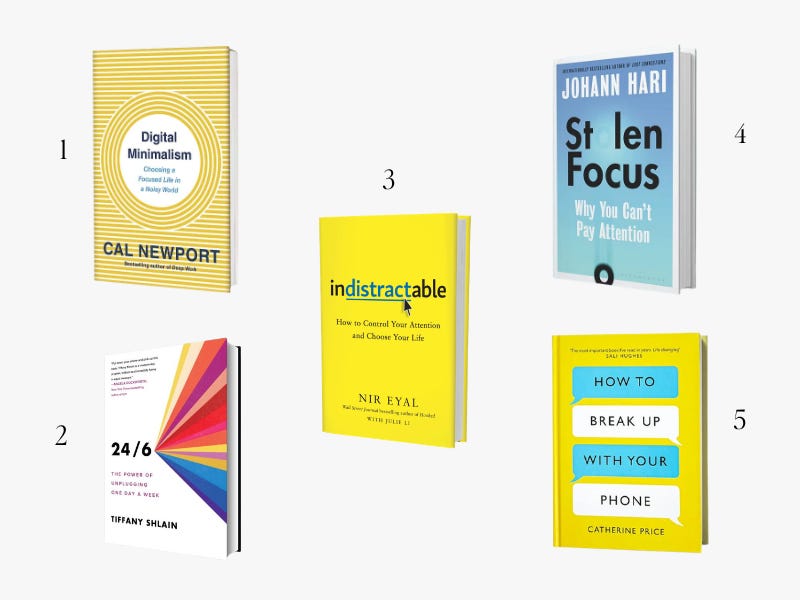
Cal Newport makes the case for intentional, minimalist technology use rather than reactive scrolling, arguing most people would be happier using far fewer digital tools far more deliberately. He offers a 30-day “digital declutter” process to help readers rebuild their relationship with tech from the ground up. I also love Newport’s newer book Slow Productivity.
Key point: Most apps don’t deserve a permanent spot in your life. An intentional tech break can help clarify what is adding value versus distraction.
Try this: Delete one app you use out of habit, not need. Wait 30 days before deciding if you'd like to reinstall it.
Digital Minimalism - Get the Book
Tiffany Shlain shares her family’s practice of a weekly “tech Shabbat” — one full day a week completely unplugged — and the surprising effects it had on creativity, relationships, and presence. It’s part memoir, part manifesto for building rest and reflection into a hyperconnected life.
Key point: You don't need a permanent detox — even one full day a week of being unplugged can transform how you think, create, and connect.
Try this: Pick one day (or even one evening) a week to go fully offline. Put it on the calendar like an appointment and honor it.
Nir Eyal, who previously wrote about how products are engineered to hook users, flips the lens to show readers how to build psychological defenses against distraction. This one is a tactical, research-backed toolkit rather than a call to unplug entirely.
Key point: Distraction is usually a symptom — it’s your brain’s way of avoiding some form of discomfort.
Try this: Next time you reach for your phone mid-task, pause and name what you’re actually trying to avoid or escape.
Johann Hari argues that the modern attention crisis isn’t a personal failing but the result of systemic forces (from tech design to work culture) undermining our ability to concentrate. He blends interviews with scientists and experts to make the case that reclaiming focus requires collective, not just individual, change.
Key point: Your attention span didn’t just decline — it was engineered to. Reclaiming it means replacing tech distractions with real sources of meaning, purpose, and flow.
Try this: Turn off autoplay everywhere you can (YouTube and Netflix let you fully disable it; Instagram limits it under Data usage settings) — then use that reclaimed time for one thing that actually puts you in flow: a hobby, deep work, a real conversation.
Catherine Price frames phone dependency as a relationship gone wrong, complete with a 30-day breakup-and-makeup plan to reset how you use your device. It’s practical and workbook-like, with concrete exercises rather than just theory.
Key point: You don’t need to break up with your phone forever — just renegotiate the relationship.
Try this: Move all social and news apps off your home screen. Make yourself take one extra step to open them.
How to Break Up With Your Phone - Get the Book
Dopamine Nation by Anna Lembke — the neuroscience/addiction angle, useful if readers want to understand the biology behind compulsive tech use
The Shallows by Nicholas Carr — an earlier, foundational look at how the internet is reshaping how we think and read
The Joy of Missing Out by Christina Crook — a gentler, more philosophical take on presence and intentional living
The Distraction Addiction by Alex Soojung-Kim Pang — focuses on “contemplative computing” and working with technology not against it
Attention Span by Gloria Mark — research-driven, from a psychologist who’s studied attention and interruption for over a decade
Of course, I'm a huge work in progress here, but these books have given me a new way to think about creating friction, setting digital boundaries, and prioritizing life beyond my devices. Also, just reading them got me off my phone for huge blocks of time. A very happy accident.
Reader Prompt: What’s been most helpful to you when it comes to unplugging and reclaiming focus? Can we find each other in the comments to share additional books, resources, tools, and tips?

SF Bay Area Event: Locals! Come meet me at The Hivery on 9/29 for a fun night out and panel discussion about Substack, entrepreneurship, and creativity - tickets and info here
Fun Feature: Your Home Might Be Secretly Impacting Your Mood via Real Simple
Watching: The Man Will Burn on HBO traces how a scrappy counter-cultural ritual became a global phenomenon (I live for a well produced docu-series!)
Capsule Wardrobe Wishlist: Eyeing these woven blush ballet flats and this dreamy taupe handbag (I’m down to just 2x bags total so this may be a future investment piece!)

Work With Me — 1:1 Mentorship, home organizing, courses and consults, all in one place. Explore offerings →
Shop My Favorites — Fewer, better faves for home, life, and wardrobe. See the recs →
My Books — Actionable strategies to clear clutter and elevate your life. Get the books →
Comments
Nothing yet. Say the first thing.
Sign in to join the conversation.