
Hi friend,
I have a few announcements before we enter our grappling together. I have three new poems in The Rumpus: an ode to my first week with my wife, an ode to the relentless generosity of Palestinians, and a sonnet that functions as a racy selfie. My global online creativity course, In Surreal Life, closed out its January session with a bang a few days ago and is already taking “Early Bird” registrants for our April (National Poetry Month) session. We’re still finalizing our Visiting Artist roster but I can hint (for those of you perusing the titles of 2026 book releases) that it’s going to be “holy” and “canonical.” As always, I encourage you to donate to my friends in Palestine, young journalist Mahmoud’s family and fellow poet Ahmed’s family. Just days ago Ahmed’s wife Remah wrote about their daughter, “Who loaded Maryam's head with what she cannot bear? Who stole the basics from her childhood? O world… answer!” There are over 4,000 people that now read this Substack (thank you!) and I feel I must advocate that if even half of my readers gave $5 today to each family, you would raise $10,000 per family. Thank you for being here, truly, and for whatever you can contribute. From Palestine to Minnesota to Sudan, we are all neighbors. We are all connected. Despite the government’s vile agenda, I believe that we can strengthen our connection every single day.
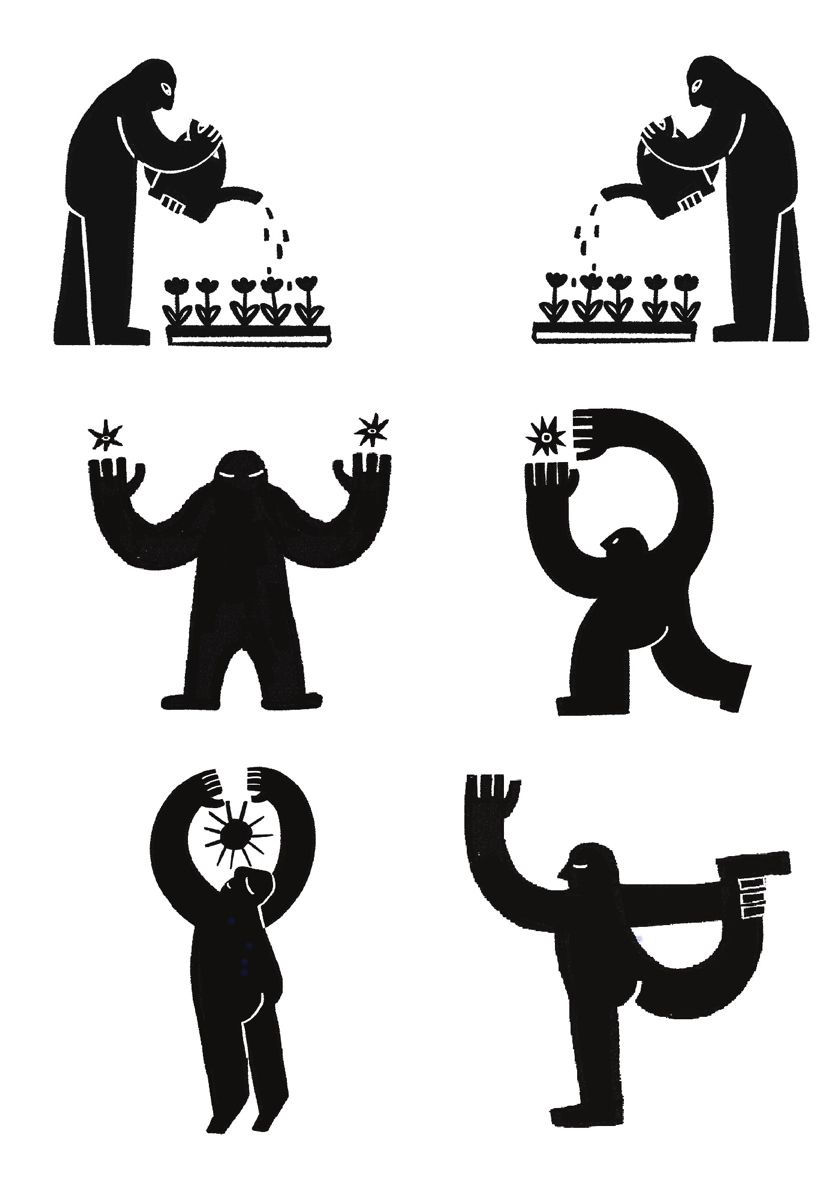
I feel incredibly scrambled these days. I walk into a room looking for something and can’t for the life of me remember what I came in there for. I sit down at my desk to answer an email and wake up mid-scroll thinking, When did I pick up my cell phone? When the work day is done I settle in front of a documentary about mountain climbers (Meru, 2015) but every now and again I feel that distinct pang to check Instagram, my inbox, play Tetris on my phone, etcetera. I know I’m not unique in this. I’ve been trained by my apps to dissipate my attention, to crave a quick hit of dopamine at the expense of (God forbid) boredom or the least bit of restlessness.
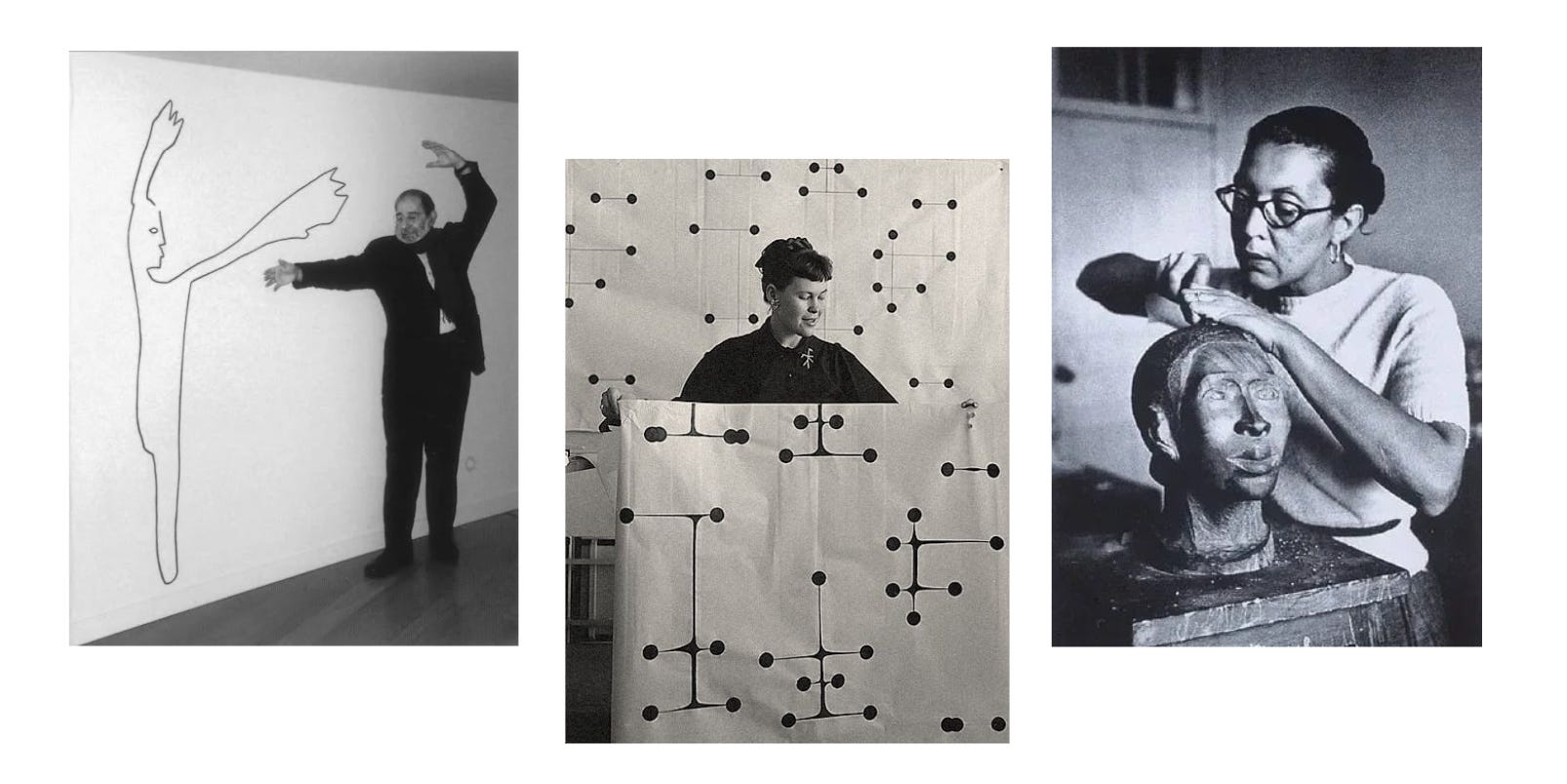
If you’ve been following along on my dispatches since 2022, you’ve noticed that my strengths ride this same line: not distraction, but dispersal. I’m interested in and moved by a lot of things. Art. Buddhism. Ethics. Mental illness. The Mystery/The Divine. They overlap. Even at their distances and disparities, they seem to speak to each other. I’ve long been told I’m a connector, able to make links between seemingly unrelated things, the calling of a poet one might say. Last month I wrote about fragments and parataxis as a poet’s particular tools for sense-making (or sense-allowing).
At the end our work days, my wife and I have been screening movies on our projector in the living room. The other day we made the bold decision to watch Werner Herzog’s documentary “Grizzly Man” (I’m still having nightmares). Speaking about Timothy Treadwell’s (the protagonist’s) ultimately fatal belief that he and the bears he followed in the wild had a transcendent understanding, Herzog says, “And what haunts me, that in all the faces of all the bears that Treadwell ever filmed, I discover no kinship, no understanding, no mercy. I see only the overwhelming indifference of nature…And [their] blank stare speaks only of a half-bored interest in food…I believe the common denominator of the universe is not harmony, but chaos, hostility, and murder.”
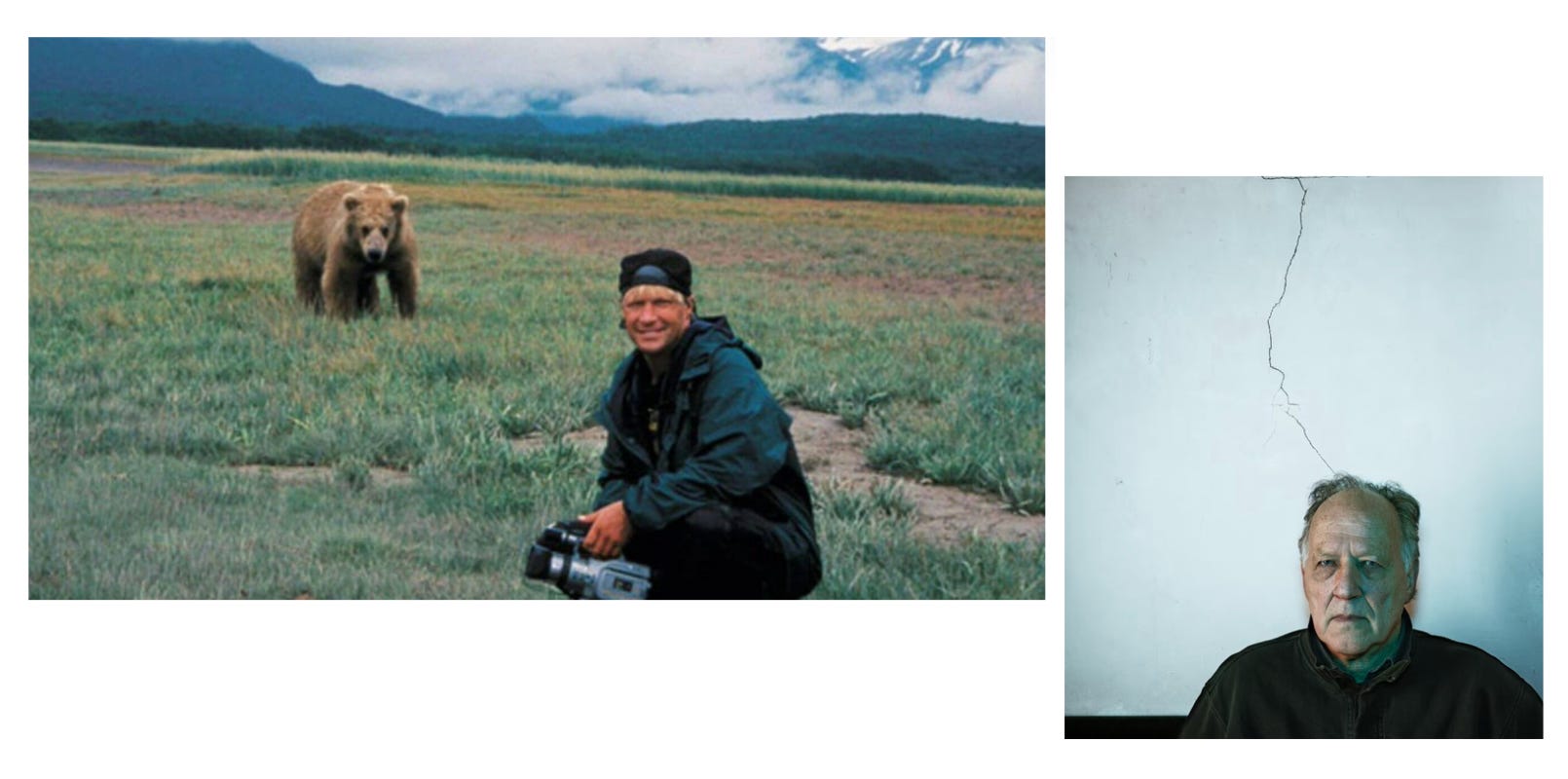
When it comes to the law and fiber of universal order, Treadwell, a self-proclaimed wilderness “master” who cooed “I love you” to ten-foot bears is on one end of the spectrum. Meanwhile, Herzog is on the other end where “chaos, hostility, and murder” reign. And where do you find yourself on this spectrum?
I’ve long been obsessed with this simple four word question: How do we live? And its secret center: What is this universe really asking from me? How does the universe’s integrity (or seeming lack thereof) influence my own integrity?
Thanks for reading Freer Form by Shira Erlichman! This post is public so feel free to share it.
Now, admittedly, we’re sitting thick inside a binary: Treadwell’s optimism (some might say naivety) vs. Herzog’s pessimism (some might argue realism). Nature as cooed to and dominable vs. a cold, hostile, indifferent chaos. I’ve learned from decades of therapy that black and white (either/or) thinking is often a symptom of insecure attachment, anxiety, deep fear, or all three. No matter where either/or thinking stems from, it can point to a person’s reactive state and a lack of capacity for grey area.
For better or worse, I’m usually on the Treadwell side of the equation. I grew up culturally but not religiously Jewish, with hand-me-down Buddhist principles from my mother’s bookshelves. I marinated in the liberalish values of my hometown of Brookline, Massachusetts, and at sixteen years old attended a fortuitous lecture by Thich Nhat Hanh at Harvard where his ethos and presence suffused the auditorium with an admirable peacefulness and left an impression on me. In those pre-teen and teen years I dosed up on ideas of the universe as worthy of deep awe by reading Mary Oliver and Rumi. I was a young white girl discovering her queerness alongside Ani Difranco records. I protested the Iraq War and joined a walk out in protest of my state’s standardized testing. I was physically disturbed by the injustices unfolding around me and longing to find my place in resisting them.
But, I can see now, at my core I felt that these injustices were fringe human behaviors; not, as Herzog says, “the common denominator.” My quickly budding Buddhist education supported this: Everyone has Buddha nature; everyone can become liberated; believe in your own transformation as wholeheartedly as you do the transformation of others; study the three poisons (hate, greed, delusion) and you’ll see that they are to blame for all unwholesome human actions; but as the Buddha taught and exemplified even they can be uprooted with insight and effort.
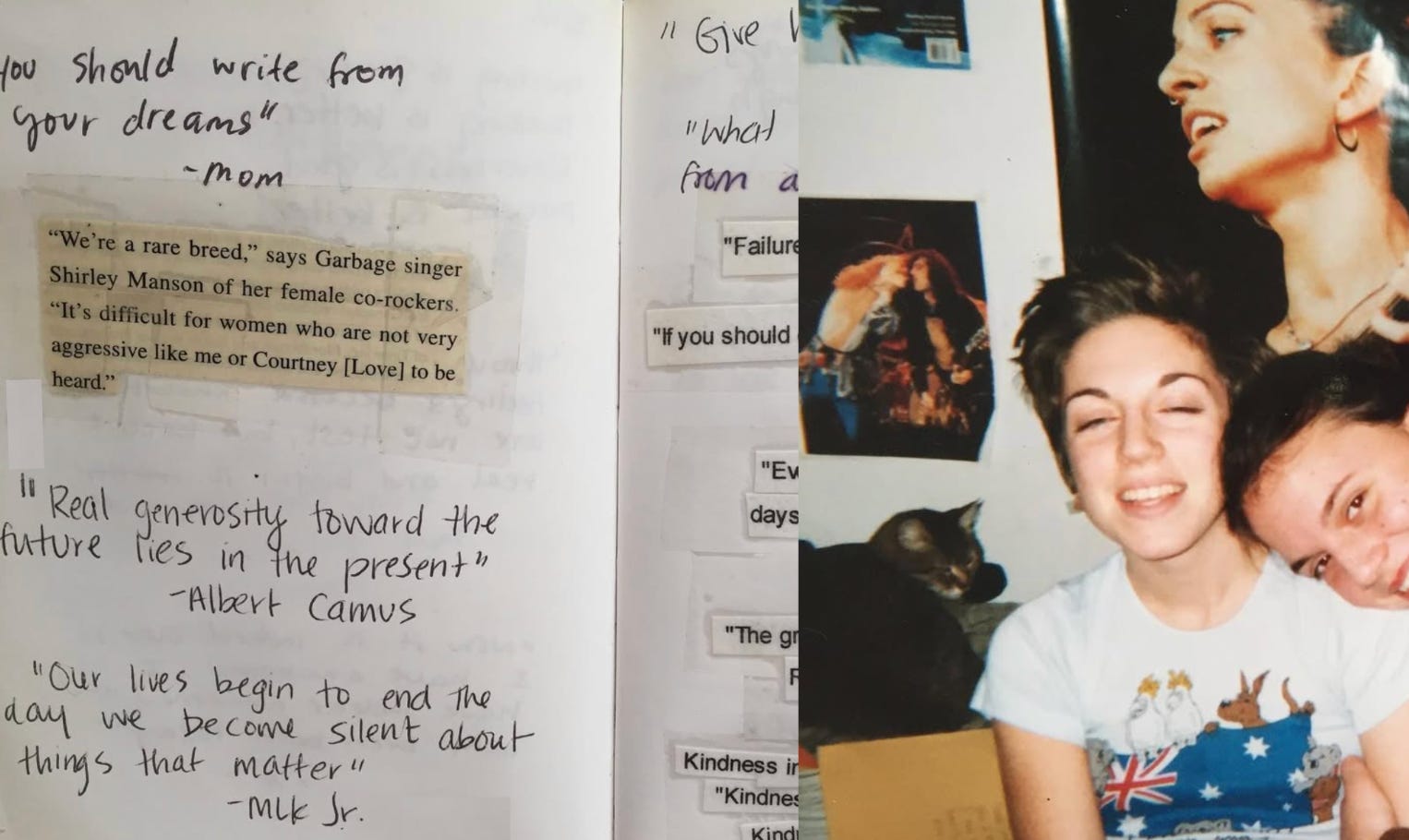
As I got older, it got harder to label humanity’s sickest behaviors as “fringe.” It got harder to maintain a tidy ethos centralized on an inherent order premised on awe, beauty, and goodness. At Twenty-two years old, I experienced a life-changing event when I came face to face with the chaotic reality of my inherited illness, Bipolar Disorder. In a decade of multiple hospitalizations, I came to see that Herzog might have some points. My world tilted on its axis. Whereas I once naively thought I could, like Treadwell, coo to a beast or, like Oliver, wander a wild world with awe or, like Rumi, tip-toe on the jagged line between God and mania, my mind slammed me into a helplessness I couldn’t outwit. My mind was not what I thought it was. Have you too had this chilling initiation? If my mind could vault me into a mental hospital through a variety of tricks and coos of its own, who was in charge here? I could no longer step into the world as the same young woman. I immersed myself in intensive therapy and dedicated my first poetry book to how I was fundamentally altered by mania’s lessons, the delusion that I could beat my illness, and a profound wrestling with my identity (I couldn’t be sick. I had to find a way out of this. This, being me, my mind.) This awakening around my illness was a major contributor to sliding down the spectrum of order vs. chaos, awesome vs. awful, God vs. whothefuckknowswhatsevenhappening.
In the same era I came into deepening consciousness around my whiteness, which had given me the simple and lived notion of personal safety and access; say, that if I got lost in a new neighborhood, there would always be some stranger who could shepherd me in the right direction. But life seeped in. Violence crowded my mind. The news. Police brutality (what a tame phrase.) Oscar Grant just trying to get home. How could I account for this perceived sense of safety (people will generally help!) with outright and consistent violations of this safety for people that didn’t look like me? It’s not as if I slid from one pole to the other: the world is entirely safe to the world is entirely unsafe. Simply put, the more I looked around and faced what I saw, the more my certainty about safety and order was dislodged, and the more I felt a responsibility toward creating a safer world for all.
The Buddha taught that the root of boredom is anger. When I’m bored, numb, exhausted, or simply craving a “hit” from an app, I find that there is, indeed, an anger inside me that my mind cannot stand. This anger is unresolvable and non-stop. Do you remember Biden licking his ice cream cone two years ago nearly to the date while docilely declaring, “My hope is by next Monday we'll have a ceasefire”? The people in power demonstrate no empathy and no imagination. They are, it is without the trace of a doubt now, moving within rings of conspiracy whose details make any ordinary person’s stomach churn. These are not unprecedented times. They have happened before with other powerful men at the helm and other ordinary people trapped in the clutch of such brutality. Still, we are the ones who are here right now to face it. We are the ones.
How do we live? What is this universe really asking from me? And are these even the right questions? Are they far too broad, too theoretical? I think of Christina Sharpe, whose transcendent interview on “Between the Covers” has stayed with me for years; primarily, her call to question our questions. So then, shall we try again? Let’s play a poet’s game. Let’s investigate the universe’s bend and our role in it from various angles. Pick whichever question is most useful to your place on the spectrum today:
In the face of the ice-cream-licking men in power, the rapists, the ICE commanders-in-chief, how do I to claim this same universe as my universe?
If the man who sleeps in the vestibule of my building is often drunk or passed out, and it happens to be Thanksgiving, what’s the cost of bringing him a plate?
The late poet Fanny Howe said, “My job, if I could say I was assigned something at birth, it would be to keep the soul fresh and clean, and not let anything bring it down.” How can I honor her words? What keeps my soul fresh and clean?
Is all garbage my garbage?
American Buddhist nun Pema Chödrön says, “Things falling apart is a kind of testing and also a kind of healing. We think that the point is to pass the test or to overcome the problem, but the truth is that things don’t really get solved. They come together and they fall apart. Then they come together again and fall apart again. It’s just like that. The healing comes from letting there be room for all of this to happen: room for grief, for relief, for misery, for joy.” How can I equally give permission to my falling-apart moments as I do to my coming-together moments?
Are all children my children?
When Fanny Howe was asked by the interviewer, “Is that a hard job [keeping the soul fresh and clean and not letting anything bring it down]?” she responded with, “It’s just what you do.” What do I commit to doing no matter the difficulties?
How can I equally give permission to the world’s falling-apart moments as I do to the world’s coming-together moments?
Louise Glück wrote “There was a time / only certainty gave me / any joy. Imagine – certainty, a dead thing.” How can I enliven my certainty so it transforms into possibility?
How might whiteness’ hubris (and its values regarding what-is-supposed-to-be-central) be feeding my view of the universe and perverting my peace? What are simple, daily ways I can upend these leanings?
What song needs singing today? How do I know? Where would I like my song to reach?
Which do I most find myself trapped by – hate, greed, or delusion – and how might tending to my particular “poison” change this world?
It feels like Werner Herzog loved Timothy Treadwell; after all, he made a whole movie about a man whose fundamental world view he disagreed with. This is because he loved the footage that Treadwell took of the bears. He saw in his antithesis a fellow filmmaker and was impressed. How can engaging with my opposite keep me whole?
We are not here on this planet to know, or we’d know. The Buddha, apparently, knew. But he also said: don’t just trust me. You’ve got to know for yourself. The Buddha, like Jesus, is used as a benchmark for what’s believed possible in a human life. Enlightenment. Pure love. Undiluted compassion. An eternal perspective. I have to admit, this little lady in Brooklyn has long looked to these figures as lighthouses cutting through the usual darkness; through the trappings of the delusional, greedy, hateful world. But I’ve also looked to less wider known figures for big teachings and lived examples of resilience: friends, poets, parents, strangers, animals, flowers, songs, poems, silence, meditation, soccer, breaths, the inexplicable, the mundane. This particulate universe.
With maple syrup,
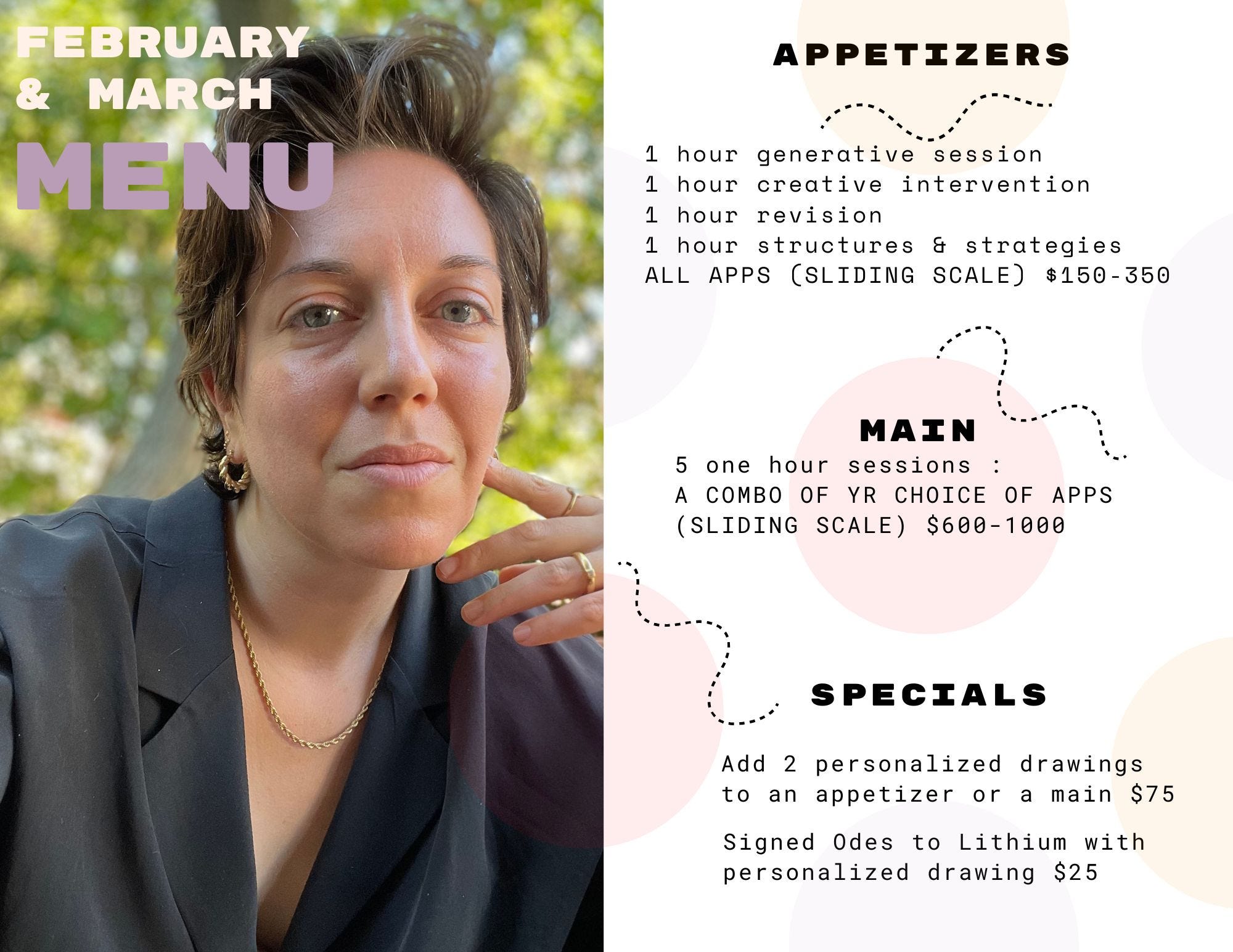
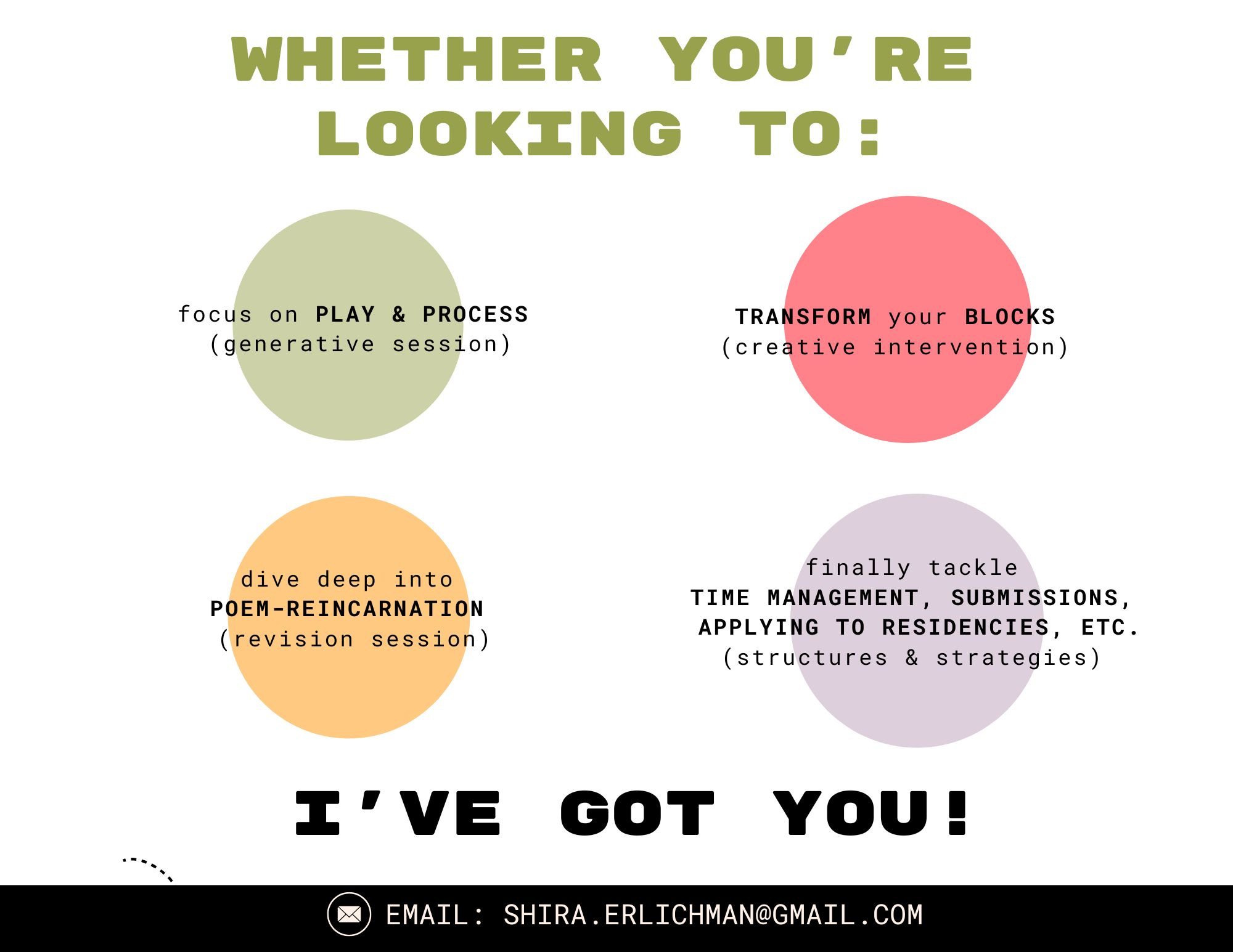
PS: I’ve opened my books for 1-on-1 sessions in February and March. Check it out and get in touch if you have any questions or if you’d like to book some time together. If you’re looking to get creative, take drafts to their next level, practice playfulness, and invest in your work, I’ve got you!
Comments
Nothing yet. Say the first thing.
Sign in to join the conversation.