
Where to begin?
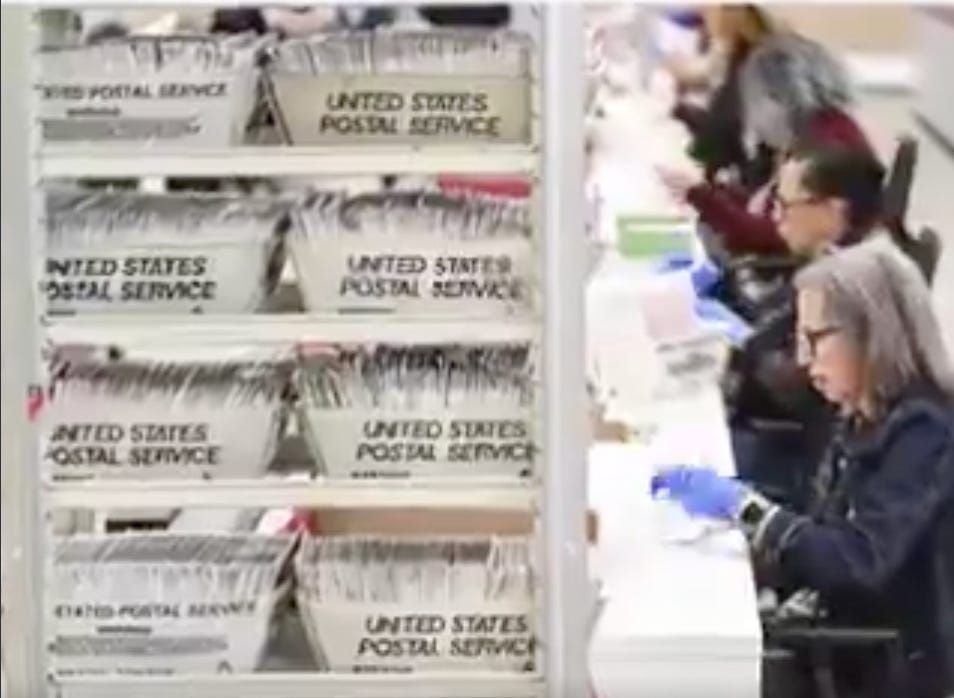
I first wrote about this issue in this article back in April after a flurry of complaints were filed on behalf of multiple plaintiffs challenging an Executive Order (EO) signed by Pres. Trump on the subject of regulations for election-related mail to be handled by the U.S. Postal Service in the future, including mail-in ballots. Of particular note at the time was that the EO in question didn’t, by itself, produce any changes in postal operations. It only directed the Postal Service and other federal agencies to begin the process for bringing about changes that would develop a standard envelope for mail-in ballots in all states in the future, including a requirement that certain features be required to be incorporated for the purpose of enhancing election security.
The Executive Order at issue is No. 14,399, signed by the President on March 31, 2026. As I noted in my first article, five civil complaints were filed in a matter of days after the EO was signed — with the first being filed in the District of Columbia District Court the very next day, April 1, 2026 — Democratic Senate Campaign Committee v. Trump. The lead attorney on that first case was notorious Defendant election lawyer Mark Elias. Other named plaintiffs are the Democrat Congressional Campaign Committee, Democrat National Committee, the Democrat Governor’s Association, the Democrat Senator Minority Leader, and the Democrat House Minority Leader.
It’s pretty obvious the Democrats are against standardizing election materials sent through the mail. Seems curious to me.
Federal district courts have a requirement for what is called a “Related Case Notice” filing when a new lawsuit has common parties, and commons facts and legal issues with a case previously filed. Such cases can be consolidated by the Judge already presiding over the first case in the interests of judicial efficiency and to reduce the chance of inconsistent outcomes. When Elias filed the first complaint on April 1, he filed a “Related Case Notice” that identified two cases he had filed in 2025 on a different election law issue, which had been assigned to D.C. District Judge long hostile to the Trump Administration - Judge Colleen Kollar-Kotelly. Based on the Notice, the new case challenging EO No. 14,399 was also assigned to Judge Kollar-Kotelly.
The following day, another Democrat party hack attorney, Norm Eisen, filed a complaint challenging EO No. 14,399 on behalf of other Democrat party interest groups. He also filed a Related Case Notice claiming his case was related to the case filed the pervious day by Elias. Based on that Notice, Eisen’s case was also assigned to Judge Kollar-Kotelly.
The same happened with a third case, filed on April 3, 2026, as well. So all three cases filed in the District of Columbia ended up with Judge Kollar-Kotelly, who had already ruled against the Trump Administration on an election law matter in the earlier cases. So far things were proceeding according to plan for the Democrat lawfare practitioners.
Not content with just having cases filed in D.C. — for reasons made clear below — on April 2, 2026, the ACLU file a complaint challenging EO No. 14,399, League of Women Voters of Massachusetts v. Trump, in the District of Massachusetts. Given the fact that every district judge now active in in that Court was appointed by either Pres. Obama or Pres. Biden, the chances of getting a favorable judge assigned to League v. Trump was 100%.
Sure enough, the case was assigned to Judge Indira Talwani, infamous for her injunction against Congress seeking to stop it from passing an appropriations bill that cut out funding to Planned Parenthood — funding Congress had put in a prior appropriations bill. The Supreme Court later vacated her injunction.
On April 3, the State of California led 21 other states, and oddly the District of Columbia, in filing another complaint in the District of Massachusetts, California v. Trump. Pursuant to a “Related Case Notice,” that case was also assigned to Judge Talwani.
So the lawfare warriors had arranged for two Trump-hating judges in Boston and Washington DC to preside over five cases challenging Trump Administration plans to enhance election integrity by implementing measures intended to make sure only eligible citizens — and not ineligible aliens — cast ballots in elections where federal offices are involved.
What happened next is why the Democrats decided it was adviseable to file in two different courts — and there have been challenges filed in only two courts.
On April 8, 2026, the DOJ filed a Motion to Reassign and Objection to Related Case Notice in the DSCC v. Trump case filed in the District of Columbia and assigned to Judge Kollar-Kotelly. The DOJ’s motion was made on two grounds — 1) EO No. 14,399 was only signed on March 31, 2026, so any challenge to it would not have common facts with any prior complaint in any other case, and 2) the Local Rule concerning Related Cases required that the “related case” still be pending on the merits. The related cases from 2025 identified by Elias in his Notice had already been concluded on their merits, and were at the time of his filing already pending in the Court of Appeals. On that basis, they didn’t satisfy one of the conditions for them to be considered as “related” to the new complaint.
Remember this the next time your read criticisms about DOJ not being above-board with federal judges in contentious cases. Mark Elias wasn’t sanctioned for his violation of the local rules even though the requirements are impossible to miss.
With no legitimate way to avoid these deficiencies, Judge Kollar-Kotelly granted the DOJ motion and ordered that the cases be randomly assigned by the Clerk’s Office. The result was that all three of the D.C. cases were reassigned to ….
Judge Carl Nichols.
Judge Nichols is probably the most cerebral of the Trump appointees from the President’s first term. He has handled a handful of cases filed as part of the “lawfare” effort waged by Democrat activist groups during the second Trump Administration, and has consistently favored the positions taken by DOJ. The soundness of his decision-making is reflected by the fact that he has not been reversed by the D.C. Circuit on any of his decisions that I’m aware of. That remains true as it applies to the three cases filed in D.C. seeking to stop implementation of EO 14,399.
What exactly is required by EO 14,300 that has created so much controversy with Democrat interst groups? The EO has 5 sections:
Section 1 states that the Administration's policy is that only U.S. citizens are eligible to vote in federal elections and that federal law prohibits noncitizens from doing so. It observes that federal agencies through the SAVE program have data that can be used to verify voter eligibility. It states that the federal government has a constitutional obligation to enforce election laws, prevent crimes related to elections, create public confidence in election outcomes, and strengthen mechanisms to provide for election integrity — such as securing ballot envelope identifiers to support auditing and enforcement.
Section 2 directs the creation and sharing with each state a list of confirmed U.S. citizens in the state who will be at least 18 years old by the next federal election, and requires that the list be regularly updated. The lists are to be created with data from the SAVE program and other databases. The EO imposes no obligation on the states about how to make use of the lists. The section also instructs the Attorney General to prioritize the investigation and prosecution of election-related offenses, particularly cases involving noncitizen voting, false voter registrations, and other forms of election fraud.
Section 3 directs the Postal Service to begin a rule-making process to create a standard for handling mail-in ballots in federal elections. The rules would require ballot envelopes to be clearly identified as such with an approved design that included Intelligent Mail barcodes or similar tracking technology. States would be required to notify USPS if they intend to use the mail for voting and to provide lists of eligible voters who would receive such ballots. The Postal Service would use these state-by-state participation lists — allowing states to update them just prior to elections — along with the citizenship lists to verify that mail-in ballots are sent and received through the Postal Service on for voters eligible to vote under federal law.
Section 4 makes several federal agencies responsible for carrying out the instructions in the EO. The section requires the Social Security Administration to provide the citizenship and identity data needed to support all such efforts, consistent with applicable law, the Privacy Act, and any applicable data-use agreements.
Section 5 directs DOJ and the other executive agencies with relevant authority to use all lawful means to enforce federal election laws. Evidence of potential violations by state or local election officials, government entities, contractors, individuals involved in administering federal elections, or entities that print, produce, ship, or distribute ballots should be reported to DOJ. Finally, the section recommends that states and localities retain, for five years, records and materials documenting voter participation in federal elections to support future investigations or enforcement actions.
Earth shaking stuff. I provided emphasis on some of the provisions that directed actions be taken specifically in accordance with applicable legal authorities or restrictions. That became significant as explained below.
So what is the basis for the claims made in the five different lawfare complaints filed over 4 days in two federal district courts seeking to stop the implementation of EO 14,399? That became apparent on April 10 when plaintiffs in all three D.C. cases filed separate motions for a preliminary injunctions. The motions all begin with the same premise — that the Executive branch is given no authority over or a role in dictating how elections are to be conducted by the states with regard to federal offices.
But what does the EO dictate?
In addition to creating eligible voter lists from databases the federal government already has, it orders the Postal Service to begin the process of rule-making to standardize the envelopes that can contain mail-in ballots rather than have 50 states each do their own thing. There are many such regulations that govern other types of mailed materials to assist in the sorting and delivery of those materials. In the case of mailed ballots, it requires some form of “Intelligent Mail” feature — widely used for other types of mail to assist in its timely and accurate delivery — without dictating what the specific technology shall be.
But what the plaintiffs — Democrat Party and its affiliated interest groups — really object to is the fact that such technology is likely to be used to guard against the U.S. Mail being used to commit a federal crime. Under 18 U.S.C. Sec. 611, it is unlawful for any alien or non-citizen to vote in an election held even in part to choose federal officials — President, Vice-President, or members of the U.S. Senate and House of Representatives.
It is difficult as a public policy matter to argue that the federal government should not take steps to PREVENT the commission of a federal crime via the U.S. Mails, so the objection the reflexively fall back on is “Orange Man Bad.”
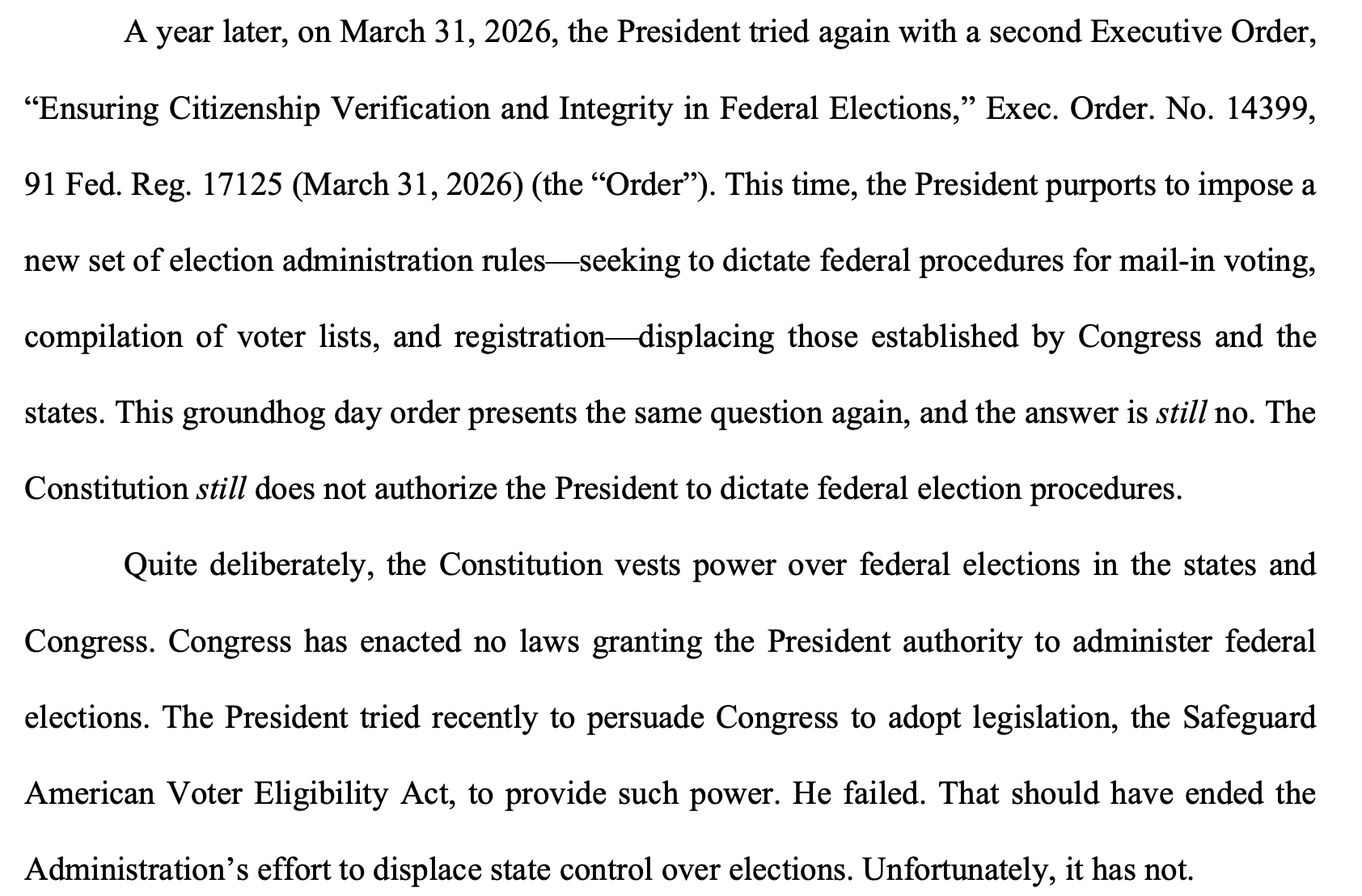
But does the EO really “impose a new set of election administration rules” as the plaintiffs claim?
The federal government uses existing database information to curate a state by state list of citizens eligible to vote, and sends each state that list.
It directs the states to give notice to the U.S. Postal Service of its intention to make use of the Postal Service in the conduct of state elections. It does not say states can or cannot use the Postal Service — it only directs that states give notice.
If a state intends to do so, the state must send a list of persons who are authorized to participate in that fashion. The EO does not dictate in any fashion how the state is to generate that list. It can have one name on it or it can have every name on it. How persons end up on the list is up to the states.
The EO directs that one standard ballot envelope be presribed for use by all states. The envelopes must have an “intelligent” tracking capability to insure that only persons on the state’s list of participants can use of the U.S. Postal Service to participate. People not on the state’s list are not denied the right to vote — they simply cannot use the Postal Service to deliver their ballot. States are free to allow them to vote in some other method if the states are convinced they are eligible.
Cross-referencing the “eligible citizen list” against the “participation list” will ensure that the Postal Service does not process and deliver ballots from non-citizens who are not eligible to vote. That states can still allow the refused individuals to cast ballots that can be counted if it turns out the person is, in fact, eligible to vote. They simply can’t use the convenience of the U.S. mail to deliver their ballot to state election officials. Again, states are free to provide them an alternative means of voting, and the EO does not dictate what that alternative should be.
Numerous tall trees were killed in connection with the filing of dozens of briefs totaling thousands of pages by the parties, intervenors, and amicus counsel. Judge Nichols in D.C. considered all this paperwork regarding the motions for Preliminary Injunction and rejected them on May 28, 2026. He did so with the exact type of legal analysis that his more progressive/liberal colleagues studiously avoid as they twist themselves in knots to find some nearly incoherent basis to avoid the world coming to an end if the Trump Administration is allowed to change federal government policy. Here is how Judge Nichols approached his task:
The plaintiff had the burden of proving they were likely to succeed on the merits.
The first requirement in doing so was to prove that the Court likely had jurisdiction to hear and resolve their claims. He concluded they had not carried their burden as to jurisdction.
To establish likely jurisdiction a plaintiff must show he has suffered an actual or imminent concrete and particularized injury; that the defendant has caused the injury; and the injury would be redressed by judicial relief. An threatened injury is not imminent if the risk is remote, speculative, conjectural or hypothetical. Allegations of possible future injury are not sufficient to establish injury in fact.
Directing the preparation of a list of citizens in each state eligible to vote in the next election requires nothing of the named plaintiffs. It is not aimed at them and only directs the actions of federal agencies.
The claim that the eligibility list will contain inaccuracies that might prevent some eligible state residents from voting is highly speculative, and any harm to the plaintiffs from such exclusions is highly attenuated. Not only had the federal government not yet compiled any lists, it had not developed the infrastructure within the relevant agencies to begin that task. Even if there were inaccuracies, the EO requires that the lists be accessible and reviewable such that individuals can update or correct inaccuracies. Because of that it is entirely speculative whether the lists will be inaccurate come election time.
The EO does not require states to make use of the lists in any fashion as part of their process for registering individuals to vote.
Claims that private information held in federal databases will be communicated to the states in violation of privacy rights is also too speculative. The direction to DHS requires that it compile the lists in a manner “consistent with applicable law.” If that can’t be done — for reasons the plaintiffs claim — then presumably no such lists will be compiled. Whether that turns out to be the case was entirely speculative, and the Court must assume that DHS will act lawfully in carrying out the Order as that is the instruction it is given.
The claim was that merely gathering the information — without transmitting it to anyone — would violate privacy rights would mean that the federal government could not centralize in one place data it has about citizens and non-citizens in several different places — the government is not allowed to know what it knows. The Plaintiffs fail to show how such intra-government conduct would cause them harm.
There is no “organizational injury” when Government action causes organizations such as those here to have to spend money to gather information and advocate against the Government action. The EO does not impose any impediment on their educational or voter registration efforts. “The Organizational Plaintiffs ‘cannot manufacture standing merely by inflicting harm on themselves based on their fears of hypothetical future harm that is not certainly impending….’”
The EO does not alter state elections in any way so there is no injury to candidates for office, and any hypothetical injury to Democrat candidates — which is the claim made by the plaintiffs — is purely speculative and only would result only from “a highly attenuated chain of possibilities…”.
Federal officials must determine that they can lawfully compile and transmit a State Citizenship List to the States; the Secretary of Homeland Security must then compile and transmit Lists containing significant errors to the States; even though the Executive Order expressly requires procedures to correct such errors, those errors would need to remain uncorrected; State election officials must then nevertheless decide to rely on the Lists; and State election officials must then decide to use the erroneous State Citizenship Lists to remove eligible voters from the States’ voter rolls (or otherwise make it more difficult for those individuals to vote). “Such speculation upon speculation does not suffice to support Article III standing….”
Judge Nichols then turned to Section 3’s instructions on a standardized ballot envelope and the delivery by states to the Postal Service of a “participation list” with regard to mail-in ballots.
Section 3 contemplates a rule-making process. Any claim of injury depends on whether the Postal Service issues a notice of proposed rulemaking, what that proposed rule says, what changes occur through notice and comment, whether a final rule issues, and how that final rule affects voters, States, or Plaintiffs. None of that has yet happened. Earlier decisions of the D.C. Circuit have held ““the issuance of a notice of proposed rulemaking, or other preliminary proceedings undertaken to promote a proposed rule, often will not be ripe for review because the rule may or may not be adopted or enforced.”
He rejected the claim of harm based on the plaintiffs having incurred costs in being forced to react and oppose the proposed rule-making on the same rationale as stated above — the Plaintiffs aren’t allowed to spend themselves into an injury by opposing government action for purposes of standing. “[P]laintiffs ‘cannot manufacture standing merely by inflicting harm on themselves based on their fears of hypothetical future harm that is not certainly impending.’”
Any prediction as to how the Executive Branch might eventually implement
Section 3(b) is mere conjecture at this time, therefore plaintiffs failed to show that their challenge to this provision is likely ripe. Article III standing requires more than the possibility of a potentially adverse regulation at some unknown time in the future. Until then, plaintiffs are mere bystanders to internal government processes.
The last issue Judge Nichols took up was the claim that EO 14,399 is facially unlawful — i.e., that it is an “ultra vires” exercise of authority because the President has no authority over the matters about which the EO directs action to be taken. But Judge Nichols points out that the EO, by its very terms, directs that agency action be. take only to the extent it complies with existing law. The EO does not direct how voter registration be conducted or how mail-in ballots will be handled, it does not intrude on the limits the plaintiffs claim exist. Because the directive is that action be taken only in compliance with the law, the EO is not, acting alone, a violation of any limitation on his authority.
My plan originally in writing this article was to contrast Judge Nichols approach in dealing with the challenges to EO No. 14,399 with the approach taken by Judge Talwani in Boston.
I’m sure no reader of mine would be shocked to learn that Judge Talwani saw the end of civilization as we know it to be hidden in the text of the EO, and granted injunctive relief to California and the other states who ran to the District of Massachusetts for protection from the EO.
But Judge Talwani’s approach to resolving the issues addressed by Judge Nichols is so ridiculous that it requires an article all its own. That will be coming in Part Two.
Comments
Nothing yet. Say the first thing.
Sign in to join the conversation.