
This is a planned “Free Article” from the start. Earlier this week I posted this very long article on these lawsuits that remains behind the paywall, but I suspect most readers don’t have a strong understanding of the issues involved, and what might happen in the very near future if the Trump Administration prevails.
I confirmed my suspicion with a poll on X, and 82% of the respondents said they did not understand what Executive Order 14,399 was all about, and why the lawfare launched against it is so aggressive.
Just so you understand how seriously the Democrats take the threat posed by this CHANGE TO POSTAL REGULATIONS, consider the groups and individuals who have been named plaintiffs in the challenges brought to date:
Case 1: Democrat National Committee, Democrat Senatorial Campaign Committee, Democrat House Campaign Committee, Democrat Minority Leader Chuck Schumer, House Minority Leader Hakeem Jeffries.
Case 2: League of United Latin American Citizens, Secure Families Initiative, Arizona Students’ Administration
Case 3: NAACP v. Trump, Common Cause, Common Cause Education Fund, Black Voters Matter Fund, BVM Capacity Building Institute
Case 4: League of Women Voters of Massachusetts, League of Women Voters Lotte E. Scharfman Memorial Education Fund, League of Women Voters of the United States, League of Women Voters Education Fund, Association of Americans Resident Overseas, U.S. Vote Foundation, OCA-Asian Pacific American Advocates, Delta Sigma Theta Sorority, Inc.
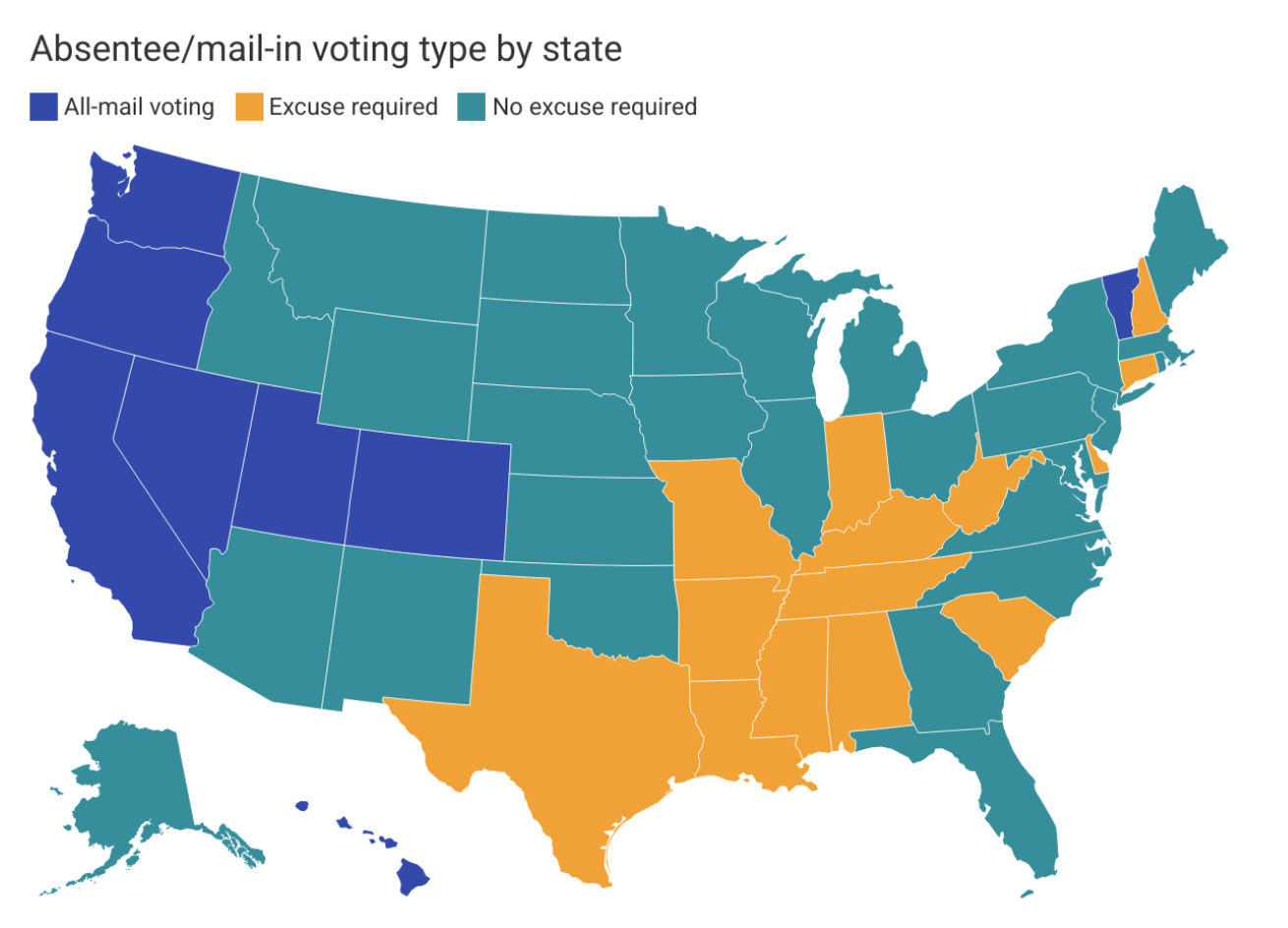
Case 5: States of California, Massachusetts, Nevada, Washington, Arizona, Colorado, Connecticut, Delaware, District of Columbia, Illinois, Maine, Maryland, Michigan, Minnesota, New Jersey, New Mexico, New York, North Carolina, Oregon, Rhode Island, Vermont, Virginia, Wisconsin, and Josh Shapiro, Governor of Pennsylvania.
These cases all involve efforts to block implementation of Executive Order No. 14,399 signed by President Trump on March 31, 2026. This was signed by President Trump 14 months after he came into office in January 2025 — I do not think that was an accident as set forth below. The EO deals with the use of the U.S. Mail by States to conduct some or all of their state elections. It has 7 sections, but the first 5 are most significant to the changes being planned:
Restates that the policy of the United States that only U.S. citizens can and should vote in elections where federal offices are on the ballot. It is a crime for an ineligible person to cast a ballot in such an election. Under Article II the Executive is responsible to see that federal laws are not violated through preventative measures when it is able to do so in order to maintain public trust and confidence in the outcome of elections. In other words, it is not enough to just prosecute offenders after the elections are over.
Directs DHS to work with other federal agencies, using data already in the possession of the Executive Branch — to the extent consistent with the law — to create state-by-state lists of U.S. citizens residing in each state who will be eligible to vote in the next general election with federal offices on the ballot. It does not apply to primary elections. These state-specific lists shall be searchable, shall be sent to the states as set forth, and there shall be a process by which states or residents in states can correct erroneous entries right up to election day.
Directs the USPS to create a regulation stating that no less than 90 days prior to an election for federal offices, any state MAY notify the USPS of the state’s intention to make use of the U.S. Mails in conducting its election. As part of that notification the state should indicate whether it intends to deliver to the USPS a list of voters to whom the state intends to deliver election materials through the mail. After receiving the names from the states, the Postal Service shall deliver back to each state a list of names of persons who are enrolled in the USPS mail-in balloting system — the “Participation List.” The regulation is to specify that the USPS shall NOT deliver election mail or return to the state a mail-in ballot to/from any person not named on a state “Participation List.” States can update the names on their individual Participation Lists in advance of any federal election up to the last day ballots may be mailed out as established by state law. The regulation shall establish a standard election mail envelope and ballot-return envelope for all 50 states with a unique “intelligent” identifier such as a barcode or QR code that the USPS can use to match the election mail with the identifier to a person on the Participation List.
Directs the Secretary of the Department of Homeland Security to establish the infrastructure to compile, transmit, and maintain the State Citizenship Lists within 90 days of the Order. The Attorney General shall enforce all provisions of law referenced in the Order and shall provide guidance to election officials, contractors; individuals involved in the administration of Federal elections; or public or private entities engaged in the printing, production, shipment, or distribution of ballots.
Directs the Attorney General to prioritize enforcement of federal election laws, and to take all lawful steps to deter and address noncompliance with such laws. Evidence of violations of existing Federal laws by State or local election officials; States or localities, including any instrumentalities thereof; contractors; individuals involved in the administration of Federal elections; or public or private entities engaged in the printing, production, shipment, or distribution of ballots may be referred to the Department of Justice for consideration of investigation or charges.
In summary:
Policy of US that only citizens eligible to vote shall cast a vote in elections with a federal office on the ballot.
Federal government shall access data already in its possession to create and deliver to each state a list of citizens residing in each state who are eligible to vote in the upcoming election.
The EO imposes no obligation on any state on how to use of such a list. In litigation over the E.O. the DOJ has stated that states are free to ignore the list — it is only a tool to assist each list in their efforts to insure that only eligible citizens vote in federal elections.
States MAY notify the USPS of their intention to use some form of “vote by mail” in any upcoming election. This is wholly voluntary. But use of the U.S. Mail for the delivery of election materials will conditioned on such notice. This does not direct states in how they can run their elections — it only affects the transmittal of envelopes with election materials from the state to the voter, and back to the state again. How votes are cast and counted is not implicated.
The lists are created by the states — who is on the list and how they get on the list is entirely up to each state. All that is required is that such a list be delivered to USPS if the state wishes to use the U.S. Mail. Because each state has different rules for mail-in voting, the lists from each state will reflect those different rules.
The USPS will deliver back to each state a “Participation List” of individuals enrolled in the USPS based on the names given to it by the states.
The USPS cannot deliver election mail or ballot-return envelopes not linked to a person on a State’s Participation List. This does not prevent the person from voting, it only prevents the U.S. Mail from being used by persons not on a Participation List. The Participation List can be updated and amended in advance of the election as consistent with state law.
The President signed the E.O. on March 31, 2026 — a period of 9 months and 3 days prior to the election. The E.O. provided for a series of “deadlines” and calendar benchmarks for certain tasks to be accomplished. Interfering with the Administration’s ability to meet those deadlines and benchmarks has been the goal of the Plaintiffs — Democrat party structure and interest groups:
Within 90 Days after signing — assemble the infrastructure to generate the Citizens List for each state.
Within 90 days after signing — issue a Proposed Notice of Rule-Making, the first step in issuing an new Postal Regulation under the Administrative Procedure Act.
No less than 90 days prior to election states MAY notify USPS of intent to make use of mail in its elections — this notice is optional.
No less than 60 days prior to election — deliver Citizen’s List to each state. This is September 4, 2026, for the mid-term election in November.
No less than 30 days prior to the election — each state shall deliver a Participation List for all persons in the state to whom election mail is to be delivered/received. This list can be updated through the final day ballots can be mailed under state law. That is October 4, 2026, for the mid-term election.
The Proposed Notice of Rule-Making was published in the Federal Register on June 2, 2026. Under the Administrative Procedures Act, the Postal Service provided for the shortest permissible time for public comment on the proposed rule — 30 days. That period ended on July 2. The USPS would normally have 30 days to consider and respond to the public commentary, and only then could it issue a final rule. Some of that period may have been compromised by the ongoing litigation.
The five lawsuits referenced above were filed in two different courts on April 1-3 — the first three in the District of Columbia, and the last two in the District of Massachusetts.
The Plaintiffs attempted to steer the D.C. cases to an Senior Judge with a long track record of anti-Trump decisions by claiming the cases were related to election challenges filed in 2025 that were assigned to that Judge. But that effort ultimately failed and they were assigned to a Judge Carl Nichols, a Trump appointee.
The Massachusetts cases — filed in Court where there are only Obama and Biden appointed Judges and has been a “go to” district for lawfare aimed at the Trump Administration — ended up assigned to notorious anti-Trump Judge Indira Talwani, infamous for her attempts to prevent Congress from ending funding for Planned Parenthood in an annual appropriations bill.
Judge Nichols denied motions for a preliminary injunction on the basis that he lacked jurisdiction because the Plaintiffs did not allege any injuries that could remedied, either actual or imminent, stemming from the issuance of the E.O. That was because, by itself, the E.O did nothing. Any potential legal challenges would have to wait until the rule-making process was complete, and the manner in which the new regulations worked in practice could be evaluated. It was not within his jurisdiction to grant relief based on mere hypotheticals about how some proposed regulation, as of then undetermined, might work in the future if one is actually ever adopted.
The D.C. Circuit Court of Appeals affirmed Judge Nichols decision in 3-0 vote.
Judge Talwani in Massachusetts didn’t let such legal niceties slow her down.
One of the cases before her involves 23 states listed as Plaintiffs, led by California. The States challenged Sections 2, 3, and 5 of the E.O. on the basis that the Constitution and prior laws passed by Congress give the Executive no legal authority over the process by which states conduct their elections.
In an shockingly poor opinion, Judge Talwani blocked implementation of Sections 2, 3, and 5 on almost no legal basis at all other than the claim that the E.O. itself to not set forth a legal basis for the exercise of Executive authority as directed by the E.O. Because the E.O. didn’t provide a legal basis for what was ordered, in her view that made the E.O. “ultra vires” on its face — contrary to law. She came to this conclusion based on her finding that the Constitution gives States the authority to decide how they conduct elections, and Congress has passed legislation already on subjects related to the E.O. so the President has no authority act in a manner that contravenes what Congress has already done.
But Judge Talwani did not focus her opinion on the text of the proposed rule or how states might be injured. She instead focused on the question of whether the Executive branch had any authority to send a list of citizens, make a REQUEST for lists of vote-by-mail voters from each state intending to use the mail, and use a standardized mailing envelope with a tracking feature that would allow the USPS to link an envelope to a person on the states’ lists.
The fact that Congress never told the President he could do this was sufficeint for her to conclude that the President was barred from doing it, making the E.O. unlawful. On She granted summary judgment to the 23 States, and entered a permanent injunction barring the Trump Administration for putting it into effect on June 25, 2026. This came 23 days after the USPS had issued its “Proposed Rule-Making” and published it in the Federal Register. That opened a 30 day period for public comment on the proposed rule. But, because she granted an injunction, it is possible that if that injunction is vacated, another 7 days remains in the Public Commentary period before the rule can proceed to being final.
The First Circuit Court of Appeal denied DOJ’s motion to stay the injunction pending appeal in a 2-1 vote. DOJ has now filed an Application for a Stay with the Supreme Court, and that application remains pending.
But Judge Talwani had two cases before her — California v. Trump, and League of Women Voters of Massachusetts v. Trump. The claims raised by the States were different than those raised by the Democrat party interest groups. The interest groups only sought to block implementation of Sec. 3 — the creation of the “Participation Lists” and the design of a standard election mail envelope. Relying on essentially the same reasoning as in her earlier decision, she granted a motion for preliminary injunction in the League of Women Voters case earlier this week.
This is an important development because the California case involved only 23 states as plaintiffs, so she could only issue an Injunction in those states. Other states were allowed to “intervene” in support of the Trump Administration and had no objection to complying with the E.O. That meant the Trump Administration could continue preparing to implement the new regulation because it could be used in as many as 27 states.
But Judge Talwani had authority to block implementation of the E.O. in all 50 states as a remedy for the interest groups in the League of Women Voters case because the plaintiffs in that case were representing members of their organizations in all states.
In both cases Judge Talwani ignored the argument that Postal Regulations do not implicate the “mechanics” of elections. All the E.O. does is direct the promulgation of regulations about the transmittal of ballots to/from voters. The first step in the new process is to identify voters authorized by the states to use mail-in ballots under state law. Which voters are authorized to use the mail is up to the states to decide, but if they want the USPS to carry those ballots then they need to tell the USPS who the authorized individuals are.
There is interesting language to consider from the Supreme Court’s decision in June in the case Watson v. RNC, challenging Mississippi’s election statute allowing ballots post-marked on or before election day to be counted if received within five days of election day.
Justice Barrett’s decision makes the following observations about the conduct of elections:
The “mechanics” of congressional elections belong to the states.
Plaintiffs in that case did not challenge the general practice of mail-in/absentee voting.
They did not challenge the use of the Postal Service or a common carrier to transmit ballots.
The defining element of an “election” has always been the electorate’s choice of candidate.
Federal election-day statutes regulate the time of the election.
The day for the “election,” is the day when the electorate must make its choice.
The election-day statutes were enacted and amended across almost two centuries and at all relevant times, the word “election” meant the act of choosing a person to fill an office.
SCOTUS has defined “election” as the expression of the electorate’s choice. “From time immemorial an election to public office has been in point of substance no more and no less than the expression by qualified electors of their choice of candidates.”
The electorate’s choice is made when voting is complete, not when ballots are received.
An “election” is the act of choosing a person to fill an office.
It could be argued that these all add up to the view that the “election” process where states are responsible for the “mechanics” does not extend to the transmittal back and forth of ballots via the mail. USPS is a federal agency over which states have no say in how it operates — and that should include delivery of election-related mail for the states. If States cannot tell USPS what its regulations should be, how is it that States can tell USPS what regulations it can’t impose?
The USPS has many regulations that dictate to mass-mailers the types of envelopes they can use for certain types of mail. USPS uses all kinds of highly sophisticated optic scanning devices to process an average of more than 35 million of pieces of mail every day.
The USPS has a criminal investigation arm — Postal Inspectors — whose job it is to make sure the mail is not used to commit federal and state crimes. It cannot be plausibly argued that the USPS operates beyond its mandate in seeking to prevent election-related crimes.
Here is what the Democrats fear — once in place, even though States have no obligation to make use of them, Republican Administrations are going to direct the USPS to cross-reference the Citizens List against the Participation List. USPS will then strike from the Participation List any person who is not on the Citizen’s List in an effort to prevent non-citizens from transmitted mail-in ballots via the USPS.
The Democrats claim there will be errors on these lists, and it is inevitable that eligible voters — U.S. citizens — struck from the Participation List by the USPS won’t be able to mail in their ballots.
But, that is not the same as saying they won’t be able to vote. Nothing under the proposed regulation limits who can cast a ballot if given one by a State. It only limits who can use the mail as their mechanism for getting it into the hands of state/county election officials to be counted.
As I noted above, the Supreme Court currently has pending on its Emergency Docket an Application to Stay Judge Talwani’s Injunction in the California case.
We should know in the next few days is there is a way to easily combine with that a similar effort on the Injunction she issued this week in the League of Women Voters case since that applies to all 50 states.
It may be that the Supreme Court has not acted while waiting for her to issue her decision on the second Injunction motion so that they could deal with both together. Or it may be that one or more Justices is writing a “Statement” objecting to whatever outcome has already been voted with respect to the pending Stay Application.
Either way, we should have an answer from the Court soon.
Comments
Nothing yet. Say the first thing.
Sign in to join the conversation.