
I’ve been attending AGMs for more than twenty years. Most fall into one of two camps: formulaic, compliance‑heavy meetings with almost no real engagement, or overproduced PR showcases that feel more like a leadership photo‑op than a forum for long‑term owners.
BT’s 2025 AGM was neither. Like its 2024 meeting, it felt calm, credible, and genuinely contemporary — and that’s no small thing in a room full of older retail shareholders whose questions often ran well beyond ten minutes. At its heart was Chair Adam Crozier, who ran the meeting in a way that would satisfy seasoned institutional investors while still feeling grounded enough for the small shareholder who has held BT shares since the “privatisation‑era” days.

BT’s audience tells its own story. This was not a room full of Gen Z or digitally native millennials. It was mostly legacy retail investors: the kind who still favour telephone engagement, printed annual reports, and the familiar ritual of an in‑person AGM.
At first glance, that can feel at odds with a company positioning itself as a digital‑first telco under a forward‑looking CEO. But in context it makes perfect sense. BT’s shareholder DNA was shaped in the era of mass privatisation, alongside the iconic “Tell Sid” campaign. That era still colours who shows up and how they engage.
Adam Crozier is not a governance disruptor in the usual sense. He is a seasoned FTSE chair, with deep experience at BT and more recently at Whitbread, a company with a similarly significant retail shareholder base. He is not chasing trends or trying to perform “next‑gen” values. Instead, he naturally embodies the qualities that next‑generation investors increasingly value: composure, clarity, accountability, and respect for the forum.
He doesn’t need to stage‑manage modernity. He simply practices good governance, consistently and well.
Crozier’s approach fits what I now think of as the BMLC model of AGM stewardship:
Balanced
Mindful (including sincerity)
Listening‑oriented
Conciliatory
And for once, the tone wasn’t defensive. It was constructive. It wasn’t flashy. It was measured. In a room where many questions ran long and some shareholders clearly carried years of accumulated frustration, that steadiness mattered.
From an academic perspective, this lines up with Stewardship Theory, which suggests leaders are motivated not only by control or self‑interest, but by a duty to serve the long‑term interests of the organisation and its stakeholders. Crozier didn’t just preside. He stewarded: calmly, accountably, without posturing.
From a regulatory standpoint, the UK Corporate Governance Code asks Chairs to “facilitate constructive relations” and ensure the “effective engagement” of all shareholders. BT met that expectation in a hybrid format, with a majority of attendees still drawn from BT’s legacy retail base. That’s why the meeting felt like more than a procedural checkpoint — it felt like a live feedback loop.
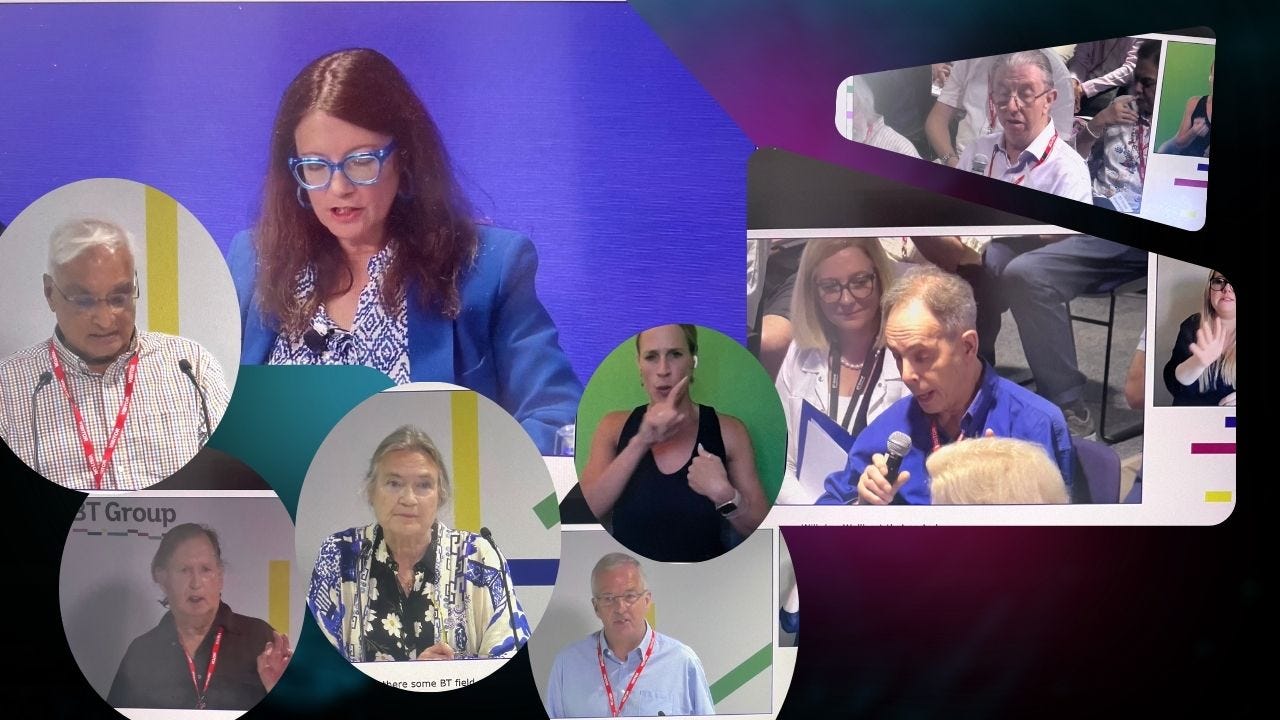
I judge AGMs less by the slides and more by how questions are handled. On that measure, Crozier came out strong.
He acknowledged each shareholder by name, including those joining virtually. Even online questions were attributed clearly and given context so they didn’t feel like disembodied text on a screen. He also matched tone well: calm when challenged, warm when thanked, and firm when needed.
He brought in the right people at the right time — Claire Gillies, for example, took on digital‑inclusion topics, while Group CEO Allison Kirkby kept the focus on strategy and long‑term direction. When there was no immediate answer, he still signalled that the point would be taken forward — especially around NED visibility and hybrid access.
The result was a meeting that respected shareholders’ time while still allowing space for proper discussion. There were no deliberate interruptions, and the room never tipped into chaos. That is easier to describe than to deliver.
This wasn’t theatrics or “chair flair.” It was governance facilitation, done well.
As someone who has spent years advocating for more inclusive investor engagement, I asked this:
“Why aren’t BT’s NEDs physically present, while executives are? And how is BT engaging nextgen and underrepresented shareholders?”
Crozier’s response was direct, respectful, and thoughtful. He acknowledged the shift to hybrid governance, explained BT’s committee‑based oversight model, and stressed the importance of transparency — without falling back on generic reassurance. There was no deflection. No polished PR line. Just adult‑to‑adult discourse.
That matters, because it showed that the board is listening to the people asking the question, not just the question itself.
The dynamic between Chair Adam Crozier and Group CEO Allison Kirkby was textbook. Crozier led the room. Kirkby brought clarity and depth around strategy and execution. They reinforced each other without duplicating roles — the kind of balance that strong governance structures are meant to produce.
Where the model showed slight strain, however, was Non‑Executive Director visibility. Crozier confirmed that not all NEDs were physically present. While committee chairs attended in person, others joined virtually. That may be practical in a hybrid setting, but it still raises a legitimate governance question.
The FRC’s expectations are about accountability in both substance and presence. When directors are effectively “present but unseen,” it invites scrutiny — and fairly so. Accountability is not only about whether they show up, but about how clearly they show up.
The Company Secretariat do not usually get the spotlight, but they were clearly central to BT’s 2025 AGM. Led by Company Secretary Sabine Chalmers, the team operated seamlessly alongside the Chair, ensuring that questions — both in‑room and online — were captured, organised, and fed into the meeting without friction.
Over nearly three hours, around two dozen retail shareholder questions were handled with care and discipline. That is no small feat in a forum that can easily tip into disorder. It was a clear demonstration of what strong governance infrastructure looks like in practice: invisible when it works, indispensable when it mattered.
What that revealed was a board that understands its audience — and why those shareholders attend. BT treated the AGM not as a procedural box‑ticking exercise, but as a live feedback loop: a chance to listen, observe, and engage with a core segment of its investor base.
That is not just good governance. With hybrid formats, it is also smart strategy. When executed well, they remove barriers for time‑poor and digitally native investors. When executed poorly, they create a two‑tier experience. BT’s 2025 AGM firmly landed in the former camp.
The meeting was strong, but not flawless. The main area for evolution is how NED presence is signalled.
If directors are attending virtually, shareholders should be able to see that clearly and understand what meaningful engagement looks like. A few simple steps could help:
Virtual NED Lounge: an open space before or after the AGM for informal exchanges with Non‑Executive Directors.
Digital Badges: clear labels showing which directors are online and available.
Short Video Introductions: brief clips that explain who the NEDs are, what committees they chair, and how they oversee BT’s strategy and risk.
This is not a cosmetic “enhancement.” It is the logical next step in an era of shareholder empowerment and ESG‑led accountability.
There was also a moment of unexpected levity. After the meeting, I offered a light‑hearted, ABBA‑inspired parody, reimagining the BT board as a disco band (I’m so Gen X!), opening with the line: “I called you last night from Glasgow.”
It was playful, but it captured two underlying truths. First, many older retail shareholders still instinctively gravitate toward traditional channels like phone‑based engagement. Second, moments of familiarity — like the shared Glasgow connection between Chair, CEO, and one particularly vocal shareholder — subtly shape the tone of the room.
Neither undercuts governance. Both remind us that AGMs are, at their core, human forums as much as they are formal ones.
We do not need Chairs to be corporate celebrities. We need them to be engaged, sincere, disciplined, and capable of holding a room — without dominating it.
Crozier didn’t try to impress. He created a forum that felt safe, inclusive, and productive. That is what governance feels like when it works well.
In one of the UK’s most experienced Chairs, BT delivered one of its most future‑ready AGMs. The takeaway is simple:
Be Balanced.
Be Mindful.
Be Listening‑Oriented.
Be Conciliatory.
Or in short:
🟢 Be More Like Crozier.
Comments
Nothing yet. Say the first thing.
Sign in to join the conversation.