
Hi all,
I see Vitec had a rough week last week. Down 5%, with its RSI back in the 30s.
I see Hemnet hit a fresh low below 90 SEK.
And I see Berner’s RSI also in the 30s. Meaning pretty oversold.
I’ll likely buy more of each soon.
But this week, I’m thinking about something a bit deeper.
I was on a podcast recently with The Dutch Investors.
They asked me about my favorite investment books.
My answer:
The Uncommon Stocks book by Philip Fisher
And 100 Baggers by Christopher Mayer
But thinking about it later, I want to change my answer.
Add to it.
Equally important to my entire framework is Antifragile by Nassim Nicholas Taleb.
A few key points on the anti-fragility concept:
There’s a difference between robust and anti-fragile
Robust is about enduring disorder and crises (like a market crash)
Anti-fragile is different
Anti-fragile doesn’t just endure. It gains, benefits, and grows stronger from crises.
It’s a cool concept.
And perhaps vital.
Because crises and crashes will still happen.
In fact, Taleb says the big crises are likely ahead of us.
Not behind. Ahead.
Everything is getting more complex and intertwined.
That doesn’t reduce vulnerability. It concentrates it.
And means larger crises await.
It’s all a bit doomsday.
But I think it’s important to keep in mind. Especially for investing.
It’s one thing to ride the wave when things are on the rise. As they are now.
It’s another to gain when the next crisis hits.
So I spend time thinking about the issue.
Thinking about which holdings of mine are simply robust. And which ones are anti-fragile.
I asked Gemini about this. And I got some pretty interesting answers.
According to the data, my most anti-fragile holdings are my micro-cap serial acquirers.
Karnell and Berner.
I was surprised. But here’s the analysis:
Most companies are at the mercy of demand
If there’s a big crash, demand and sales decline. And share prices follow
But serial acquirers are different. They buy companies. At the lowest price possible
When markets crash, they can keep buying
At fire sale prices
So when markets plummet, the growth engine accelerates.
Anti-fragile.
It’s not a new concept.
Berkshire wrote the book on this.
And yes, Berkshire is highly anti-fragile.
They’re sitting on a huge pile of cash, waiting to pounce.
But there’s a mathematical advantage with my Swedish compounders.
They're not yet Berkshire.
Berkshire is already massive. Its chances to 10x from here are low.
With Karnell and Berner, it’s the opposite.
In fact, check out the table of companies on my radar.
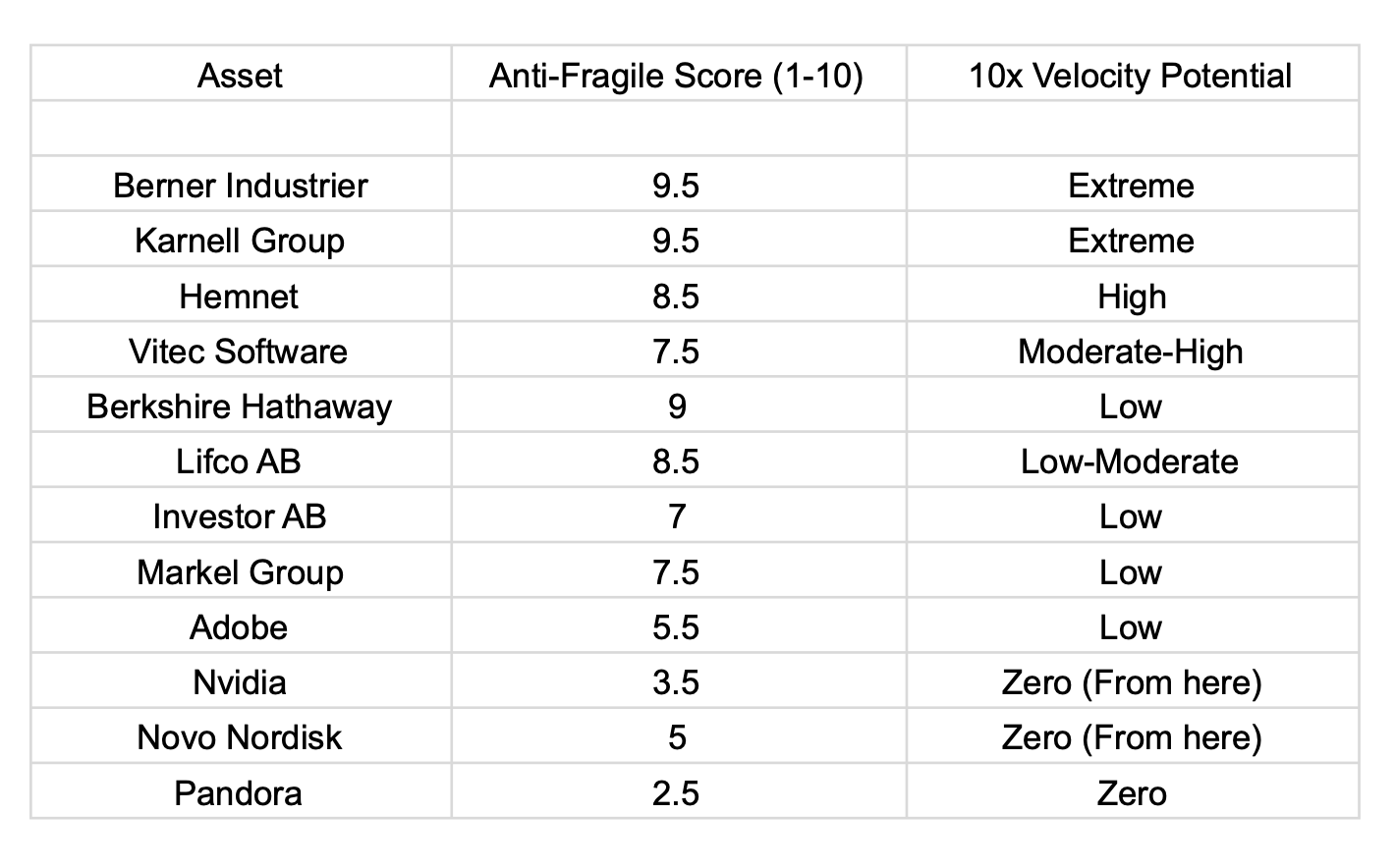
Super interesting chart.
Anti-fragility rankings in one column. High-growth potential on the other.
And two Swedish compounders at the top of both.
And it makes me wonder — could Karnell and Berner offer the best of both worlds?
10x potential…
…plus anti-fragility?
Ie high growth that’s also safe?
Gemini thinks so.
“It’s arguably the rarest, most beautiful sweetspot in all of corporate finance,” it says.
Sure, it’s strange world we live in when you’re quoting an AI chatbot.
But I think this finding is pretty interesting.
Thanks for reading. Talk to you next week.
Hi, I’m Joel Sherwood.
I invest each week and write about it here. Building a fund in public and sharing my analysis and performance.
Focused on the Nordics, where I live.
I’m a former financial journalist and current bank employee. I started the Sherwood Investment Letter in January 2025.
Purchases are not recommendations.
Comments
Nothing yet. Say the first thing.
Sign in to join the conversation.