
If you identify as someone on the political left, you likely feel a constant pressure to address the vast array of challenges facing our society. You bear the weight of injustice, inequality, and the decline of our institutions. You are aware of the urgency of climate disruption, economic instability, and the erosion of democratic norms. Our institutions are failing, and the flow of information is often polluted and manipulated by algorithms designed to provoke a reaction. This manipulation has eroded trust to the point that even basic coordination seems impossible. The political sphere has shifted from a space for problem-solving to a platform for performance. This is not surprising; complex systems under sustained stress lose coherence long before they collapse completely. They become noisy, reactive, and unable to process new information. This is the large-scale environment we are navigating today.
None of this is imagined. None of it is trivial; the stakes are very real. However, the crucial question is not whether these problems exist but rather where your actual power lies. Your true leverage does not come from your outrage, analysis, or ability to post an impassioned response on social media. Instead, it is found in the relationships you build and the actions you take that have a genuine impact.
Right now, that leverage point lies in your local environment: your neighborhood, community, or city.
When a system experiences this level of volatility, the point of leverage shifts. National institutions are often too slow and too entrenched to respond effectively. While individual reflection and maintaining personal grounding are essential, they do not extend beyond the individual level. Change takes hold when people act together—when their efforts are relational, rooted in community, and coordinated. This is why the point of leverage in our current systemic crisis has moved to a middle layer: small groups, neighborhoods, and local networks. This is the scale where individual actions can combine into collective strength, and where that collective strength can still influence the broader system. It is the space where trust can be rebuilt, and coordination is still achievable (as seen in Minneapolis). A local focus allows for short feedback loops, making it possible for actions to have a significant impact. If you wish to influence the trajectory of a turbulent system, you must start where coherence is still possible.
Local action may seem modest, perhaps even “too simplistic,” but it is not easy. It is the one domain where you cannot hide behind abstractions or curated identities. When you commit to a project in your neighborhood—working with actual people—you are confronted with a full spectrum of human differences. You cannot filter out those who do not share your worldview; you cannot reduce them to political stereotypes and walk away. You must engage with the person in front of you, not the caricature that has been presented to you.
Many people tend to avoid understanding the importance of community in developing the self because it requires a different kind of self-identity and agency. This isn’t about self-esteem or simply “believing in yourself.” It’s about maintaining your sense of self while considering the experiences and values of those who see the world differently. It’s the ability to stay grounded when faced with differing perspectives—to listen without losing your balance, to remain curious without feeling threatened. This form of self-trust is crucial in a diverse society, and it has unfortunately diminished over time.
Rebuilding this capacity doesn’t come from introspection; it comes from interaction. Genuine connections—especially those that endure despite differing values and uncomfortable conversations—provide the necessary friction and texture of genuine, in-person relationships.
When you collaborate with others in the same space—not through a screen—you become attuned to the full complexity of human interaction. You pick up on nuances such as tone, timing, cadence, gestures, pauses, and the person’s overall body language. You sense how they inhabit space, respond to uncertainty, and express disagreement or care. You feel, in your own body, whether you are guarded or open, whether your voice is welcomed or merely tolerated, and whether the interaction is reciprocal or performative. These signals are lost online; they are embodied and cumulative. They make real coordination possible. You learn how to stay in relationship even when values diverge, how to navigate discomfort without retreating, and how to repair through presence and shared effort. This is what analog relating entails.
In face‑to‑face interactions, you cannot mute someone or scroll past them. You stay in the room. And in staying, you rediscover what authentic engagement feels like. Coordination becomes physical, trust becomes iterative, and difference becomes workable. While analog relating is slower and messier than digital discourse, it is the only way to build relationships that endure—and those relationships form the foundation for any viable future.
This is where values become significant—not as mere slogans, but as the underlying framework that shapes how people understand the world. Most political conflicts do not center on facts; instead, they revolve around the values people use to interpret them. Unfortunately, we often treat “values” as a single, unchanging entity. We tend to reduce a person’s entire value system to one visible political choice, interpreting that choice as a complete moral judgment. For example, if you voted for X, it seems to imply that you do not care about human dignity. Conversely, if you voted for Y, you may be perceived as dismissing family or personal responsibility. We take a headline, a soundbite, or a party label and treat it as a complete psychological profile, oversimplifying someone’s complexity to a single data point.
However, values are not monolithic; they exist as a layered system, with each layer serving a distinct cognitive function.
Some values are immutable—deeply rooted commitments shaped by history, culture, family, or personal experiences. These values are not easily changed and should not be expected to shift. They form the core of a person’s identity.
Other values are foundational. While they are significant, they are not fixed. These values guide people’s beliefs about how communities should function, how decisions should be made, and what fairness looks like. They can evolve as individuals encounter new information or relationships.
Lastly, there are practical values that encompass everyday preferences about how things should operate—what a neighborhood should feel like, what constitutes safety, the effective use of resources, and what makes a community livable. These values are adaptable, as they are connected to specific conditions rather than tied to one’s identity.
Once you start to view values as a layered system rather than a single, rigid block, your perspective begins to shift. You stop assuming that every disagreement is a clash of identities, and you recognize that differences do not have to lead to a dead end. It becomes clear that someone can hold immutable values that differ from your own while still sharing foundational or practical values. You start to identify the layer where collaboration is possible.
By navigating differences rather than reducing them, we can gain sufficient clarity to uncover areas of agreement and make real progress. This cognitive shift makes local action feasible. You don’t need to change or agree with someone’s core values and beliefs to create a neighborhood resilience plan or establish a neighbor-to-neighbor support network. You only require enough common ground in the foundational or practical layers to coordinate effectively. When you recognize values as a layered system, you stop trying to dominate the argument at the top layer and instead focus on the layers where change is possible.
There’s another piece progressives often overlook: conservatives already practice many of the behaviors this essay is calling for. Jonathan Haidt’s Moral Foundations Theory shows that conservatives draw more evenly across the loyalty, authority, and sanctity foundations—orienting them toward continuity, mutual obligation, and local networks of support. They rely on neighbors, churches, and informal relationships long before they rely on institutions or professionals. In many ways, they already inhabit the relational world that progressives are now rediscovering out of necessity. This isn’t because one side is morally superior; it’s because each moral matrix emphasizes different strengths. Liberals elevate care, dignity, and fairness. Conservatives elevate loyalty, tradition, and communal responsibility. This meeting point is where complementary strengths can be realized.
Here’s my challenge, especially for left‑leaning readers who feel the weight of the world on their shoulders: be as committed to connection as you are to critique. Be as committed to local action as you are to national analysis. Be as committed to curiosity as you are to justice. You don’t have to agree with your conservative neighbor. You don’t have to validate their worldview. You don’t have to pretend differences don’t exist. But you can still choose to build something together.
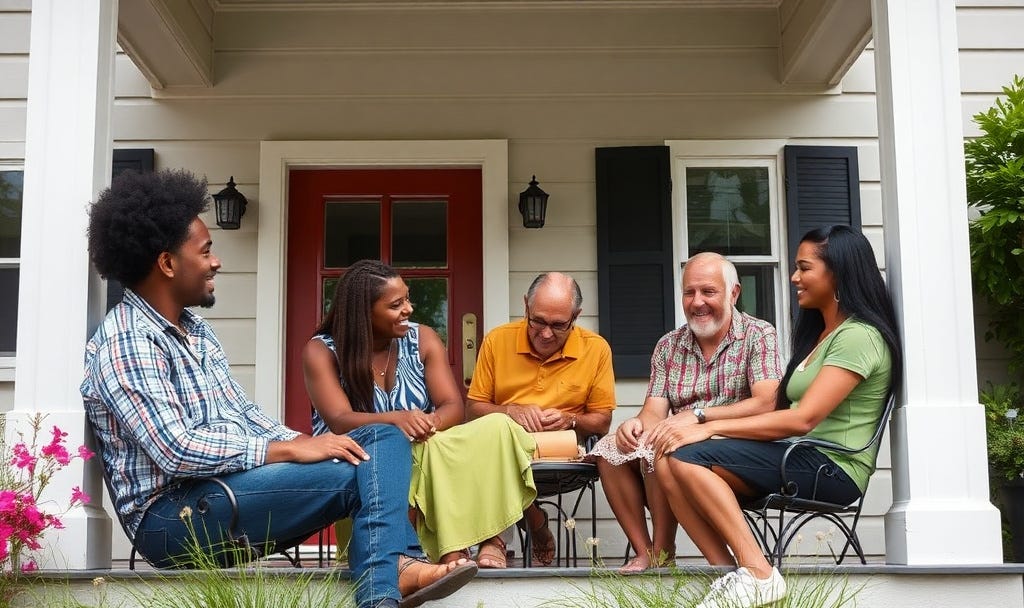
And remember: conservatives already know how to do this. Their moral matrix—rooted in loyalty, community, and continuity—has kept neighbor‑to‑neighbor support alive even as national institutions have frayed. When you meet your neighbors, you’re not just building community; you’re entering a space where conservative strengths and progressive strengths can actually complement each other. You’re stepping into a moral ecosystem that is broader than your own.
The reason meeting your neighbors is a form of radical resistance is simple: it interrupts the very dynamics that keep the larger system unstable. Polarization depends on distance. Manipulation depends on isolation. Fragility depends on people having no real relationships outside their curated ideological circles. When you step outside that pattern—when you knock on a door, learn a name, share a project, or build a habit of showing up—you’re doing something the national system can’t easily absorb or weaponize. You’re rebuilding the basic unit of democratic life: trust between actual human beings.
And that trust is the one thing the current environment can’t manufacture, simulate, or replace with algorithms. It only emerges through repeated, embodied contact with people who are not you. It grows through the slow accumulation of shared effort, small repairs, and the recognition that difference is not a threat but a resource. Every time you choose to relate in this way, you’re withdrawing attention from the national performance arena and reinvesting it in the one domain where your actions have real leverage.
This is why local action is radical. It restores coherence where the system has lost it. It builds adaptive capacity where the system is weak and prone to breaking. It creates the internal variety needed to withstand complexity. And it does all of this through the simplest, most overlooked act available to you: meeting the people who live around you.
The future won’t be shaped by perfectly aligned ideological groups. It will be shaped by neighbors who decide to work together despite their differences. That choice—quiet, unglamorous, and profoundly human—is the most subversive thing you can do in a system that profits from keeping us divided.
Comments
Nothing yet. Say the first thing.
Sign in to join the conversation.