
A woman I know—call her Mara—has dyslexia. In conversation, she is sharp, warm, and perceptive in a way that makes you feel immediately at ease. She works at a major airline in a customer-facing role, and she is extraordinary at it. When a family arrives frazzled after a cancelled flight, or a child is in tears because they want to go home, Mara doesn’t recite a script. She reads the room—fast, whole, without reducing what she sees to parts—and finds the response that makes people feel genuinely cared for. She embodies something her company talks about in training materials but rarely sees executed this well: the ability to turn a problem into a moment of authentic value.
But writing has always been a wall. Not a hurdle she could train herself over, but a structural barrier between her mind and the page. The sheer effort of wrangling spelling, sequencing, and sentence mechanics overwhelms the signal. What shows up in writing isn’t Mara. It’s Mara coping with a mechanical problem. The warmth disappears. The perceptiveness flattens. If you’d only read her writing, you’d never guess you were looking at the same person who can make a crying child laugh in ninety seconds.
When a position opened up in another industry she is passionate about—a role that would let her embody all the relational skills she’d spent years developing—the application required a written cover letter. She used an AI writing assistant. She spoke her ideas, her experience, her sense of why she was right for the role—the joy she gets from helping people, the way she reads emotional cues, how those skills turn difficult moments into genuine connection—and the AI helped translate that into written form. The result read like her. For the first time, the document on the hiring manager’s desk matched the person who’d created it.
• • •
Here is a second story. In late 2025, The Atlantic reported that a personal essay in The New York Times’s “Modern Love” column appeared to be partly AI-generated.1 The writer—skilled, with full command of English—had lost custody of her son during years of alcoholism. Now sober, she compressed a decade of devastation into fifteen hundred words.
The essay was technically competent. It hit the expected emotional beats. But as essayist Victoria Livingstone observed, the writer glossed over the moments that should have cut deepest—her twelve-year-old son telling her he didn’t love her.2 Instead of staying with that devastation, she pivoted immediately to recovery, described in language so general it could have belonged to anyone: she “didn’t give up,” she “shifted,” she “started showing up in quiet, invisible ways.” The strongest moments were the irreplaceable details—the Franklin the Turtle books she once read to her son. Details no AI could access. Everything else felt smoothed, resolved, written about the experience rather than from within it.
• • •
Both writers used AI. Both produced text. They are fundamentally different cases. The current debate about AI and language cannot (or doesn’t even attempt to) explain why.
That should bother us more than it does.
Here are the tired arguments I keep reading (beyond the ubiquitous hype for and against using AI):
AI degrades writing quality—it lets writers stay on the surface where the uncomfortable work should be.3 (The whole “AI makes us dumb” argument.)
AI homogenizes language—a 2026 synthesis in Trends in Cognitive Sciences confirmed what many suspected: LLMs flatten style, perspective, and reasoning, because they’re optimized for the most probable patterns, which means the most dominant, which means: not yours.4
AI enables inclusion—for people with dyslexia and other neurodivergent processing styles, these tools are genuinely transformative.5
And then the cop-out synthesis: it’s a tradeoff. More inclusion, less diversity. Find the balance.
Every one of these positions treats language as a tool that produces something—craft, cognition, access, diversity. They argue about the outputs. None of them asks what language actually is.
The ancient Greeks had a word we almost always mistranslate. Logos is rendered as “word,” “reason,” or “speech.” All of these are too small. Logos is closer to: the living mind encountering the world and bringing back what it found. Not a vehicle for shipping ideas between heads, but the medium through which a person’s encounter with reality becomes visible—to others, and to themselves.6
You know what this feels like. When someone says something truly their own—not a platitude, not a formula, but something arrived at through genuine experience—you can feel the difference. The words carry weight. Other people feel it too. They may not agree, but they recognize that something real is being communicated. That’s logos. The living mind shows up in the language.
Contemporary science backs this up. Cognitive scientist Lera Boroditsky has spent decades demonstrating that language doesn’t just describe perception—it builds the perceptual system. A five-year-old Kuuk Thaayorre child in Australia can point north instantly because her language requires cardinal-direction tracking in every utterance. Stanford professors, tested the same way, fumble.7 Russian speakers discriminate shades of blue faster than English speakers because Russian has separate words for light and dark blue. These aren’t stylistic preferences. They are different cognitive architectures, built by the language a person inhabits.
Developmental psychologist Susanne Cook-Greuter goes further: language doesn’t reflect experience; it organizes and filters it.8 We are born into undifferentiated sensation. Through language, we learn to carve reality into objects, categories, relationships, and abstractions. By age five, the labels feel like they’re just in the world. The constructed, arbitrary origins of our entire conceptual system have been completely forgotten.
Language is not something we use. It is something we are in the process of doing when we are being human.
Think about what actually happens when you say or write something that matters to you. You’re doing at least four things at once. You’re expressing what you take to be real. You’re processing how you experience what’s real—the feel of it, the emotional texture. You’re drawing on how you’ve come to know what you know—through your particular history of learning and failing. And you’re expressing what you value. These four dimensions aren’t separate activities. They’re aspects of a single process: making meaning out of the raw material of being alive.9
And story is how that process works. Angus Fletcher, professor of story science at Ohio State’s Project Narrative, argues that the human brain possesses a distinct cognitive capacity he calls storythinking—fundamentally different from logic.10 Where logic operates through correlational reasoning (this equals that), storythinking operates through causal speculation (what if?). It is how we link causes to effects, consider hypotheticals, anticipate how others will react, and revise our beliefs when reality doesn’t match our expectations. Crucially, Fletcher argues, AI can perform symbolic logic and mathematical calculations but cannot deliberate in narrative contexts. Storythinking is distinctly, stubbornly human.
Research on narrative cognition has mapped how this works: we identify with a character, feel their dissonance when old beliefs fail, experience the failure vicariously, and when the character discovers something new, the discovery feels like our own.11 Stories bypass the psychological immune system—confirmation bias, defensive rationalization—because they let us feel the failure of old beliefs rather than being told they’re wrong. Storythinking is embodied (you feel it in your body before your language catches up), emotional (affect drives the process), ethical (values are always at stake), and emergent (the outcome is genuinely new). It requires real dissonance—the actual encounter with the failure of your current understanding. You cannot skip it. You cannot outsource it. The encounter is the insight.
Now go back to the two opening stories. With this in view, the difference between them has nothing to do with how much AI was involved.
Mara’s logos was intact. She knew the reality of the job, had experienced it in her body every day for years, had earned the knowledge by doing it, and cared about it deeply. Every dimension of her meaning-making was present. The AI operated below the level of meaning—at the transcription layer, the mechanical interface between her mind and the page. It let her through.
The Modern Love writer’s channel to the page was wide open. But at the exact moment where her own encounter with her experience needed to go deeper—where she needed to feel her son’s rejection again, to let it restructure the story she’d been telling herself for years—she turned to AI. Not to transcribe what she’d already felt, but to generate text where her own feeling should have been. The AI provided a resolution without dissonance. A climax no one lived through. Language that looked like logos but carried no one’s encounter with reality.
The question is never “did AI touch the language?” The question is “whose logos is in the language?”
Authorship isn’t about who typed the words. It’s about whose thinking-being generated the meaning the words carry. Below the level of meaning-making—at the transcription layer—AI serves logos. At or above the level of meaning-making—generating meaning in spaces where the person hasn’t done the work—AI produces what I’ve started calling anti-logos: language with the form of meaning but no being behind it.
I should be transparent: this essay emerged from a conversation with an AI—a long, structured one. I walked in with a gut feeling that the AI-and-language debate was missing something foundational, but I couldn’t name what. The AI offered frames. I rejected the ones that were close but wrong. It surfaced research I hadn’t seen. I followed hunches I couldn’t yet defend. Hours later, I arrived at the insight you’ve just read.12
The logos is mine. The gut feeling was mine—rooted in decades of work in human systems. The dissonance was mine. The felt sense of which frames fit and which rang hollow was mine. The AI contributed retrieval, pattern-recognition, and challenge. Those contributions were real. But the AI didn’t feel the dissonance. It didn’t care what we found. I did.
The Greeks had a word for what the AI brought: techne—skilled craft applied to organizing information. What I brought was the existential content: the felt problem, the values, the stakes. The meaning emerged from the encounter between the two. But the wisdom—the sophia—was not shared. The AI has patterns, not wisdom. The patterns were useful. The wisdom was mine to bring or not bring.
This is a third case, distinct from both Mara’s and the memoirist’s. And I think it matters that I say so, because many of you use AI in similar ways and wonder whether the result is still yours. Here’s how I’d put the test: Can you trace the meaning in the output back to your own encounter with the reality it describes? Did you feel the dissonance? Did you do the embodied, emotional, ethical work of sitting with a hard problem until something new emerged? If yes, the logos is yours. If not—if you accepted fluent language in spaces where your own thinking should have been—you may have handed off your logos without realizing it.
Developmental scientist Pamela Cantor argues that human potential is not fixed by biology but activated by context.13 Language is one of the primary contexts through which potential is cultivated. If the dominant language environment becomes homogenized—if more and more of what people read and write passes through the same probability engine—the developmental context narrows. Not just less interesting prose. Fewer cognitive architectures for perceiving reality. A diminished field within which human minds can grow.
And it goes beyond individual development. Every domain where language is the operating system of human systems—organizations, schools, courts, communities—depends on the logos of the language being real. When strategy documents sound coherent but carry no one’s felt understanding of the business, when policy proposals use the right words but reflect no one’s encounter with the problem, when educational materials are fluent and empty—those systems are running on anti-logos. They still function. They still process inputs and produce outputs. But they’ve been severed from the human meaning-making that was supposed to give them direction and life.
The systems scholar Alexander Christakis coined the term demosophia—combining the Greek demos (people) and sophia (wisdom)—to describe the collective understanding that emerges when people search together in genuine dialogue.14 That searching assumes each participant brings something real from their own encounter with experience. When the language in the room is generated by probability engines rather than people who have done the work of encountering reality, the searching cannot produce wisdom. It can only produce fluent consensus—agreement that sounds meaningful but has no roots.
This is not an argument against AI. Mara’s story and the story of this essay’s own creation demonstrate that AI can serve logos when the human holds the locus of meaning.
But it is an argument for asking different questions. Not “does AI help or harm language?” but “does this use preserve or displace the thinking-being process that gives language its meaning?” Not “will AI take our jobs?” but “will we stop doing the existential work that makes our work ours?”
The hardest version: How do I know whether I’m holding the logos or have handed it off without realizing it?
That recognition—the awareness of whether your own thinking-being is active or has been quietly replaced—is itself an act of logos. It may be the most important capacity we can develop in an age of machines that speak fluently without meaning a word of it.
• • •
The ideas in this essay are distilled from a longer book chapter, “Whose Logos Is in the Language?”, which develops the full theoretical architecture connecting the ancient Greek concept of logos, Angus Fletcher’s storythinking, the neuroscience of language, and the design of viable human systems. That chapter is currently seeking a home. If you’d like to read it or discuss where it might land, I’d welcome your feedback.
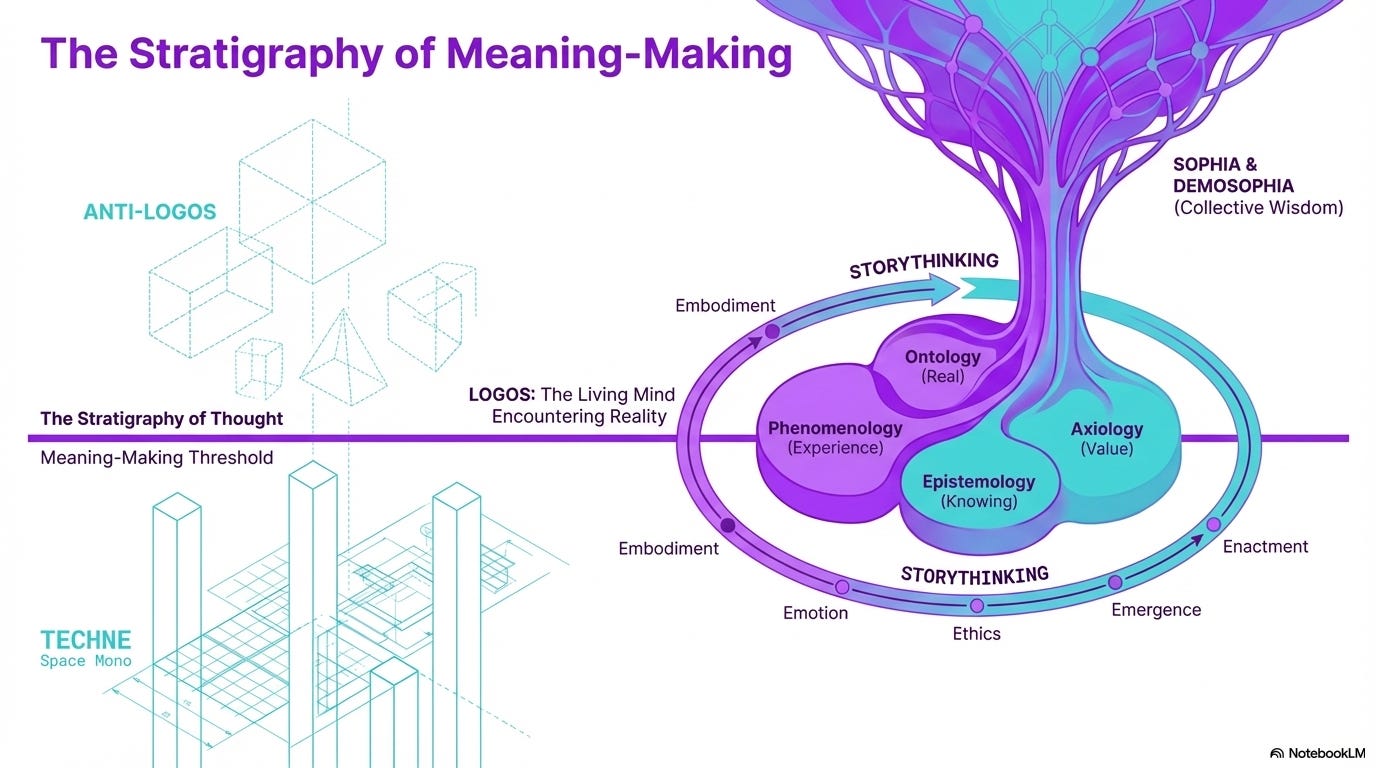
I used Google’s NotebookLM to generate this visual, because Claude sucks at graphics and Notebook creates decently useful visuals. Even AIs have their areas of expertise and weakness.
1. Vara, V. (2026, March 25). How AI is creeping into The New York Times. The Atlantic. https://www.theatlantic.com/culture/2026/03/how-ai-creeping-new-york-times/686528/
2. Livingstone, V. (2026, March 26). AI in The New York Times “Modern Love” column. Human Generated.
3. Livingstone, V. (2026, February 15). LLMs are terrible thought partners. Human Generated.
Livingstone draws on Melissa Febos’s argument in Body Work (Catapult, 2022) that early drafts are often a “theater of types” in which writers cast themselves in roles rather than reaching the complex truth.
4. Sourati, Z., Ziabari, A. S., & Dehghani, M. (2026). The homogenizing effect of large language models on human expression and thought. Trends in Cognitive Sciences. Advance online publication. https://doi.org/10.1016/j.tics.2026.01.003
5. Alty, S. R., Kent, M., & Dogan, H. (2025). The use of generative AI by students with disabilities in higher education. Computers & Education: Artificial Intelligence, 8, 100335. https://doi.org/10.1016/j.caeai.2025.100335
6. Pattakos, A., in Banathy, B. H. (1996). Designing social systems in a changing world (p. 216). Plenum Press.
7. Boroditsky, L. (2011). How language shapes thought. Scientific American, 304(2), 62–65. See also her TED Talk: How language shapes the way we think (2018).
8. Cook-Greuter, S. R. (2014). Ego development: A full-spectrum theory of vertical growth and meaning making. In S. Pfaffenberger et al. (Eds.), The postconventional personality (pp. 19–76). SUNY Press.
9. The four-dimensional framework—ontology, phenomenology, epistemology, axiology—as an integrated system of meaning-making is developed in Jones, B. C. (2025–2026). Values Engineering Method and Theory (VEMaT). 3C Labs LLC. Christakis’ framework uses epistimology as the overlying framework: how we think about reality, how we think about experience, how we think about value. Both frameworks are useful.
10. Fletcher, A. (2023). Storythinking: The new science of narrative intelligence. Columbia University Press. Fletcher holds dual degrees in neuroscience (Michigan) and literature (Yale) and is professor of story science at Ohio State’s Project Narrative. See also Fletcher, A. (2021). Wonderworks: The 25 most powerful inventions in the history of literature. Simon & Schuster.
11. The account of narrative cognition and belief revision synthesizes the Transportation-Imagery Model (Green & Brock, 2000) with the narrative structure analysis in Jones, B. C. (2025). Belief revision through story structure [Working paper], 3C Labs LLC. My 5Es framework (Embodiment, Emotion, Ethics, Emergence, Enactment) describes the human cognitive dimensions through which storythinking operates. See Dimitry, S. (2025). The rise of the cognitive human [Manuscript in preparation], Human Futures Design Lab.
12. I use Anthropic’s Claude, configured with detailed protocols for how I want it to engage with me—as a thinking partner, not a performer—along with dozens of reference documents drawn from my own research and the work of collaborators and researchers I draw on regularly. The AI has been shaped by me, toward me, and for me. The logos in this essay is mine; the techne was shared.
13. Cantor, P. (2026, March 6). Human potential: What we assume vs. what the science shows. The Biology of Becoming.
14. Christakis coined demosophia by combining the Greek demos (people) and sophia (wisdom) to name the collective understanding that emerges through structured dialogic design. See Christakis, A. N., & Bausch, K. C. (2006). How people harness their collective wisdom and power to construct the future in co-laboratories of democracy. Information Age Publishing. See also Christakis, A. N. (2024). The Thread: Democracy in action. Edward Elgar Publishing.
Comments
Nothing yet. Say the first thing.
Sign in to join the conversation.