
The problems most organizations face right now don’t sit still long enough to be solved by conventional methods. They shift, multiply, and interact in ways that weren’t anticipated. And when groups try to think through them together, something predictable happens: people talk past each other, default to familiar assumptions, and end up debating the present instead of designing the future.
This isn’t a failure of intelligence or effort. It’s a mismatch between the tools we have and the problems we’re facing. Most problem-solving methods were developed for relatively stable environments. Where cause and effect were clear, expertise was concentrated, and the right answer could be found if you gathered enough data. That’s not the environment most of us are working in anymore.
What’s needed instead is the ability to think together across differences—disciplines, identities, assumptions—well enough and long enough to imagine futures that aren’t just projections of the present. That’s the gap this work is designed to address.
Over the past several years, my colleague Brian Jones has been developing a method called VEMaT—Values Evaluation, Mapping, and Tradeoff. It started from a straightforward observation: every idea, proposal, and strategy has values embedded in it. Some are stated. Most aren’t. And when values stay invisible, they quietly shape decisions, limit imagination, and generate conflict whose source nobody can quite locate.
VEMaT makes those values visible. It helps groups identify what they actually care about across four levels: identity-anchored commitments, relational expectations, operational preferences, and system-level priorities. It distinguishes between what’s genuinely non-negotiable and what’s become habit. And it gives teams a structured way to work through value tensions without triggering defensiveness.
In short, VEMaT helps groups understand why they think the way they do, not just what they think. That distinction matters enormously when the work is imagining something that doesn’t exist yet. You can’t design a genuinely new future if you’re still operating from yesterday’s assumptions.
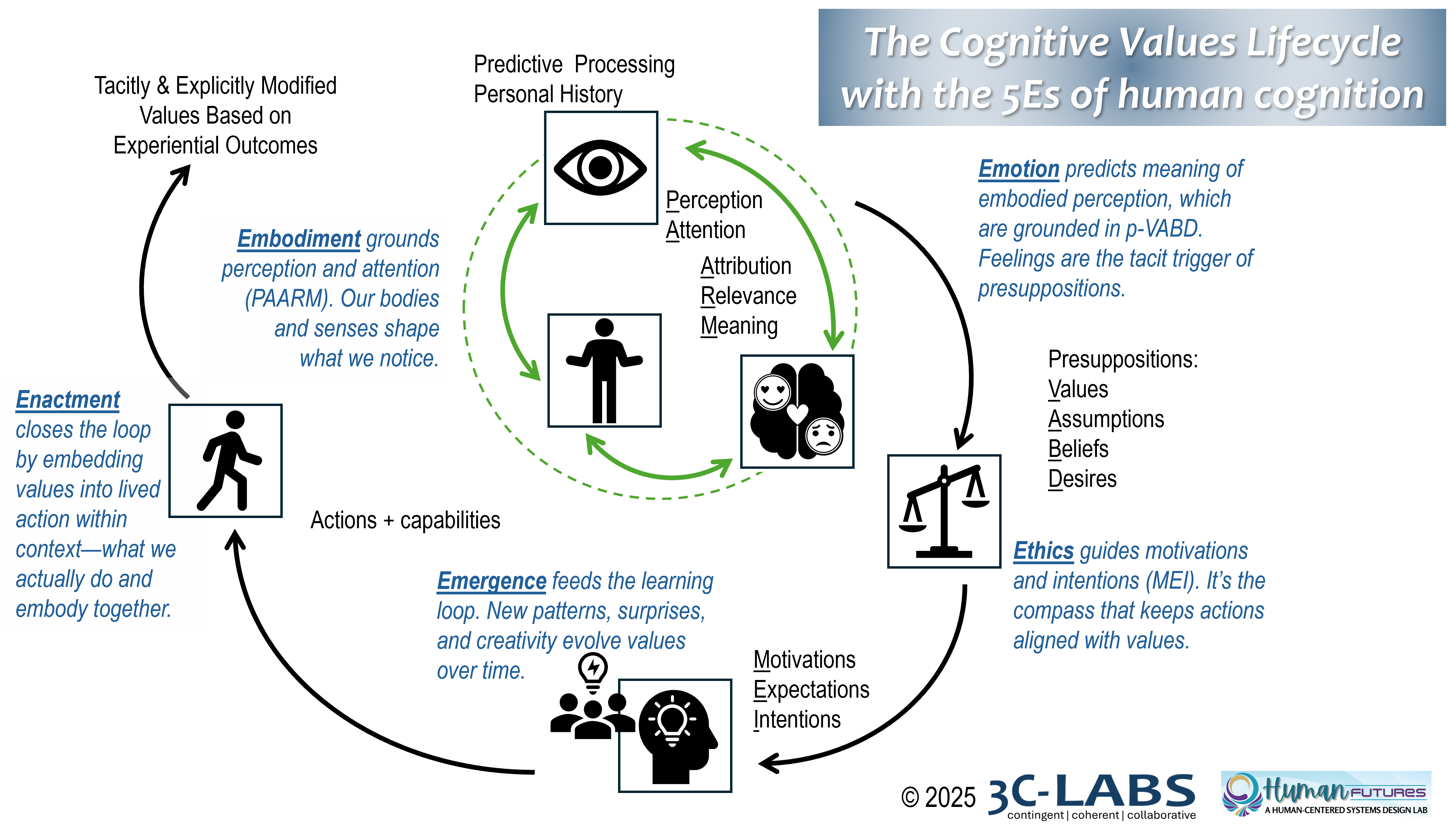
One of Brian’s more useful contributions is a framework for understanding how humans build belief systems—a process he calls factualization, which he captures in his Cognitive Values Lifecycle. It’s not purely rational. My own research identifies five overlapping forces that shape it, which I call the 5Es:
Embodiment: how our physical and emotional states shape perception
Emotion: how affect drives meaning-making
Ethics: how moral intuitions guide judgment
Emergence: how dialogue and human collaboration generate new ideas and wisdom
Enactment: how beliefs become real through action
Together, these forces shape what Brian calls the “space of factualization”—the integrated set of facts, interpretations, and values that guide how we think, talk, write, and act. His Cognitive Values Lifecycle maps how that process moves through prediction, perception, judgment, decision, and action. The 5Es explain what makes that cycle distinctly human: the embodied, emotional, ethical, and emergent dimensions that no purely analytical system can replicate. Over time, these shared patterns become cultural norms.
The problem is that when the world changes, our factualized beliefs often don’t. Disruption—technological, social, environmental—tends to produce a predictable response: people apply familiar solutions to unfamiliar problems, cling to well-worn values even when they no longer fit, and mistake deeply held identity commitments for practical necessities. It’s a reasonable response to uncertainty, but it’s also what makes adaptation so difficult. Christakis named this challenge “defactualization”—the hard cognitive work of loosening our grip on present reality to genuinely envision what ought to be, rather than just what is or what can be. It’s the central challenge of futures-creative SDD, and it turns out to be much harder than it sounds.
Brian extended Christakis’ concept by mapping defactualization as one stage within a larger cognitive lifecycle: beliefs get built (factualization), conditions shift and disrupt them (emergent variables), the old assumptions must be examined and released (defactualization), and a more coherent updated framework gets constructed in their place (refactualization). VEMaT is the practical tool Brian developed to help groups navigate that cycle—specifically the defactualization and refactualization stages—as an ongoing practice:
Surface and examine outdated assumptions
Evaluate the values beneath them
Map the relationships among those values
Distinguish identity-based values from contextual ones
Re-factualize—build a more coherent, updated belief system
This is what VEMaT operationalizes: a structured process for helping groups move through defactualization and into refactualization—updating the values architecture that shapes how they see problems, make decisions, and imagine futures.
Brian and I met with Alexander “Alecos” Christakis and Jeff Deitrich in Chicago this past January to explore whether VEMaT could be integrated with Structured Dialogic Design (SDD)—the dialogic science Alecos has refined over fifty years.
SDD is one of the few methods that consistently helps diverse groups think together in high-complexity situations. Its six Laws reduce cognitive overload, protect individual autonomy, prevent any one voice from dominating, and create the conditions for genuinely shared meaning. That’s why it’s worked across cultures, political divides, and high-stakes public systems.
But SDD was never designed to surface values explicitly. It intentionally avoided values dialogue, because values can trigger identity threat and derail the process. That’s a reasonable design choice—but it also means SDD alone can’t address the deeper assumptions that shape how people interpret a problem in the first place.
That’s where the integration becomes useful. SDD provides structural integrity: the laws, the process, the cognitive safety. VEMaT provides values-level clarity: the architecture that helps participants examine and loosen inherited assumptions before they constrain the conversation.
Together, they support what we’re calling the futures-creative move—the ability to imagine possibilities that aren’t just extensions of what already exists. This isn’t theoretical. It’s a coherent, testable approach ready for real-world application.
Most problem-solving methods treat people as rational actors who just need better data or better facilitation. But cognition isn’t purely rational. My 5Es framework identifies what makes it distinctly human: it’s embodied, emotional, ethical, emergent, and enacted. These aren’t soft variables—they’re the substrate of how people make meaning. Ignore them, and you get solutions that make sense on paper but fail in practice.
The integrated VEMaT + SDD approach is designed differently:
It engages the full cognitive system, not just analytical reasoning
It surfaces the values architecture, shaping how people interpret problems
It creates the developmental safety required for reflective, future-oriented thinking
It uses dialogic structure to protect autonomy and meaning, even under stress
It’s augmented—not replaced—by technology, including AI tools for pattern recognition, documentation, and synthesis
This isn’t design thinking. It isn’t brainstorming. It’s a structured, values-aware approach to collective intelligence—one that takes both the rigor of the process and the humans inside it seriously.
One practical challenge we discussed in Chicago was that SDD’s developmental safety has historically depended on in-person Co-Labs. Physical presence matters. Embodied cues matter. Trust builds differently when people share a room.
But the settings where this work is most needed—distributed organizations, cross-sector coalitions, global partnerships—can’t always bring people together in person. If we limit the integrated method to in-person settings, we constrain its usefulness precisely where the stakes are highest.
The answer isn’t to abandon the in-person model, but to extend it thoughtfully:
Hybrid Co-Labs where core sessions are in person, with preparatory and follow-on work happening online
Distributed Co-Labs with enhanced scaffolding—embodied grounding, relational attunement, and trust-building practices adapted for virtual space
AI-supported synthesis that preserves the Laws of SDD while reducing cognitive load
Digital tools that help participants track values, assumptions, and influence relationships over time
The goal isn’t to replicate the in-person experience online. It’s to design something new that preserves the essential developmental conditions while expanding who can participate and when.
The conceptual integration of SDD and VEMaT is complete. We have enough alignment to start testing it in real contexts—pilots, action research, iterative refinement. That’s the next step.
What the world doesn’t need is another theoretical framework. What it does need are methods that help people think together in ways that match the actual complexity of the problems they’re working on. We believe this integrated approach—SDD’s structural rigor, VEMaT’s clarity of values, and the developmental grounding of the 5Es framework—offers a credible path toward that end.
A way to design and build human systems that can adapt under pressure. A way to restore the capacity to imagine what doesn’t yet exist. And, practically speaking, a way for groups to think together again.
Comments
Nothing yet. Say the first thing.
Sign in to join the conversation.