
Most of us don’t have a prioritization problem. We have a desire problem.
There are simply too many things we could do, buy, pursue, learn, become, watch, visit, build. The hard part is that from inside our own heads, many of them feel equally compelling.
A new project feels like a calling. A new purchase feels like a necessity. A new city feels like the place we were always supposed to live.
Some desires genuinely nourish us. Others only leave us wanting more.
So how do we tell the difference?
That question has been following me since sitting with the closing lines of Verse #12 of the Tao Te Ching:
thus the rule of the sages
favors the stomach over the eyes
thus they pick this over that
After recording the original deep dive, I wrote those lines at the top of my journal and asked two questions underneath:
What is my this versus that?
What is felt in my stomach versus desired by my eyes?
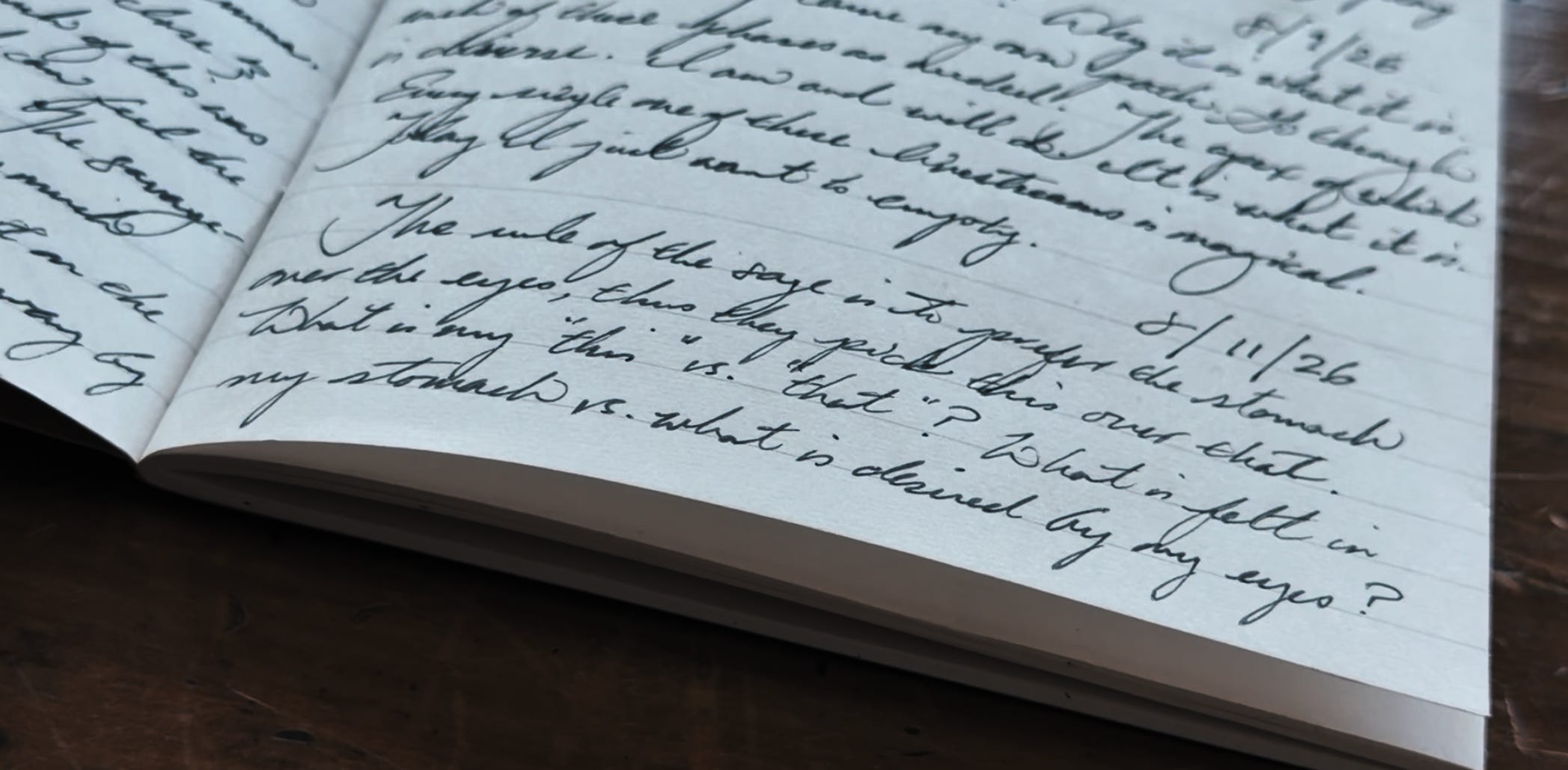
I made it about one paragraph before realizing that words weren’t going to cut it. Too many things were coming up at once, so I switched notebooks and started mind mapping instead.
Out came my parents, early mornings alone, Austin friends, travel, dating apps, sardines, dance, writing, a podcast I’ve been wanting to start, a new ebike I absolutely don’t need.
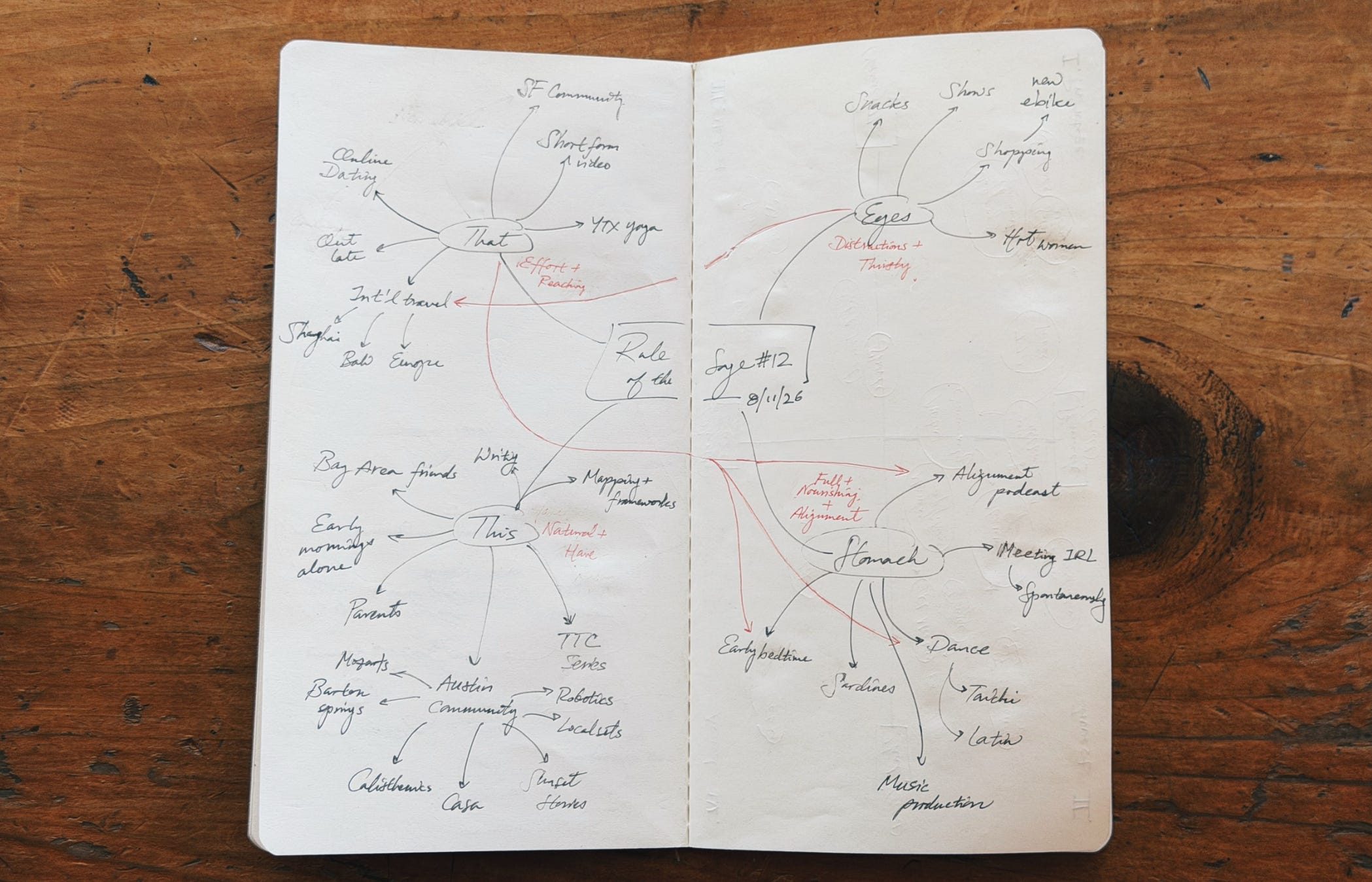
The map helped me see what was inside me.
Then my old management consultant brain kicked in…
So how do I make decisions from this?
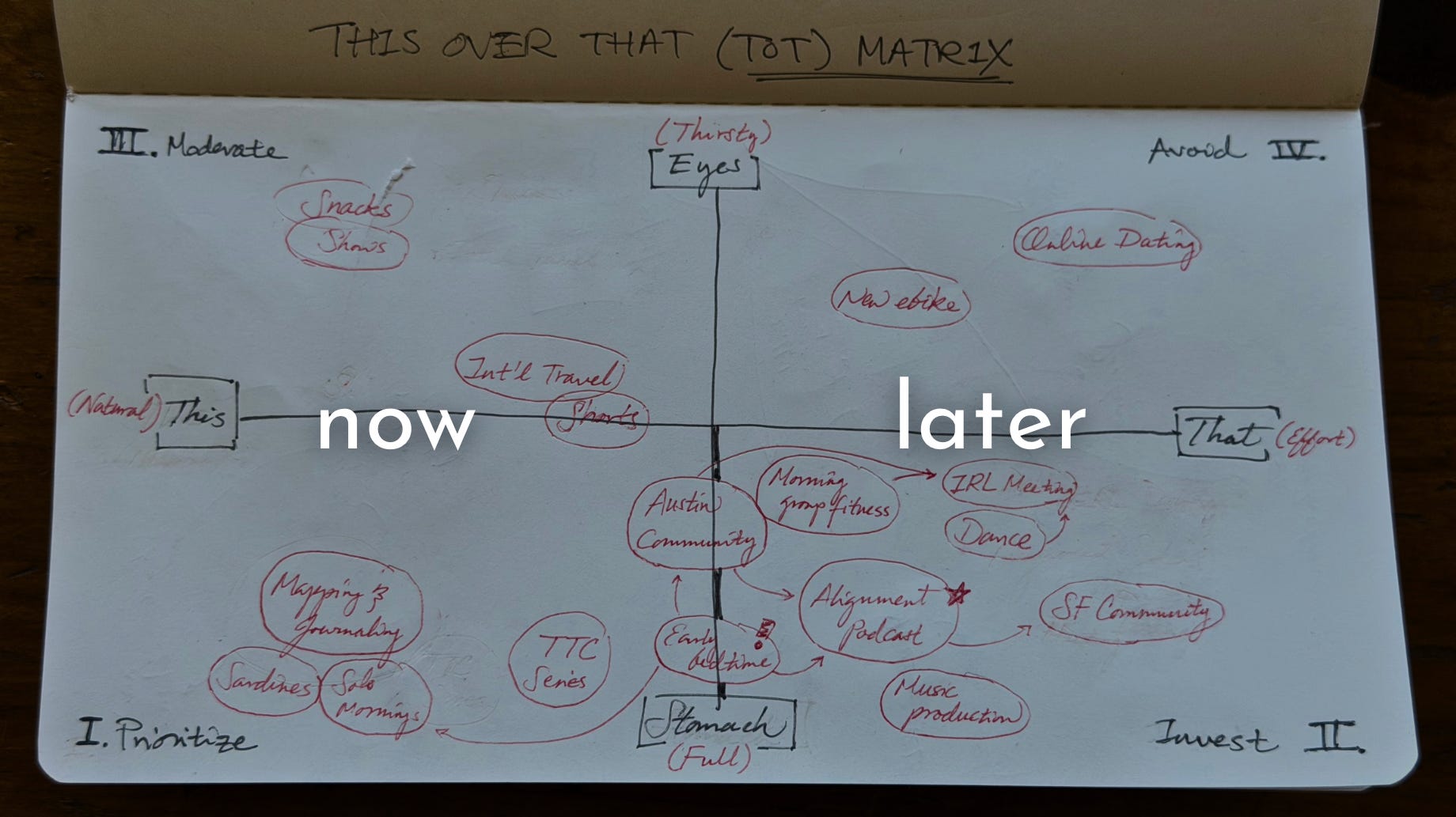
So I drew two lines through the middle of the page and turned the whole thing into a matrix.
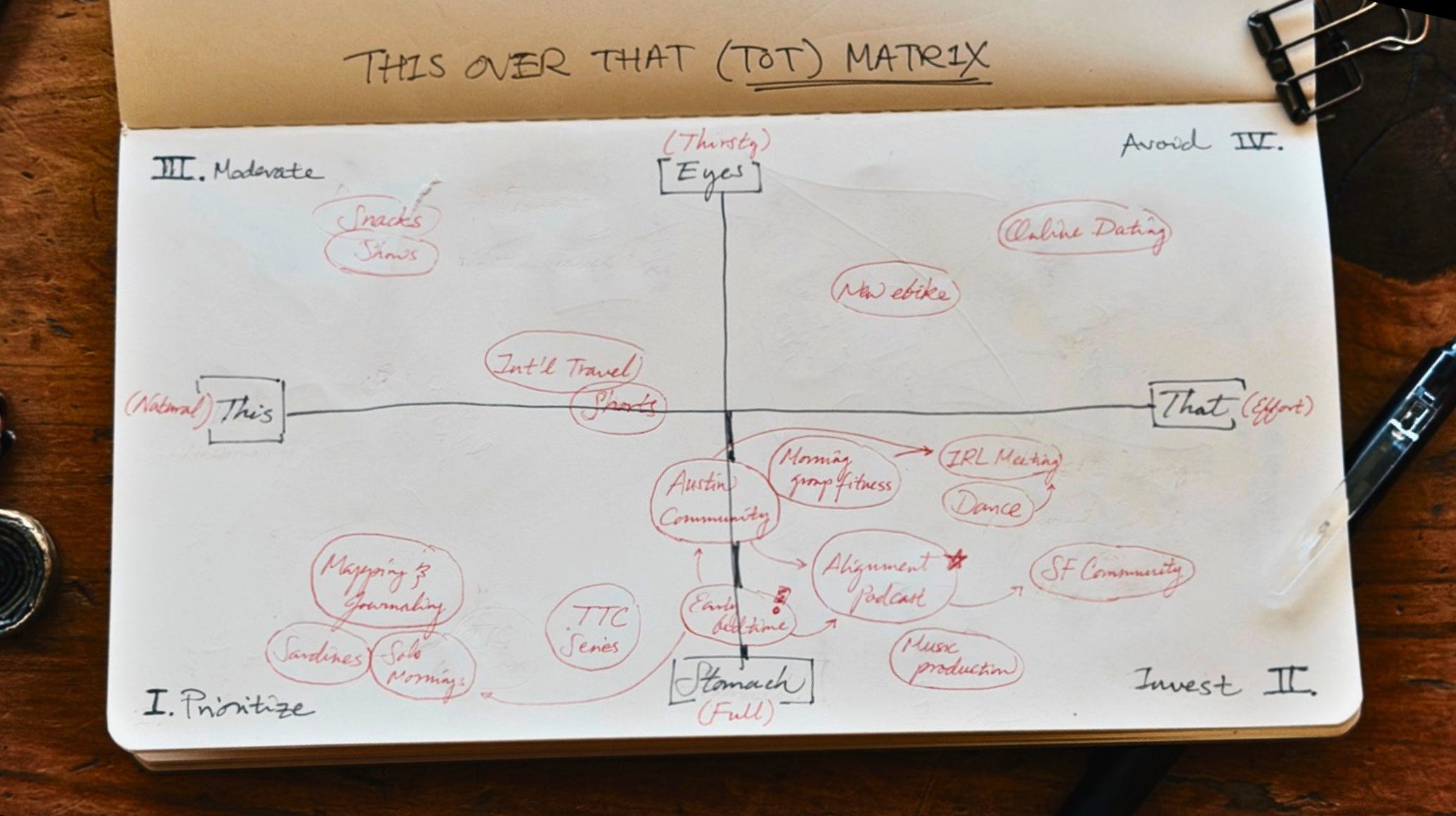
I call it the This Over That Matrix - or TOT Matrix for short.
At first glance, it looks like another 2x2 productivity chart, but it’s actually a map of our relationship to desire.
The vertical axis asks a simple question: does this leave me full or thirsty?
The horizontal axis asks another: is this already close to me, or am I reaching for it?
From there we get four basic territories.
I. Something that is both nourishing and already close belongs in the lower-left: prioritize it.
II. Something that seems nourishing but still requires some reaching belongs in the lower-right: invest in it.
III. Something that is easy to access but leaves you wanting more sits in the upper-left: moderate it.
IV. And something that takes effort to obtain and still leaves you thirsty belongs in the upper-right: avoid.
That’s basically the whole tool.
You can stop reading here, draw the two lines on a piece of paper, throw your life onto it, and probably learn something useful.
But after making the Matrix, I kept staring at it.
There was something interesting about the placement of everything. Eyes on top. Stomach on the bottom. This on the left. That on the right.
I hadn’t placed them randomly. Yet I also hadn’t realized how much meaning was buried inside those positions until afterward.
The Matrix has a hidden geometry.
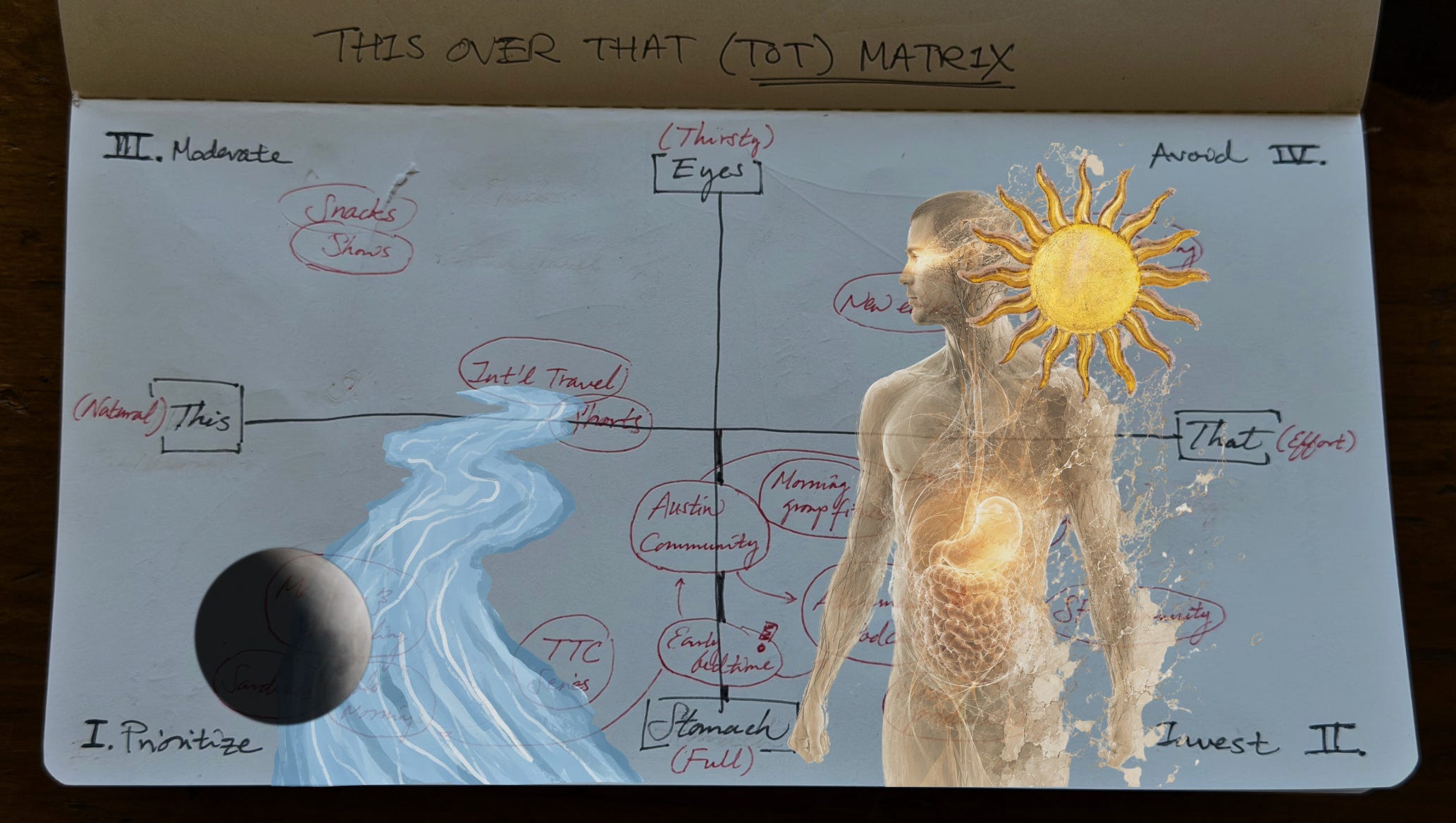
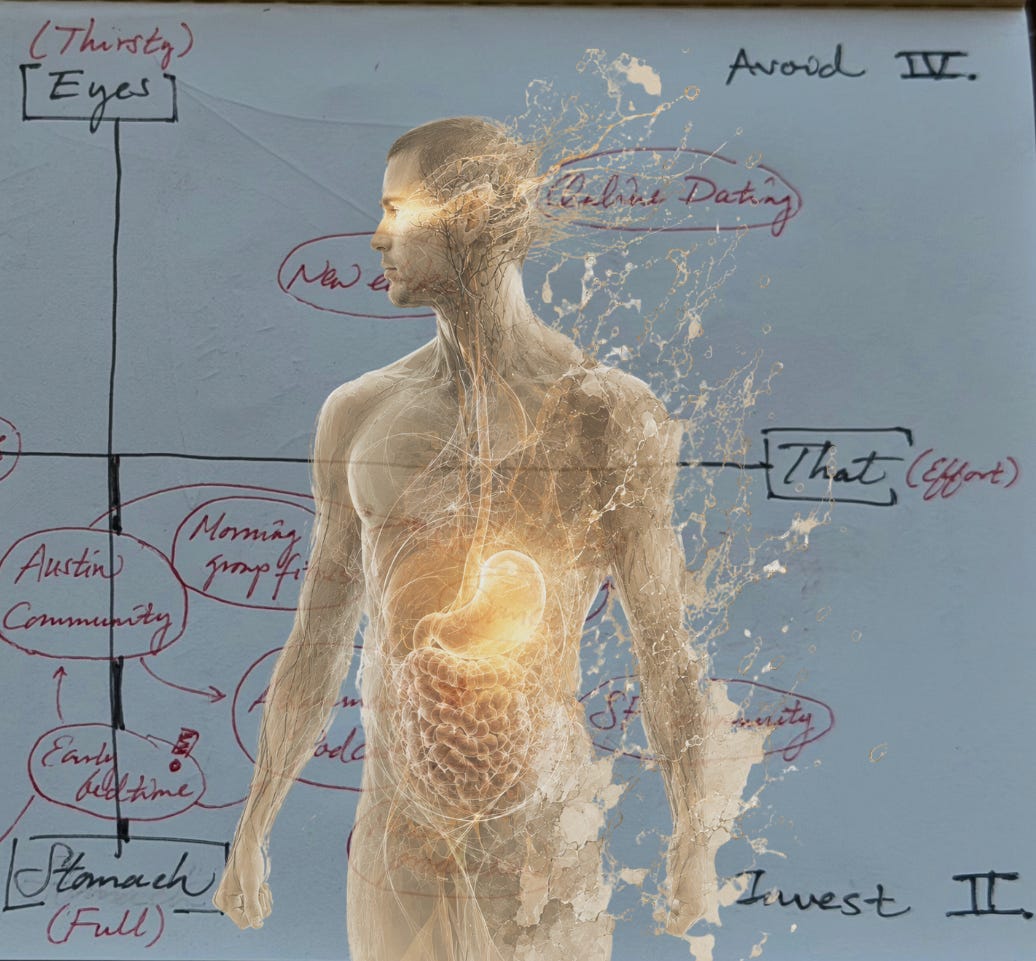
Let’s start with the obvious: our eyes are literally above our stomach.
The eyes point outward. They scan the environment for whatever is over there: another person’s food, another person’s life, another opportunity, another thing to buy. The eyes will always find something new to look at.
The stomach has a limit. Eat enough and eventually your body tells you: I’m full. Stop.
The eyes are very good at scanning for problems and what’s missing.
The stomach knows when we’ve reached a solution and have enough.
This was one of the connections that struck me during the Verse #12 deep dive because the stomach keeps appearing in the Tao Te Ching.
Back in Verse #3, the sage “empties the mind and fills the stomach.” There is something almost anti-intellectual about the image. The mind knows, categorizes, compares and wants. The stomach simply receives, digests and eventually becomes full.
So the vertical axis started becoming more than simply thirsty versus full.
The higher I moved, the more I saw the world of appearances, stimulation and wanting.
The lower I moved, the more I felt presence, nourishment, intuition, enough.
Then I looked at the other axis.
Say these words out loud while looking around wherever you are:
This cup. This chair. This notebook.
vs.
That tree. That building. That mountain.
There’s a spatial quality embedded in the words themselves. “This” tends to be near. “That” tends to be farther away.
Red Pine picked up on the same distinction in his commentary on Verse #12:
“this” can refer to what is within reach, while “that” is something obtained through effort.
And the farther right I move on the Matrix, the more effort that reaching requires.
Writing in my journal is almost all the way to the left for me. I do it without thinking. Give me a notebook and a quiet morning and I’m already going.
Producing the Tao Te Ching series sits a little farther right. Sitting with the text feels incredibly natural, but filming, editing, publishing, packing my gear and trekking into the forest requires more effort.
Launching a new podcast sits farther right still. I haven’t done it yet. There are microphones to set up, guests to invite, a format to figure out, another whole thing to bring into existence.
And that’s when physical distance on the Matrix turns into time.
This is not only near. It is now.
That is not only farther away. It is also later.
The farther something moves toward “that,” the more it begins to resemble a backlog, a possibility or perhaps even a future season of life.
I can journal this morning.
I can launch the podcast in the coming months.
I may spend more time building community again in San Francisco a few years from now.
Spatial distance becomes temporal distance.
And then I noticed something that made my former consultant self laugh.
This chart goes in the wrong direction.
Pull up almost any business presentation and good news tends to travel northeast.
Revenue goes up and to the right.
Users go up and to the right.
Subscribers, profit, output, market share, growth.
Up and to the right means winning.
Yet if you look at the TOT Matrix, the direction I actually want my life to move is almost exactly the opposite.
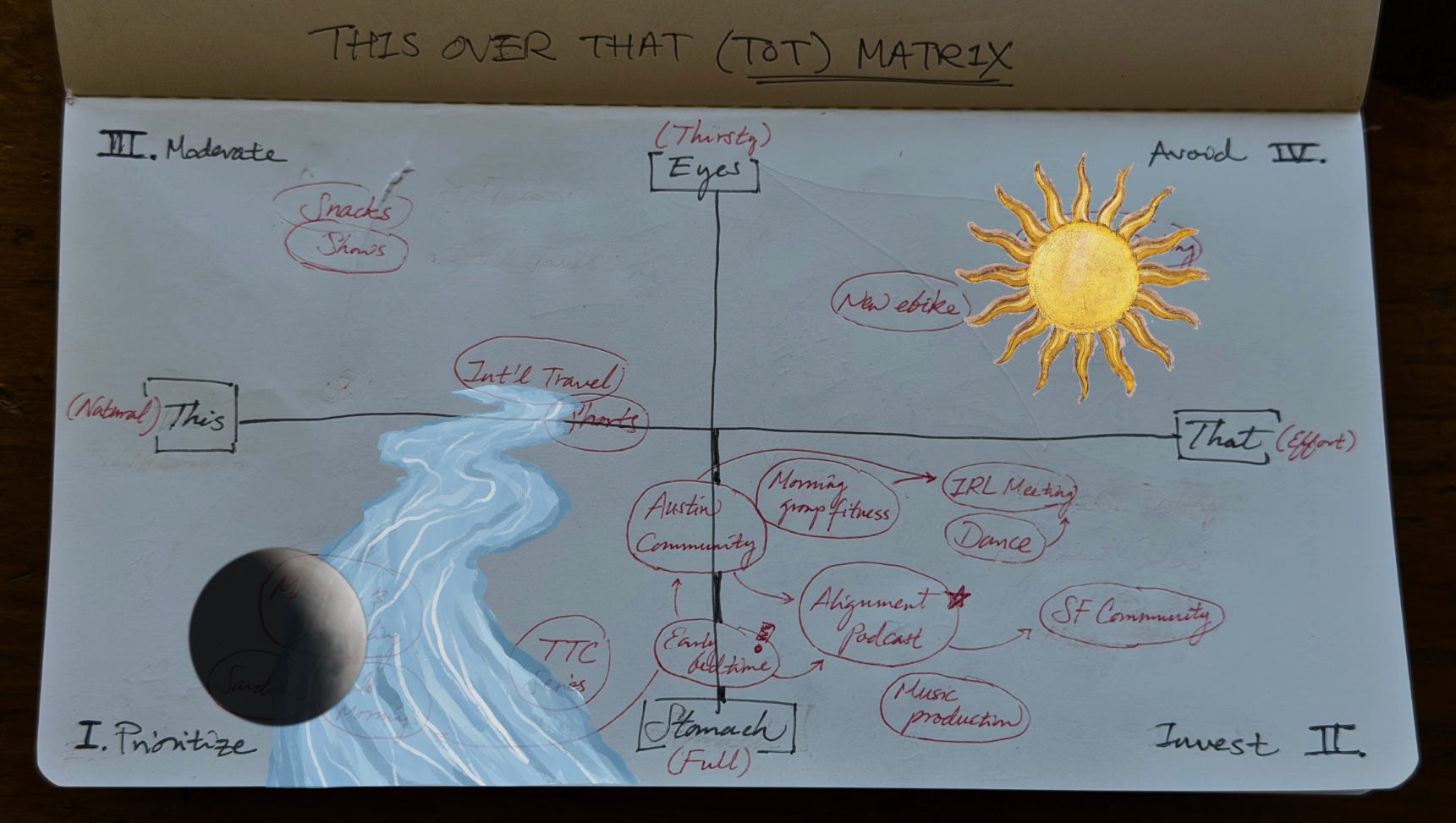
Down and to the left, toward the stomach, toward this.
Toward what nourishes me and has become close enough to touch.
There is something very Taoist about that reversal.
All the world wants to be bright like the sun. Visible. Impossible to ignore. High in the sky.
Yet the Taoist sage always seemed comfortable down low - like water.
Water flows toward the lowest places. It doesn’t climb the hill to make itself more impressive. It finds the valley, the cracks, the places everything else passes over, and somehow everything living depends on it.
I also started thinking about the new moon. When the moon is new, it is almost invisible to us. No glorious full moon begging to be photographed. It’s just dark, invisible, barely noticeable. Yet its impact can be felt in everything.
Yet there’s an obvious objection here:
If the goal is the lower-left, are we supposed to stay there forever?
Does preferring “this” just become an excuse to never leave the house, never try anything difficult, never grow?
I don’t think so.
Nature certainly doesn’t work that way.
A squirrel still has to leave the tree and forage for nuts. A tiger has to hunt. A pigeon has to do its funny little dance if it wants to find a mate.
Every living thing has to act in order to live and thrive. Wuwei, effortless action, doesn’t mean lying on the forest floor waiting for acorns to fall directly into your mouth.
The distinction is how the action arises.
A squirrel doesn’t wake up with a five-year strategic plan to become a better tiger. A tiger isn’t comparing itself to the squirrel and wondering why it is so bad at climbing trees.
They act according to their natures.
That is why the lower-right quadrant exists.
Sometimes something that’s aligned and nourishes us is still “that.”
And sometimes we must act in order to bring that toward this.
Dance currently sits in Quadrant II for me.
Something about it keeps pulling at me. It resonated deeply during a recent nature solo when my body felt compelled to sway to the sunset, winds and music.
But dance is still “that.”
I don’t have much training. I need to find a class, drive there, walk through the door, probably look ridiculous for a while and learn how to move my feet without thinking so hard.
That requires effort.
But if dance is actually aligned with my nature, I suspect something will change with repetition. The first class might feel awkward. The tenth less so. A year later I may hear music and simply move.
Effort becomes practice. Practice becomes familiarity. Familiarity becomes second nature.
Hence “that” moves toward “this.”
That’s the movement I want the TOT Matrix to encourage.
Not us endlessly chasing farther and farther toward the right, collecting achievements and possessions and identities as we go.
We bring nourishing things closer until they become part of how we live. Until the stomach becomes full. And then, at least for a little while, nothing else is required.
However, there’s a catch:
I think dance will nourish me. I don’t know until I try.
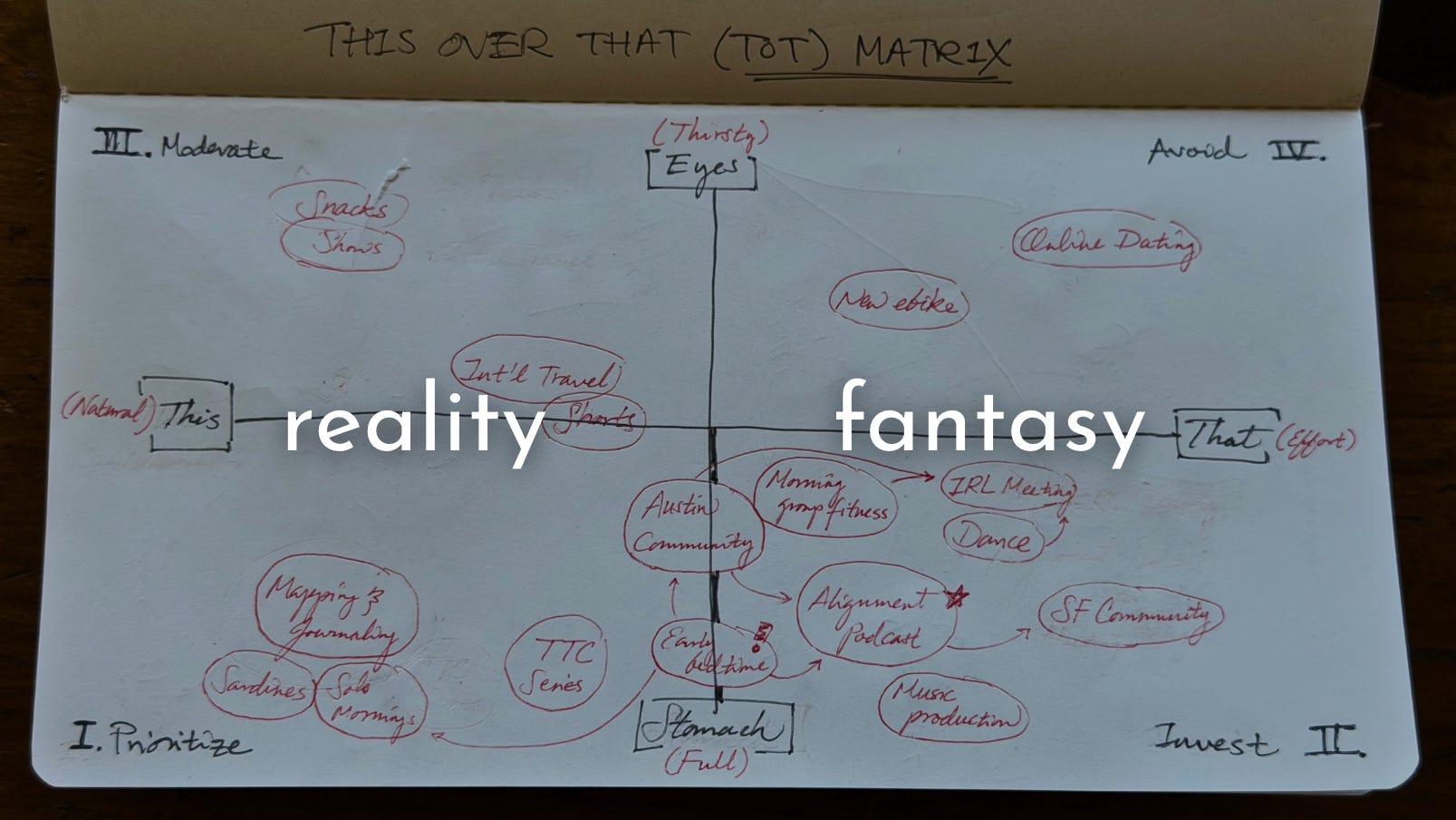
Quadrant II is interesting because almost everything inside it contains a degree of fantasy.
I think I would enjoy starting the Alignment Podcast.
I think meeting more people IRL will nourish me.
I think I’ll love dance.
But these are still hypotheses.
Until something is lived, it remains a fantasy about who we think we are.
I could spend a year dreaming about the perfect podcast, finally launch it and discover that I hate interviewing people.
Then what?
Reality wins. Move the bubble.
That sounds embarrassingly obvious, yet we humans are extraordinarily good at continuing down a path simply because we’ve already invested in the story.
I studied for this career. I moved here for this relationship. I spent three years building this company. I told everyone this was my dream.
So we keep going.
The TOT Matrix gives me another option:
Take the class. Record the episodes. Try the routine.
Then return to your stomach: Did this actually nourish me? Did the experience leave me full? Or did finally getting the thing only create another list of things I now need, an identity I now need to justify?
That last question has become one of the most useful distinctions for me.
There’s another reason I assign a date to my Matrix.
It’s not a personality test.
International travel isn’t inherently Quadrant III any more than dance is inherently Quadrant II. I’m not trying to create some universal Taoist ranking system where sardines are spiritually superior to France.
These placements describe my relationship to these things right now.
For years, slow travel was deeply nourishing to me. I would spend a month or two in a new city, learn its rhythms, build friendships and let the place change me. At another point in my life, that belonged much closer to Quadrant I.
But this year it feels different.
When I imagine flying off to Shanghai, Bali or Europe right now, I can feel some of the old excitement, but I can also feel the distraction. There are things here in Austin, in my family, in my community and in this season of my own life that are asking me to stay.
So the bubble moved.
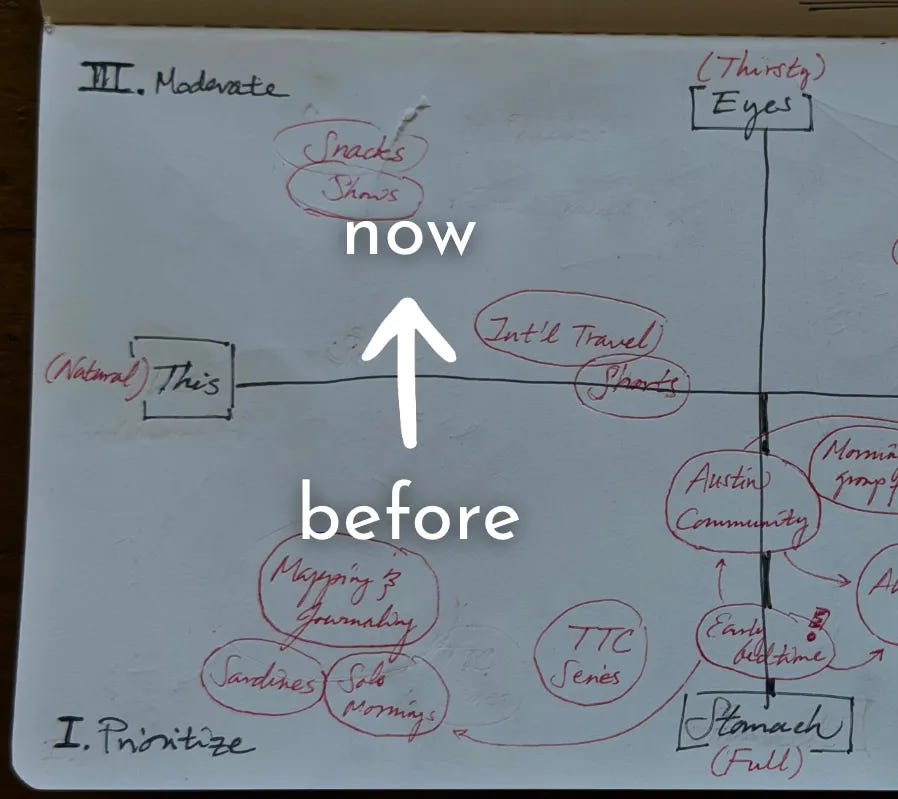
Maybe it’ll move back.
That’s why I think of the TOT Matrix as an artifact rather than a fixed answer.
Change is constant. Thoughts pass. Emotions pass. Priorities change with seasons.
If I draw another Matrix 6 months from now, I want to see what migrated.
Did a nourishing “that” become “this”?
Did something I thought I needed turn out to be an eye desire?
Did something that once filled my stomach begin to feel empty?
The chart changes because we change.
The purpose of this Matrix is not to engineer a perfectly optimized life. That’s like turning the Tao Te Ching into just another productivity system, which is missing the point.
It’s simply a way for you to notice where you’re reaching, what you’re reaching for, and whether getting it is likely to leave you any fuller than you were before.
The world has no shortage of things to thirst for.
Maybe the harder practice is noticing how much is already here.
And then, when life does ask us to venture outward, doing what every living thing has always done: find what nourishes us, bring it home, take our fill.
Then stop reaching.
Until nature calls us out again.
No posts
Comments
Nothing yet. Say the first thing.
Sign in to join the conversation.