
The episode was finished. The ending was recorded, the questions I planned to sit with were asked. Verse #10 of the Tao Te Ching had taken me almost an hour to walk through, question after question with not one answer given, and a week's practice that still had me baffled. I closed the book anyway.
Then as if the Universe felt my disquiet, my phone lit up with a passage I had once highlighted in Readwise for Michael Singer's The Untethered Soul:
You do not have to leave the seat of self in order to deal with the darkness. It will purify itself if you let it.
It stopped me in my tracks. I read it twice.
That's it!
I sat back down in front of the camera, and hit record to capture the emerging practice for Verse #10…and ultimately threw the initial ending away. The somewhat awkward seam is still visible in the video. I left it there as a reminder that creation is a process, not a destination.1
I don't usually bring another book into these talks. We have ancient sages thanks to Red Pine. It turns out we also have modern ones. When I mapped the two onto each other, this is what stood side by side.
Singer says: the seat of self
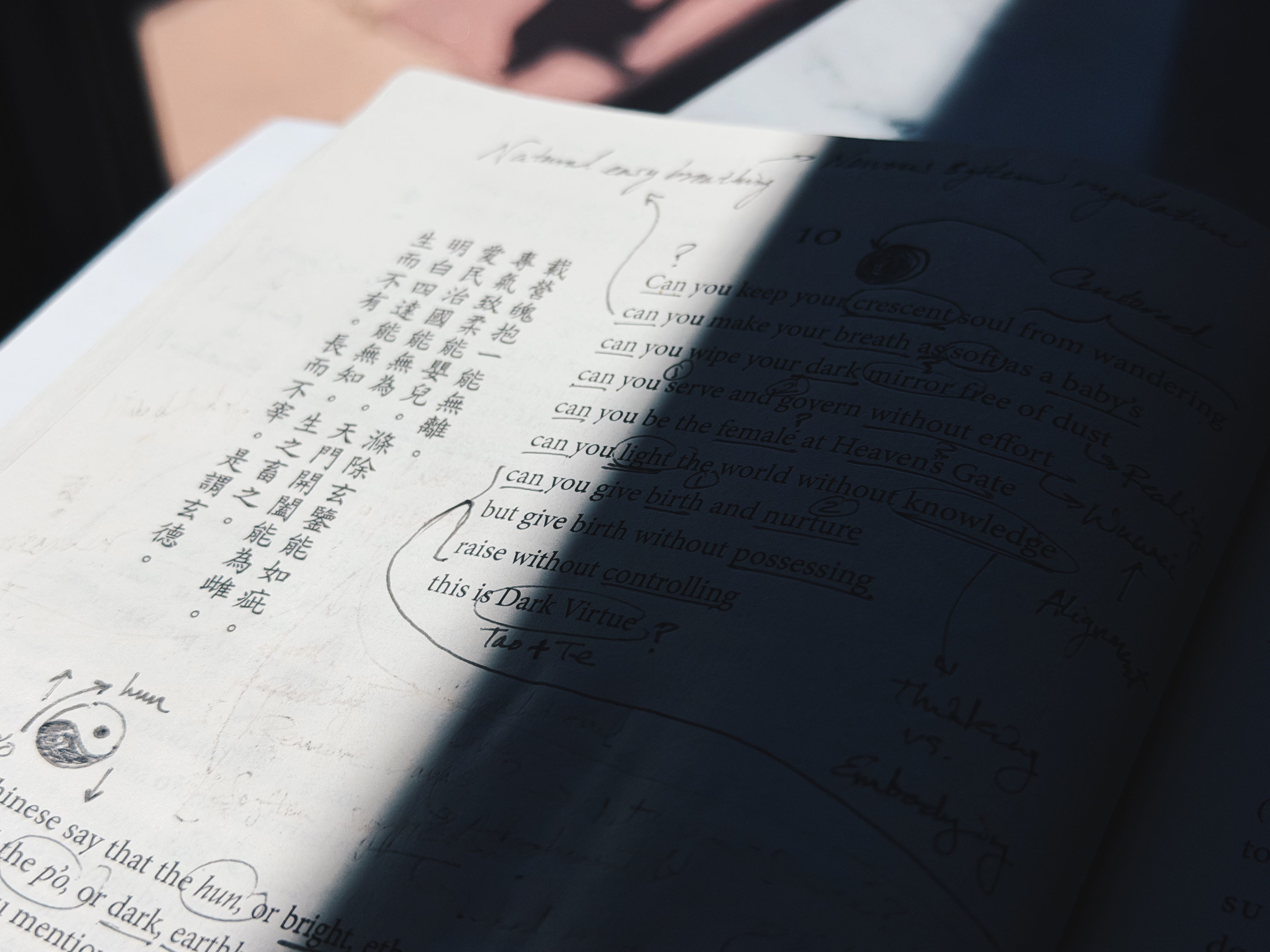
Verse #10 asks: can you keep your crescent soul from wandering
A crescent moon is mostly dark; the seat is in the dark part. The verse is not asking you to light it up, only whether you can stay in it.
Singer says: it will purify itself if you let it
Verse #10 asks:
can you give birth and nurture
but give birth without possessing
raise without controlling
In the episode, I read those birth lines outward: the projects, businesses, and relationships always arising from us, each with a beginning, middle, and end. My first ending was a repair project: find the dams, remove the obstructions, soften the suppressions.
Then Singer's passage turned the lines inward. We give birth to our worries too. In the Buddhist sense these are the sankharas: blocked energy packets we call emotions that replay inside us, and because they are energy, they take on a life of their own.
Act on one and you have fed it - possessing.
Clamp down on one and you have dammed it - controlling.
There was never anything to remove, only a lifecycle to stop interfering with - let it rise, let it pass into the ether.
Even Wang Pi's note, the one that ending grew from, reads differently on the far side of the seam:
If we don't obstruct their source, things come into existence on their own. If we don't suppress their nature, things mature by themselves.
First read, a work order. Second read, non-work. The latter feels more aligned with the TTC.
So here is my practice for Verse #10:
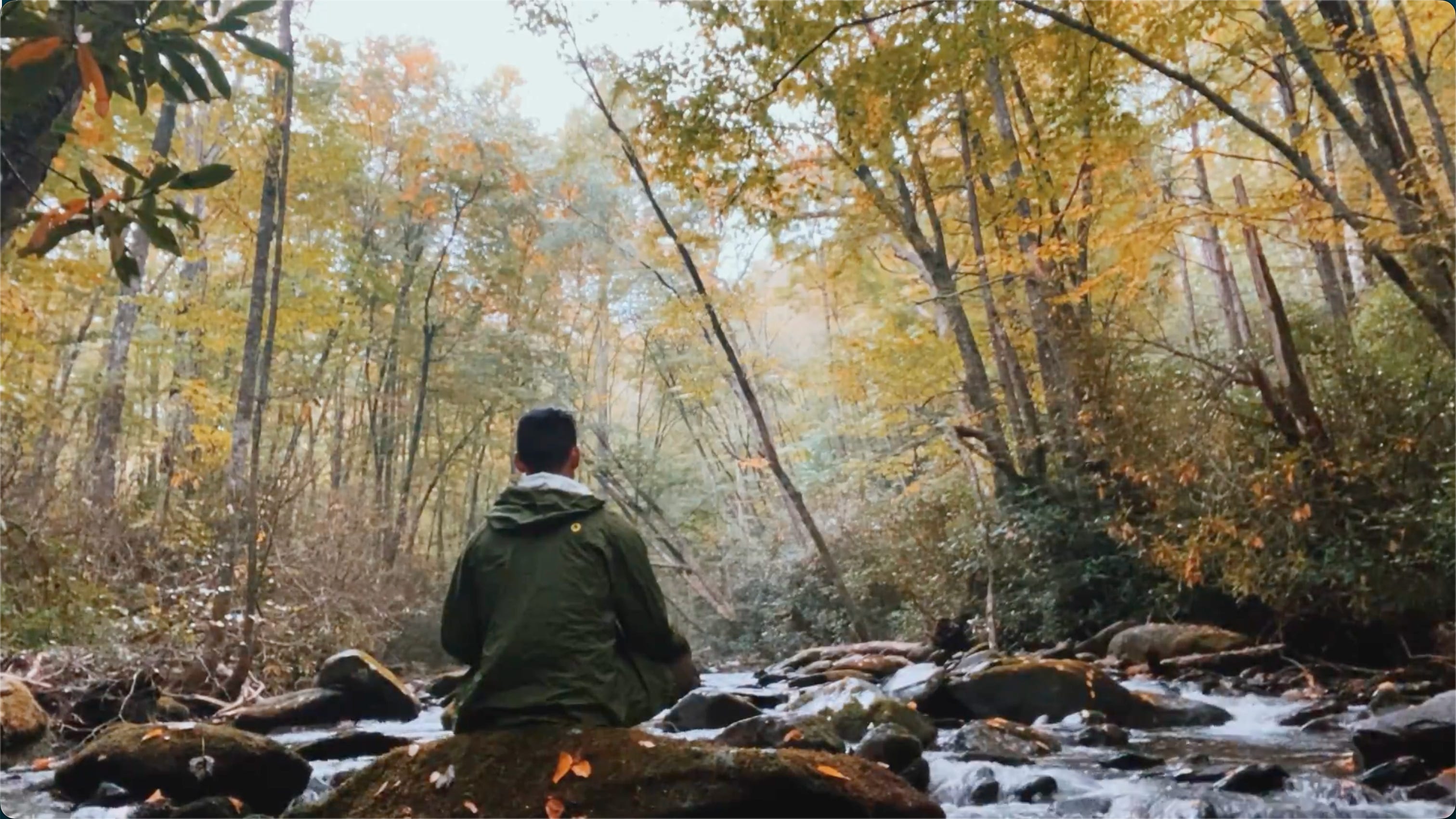
Somewhere in the middle of the river of life there is a rock. The river is the torrent of everything that moves through you: thoughts, emotions, agitations, the replay of an old conversation.
The practice is to sit on the rock, still, and watch the river go past. Choosing not to be swept away. Not building a dam to control the flow. Not suppressing its ability to go somewhere. Just watching, effortlessly, from the seat of consciousness, while the water does what water has always done: flow past, fall off the waterfall, into the ocean, where it disappears and goes back to its source.
And while you sit, one instruction, and the words are Singer's: notice who's noticing. It's really that simple. Anyone who has had a runaway worry knows what it feels like to be taken over by a phantom. Watched, and not fed, it does what everything in the river does. It moves on.
For me, this week, it is the loneliness I have been carrying after several misfired relationships. When I suppress it, it does not go away; it reroutes into my familiar four horsemen: sugar, streaming, sex, shopping.
So the practice is to notice when it pops up, what insecurities it triggers, what impulsions. And then not to do anything about it. Not to engage the downstream behaviors. Not to expend any energy pursuing it. Just to sit on the rock and watch it go past. Feeding it is expensive. Watching it is supposed to cost nothing.
Your river might carry different debris. But the practice is the same.
Witnessing is not white-knuckling. If you're gripping the rock with your jaw set, waiting for the river to admit defeat, that is the dam again with better posture. Avoidance and repression take a lot of energy, because you are trying to shield yourself from it. And dams don't just cost energy - they break.
A friend of mine spent fifteen years building one, and then built a whole life behind it. When a dam like that breaks, the tsunami drowns the entire town on the other side. The alternative is not a stronger dam. It is letting everything pass through.
Because everything does pass.
And the rock is not retirement from your life. Whatever we create while obstructed inherits the obstruction. You do more, not less, by letting go, because what you do next comes out clean. Can you sit on the rock for one minute today. Can you let one wave go all the way past without following it.
A few days in, I have a first report. My loneliness still bubbles up. But I can watch it surface now, feel it in the quiet moments, in my morning meditation, and notice who's noticing. And the energy I'm not feeding it isn't mindlessly being transmuted into rage snacking, binge watching, rampant shopping or endless dating app swiping. Instead, my cup is "empty" enough to go for walks with my dad, eat dinner with my mom, and plan how to get to know San Francisco again after three years away.
Has it been perfect? Of course not. I've had some relapses. But overall, the new awareness is sticking, allowing me to get back on my rock if I fall into the river - precisely because I know there's a rock there in the first place to rest and observe.
This week, find your rock. Once a day, for as long as you can stay seated, centered, watch what your river is carrying, and notice who's noticing. If witnessing is not the practice that calls to you, any line of the verse can hold a week. I expect it to be easier said than done. Therein lies the experiment, and the practice.
On Sunday we gather at the river, our weekly reflection, and report back: what we watched, what swept us away, what we managed not to feed. Bring what you saw.
I'll see you soon, my friend.
This grew out of Verse #10 of the Tao Te Ching. The full walkthrough, including the ending I threw away and the one that replaced it, is in the video here:
We sit with the verse together at Sunday's reflection 8am PT.
And if watching the river feels near to its sibling practice, emptying, that one lives in The Void Meditation.
I could have kept the tidy ending. Nobody would have known. Except that people always know. We feel what sits behind words before the words arrive. Whatever the mind is carrying leaks into the voice, no matter how calm the voice. So the choice was never between hiding and showing. It was the fork I keep arriving at: the honest path on the left, the honest and vulnerable path on the right. I've been trying to take the right path for six years now. It still asks for a leap of faith every time. It's vulnerable precisely because it's scary.
No posts
Comments
Nothing yet. Say the first thing.
Sign in to join the conversation.