

When there’s a fork in the road...
Something unusual is happening in food right now.
The most expensive brands are growing. So are the cheapest ones.
That combination shouldn’t coexist in a normal economy. But it does — and increasingly so. The reason isn’t confusion. It’s sorting.
Consumers aren’t moving together anymore. They’re responding to the same prices with very different constraints.
Inflation hit every household. But it didn’t hit them equally.
Higher-income households entered this cycle with savings, asset appreciation, and income stability. For them, grocery inflation was frustrating — but manageable. The result hasn’t been broad retrenchment. It’s been selectivity: fewer purchases overall, but continued willingness to pay for products that feel meaningfully better.
Lower-income households faced a different reality. Rising food prices collided with rent, utilities, and debt. For these shoppers, grocery decisions became less about preference and more about control. The rational response was to reduce risk — often by defaulting to private label.
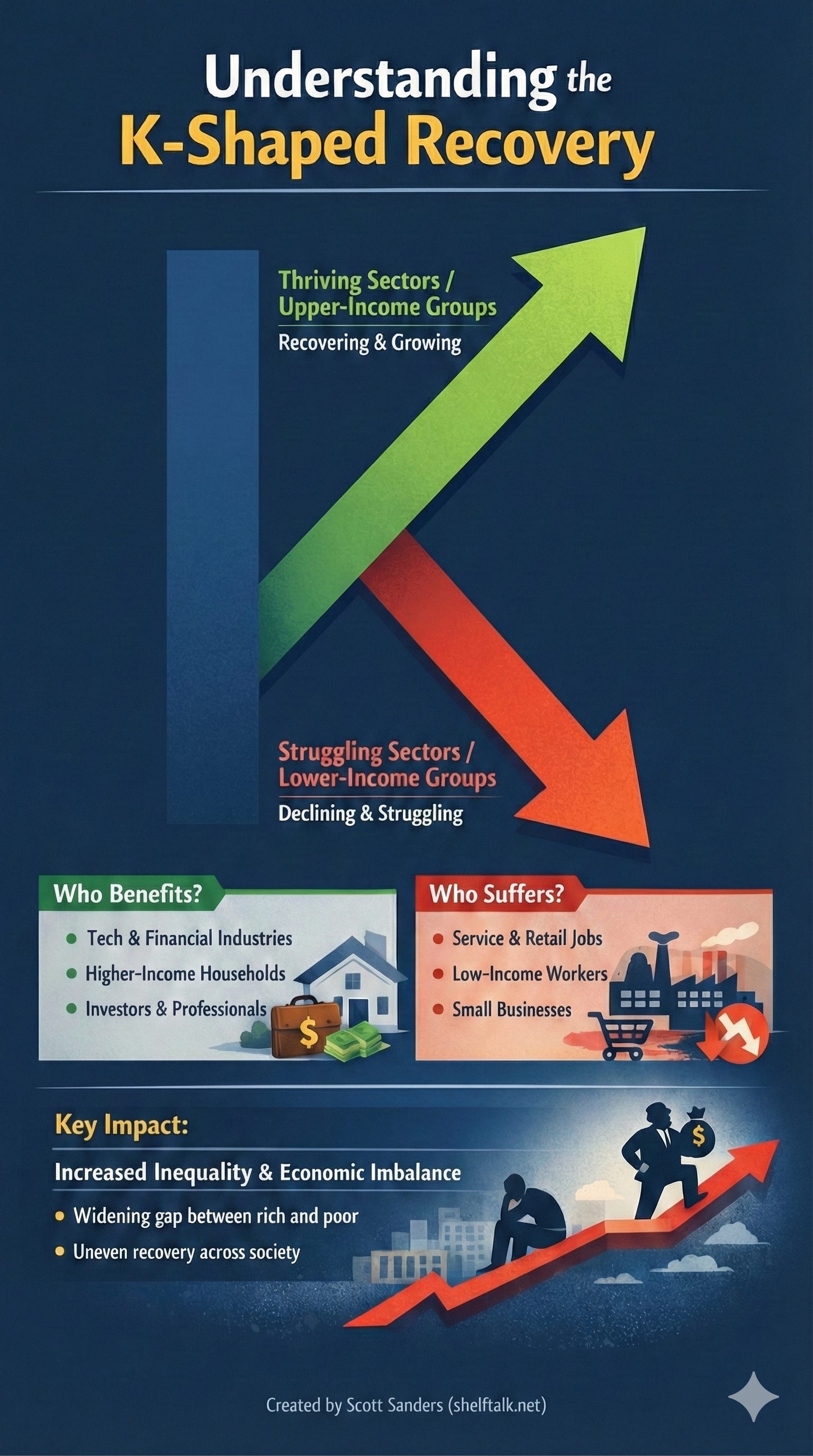
Economists often describe this dynamic as a K-shaped recovery: one group regains stability and spending power relatively quickly, while another continues to fall behind. The “K” reflects divergence — two paths moving in opposite directions at the same time.
That split shows up clearly in consumer research. Higher-income households have largely maintained discretionary spending, while lower-income households continue to pull back sharply. (McKinsey)
Same aisle. Same price increases. Opposite behavior.
Private label sales are growing faster than national brands, with unit growth, not just inflation-driven dollar gains. Consumers aren’t only paying more for store brands — they’re buying more of them.
Even more important, private label isn’t confined to the lowest price point anymore. Roughly 40% of private-label dollar sales now come from premium-positioned store brands, reflecting real improvements in quality and brand equity. (NielsenIQ)
Retailers aren’t just offering cheaper substitutes; they’re offering credible alternatives. That pulls share not only from financially constrained shoppers, but also from mainstream brand buyers who no longer see a meaningful quality gap.
Private label today is both a defensive choice and an offensive one. That changes the competitive math.
The biggest casualty in this environment isn’t value or premium.
It’s the middle.
This increasingly resembles Michael Porter’s generic strategies (overview) playing out in real time. Advantage comes from choosing a clear role — either relieving pressure through cost leadership or justifying a premium through differentiation.
Brands priced above private label but below true premium often struggle to answer a simple question: Why me? They aren’t cheap enough to reduce stress, and they aren’t distinctive enough to earn a splurge.
Strategy research echoes this risk: when consumers polarize, brands without a clear cost or differentiation advantage are the most exposed. (Simon-Kucher)
The idea of a K-shaped recovery first surfaced during the early months of COVID. What’s striking in hindsight is how durable that split has proven — and how clearly it’s now showing up on the shelf.
This environment rewards clarity and punishes ambiguity.
Brands that win tend to do one of two things well:
Relieve pressure, or
Justify the splurge
What we’re seeing now isn’t a new pattern — it’s the consumer-facing expression of the same K-shaped recovery that’s been unfolding for years.
P.S. The header image choice was intentional. It reminded me of Yogi Berra’s line: “When you come to a fork in the road, take it.” The joke, as he later explained, was literal. Near his home in Montclair, NJ, you could take the left fork or the right fork and both got you there. In a way, today’s consumer economy feels similar: very different paths, but each one rational depending on where you’re coming from.
No posts
Comments
Nothing yet. Say the first thing.
Sign in to join the conversation.