
In a now-famous behavioural experiment of 1953, the neuroscientists James Olds and Peter Milner implanted electrodes in specific areas of rats’ brains, giving the animals the ability to stimulate those areas themselves by pressing a lever. Every time they did so, the mechanism would deliver a small electrical charge, triggering the release of an organic chemical that would later be given the name “dopamine”.
This release would produce a pleasant effect, signalling to the rats that their actions were meaningful and that they would be rewarded again if they continued. Unrestrained by anything, they would press the lever over and over, neglecting food, water, and rest – until they collapsed from exhaustion. In later experiments, they would even cross electrified grids that caused them pain, just to reach the lever and feel the “pleasure” again.
But the fact that their actions would eventually lead to exhaustion implied that those actions had never been meaningful in the longer term – either for their own well-being or for the survival of their species – but only the brain’s signal for it, which the lever directly triggered.
Rats are smart animals who possess the building blocks of futurity – they can imagine a place or a time they are not in, hold that image, and act on what they imagine. Yet given unrestricted access to self-stimulation, and the dopamine release that follows, those imaginative abilities are overridden and the natural instincts lose their hold. Any possible future becomes irrelevant; time itself implodes into a series of impulses to press the lever again and again; and those impulses close into a loop of perpetual present that ends only with the physical inability to press on.
Alongside the experiments on rats, similar work was conducted on humans. In the 1950s-70s, neuroscientists implanted electrodes in people’s brains to find ways of treating mental illnesses – and what was then considered as such – and, later, to understand the nature of addiction, not only to drugs but also to gambling.
And it was not until much later – and after many further scientific investigations – that a clear parallel was drawn between the rat pressing a lever to trigger a release of dopamine and the human pulling a lever of a slot machine to do the same. And though the human is reckoned by far the smarter animal, some of the effects of machine play are scarcely distinguishable from those of the laboratory experiments with rats and electrodes.
In Addiction by Design, an immersive study of the slot machine, Natasha Dow Schüll describes how the machine draws each player into what gamblers themselves call “the zone”: a trancelike state co-produced by player and apparatus in which everyday cares, the claims of other people, and even the sense of one’s own body recede.
What Schüll describes can be understood as a rupture between two orders of time. There is “clock time”, the time we share with others, social time, with a past, a present, and a future. And there is the time of the zone: radically individual and anti-social, an indefinite event of play with neither past nor future, a never-ending present. That never-ending present is sustained visually, by an endless stream of colour and light, and audibly, by a no less endless stream of sound.
Like the neuroscientists in the experiments with rats, the makers of the slot machine and their kin learnt to hack – intuitively, empirically – the nervous system, and to flatten perceived time. Their interest, however, was economic: the flattening of time was the very foundation of the slot machine’s business model, since the gambler’s impulse towards a future was precisely what undermined it. To keep the machine fed, that impulse had to be dissolved.
But if the original makers of the slot machine acted intuitively, with no science of reward behind their monetising assault on the future, the technology companies that came to dominate our online lives knew exactly what they were doing. They placed engagement – and the dissolution of the future – at the heart of their business model; unlike the slot-makers, they had a behavioural science to guide them.
The commercialisation of the internet began as early as the 1990s, and engagement mattered even then – someone had to click on all those banners. But it was not until the mid-2000s that the manufacture of a never-ending present became less a side effect than the central product of the technology companies. What made it impossible in the 1990s was the state of the technology itself: two conditions had to converge before the anti-futural business model could be built. One was the smartphone; the other was cheap mobile bandwidth to feed it.
The smartphone created a readily available personal zone outside social space – one that allowed a deeper dive than reading a newspaper or a book in public ever had. The mobile bandwidth made that zone sustainable and captivating, delivering a continuous stream of sound and image to hold it open.
And the arrival of infinite scroll and the pull-to-refresh gesture – each uncannily echoing the pull of the slot-machine lever in its indefinite event of play – completed the apparatus of a new machine devoted to “optimising user engagement”: which is to say, to collapsing the flow of time into a perpetual present.
The creators of this new machine did so deliberately. As one technology entrepreneur admitted, the thinking behind “optimising user engagement” turned on a single question: “How do we consume as much of your time and conscious attention as possible?”. The answer was to give the user “a little dopamine hit every once in a while, because someone liked or commented on a photo or a post or whatever”. The technique was “a social-validation feedback loop” that consciously exploited, in his words, “a vulnerability in human psychology”.
The Techno-Oligarchy’s First “Holocaust”
·
Jun 5

A conventional story tells us that, after the Third Reich lost the Second World War, the Western allies made a convincing case about the Shoah – the Nazi programme aimed at eradicating the Jews from …
While the tricks for flattening time first and most prominently emerged around social networks, their modifications and adaptations have spread across virtually every major domain where the technology companies have established control. Consider the infinite autoplay feeds of audio- and video-streaming services: they are the never-ending present made into a product. But it is not only the future that the swollen present consumes. Search engines are biased towards recency, so they bury the durable beneath the just-published, and the user’s sense of the past thins.
The technology companies exploit vulnerabilities in human psychology for money. They monetise the perpetual present. The techno-oligarchy – the handful of ultra-wealthy technology elites who now own the infrastructures of public life – does something different. Their stake in the never-ending present is no longer only economic. They do not merely monetise the collapse of time – they politicise it.
Techno-oligarchy is not an ideological movement, and techno-oligarchs differ on how political power should be wielded; yet several traits, taken together, form a tacit ideological core. In this view, what its adherents call “technological progress” takes precedence over the fate of humankind. Humanity has no value in itself: humans are weighed on the same scale as inanimate objects, by a single measure – their usefulness to “progress”. Humanity, moreover, will not inherit the advanced stages of that progress; that will be the fate of transhumanity, a fusion of human and machine. And it is the interests of that future race that, on this logic, all the political, economic, and technological power of the present is to serve. The techno-oligarch’s role is to steer the “progress” and secure the transhuman outcome – for which he must first secure his own longevity, if not outright immortality, and a permanent hold on economic and political power. But he must also remove the social and political opposition to his project – an opposition broad and various, since few are drawn to the idea of discounting humanity. And one of the pillars of that opposition is the same force that threatens the slot machine’s business model: the natural human impulse towards the future.
Techno-oligarchy is radically futurist; yet not only is the future it imagines inaccessible to “ordinary people” by its own ideological design, the manipulation of time has become one of its major weapons for neutralising opposition. The concept that helps us see how this weapon is configured is what Taina Bucher calls “the kairologic of algorithmic media”.
The Greeks distinguished two kinds of time: chronos (χρόνος), chronological or clock time, and kairos (καιρός), the right or opportune moment. In Bucher’s account, algorithmic media have shifted from chronos to kairos: our feeds are no longer ordered chronologically but arranged so that each item of information surfaces “at the right moment” – where “right” means whatever the system judges most relevant to each user. The making of these individualised feeds of kairos is, as with the zones of the gambling hall, co-produced by machine and – largely unwittingly – by human. The machine’s part is the algorithms that filter, sort, and rank what reaches us. The human’s part is personal data and behaviour: hours of presence, browsing history, search terms. Together they fabricate kairos – a right-time engineered to hold the user as long as possible.
If the kairologic governs the when, the what – the exact content the algorithms feed us – does not matter: this item or that, it is interchangeable. The kind, however, does. The rationale of stretching the present indefinitely for “ordinary people” – armed with scientific knowledge of human psychological vulnerabilities – gives the system its preferences. It favours political polarisation, social anger, cultural oddities and curiosities: whatever reliably generates a strong emotional response, according to what the machine “knows” about a particular user.
The techno-oligarchs have their own socio-cultural preferences, and they often amplify racist and anti-democratic content. But this explains only part of the techno-oligarchy’s campaign against the opposition to its project. The project is, beyond doubt, illiberal – which seems to place it close to what political scientists call “radical right-wing populism”. Yet the resemblance is tactical. Race in the ordinary sense is of little concern to the larger project of transhumanism: in that project’s own terms, the races are still human, and the human as such does not matter. The only race that finally counts for them is the transhuman one – which is precisely why the human races do not. Seen this way, the techno-oligarchy enlists the far right as an instrument of polarisation, and so of the never-ending present – but this fellow-travelling ends the moment the racists, being human, are to be discarded with everyone else.
Worse than Fascism
·
May 4
In recent years, with the rise of Big Tech and its authoritarian socio-political ambitions, it has become commonplace to speak of “techno-fascism”. This is understandable. The embrace of authoritaria…
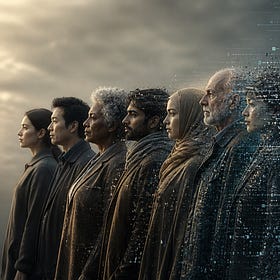
The genuine political core of the techno-oligarchy’s manipulation of time lies elsewhere. The kairologic locks each of us into an individual time-zone fixed upon the present, and in doing so tears into billions of pieces the shared social time in which humans might engage in the collective production of meaning. At the same time, as it dissolves our impulse towards the future, we lose the continuity between our present and future selves. And a self with no future cannot act for one: it can neither formulate the socio-political interests whose realisation would carry it forward, nor imagine alternatives to the grim, anti-human future the techno-oligarchy intends. That future, the techno-oligarchy’s own, becomes unchallengeable.
The techno-oligarchy’s existential challenge to democracy lies precisely in this cancellation of alternative futures, since democracy is constitutively future-oriented – it is the institutionalised, peaceful contest among alternative tomorrows. The techno-oligarchs reserve the future for themselves and for the transhuman race they mean to manufacture; for everyone else, they collapse time into the never-ending present. In doing so, they do not merely demobilise political participation – they dissolve the temporal space in which it is even possible.
No posts
Comments
Nothing yet. Say the first thing.
Sign in to join the conversation.